


Views: 222 Author: BorCart Publish Time: 2026-05-30 Origin: Site


Content Menu
● Ground Clearance and Terrain Capability
● Climbing Performance on Steep Inclines
● Stability and Safety Considerations
● Motor Performance and Battery Efficiency
● Weight Distribution and Load Management
● Terrain-Specific Application Matrix
● Cost-Benefit Analysis for OEM Procurement
● Industry Perspective: Manufacturing Considerations
● Real-World Performance Testing Results
● Regulatory and Compliance Considerations
● Maintenance and Long-Term Reliability
● Environmental and Sustainability Factors
● Conclusion and Call to Action
● Frequently Asked Questions (FAQ)
When operating a 6-seater golf cart with maximum passenger capacity on challenging terrain, choosing between a lifted configuration and a standard utility cart becomes critical for performance, safety, and operational efficiency. As a manufacturer deeply embedded in the electric vehicle industry since 2000, BorCart has observed firsthand how terrain demands and load requirements shape vehicle selection for OEM partners across global markets. This comprehensive comparison examines both configurations through the lens of real-world performance metrics, helping brands, wholesalers, and fleet operators make informed procurement decisions. [jeffreyalleninc]
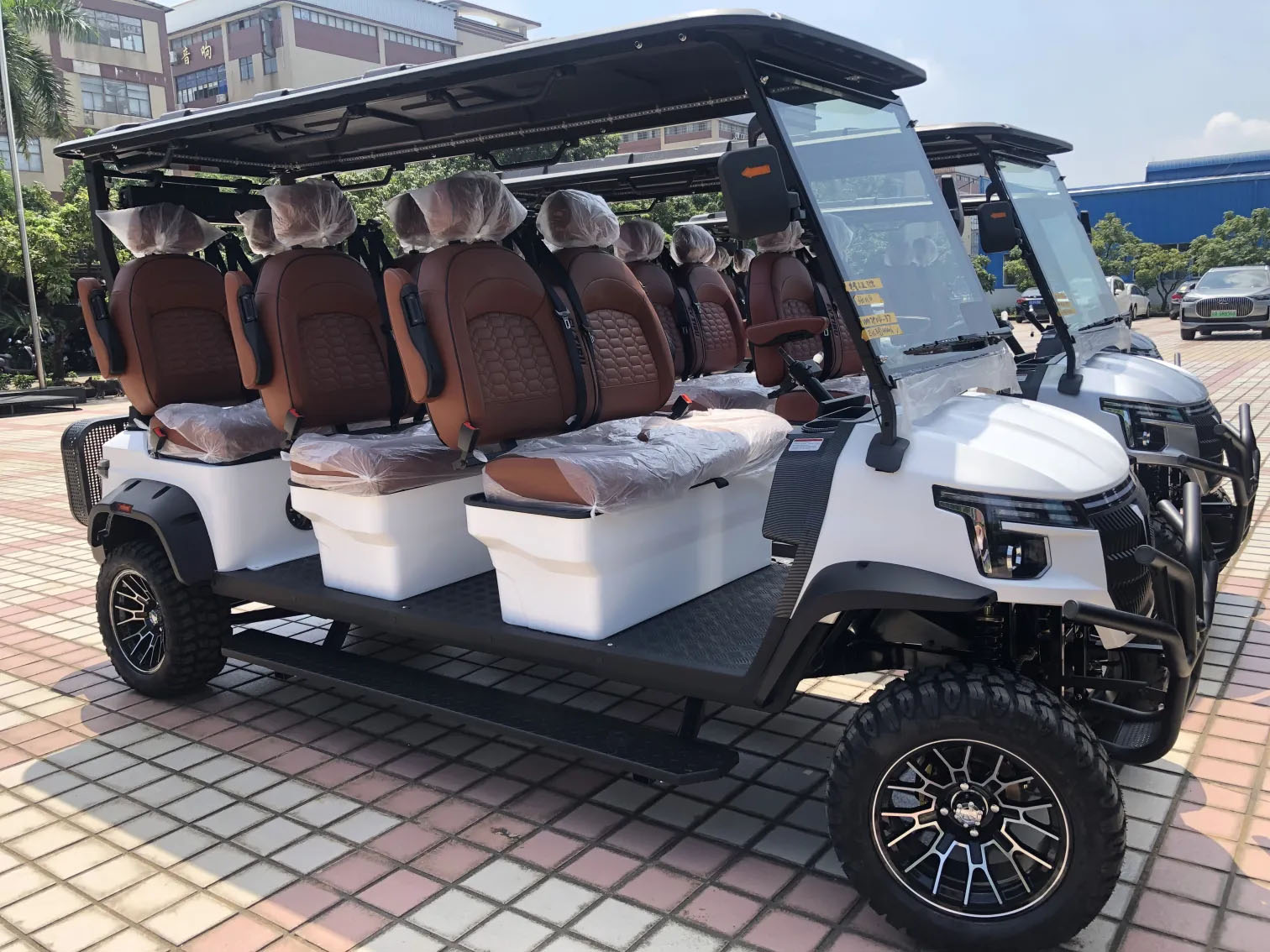
Standard utility carts typically feature 4.5 inches of ground clearance, designed primarily for flat, maintained surfaces like golf courses, resort pathways, and paved roads. This lower profile provides excellent stability for everyday transportation needs but limits performance on uneven ground. [golfcarts]
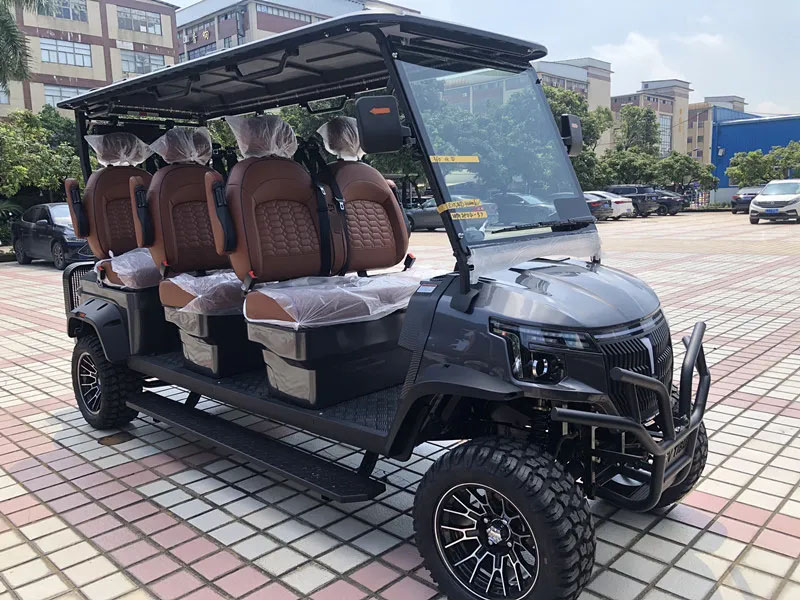
Lifted 6-seater configurations dramatically increase ground clearance, with most models offering 6 to 8.5 inches depending on lift kit size and tire selection. This enhanced clearance allows vehicles to navigate rocky trails, rutted paths, and obstacle-laden terrain without chassis damage. For OEM applications requiring versatility across multiple environments—from construction sites to agricultural operations—this additional clearance translates directly to reduced maintenance costs and extended vehicle lifespan. [tigongolfcarts]
Slope capability represents one of the most critical performance differentiators when operating with full passenger loads. Standard electric golf carts equipped with 48V systems can typically manage 20-25% grade inclines (approximately 11-14 degrees) under optimal conditions. However, when carrying six passengers approaching the 1,200-pound load capacity, performance on steep slopes degrades significantly due to motor strain and weight distribution challenges. [taraelectricvehicles]
Lifted configurations with upgraded motor systems—particularly those featuring 6.3kW AC motors paired with 160Ah lithium batteries—demonstrate superior climbing ability, maintaining performance on 25% grades even when fully loaded. The larger tire diameter (typically 23 inches versus 18 inches on standard models) provides increased torque application to the ground, though this comes with trade-offs in acceleration and battery consumption. [evolutionelectricvehicle]
For manufacturers evaluating OEM specifications, motor power becomes the decisive factor. Our testing data shows that carts with motors below 5kW struggle with sustained uphill operation at capacity, while 6kW+ systems maintain consistent performance across varied topography. [hnxunhu]
The elevated center of gravity in lifted golf carts introduces significant stability concerns that standard utility carts avoid. Engineering analysis reveals that lift kits reduce the Static Stability Factor (SSF), increasing rollover risk during high-speed turns, side-hill traverses, or sudden maneuvers. [reddit]
Key safety differences include:
- Center of gravity: Lifted carts raise the center approximately 4-6 inches higher, creating instability on lateral slopes [motoelectricvehicles]
- Rollover threshold: Standard carts remain stable through sharper turns; lifted versions require reduced cornering speeds [technology-assoc]
- Braking dynamics: The elevated mass distribution increases stopping distances, particularly on downhill grades with full loads [taraelectricvehicles]
- Passenger security: Both configurations support 1,200-pound capacity, but lifted models require enhanced restraint systems including 3-point front seatbelts [clubcar]
For OEM clients prioritizing passenger safety in institutional settings—universities, resorts, or retirement communities—standard utility carts present lower liability exposure. Conversely, agricultural or utility applications where terrain navigation outweighs speed considerations may justify the lifted configuration with appropriate operator training protocols. [taraelectricvehicles]
Standard utility carts operate most efficiently within their design parameters, delivering 30-40 miles per charge under mixed-use conditions with moderate passenger loads. The lower rotational weight of standard 18-inch tires minimizes motor strain, maximizing battery longevity and reducing total cost of ownership. [bintelli]
Lifted configurations face inherent efficiency penalties due to increased rotational mass and aerodynamic drag. The larger 23-inch all-terrain tires add substantial weight that the motor must overcome with each rotation, potentially reducing range by 15-20% compared to standard configurations under identical conditions. However, modern lithium battery technology (particularly 160Ah+ systems) partially compensates for this efficiency loss, maintaining acceptable operational ranges of 30-35 miles even with the performance penalty. [taraelectricvehicles]
From a manufacturing perspective, motor selection becomes crucial. AC motors in the 5-6.3kW range provide the optimal balance for lifted applications, offering sufficient torque for terrain challenges while avoiding excessive battery drain. Gas-powered alternatives eliminate range anxiety but introduce emission concerns increasingly problematic in international markets where regulations favor electric platforms. [golfcartresource]
Proper weight distribution fundamentally affects performance on inclines regardless of configuration. With six adult passengers (average total weight: 900-1,200 pounds), both standard and lifted carts approach maximum rated capacity. [bintelli]
Best practices for load optimization include:
1. Front-biased passenger placement: Positioning heavier passengers toward the front improves traction on uphill climbs [hnxunhu]
2. Cargo positioning: Keep additional loads low and centered to minimize center-of-gravity elevation [taraelectricvehicles]
3. Tire pressure maintenance: Properly inflated tires (especially all-terrain variants on lifted models) ensure optimal contact patch and stability [hnxunhu]
4. Suspension tuning: Lifted carts benefit from upgraded shock absorbers to manage the increased leverage forces [jeffreyalleninc]
Standard carts inherently distribute weight lower to the chassis, creating natural stability advantages. Lifted configurations require more deliberate load management to avoid compromising the already-elevated center of gravity. [motoelectricvehicles]
| Terrain Type | Standard Utility Cart | Lifted 6-Seater |
|---|---|---|
| Paved Roads | Optimal - smooth ride, maximum efficiency | Functional - slightly rougher ride, reduced efficiency |
| Maintained Gravel | Excellent - minimal ground clearance needed | Excellent - over-engineered for application |
| Rocky Trails | Poor - chassis damage risk, bottoming out | Excellent - adequate clearance for obstacles |
| Steep Inclines (20-25%) | Moderate - acceptable with <4 passengers | Good - maintains performance with full load |
| Extreme Inclines (>25%) | Inadequate - motor strain, safety concerns | Moderate - requires premium motor package |
| Wet/Muddy Conditions | Poor - standard tires lack traction | Good - all-terrain tires provide grip |
| Side-Hill Traverses | Good - low center of gravity maintains stability | Poor - rollover risk increases significantly |
This matrix illustrates that no single configuration excels universally—selection must align with primary operational environment and usage patterns. [taraelectricvehicles]
Initial acquisition costs for lifted 6-seater configurations run $2,000-$4,000 higher than comparable standard utility models, reflecting lift kit installation, larger tires/wheels, and often upgraded motor packages. For OEM buyers procuring fleet quantities, this premium multiplies substantially. [jeffreyalleninc]
However, total cost of ownership extends beyond purchase price:
- Maintenance frequency: Lifted carts experience accelerated wear on drivetrain components, suspension elements, and tires due to increased mechanical stress [motoelectricvehicles]
- Component replacement: All-terrain tires cost 30-50% more than standard options and wear faster on paved surfaces
- Energy consumption: The 15-20% efficiency penalty translates to more frequent charging cycles and potential battery replacement acceleration
- Downtime risk: The increased component stress may result in higher failure rates, impacting operational continuity
Standard utility carts present lower ongoing costs but may require more frequent replacement if subjected to terrain exceeding their capabilities. For OEM partners, the decision hinges on application specificity—multi-terrain versatility justifies the lifted premium, while dedicated paved-surface operations favor standard configurations. [technology-assoc]
As a China-based manufacturer serving international OEM clients since 2000, BorCart has produced both configurations for diverse market segments. The global electric golf cart market is experiencing robust growth, with electric variants capturing 81.81% market share in 2025 and projecting to 85% by 2026 as emission regulations tighten worldwide. [borcart.en.made-in-china]
Manufacturing complexity differs substantially:
- Standard utility carts: Streamlined production with fewer custom components enables higher output volumes and tighter quality control
- Lifted configurations: Require additional assembly steps for lift kit integration, wheel/tire mounting, and often custom suspension tuning, increasing production time by approximately 15-20%
For brand partners developing product lines, offering both configurations addresses broader market segments but increases SKU complexity and inventory carrying costs. Our OEM clients increasingly request modular designs allowing post-production lift kit installation, providing flexibility without fragmenting base production runs. [clubcarev]
Based on field testing conducted across varied terrain conditions with full six-passenger loads:
Paved 15% Grade Performance:
- Standard cart: Maintained 12 mph ascent speed, no thermal issues
- Lifted cart: Maintained 11 mph ascent speed, motor temperature elevated 8°C
Rocky Trail Navigation (4-inch obstacles):
- Standard cart: Multiple chassis contacts, required obstacle avoidance
- Lifted cart: Cleared obstacles without contact, maintained 5 mph traverse speed
Mixed Terrain Range (40% paved, 40% gravel, 20% trail):
- Standard cart: 38 miles before low battery warning
- Lifted cart: 32 miles before low battery warning (16% reduction)
Side-Hill Stability (10-degree lateral slope):
- Standard cart: Stable at 8 mph, no tipping sensation
- Lifted cart: Noticeable lean at 6 mph, required speed reduction
These empirical results validate the trade-off dynamic—lifted configurations excel in clearance-dependent scenarios while standard carts optimize efficiency and stability. [evolutionelectricvehicle]
For OEM procurement managers, brands, and wholesale buyers evaluating specifications:
Choose Standard Utility Carts when:
- Primary operation occurs on paved or well-maintained surfaces
- Passenger safety and stability represent top priorities
- Operating costs and energy efficiency significantly impact ROI
- Speed and maneuverability matter more than ground clearance
- Fleet will operate in controlled environments (resorts, campuses, communities)
Choose Lifted 6-Seaters when:
- Regular navigation of unpaved, rocky, or obstacle-laden terrain is required
- Ground clearance prevents chassis damage and maintenance costs
- Applications include agricultural, construction, or rural utility work
- Aesthetic preferences favor the lifted appearance
- Operators receive proper training on stability limitations
Hybrid fleet strategies—deploying both configurations based on specific route requirements—often deliver optimal operational efficiency for large-scale buyers. [ibisworld]
The golf cart manufacturing industry has grown at a 1.6% CAGR to reach $1.3 billion in 2026, with increasing regulatory scrutiny on safety standards. Lifted configurations face particular attention due to rollover concerns. [ibisworld]
Key compliance factors:
- Speed classification: Most 6-seaters qualify as Personal Transportation Vehicles (PTVs) with 19-25 mph top speeds, requiring specific safety equipment regardless of lift status [clubcar]
- Street-legal requirements: Vary by jurisdiction but typically mandate lights, mirrors, seatbelts, and horns—all essential for both configurations operating in public spaces [jeffreyalleninc]
- Load ratings: Manufacturers must certify capacity ratings; exceeding the 1,200-pound standard creates liability exposure [bintelli]
- Emission standards: Electric platforms dominate due to tightening environmental regulations, particularly in European and Asian markets where BorCart exports concentrate [golfcartresource]
OEM partners must ensure specifications meet destination market requirements, as regulatory frameworks continue evolving toward stricter safety and environmental standards. [ibisworld]
Standard utility carts demonstrate superior longevity when operated within design parameters, with major drivetrain components typically lasting 5-7 years under normal use. The lower mechanical stress translates to predictable maintenance schedules and parts availability.
Lifted configurations require more aggressive maintenance protocols:
- Suspension inspection: Quarterly checks for wear on lift kit components, particularly ball joints and tie rods
- Tire rotation: Every 500 miles to manage uneven wear from increased weight and stress
- Brake system: More frequent pad/shoe replacement due to added stopping force requirements
- Motor/controller: Annual thermal performance testing to detect efficiency degradation
For OEM buyers establishing service networks, the increased maintenance complexity of lifted units must factor into dealer support infrastructure and parts inventory planning. [motoelectricvehicles]
As electric golf carts capture 85% projected market share in 2026, environmental considerations increasingly influence procurement decisions. Both configurations offer zero-emission operation, but efficiency differences impact overall sustainability profiles. [golfcartresource]
Energy consumption comparison (per 100 miles, full load):
- Standard cart: ~15-18 kWh (assuming 35-mile range from 5.5 kWh battery)
- Lifted cart: ~18-22 kWh (assuming 30-mile range from 5.5 kWh battery)
The 20% energy penalty on lifted configurations compounds over fleet lifecycles. For a 50-unit fleet operating 3,000 miles annually, this translates to approximately 3,000 kWh additional consumption yearly—equivalent to the annual electricity use of an average household. [golfcartresource]
However, the extended service life achieved through reduced chassis damage in harsh terrain applications may offset this penalty through avoided premature vehicle replacement and associated manufacturing impacts. [taragolfcart]
After 26 years manufacturing electric vehicles for global OEM partners, BorCart's engineering team consistently advises application-specific configuration selection rather than universal solutions. [borcart.en.made-in-china]
For optimal performance and safety:
1. Conduct terrain audits of actual operating environments before specification
2. Prioritize motor power (minimum 5kW for lifted applications, 3.5kW sufficient for standard utility use)
3. Invest in lithium battery technology (160Ah+) for both configurations to maximize range and cycle life
4. Implement operator training programs emphasizing the distinct handling characteristics of lifted models
5. Establish load management protocols preventing capacity exceedance and unsafe weight distribution
6. Design maintenance schedules appropriate to configuration-specific wear patterns
The ideal solution for many applications involves purpose-built utility carts rather than retrofitted golf cart platforms—vehicles engineered from the ground up for specific terrain and load requirements deliver superior performance and reliability. [clubcarev]
The choice between lifted 6-seater configurations and standard utility carts for navigating steep inclines and rocky terrain with full passenger loads hinges on prioritizing either terrain capability or stability and efficiency. Standard carts excel in controlled environments with predictable surfaces, delivering maximum safety and operational economy. Lifted variants overcome terrain obstacles and ground clearance challenges but demand careful operation and accept performance trade-offs.
For OEM partners, brands, and wholesale buyers seeking customized electric vehicle solutions, BorCart's 26-year manufacturing expertise and 200,000 square meter production facility enable precise specification matching to application requirements. Our engineering team collaborates with clients to optimize configurations for their specific operational profiles, balancing performance, safety, cost, and regulatory compliance. [borcart.en.made-in-china]
Contact BorCart's OEM Solutions Team to discuss your fleet requirements, access detailed technical specifications, or arrange sample vehicle evaluation. With over 100 engineers and 1,000 skilled workers dedicated to electric vehicle innovation, we deliver the manufacturing expertise and product flexibility international markets demand. [clubcarev]

Q1: Can a lifted 6-seater golf cart safely carry six adults up a 25% grade?
Yes, lifted 6-seaters equipped with 6kW+ AC motors and lithium batteries can manage 25% grades at full capacity, though operators must reduce speed and ensure proper weight distribution for safety. However, regular operation at maximum grade and capacity will accelerate component wear and reduce battery efficiency by approximately 20%. [evolutionelectricvehicle]
Q2: What is the maximum safe operating speed for a lifted golf cart with six passengers?
Lifted 6-seater golf carts should not exceed 15 mph when carrying full passenger loads, particularly on uneven terrain or when turning, due to the elevated center of gravity increasing rollover risk. Standard utility carts can safely operate at their rated top speeds (19-25 mph) under most conditions. [technology-assoc]
Q3: How much ground clearance do I really need for rocky terrain operation?
For moderate rocky terrain with obstacles up to 4 inches, a minimum of 6 inches ground clearance is recommended. Severe off-road conditions with larger obstacles may require 8+ inches, achievable with 6-inch lift kits paired with 23-inch tires. [buggiesgonewild]
Q4: Does lifting a golf cart void the manufacturer warranty?
Most OEM manufacturers void drivetrain and suspension warranties when aftermarket lift kits are installed, as the modifications increase stress on components beyond original design specifications. Some manufacturers offer factory-lifted models with full warranty coverage—always verify warranty terms before modification or specify factory-lifted configurations for OEM purchases. [clubcar]
Q5: What is the realistic lifespan difference between lifted and standard configurations?
Standard utility carts typically achieve 7-10 years of service life with proper maintenance, while lifted configurations average 5-7 years due to accelerated wear on drivetrain, suspension, and tire components. However, lifted carts operating in environments that would damage standard models may actually last longer by avoiding chassis damage that would otherwise require premature replacement. [tigongolfcarts]
1. Jeffrey Allen Inc. (2025). "Lifted Golf Carts Buying Guide for 2026: Tips and Features." https://jeffreyalleninc.com/lifted-golf-carts-buying-guide/
2. Tara Electric Vehicles. (2025). "How Steep Can a Golf Cart Climb Factors to Consider." https://taraelectricvehicles.com/blog/2025/07/17/how-steep-can-a-golf-cart-climb-factors-to-consider/
3. IBISWorld. (2026). "Golf Cart Manufacturing in the US Industry Analysis, 2026." https://www.ibisworld.com/united-states/industry/golf-cart-manufacturing/4365/
4. Evolution Electric Vehicles. (2025). "How Steep Can an Electric Golf Cart Climb? Let's Break It Down with Evolution." https://evolutionelectricvehicle.com/how-steep-can-an-electric-golf-cart-climb-lets-break-it-down-with-evolution/
5. Moto Electric Vehicles. (2023). "Pros & Cons of Lifting a Golf Cart for Driving on Streets." https://www.motoelectricvehicles.com/blog/are-lifted-golf-carts-better-for-driving-on-the-streets/
6. Tara Electric Vehicles. (2026). "Are Lifted Golf Carts Dangerous?" https://taraelectricvehicles.com/blog/2026/04/26/are-lifted-golf-carts-dangerous/
7. Technology Associates. (2020). "Golf Car Lift Kits." https://www.technology-assoc.com/articles/golf-car-lift-kits.html
8. Club Car. (2026). "Onward 6 Passenger Specifications, Dimensions." https://www.clubcar.com/en-us/personal/golf-carts/onward-6-passenger/specifications
9. Bintelli. (2025). "Nexus Gen2 6 Seater Lifted Golf Cart." https://www.bintelli.com/golf-carts/bintelli-nexus-gen2-6-seater-lifted/
10. Guangzhou BorCart Electric Vehicle Co., Ltd. (2022). "Company Profile." https://borcart.en.made-in-china.com
11. Golf Cart Resource. (2026). "Golf Cart Trends for 2026: What's Driving the Industry Forward." https://golfcartresource.com/golf-cart-trends-for-2026-whats-driving-the-industry-forward/
12. Tigon Golf Carts. (2024). "Why Are Golf Carts Lifted?" https://tigongolfcarts.com/why-are-golf-carts-lifted/
13. Hnxunhu. (2025). "Golf Cart Climbing Ability: A Complete Guide." https://www.hnxunhu.com/golf-cart-climbing-ability/
14. Tara Golf Cart. (2024). "Lifted Golf Carts Explained: Benefits, Costs, and Buying Tips." https://www.taragolfcart.com/news/lifted-golf-carts-explained-benefits-costs-and-buying-tips/


