


Views: 237 Author: BorCart Publish Time: 2026-10-14 Origin: Site


Content Menu
● Electric Cargo Truck with Steel Box vs. Open Cargo Bed: Quick Comparison
● What Is an Enclosed Steel-Box Electric Cargo Truck?
>> Steel Box Does Not Automatically Mean Stainless Steel
>> An Enclosed Body Is Not Automatically Refrigerated
● What Is an Open Cargo Bed Electric Vehicle?
● Cargo Protection, Theft Risk, and Load Restraint
>> Weather Protection Requires More Than Walls
>> Locks Help, but Cargo Still Needs Restraint
● Payload Capacity, Cargo Volume, and Vehicle Stability
>> Compare Usable Payload, Not Advertised Capacity Alone
>> Measure the Loading Opening and Floor Rating
● Battery Range: Why Body Style Alone Cannot Decide
● Maintenance and Total Cost of Ownership
>> Inspect Different Wear Points
>> Evaluate Cost per Completed Delivery
● A Practical Five-Step OEM Selection Process
>> 1. Define the Cargo Envelope
>> 2. Map the Operating Environment
>> 3. Agree on the Body Specification
>> 4. Validate a Representative Prototype
>> 5. Confirm Market Access and After-Sales Support
● Two Application Scenarios: Matching the Body to the Job
>> Packaged Automotive Parts Distribution
>> Landscaping and Facilities Maintenance
● Specify Your BorCart OEM Cargo Vehicle Around the Actual Load
>> Is an Electric Cargo Truck with Steel Box Better for Deliveries?
>> Does an Open Cargo Bed Always Carry More Weight?
>> Is a Steel Cargo Box Waterproof?
>> Can an Enclosed Electric Cargo Truck Transport Refrigerated Goods?
>> Can Both Body Styles Be Customized for OEM Orders?
>> Are Both Configurations Suitable for Public Roads?
An electric cargo truck with steel box protects enclosed freight, while an open cargo bed prioritizes loading access and flexibility. For overseas brands, wholesalers, and manufacturers sourcing from BorCart, the right configuration depends on cargo vulnerability, usable payload, delivery workflow, and destination-market requirements—not appearance alone.
My recommendation is to start with the shipment, not the vehicle brochure. A body that suits packaged electronics may frustrate a landscaping crew. Conversely, an accessible open bed can create unnecessary exposure for cartons, tools, and valuable replacement parts.
This guide compares enclosed steel-box electric cargo trucks and open-bed electric utility vehicles from a procurement and body-specification perspective. It does not assume both configurations share identical dimensions, performance, or road-use approval.
| Decision factor | Enclosed steel box | Open cargo bed |
|---|---|---|
| Weather exposure | Limits exposure when properly sealed | Cargo remains exposed unless covered |
| Loading access | Through specified doors | Often accessible from multiple sides |
| Cargo security | Lockable enclosure conceals goods | Requires separate security measures |
| Cargo dimensions | Limited by internal space and door opening | Greater flexibility for tall or irregular items |
| Payload | Depends on complete vehicle weight | May benefit from a lighter body |
| Maintenance | Doors, seals, coatings, and hardware | Deck, drainage, gates, and anchor points |
| Typical applications | Parcels, packaged parts, protected tools | Landscaping, equipment, bulky materials |
These are configuration tendencies, not guaranteed specifications. Compare completed vehicles with the same chassis, battery, and accessories wherever possible.
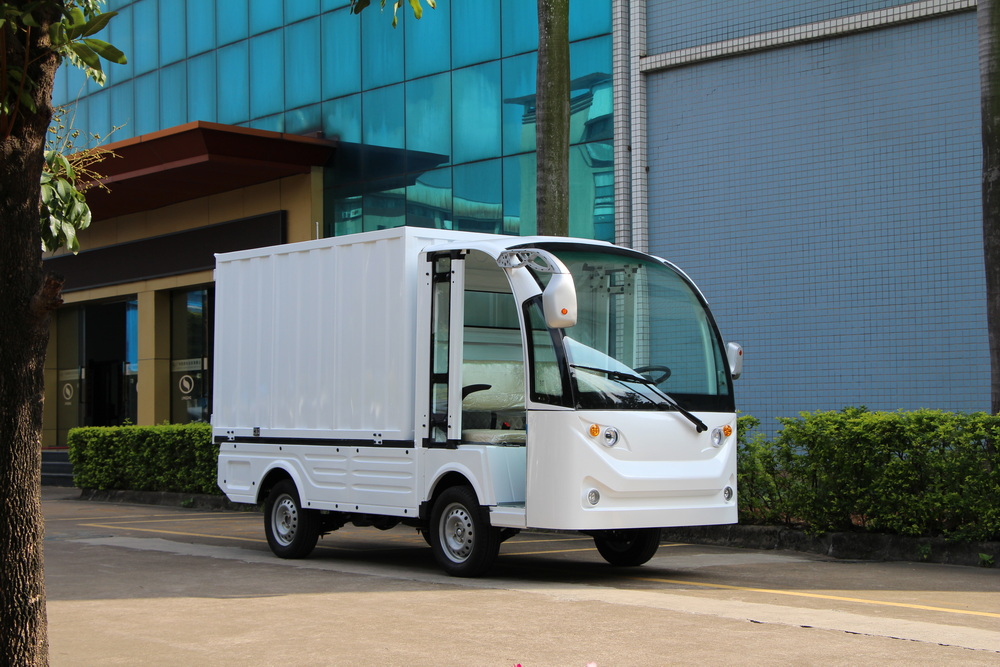
An enclosed steel-box electric cargo truck uses a roof, walls, floor, and doors to separate freight from the outside environment. Depending on the design, access may be through rear doors, side doors, or both.
The enclosure can support shelving, partitions, interior lighting, and branding. However, each addition affects weight, space, and serviceability.
Buyers should distinguish coated carbon steel from stainless steel. BorCart's cargo-van category lists a two-seat electric cargo van with a stainless steel box. That description should not be generalized to every enclosed body or customized order.
Specify material grade, sheet thickness, coating system where applicable, and weld treatment. Stainless steel is not immune to every corrosive environment, and painted steel performance depends heavily on coating quality and maintenance.
A steel enclosure protects against direct exposure; it does not establish temperature control. Food, pharmaceuticals, and other temperature-sensitive products may require insulation, active refrigeration, monitoring, and application-specific compliance.
Ask for those systems explicitly rather than treating an enclosed box as a cold-chain vehicle.
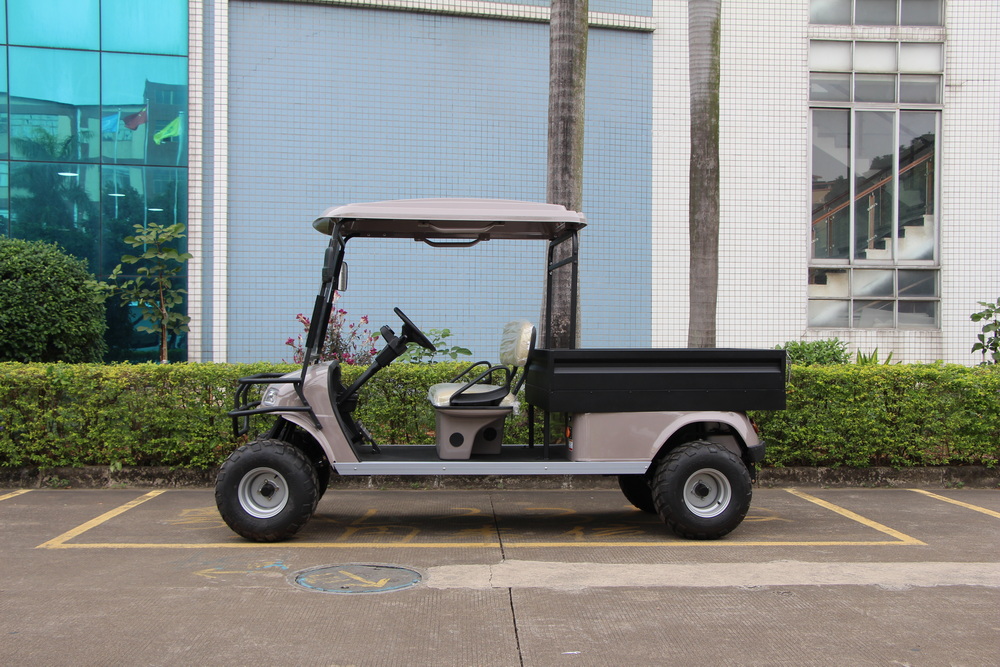
An open cargo bed provides a load platform without a permanent enclosed roof. Designs may include fixed side panels, drop-down sides, a tailgate, or removable racks.
An open bed is not necessarily a flatbed: sidewalls and gates can materially change forklift access and loading options. Likewise, tipping capability is a separate feature, not a standard characteristic of every open-bed truck.
For buyers handling mixed tools, plants, or irregular equipment, this configuration can simplify access. Its value depends on deck dimensions, floor strength, anchor locations, and the loading equipment available.
A well-designed enclosed box reduces direct rain, dust, and sunlight exposure. Actual protection depends on door seals, roof joints, drainage, ventilation, and workmanship.
For open beds, tarpaulins can provide temporary protection, but introduce covering time, inspection requirements, and possible interference with loading. They are not equivalent to a validated enclosed-body design.
Neither configuration automatically guarantees waterproof storage. Request a documented water-ingress test if moisture-sensitive cargo is central to the application.
A lockable steel box conceals goods and restricts casual access. It does not eliminate theft risk or prevent freight from moving inside the vehicle.
Open-bed cargo generally requires direct attention to restraint and security. Enclosed cargo also needs appropriate blocking, tiedowns, or other engineered containment.
For commercial vehicles covered by United States federal rules, cargo-securement requirements apply to enclosed cargo areas too. Relevant performance criteria include 0.8 g forward deceleration and 0.5 g rearward and lateral acceleration, applied separately. These are jurisdiction-specific requirements, not a universal approval standard.
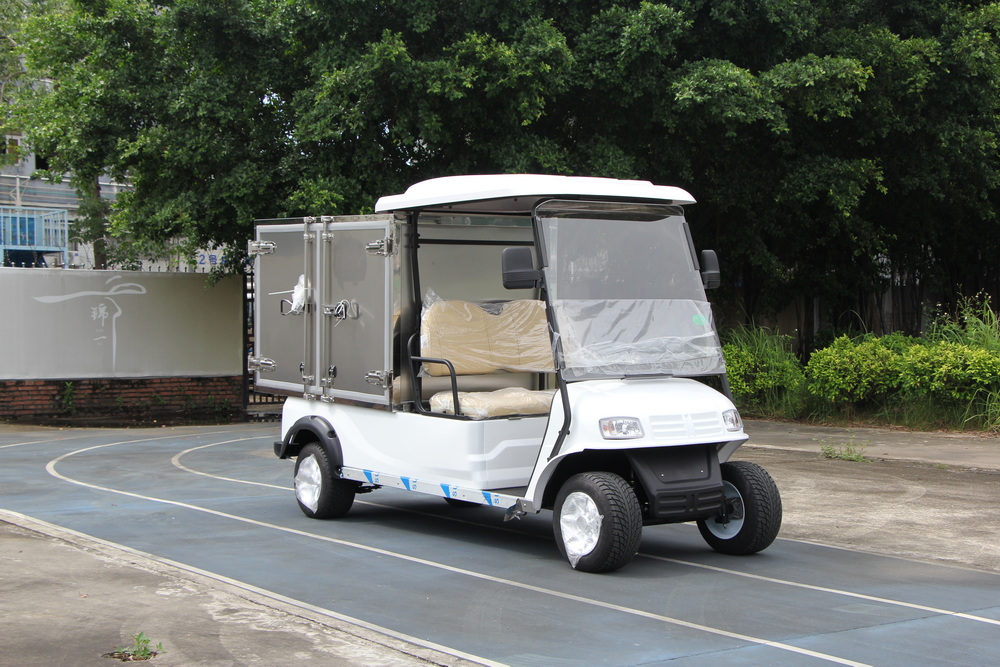
A heavier body can leave less capacity for freight when gross vehicle weight limits remain unchanged. However, an open bed is not automatically lighter: reinforced decks, racks, tipping hardware, and accessories can offset the difference.
Freightliner explicitly notes that final curb weight and payload depend on the installed cargo box or flatbed. That principle is useful for procurement, although its truck specifications should not be transferred to BorCart vehicles.
Start with allowable loaded vehicle mass and subtract the completed vehicle, occupants, and equipment not already included in its declared weight. Then check individual axle, tire, and body limits. Avoid double-counting equipment included in curb weight.
Internal volume alone can mislead buyers. A pallet may fit inside the box but fail to pass through its door. Similarly, a bed with sufficient total capacity may not tolerate concentrated loads from small equipment wheels.
Request:
- Clear door dimensions and internal dimensions.
- Deck height and usable floor area.
- Distributed and concentrated floor-load limits.
- Rated anchor points and approved mounting positions.
- Axle-load calculations for representative cargo arrangements.
Tall loads and uneven placement also require stability review. Neither an enclosure nor an open platform removes the need for an appropriate loading plan.
Electric cargo truck range depends on payload, speed, terrain, ambient temperature, auxiliary loads, and driving pattern. Oak Ridge National Laboratory identifies vehicle weight, route characteristics, and job-site power demands as important duty-cycle factors.
An enclosed box can change aerodynamic drag, while an exposed irregular load can also disturb airflow. It is therefore unsafe to promise that an open bed always achieves better range.
Compare both configurations on the same route with equivalent cargo, tire settings, starting charge, and operating conditions. Record energy use per kilometer, remaining charge, loading time, and accessory consumption.
Include hills, repeated stops, and the heaviest planned load. If heating, cooling, or powered equipment is required, operate it during testing.
The most useful result is not an unloaded range claim. It is whether the vehicle completes the intended shift with an agreed reserve under representative conditions.
For steel-box vehicles, inspect door alignment, hinges, locks, seals, roof joints, welds, and damaged coatings. Interior cleanliness and ventilation also deserve attention.
For open beds, inspect deck damage, drainage, tailgate latches, side hinges, anchor points, and exposed fasteners. Where tipping equipment is fitted, follow its separate inspection procedure.
Automotive corrosion-protection guidance emphasizes surface preparation, coatings, seam sealing, and protection inside enclosed cavities. Repair scratches and coating damage before deterioration spreads; choose procedures compatible with the specified material.
Purchase price is only one component. Include energy, loading labor, packaging, maintenance, downtime, cargo damage, and charging infrastructure.
A protected enclosure may reduce packaging or weather-related disruption. An open bed may reduce handling time for accessible, bulky loads. Either advantage must be measured against the actual work.
For mixed fleets, cost per completed delivery or per productive shift often provides a more useful comparison than purchase price alone.
Document maximum dimensions, weight, packaging, moisture sensitivity, value, and loading method. Include occasional large shipments, not just the average order.
Identify route distance, gradients, surface conditions, temperature, parking restrictions, and charger access. Specify whether operation is on private premises or public roads.
For enclosed bodies, define material, doors, seals, ventilation, and restraint provisions. For open beds, define deck strength, side access, anchor ratings, drainage, and any requested tipping system.
Treat these as requirements for supplier confirmation, not assumptions about standard equipment.
Use real cargo and normal operators. Check loading clearance, restraints, axle weights, braking behavior, water ingress where relevant, and route energy consumption.
Set acceptance criteria before testing. A demonstration without measurable pass/fail requirements is difficult to use for purchasing decisions.
Request documents identifying the exact vehicle configuration and intended market. Do not assume a cargo cart qualifies as a road-legal delivery truck.
Agree on spare parts, service instructions, warranty scope, and responsibilities between the manufacturer, importer, and brand owner.
The following are illustrative planning scenarios, not documented BorCart customer results.
A wholesaler delivering boxed sensors, electrical components, and repair kits may prioritize dry storage, organized picking, and concealed cargo. An enclosed steel box can support that workflow.
The specification should still address door clearance, load restraint, ventilation, and the weight of shelves. Otherwise, storage improvements may reduce usable payload unexpectedly.
A maintenance team moving plants, tools, and irregular equipment may prioritize side access and easy cleaning. An open cargo bed can suit those tasks.
The buyer should verify anchor ratings, drainage, deck durability, and practical security arrangements. Sensitive tools may need a separate lockable compartment.
Choose protection for vulnerable freight and access for difficult-to-handle loads. Then validate payload, energy use, restraint, and market suitability together.
Send BorCart your cargo dimensions, maximum load, route profile, destination market, preferred body style, and customization requirements. Request a configuration proposal with verified weights, body specifications, testing arrangements, and export documentation before placing an OEM order.
It is often better for weather-sensitive packaged goods and concealed storage. Open beds may work better for bulky or irregular cargo. The delivery workflow determines the stronger option.
No. Payload depends on complete vehicle weight and applicable limits. Reinforcement, accessories, and tipping hardware can substantially change the result.
Not automatically. Water resistance depends on the complete design, particularly seals and joints. Request relevant testing and clearly defined acceptance criteria.
Only when specified with suitable temperature-control equipment and validated for the intended cargo. A steel box alone does not provide refrigeration or cold-chain compliance.
BorCart offers OEM/ODM electric-vehicle solutions. Confirm the requested body's feasibility, engineering requirements, minimum order quantity, lead time, and documentation before committing to a project.
Not necessarily. Road-use eligibility depends on the exact vehicle and destination-market requirements, not simply whether the cargo area is enclosed or open.
1. BorCart. "Cargo Vans." Manufacturer product-category information identifying a two-seat electric cargo van with a stainless steel box and describing OEM/ODM services. Supports the product-material distinction and customization discussion. [borcart]
2. Federal Motor Carrier Safety Administration, U.S. Department of Transportation. "Cargo Securement Rules." Explains applicable U.S. commercial-vehicle requirements, including restraint performance under forward, rearward, and lateral forces. Supports the cargo-securement figures. [fmcsa.dot]
3. Federal Motor Carrier Safety Administration. "Do the rules for protection against shifting or falling cargo apply to CMVs with enclosed cargo areas?" Official guidance confirming that applicable cargo-securement provisions also cover enclosed cargo areas. [fmcsa.dot]
4. Freightliner. "Freightliner eM2 Electric Truck: Specs & Features." Explains that final vehicle curb weight and payload depend on the installed cargo box or flatbed body. Used for the body-weight principle, not as a specification for BorCart products. [freightliner]
5. Oak Ridge National Laboratory. "Medium- and Heavy-Duty Vehicle Electrification." Technical report discussing duty cycles, payload, route characteristics, and job-site energy demands. Supports the recommendation to assess range against actual operating conditions. [info.ornl]
6. 3M. "Collision Repair Corrosion Protection Resources & SOPs." Technical guidance covering surface preparation, undercoatings, seam sealers, cavity protection, and corrosion-control procedures. Supports the steel-body maintenance discussion. [3m]


