


Views: 255 Author: BorCart Publish Time: 2026-10-13 Origin: Site


Content Menu
● Electric Cargo Van vs. Electric Utility Cart: The Main Differences
● Define "Electric Cargo Van" Before Comparing Specifications
>> Road-going electric vans and compact cargo vehicles are different
>> Compare equivalent chassis whenever possible
● Which Vehicle Is More Maneuverable in Narrow Areas?
>> Operating width matters more than body width
>> Turning radius and turning circle are not interchangeable
>> Corners expose weaknesses that straight passages conceal
● A Practical Clearance Calculation for Narrow Routes
● Payload, Cargo Volume, and Loading Efficiency
>> An electric cargo van suits protected deliveries
>> An electric utility cart suits frequent handling
>> Distinguish bed capacity from total payload
● Safety, Visibility, and Public-Road Access
>> Smaller does not automatically mean safer
>> Evaluate visibility with the final cargo configuration
>> Confirm road eligibility for the destination market
● Three Application Scenarios: Matching the Vehicle to the Work
>> Resort maintenance: frequent stops favor accessible beds
>> Campus supplies: protected cargo favors an enclosure
>> Factory logistics: route geometry can outweigh capacity
● A Six-Step Vehicle Selection Test for Buyers
● OEM Customization: What Overseas Buyers Should Specify
● Compare Cost per Completed Delivery, Not Purchase Price Alone
● Discuss Your Narrow-Area Vehicle Project with BorCart
>> Is an electric utility cart always better in narrow areas?
>> Can a compact electric cargo van be as maneuverable as a utility cart?
>> Which vehicle is better for weather-sensitive cargo?
>> How should buyers compare turning specifications?
>> Can either vehicle operate on public roads?
>> What should an OEM inquiry include?
An electric cargo van protects goods inside an enclosed body, while an electric utility cart often makes short, frequent trips easier in confined spaces. For buyers comparing an electric cargo van vs. electric utility cart, the better choice depends on operating width, corner geometry, cargo requirements, and whether the route includes public roads.
My recommendation is to measure the route before comparing vehicle prices. A vehicle that passes through the entrance may still struggle at a blind corner, loading point, or turnaround.
For overseas brands, wholesalers, and manufacturers sourcing from BorCart, this comparison also informs OEM development. Choosing the right chassis and cargo configuration early helps avoid expensive changes after production begins.
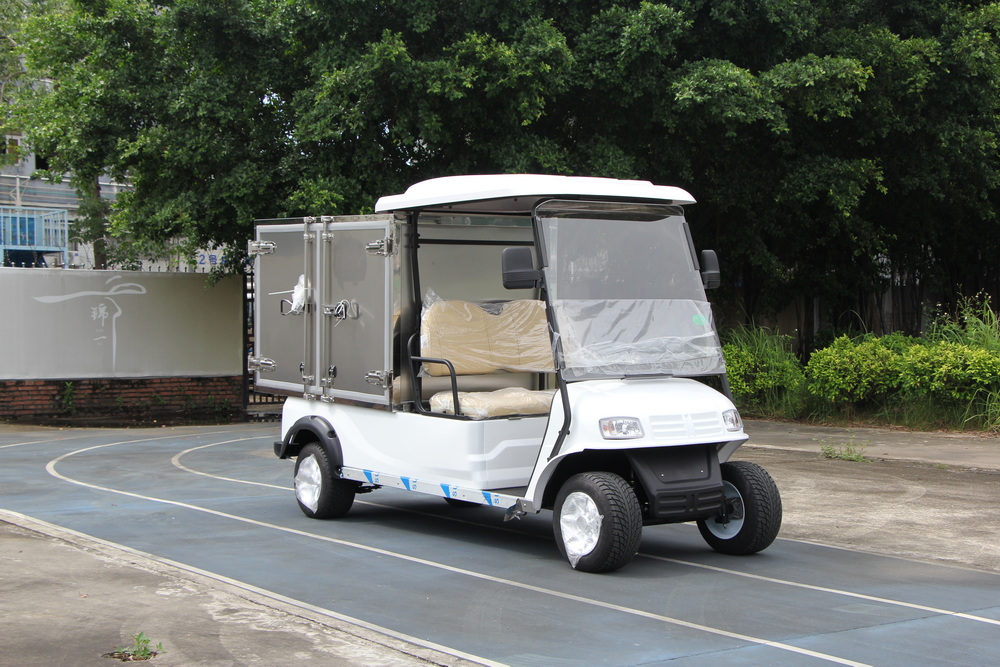
Neither vehicle category has one universal size or capability. Compact cargo vans can share a chassis with utility carts, while road-going electric vans belong to a substantially different vehicle class.
| Decision factor | Electric cargo van | Electric utility cart |
|---|---|---|
| Primary advantage | Enclosed, protected cargo space | Accessible cargo bed and potentially smaller footprint |
| Narrow-route suitability | Strong when a compact model fits the route | Strong for frequent movements on confined private sites |
| Loading access | Depends on door positions and openings | Often accessible from multiple sides |
| Weather protection | Enclosed body provides greater protection | Requires suitable covers or an enclosure |
| Cargo security | Can offer lockable storage | Open beds need additional security measures |
| Public-road operation | Depends on vehicle approval and registration | Must not be assumed from appearance or equipment |
| OEM priorities | Body dimensions, doors, sealing, payload | Bed layout, operating width, steering, load restraint |
The practical question is not simply "Which vehicle is smaller?" It is "Which configuration completes the required work safely, with fewer unnecessary movements?"
A road-going electric cargo van typically combines an enclosed load compartment with equipment and approvals intended for its designated road market.
A compact electric cargo van may instead be a low-speed utility platform fitted with an enclosed cargo box. BorCart's cargo category includes enclosed-box vehicles alongside cargo carts and utility configurations.
These vehicles should not be treated as interchangeable. Their dimensions, performance, approval requirements, and service arrangements may differ substantially.
For an OEM project, compare an open-bed utility cart with an enclosed cargo version on a similar chassis first.
This helps isolate the effects of:
- Added body width and height.
- Enclosure weight and available payload.
- Door-opening space.
- Rear visibility.
- Loading and unloading access.
A cargo enclosure does not automatically make a vehicle unsuitable for narrow areas. Equally, calling a vehicle a "cart" does not guarantee a compact operating footprint.
Published body width may exclude mirrors, handles, accessories, or cargo projecting beyond the bed.
Request the maximum operating width in the intended configuration. Include mirrors in their normal driving position and any permanently installed equipment.
For context, Ford's published E-Transit Custom specifications list a width of 2,032 mm without mirrors and 2,275 mm with mirrors. That difference matters when evaluating a restricted entrance.
An electric utility cart may offer a narrower footprint, but the final dimensions must come from the selected model—not assumptions about the category.
Turning radius describes a radius; turning circle usually describes a diameter. Comparing the two directly can produce a misleading result.
Measurement methods also matter. A curb-to-curb figure does not necessarily describe clearance around walls, shelving, or bollards.
Ford lists a 10.9 m curb-to-curb turning circle for the short-wheelbase E-Transit Custom. That specification provides useful context, but it cannot prove the van will negotiate a particular right-angle service passage.
For narrow-site procurement, request a swept-path drawing showing the space occupied by the entire vehicle during a turn.
A vehicle may travel comfortably along a straight lane but fail at the next intersection.
Check:
- Front-corner swing.
- Rear overhang movement.
- Wheelbase and inside-wheel tracking.
- Mirrors and cargo-box corners.
- Space needed to reverse or reposition.
My evaluation priority would be the route's hardest maneuver, not its widest section. That maneuver often determines whether the vehicle is workable.
Consider an illustrative passage 1,800 mm wide.
If a proposed cart has a verified operating width of 1,250 mm, the remaining geometric clearance is:
1,800 − 1,250 = 550 mm.
If centered perfectly, that leaves 275 mm on each side. These dimensions are hypothetical, not BorCart product specifications.
The calculation is only an initial fit check. It does not establish a safe traffic-route width.
Pedestrians, steering corrections, uneven surfaces, projecting loads, and trapping points all affect suitability. A shared passage needs a site-specific risk assessment, not merely a positive subtraction result.
Use this screening sequence:
1. Measure the narrowest usable route width.
2. Confirm the vehicle's complete operating envelope.
3. Identify pedestrian interaction and escape space.
4. Evaluate corners and loading positions separately.
5. Validate the route with the intended load.
If people cannot remain safely separated from the vehicle, choose another route or change the operating arrangement.
An enclosed cargo body offers practical advantages for goods that need shelter or controlled access.
Typical applications include:
- Packaged supplies moving between buildings.
- Tools stored inside a lockable compartment.
- Linen and housekeeping materials.
- Multiple deliveries organized by compartment.
However, "enclosed" does not automatically mean waterproof, refrigerated, or dust-tight. Specify sealing, drainage, temperature requirements, and locking arrangements separately.
An open cargo bed can simplify repeated loading of tools, maintenance materials, and bulky items.
Access from multiple sides may reduce the need to reposition the vehicle. That advantage becomes valuable when operators stop repeatedly along a confined route.
Open-bed convenience brings responsibilities, however. Cargo needs suitable restraint, and projecting items must not compromise clearance or visibility.
Cargo-bed capacity and total vehicle payload describe different limits.
For example, Club Car advertises an 800 lb cargo-bed capacity for the Carryall 500. Buyers should not interpret a bed rating as permission to ignore occupant weight, accessories, or other vehicle limits.
For every configuration, request:
- Permitted cargo load.
- Total payload and axle limits.
- Allowances for occupants and accessories.
- Required load distribution.
- Any operating restrictions on slopes.
An OEM enclosure, toolbox, or additional battery changes the weight calculation. Confirm the finished vehicle's rating rather than relying on the base chassis.
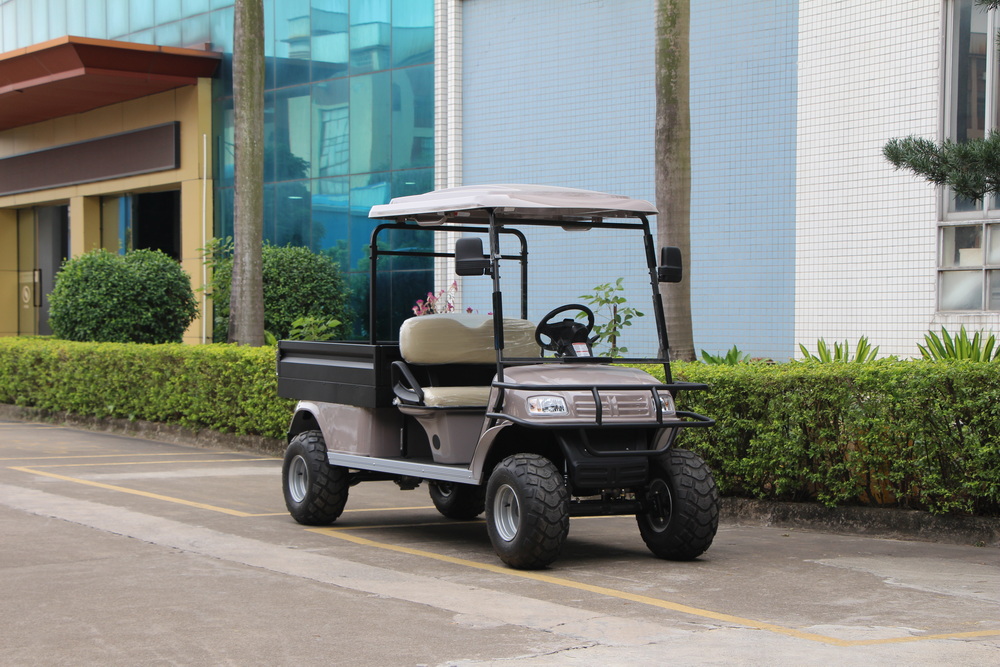
A compact electric utility cart can reduce space demands, but confined routes still create collision and trapping risks.
Priority controls include separate pedestrian routes, suitable crossing points, clear sightlines, controlled speeds, and arrangements that minimize reversing.
Mirrors, cameras, and warning devices can support these controls. They should not substitute for safe site design or attentive operation.
An open-bed cart may provide useful rearward visibility until a tall load blocks it. An enclosed cargo van may require additional visibility aids.
Test the actual configuration from the driver's normal seating position. Include the maximum approved load, not an empty demonstration vehicle.
Do not assume that lights, indicators, seat belts, or an enclosed cab make a vehicle road legal.
Before ordering, establish the applicable vehicle category, approval documentation, registration requirements, and local operating restrictions.
This matters particularly when a private-site route briefly crosses a public street. That crossing can change the procurement requirements even when most journeys remain inside a facility.
The following scenarios are decision examples, not documented customer case studies.
A maintenance team carries tools, replacement parts, and landscaping supplies through narrow service lanes.
An electric utility cart may be the stronger option when loading is frequent, routes are short, and weather-sensitive items can be secured appropriately.
Before choosing, check guest interaction, blind corners, gradients, and parking space at each work location.
A campus team transports packaged supplies between buildings throughout the day.
A compact electric cargo van may work better if rain protection and lockable storage outweigh the convenience of an open bed.
Specify door placement around the actual unloading routine. A rear-access body is less convenient if the vehicle must repeatedly park against a wall.
A factory moves components between production areas through restricted intersections.
The largest vehicle is not necessarily the most productive. Extra capacity provides little benefit if each journey requires repeated reversing or disrupts pedestrian movement.
Compare both candidates using representative loads and a controlled trial. Record completed deliveries, maneuvering time, loading time, and operator observations.
Use the same evaluation process for both vehicle types.
1. Map the route. Record entrances, corners, slopes, overhead restrictions, loading points, and pedestrian crossings.
2. Define the load. Include dimensions, weight, fragility, weather sensitivity, and security needs.
3. Obtain comparable specifications. Request operating width, height, wheelbase, turning methodology, and finished-vehicle payload.
4. Conduct a controlled trial. Use trained operators, representative loads, and appropriate site controls.
5. Measure work output. Track successful deliveries and total cycle time—not driving time alone.
6. Document acceptance criteria. Put agreed dimensions, performance limits, and test conditions into the purchase specification.
This approach turns a subjective preference into a repeatable procurement decision.
BorCart offers OEM/ODM options covering vehicle configuration, branding, battery selection, and functional modifications. Buyers should translate operational needs into measurable requirements.
| OEM requirement | Information to provide |
|---|---|
| Route constraints | Minimum width, corner layout, overhead clearance |
| Cargo system | Bed or box dimensions, doors, restraints, locks |
| Workload | Payload, trip frequency, gradients, daily distance |
| Power configuration | Battery requirements, charging windows, site supply |
| Safety equipment | Visibility aids, lighting, restraints, speed settings |
| Market documentation | Destination country and intended operating category |
| After-sales support | Spare parts, manuals, diagnostics, warranty expectations |
I would settle chassis geometry and cargo access before cosmetic customization. Branding cannot correct an unsuitable turning envelope.
For distributors, prioritize serviceable configurations and clearly documented limits. For manufacturers integrating components, request interface drawings and compatibility information before finalizing assemblies.
A lower purchase price does not guarantee lower operating cost.
Compare acquisition, charging, maintenance, downtime, operator time, and any additional handling required by the route.
A useful internal metric is:
Cost per completed delivery = total operating cost ÷ successfully completed deliveries.
Use consistent periods and comparable workloads. Do not award a vehicle an advantage for carrying more if the operation rarely uses that capacity.
A utility cart may suit repetitive short trips. An enclosed van may justify additional cost through cargo protection or fewer journeys. The better business case follows the workload.
Send BorCart your route dimensions, representative cargo details, required daily trips, and destination market.
Request a configuration comparison between an electric utility cart and an enclosed electric cargo vehicle, including operating dimensions, payload limits, charging requirements, and available documentation.
For overseas brands, wholesalers, and manufacturers, this creates a practical starting point for an OEM quotation, prototype evaluation, and agreed production specification.

No. It may have a smaller footprint, but dimensions, corner clearance, load projection, and pedestrian separation determine suitability.
Potentially. Similar chassis geometry can produce similar handling, although enclosure dimensions and visibility still require evaluation.
An appropriately specified enclosed cargo van generally provides greater protection. Confirm sealing and any temperature-control requirements rather than assuming them.
Compare figures measured using the same method. Distinguish radius from diameter, and request swept-path information for confined corners.
Only where the specific vehicle and operating arrangement meet the destination market's requirements. Obtain relevant documentation before purchase.
Provide route measurements, cargo requirements, daily workload, charging conditions, destination market, customization needs, and expected order quantity.
1. [Ford — E-Transit Custom and Transit Custom PHEV Technical Specifications]. Manufacturer specifications covering dimensions, turning circle, cargo space, payload qualifications, and configuration-dependent performance. [fromtheroad.ford]
2. [Club Car — Carryall 500 Utility Vehicle]. Manufacturer information covering cargo-bed capacity, electric powertrain options, and utility applications. Specifications apply to this model, not all utility carts. [clubcar]
3. [UK Health and Safety Executive — Introduction to Workplace Transport Safety]. Guidance on route planning, pedestrian separation, one-way systems, and minimizing reversing. [hse.gov]
4. [UK Health and Safety Executive — Separating Pedestrians and Vehicles]. Guidance on traffic-route separation, crossing points, clearance, and trapping hazards. Used as workplace-safety guidance, not a statement of law for every destination country. [hse.gov]
5. [BorCart — Cargo Vans]. Company-published information on enclosed cargo vehicles, utility configurations, and available customization services. Specific project capabilities require confirmation. [borcart]
6. [BorCart — Utility Carts]. Company-published information on utility vehicles and OEM/ODM configuration, branding, and component options. [borcart]


