


Views: 217 Author: BorCart Publish Time: 2026-09-05 Origin: Site


Content Menu
● What Is the Core Difference?
● Electric Utility Vehicle vs Forklift Comparison
● Where Forklifts Perform Best
>> 1. Pallet Storage and Retrieval
>> 2. Loading Docks and Containers
>> 3. Repetitive Heavy-Duty Work
● Where Electric Utility Vehicles Perform Best
>> 1. Outdoor Delivery Between Buildings
>> 2. Maintenance and Engineering Support
>> 3. Site Personnel Transport
>> 4. Last-Mile Internal Logistics
● Why a Forklift Cannot Replace a Utility Vehicle
>> Long-Distance Travel Reduces Forklift Availability
>> Outdoor Travel Can Increase Wear
>> Personnel Transport Is Not Its Job
>> Small Loads Do Not Need Heavy Equipment
● Why an Electric Utility Vehicle Cannot Replace a Forklift
>> No Substitute for Rated Lifting
>> Cargo Capacity Is Not the Same as Forklift Capacity
>> Warehouse Space Requires Specialized Design
● The Best Model: A Two-Vehicle Workflow
● How to Select the Right Vehicle Mix
>> Step 1: Map Every Material Route
>> Step 2: Separate Vertical and Horizontal Work
>> Step 3: Define the Duty Cycle
>> Step 4: Design Charging Around Operations
>> Step 5: Build Safety into Vehicle Selection
● OEM Opportunities for Electric Utility Vehicles
● Final Decision: Forklift, Utility Vehicle, or Both?
● FAQ
>> 1. Can an electric utility vehicle replace a forklift?
>> 2. What is the main advantage of an electric utility vehicle for factories?
>> 3. Are electric utility vehicles suitable for outdoor industrial delivery?
>> 4. Should a warehouse buy a forklift or an electric cargo cart first?
>> 5. What should buyers ask an OEM electric utility vehicle manufacturer?
>> 6. Can an electric utility vehicle tow trailers or carts?
An electric utility vehicle vs forklift comparison is not simply a choice between two battery-powered machines. It is a decision about how efficiently your operation moves people, parts, tools, pallets, and finished goods between the warehouse, production line, loading zone, yard, and final delivery point.
For many manufacturers, distributors, resorts, campuses, and industrial parks, the best answer is not replacing forklifts with electric utility vehicles. It is building a coordinated material-flow system in which each vehicle performs the work it is designed to do. Forklifts handle vertical storage and palletized loads. Electric utility vehicles handle horizontal movement, outdoor transport, personnel mobility, and light-to-medium cargo delivery.
As a China-based manufacturer of electric golf carts, utility vehicles, and automotive components, BorCart works with overseas brands, wholesalers, and OEM partners that need configurable vehicles for real operating conditions. From our perspective, the key question is not "Which machine is better?" It is: Which machine should perform each transport task, and where does one vehicle create a bottleneck for the other?

A forklift is a powered industrial truck designed primarily to lift, lower, stack, retrieve, and position loads, especially palletized goods. Its forks, mast, hydraulic lifting system, and rated load capacity make it essential for racking, loading docks, containers, and warehouse storage.
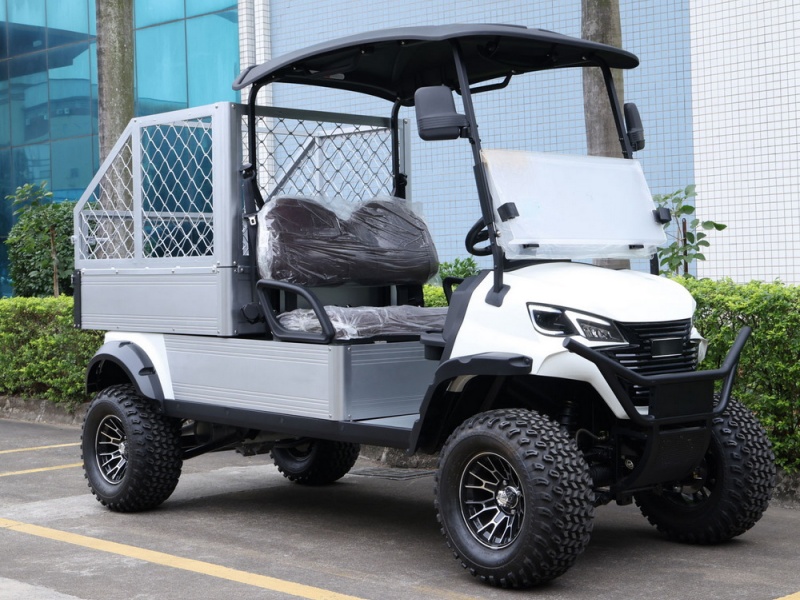
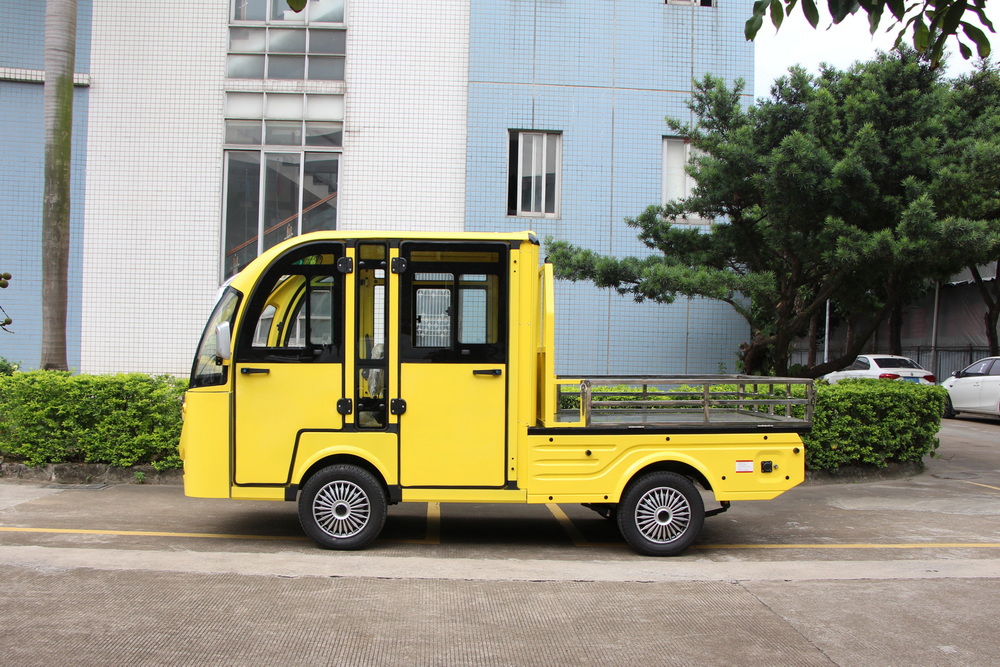
An electric utility vehicle is designed primarily to carry people, tools, small goods, parts, and cargo across a site. Depending on the configuration, it may include a cargo bed, enclosed cab, rear seats, utility box, flatbed body, dump bed, tow hitch, tool racks, or weather protection.
The most practical distinction is simple:
- Forklifts solve vertical material-handling problems
- Electric utility vehicles solve horizontal mobility and outdoor-delivery problems
- A combined fleet connects the two workflows
For example, a forklift can remove a pallet of packaged components from a warehouse rack and place it in a staging area. But it is usually not the ideal vehicle for delivering maintenance tools across a large industrial campus, transporting technicians through outdoor production areas, or carrying small urgent parts between buildings.
| Comparison Area | Electric Utility Vehicle | Forklift |
|---|---|---|
| Primary purpose | Transporting people, tools, parts, and light cargo | Lifting, stacking, loading, and unloading palletized materials |
| Core movement | Horizontal transport | Vertical lifting plus short-distance transport |
| Typical operating area | Outdoor sites, campuses, factories, resorts, yards, industrial parks | Warehouses, docks, racking aisles, loading bays, production zones |
| Load format | Loose items, bins, packages, tools, equipment, small cargo | Pallets, bulk loads, crates, containers, heavy industrial materials |
| Lift capability | Usually no high-lift function | Designed for controlled lifting and stacking |
| Passenger capacity | Often one to multiple passengers | Normally operator-only |
| Terrain suitability | Can be configured for paved roads, mixed surfaces, and outdoor routes | Depends on tire type and model; typically optimized for controlled work areas |
| Speed and travel distance | Better for longer site routes and repeated inter-building movement | Better for short material moves within defined work zones |
| Turning and visibility | Often car-like steering and open visibility | Requires careful operation around raised loads, blind spots, and pedestrians |
| Main buyer concern | Range, payload, cargo-bed layout, seating, weather protection | Lift capacity, mast height, aisle width, battery system, stability |
| Best use case | Outdoor delivery, maintenance response, parts runs, personnel transport | Warehouse storage, loading trucks, handling pallets, supplying production lines |
A forklift should never be selected merely because it can carry a load. Likewise, an electric utility vehicle should not be chosen for tasks requiring formal lifting capacity, pallet stacking, or safe operation at height.
Forklifts remain the primary equipment for warehouse storage and high-density material handling. Their value comes from their ability to safely manage heavy loads in three dimensions: forward and backward movement, vertical lifting, and controlled placement.
If goods are stored on racking, a forklift is usually indispensable. The vehicle can lift a pallet from floor level to elevated storage positions and retrieve it when needed for shipping, assembly, or replenishment.
This is especially important in industries such as:
- Automotive parts distribution
- Food and beverage warehousing
- Packaging-material storage
- Furniture and appliance manufacturing
- Building-material distribution
- E-commerce fulfillment
- Export consolidation centers
The more vertically organized the warehouse is, the more important forklift capability becomes.
Forklifts are built for transferring palletized goods between warehouse floors, truck trailers, shipping containers, and staging zones. A properly selected forklift can reduce manual handling, improve loading consistency, and support faster dispatch cycles.
For export-oriented manufacturers, this can be particularly valuable. Products often move through several stages before shipment:
1. Finished goods leave the production line
2. Workers move them to a staging zone
3. Loads are palletized and labeled
4. Forklifts transport pallets to the loading dock
5. Goods are loaded into containers or trucks
6. Documentation is checked before dispatch
At this stage, a forklift is not just a transport machine. It becomes part of the shipping-control process.
A forklift is usually the better choice when a facility has:
- High pallet volumes
- Heavy loads
- Frequent loading cycles
- Narrow warehouse aisles
- Elevated racking
- Strict loading schedules
- Defined indoor traffic routes
However, forklift productivity declines when operators are asked to perform long-distance, low-load, outdoor transport tasks. Those tasks consume equipment time without using the forklift's core lifting capability.
An electric utility vehicle is most effective where forklifts become inefficient, oversized, or inconvenient. It is particularly valuable when the facility includes outdoor roads, multiple buildings, long travel distances, frequent parts movement, or service teams that need to carry tools and equipment quickly.
A factory may have separate facilities for machining, painting, assembly, packaging, quality control, warehouse storage, and administration. Workers may need to move parts, samples, documents, tools, and small batches repeatedly throughout the day.
Using a forklift for this type of task can create unnecessary congestion. Using manual carts can be slow and physically demanding. An electric utility vehicle offers a practical middle ground.
A cargo utility vehicle can move:
- Cartons of components
- Production samples
- Spare parts
- Hand tools and maintenance equipment
- Packaging materials
- Quality-inspection equipment
- Documents and small parcels
- Cleaning supplies
- Safety equipment
For facilities with repeated outdoor routes, this function can save significant travel time over a full shift.
Maintenance teams often lose time walking between workshops, utility rooms, production lines, and outdoor equipment areas. A configurable electric utility vehicle can carry technicians plus common tools, replacement parts, ladders, testing instruments, and emergency equipment.
This makes it suitable for:
- Factory maintenance departments
- Warehousing facilities
- Airports and logistics parks
- Hotels and resorts
- Universities and campuses
- Property-management companies
- Industrial estates
- Agricultural operations
In practice, a maintenance vehicle is often less about speed and more about response time. If a production line stops because of a small mechanical or electrical failure, every minute matters.
A forklift is not designed to transport multiple employees around a property. An electric utility vehicle can be configured with rear-facing seats, forward-facing seats, enclosed cabins, or specialized passenger layouts.
This is useful where employees regularly travel between distant work zones, including:
- Large factories
- Ports and terminals
- Warehouses with extensive outdoor yards
- Golf courses and resorts
- Theme parks
- Corporate campuses
- Construction-support areas
A passenger-and-cargo configuration can also support supervisors, security teams, facility managers, and customer visitors.
Internal logistics is often overlooked because each individual delivery is small. Yet the cumulative cost of moving urgent parts, packaging supplies, quality samples, and repair tools can be substantial.
An electric utility vehicle helps create a fast "last-mile" connection between:
- Warehouse and production line
- Production line and quality-control area
- Warehouse and outdoor loading zone
- Administration building and workshop
- Maintenance office and equipment location
- Spare-parts room and service point
This is where electric utility vehicles can bridge the gap between warehouse storage and outdoor delivery.
Forklifts are powerful, but they are specialized. Using one for every site-transport task can create operational inefficiency.
When a forklift spends 15 or 20 minutes delivering a small box to another building, it is unavailable for loading, pallet retrieval, replenishment, or dock work. In busy facilities, that can delay the entire material flow.
The hidden cost is not only energy use. It is lost access to lifting capacity.
Depending on the model, forklifts may be less suitable for extended travel over uneven surfaces, potholes, ramps, wet conditions, or long outdoor routes. Repeated exposure to outdoor conditions may also increase cleaning, tire, suspension, and maintenance demands.
A forklift is not a general passenger vehicle. Transporting workers improperly or allowing riders in unsafe positions creates serious risk. Employers should follow applicable local regulations, manufacturer instructions, and workplace safety procedures for every piece of equipment.
A common operational mistake is choosing equipment based on maximum capability rather than typical daily tasks. A forklift can carry a small carton, but that does not mean it is the most efficient tool for the job.
Fleet right-sizing means matching the vehicle to the mission. The U.S. Department of Energy recommends evaluating vehicle use, operating characteristics, duty cycles, and charging access before deploying electric fleet equipment.
Electric utility vehicles are highly versatile, but they should not be treated as warehouse lifting equipment.
If a task requires lifting a pallet onto racking, handling heavy crates, unloading a container, or transferring loads at dock height, a forklift is the correct category of equipment.
A utility vehicle with a cargo bed may carry supplies horizontally, but it generally cannot safely perform high-lift work. Attempting to adapt a vehicle beyond its intended use can damage goods, reduce stability, and increase injury risk.
A utility vehicle's payload rating applies to its approved cargo area and operating conditions. A forklift's load capacity is tied to specific factors such as load center, lift height, attachments, tire configuration, and stability characteristics.
This distinction matters. A forklift may be rated for a certain load at a specified load center, but its practical capacity can change when the load is extended forward, lifted higher, or handled with attachments.
Warehouses with narrow aisles, high racks, dock plates, pallet locations, and repeated loading operations often need forklifts designed for those exact conditions. A utility vehicle may be highly effective outside the warehouse but less appropriate inside dense storage areas.
The strongest logistics system often combines forklifts and electric utility vehicles rather than forcing one machine to handle every task.
Consider this practical example:
A manufacturer produces packaged automotive components. Finished cartons are placed on pallets at the end of the assembly line. A forklift transfers full pallets into warehouse racking and later brings outbound pallets to the loading dock.
At the same time, the company must move small urgent items across a large site: replacement parts, production samples, packaging labels, maintenance tools, and quality-control documents. Instead of assigning a forklift to these runs, the business uses an electric utility vehicle with a rear cargo bed.
The workflow becomes clearer:
| Task | Recommended Equipment | Reason |
|---|---|---|
| Lift pallets into racking | Forklift | Requires vertical lift and controlled placement |
| Unload containerized materials | Forklift | Requires pallet handling and heavy-load stability |
| Transport spare parts across campus | Electric utility vehicle | Faster and more practical for repeated outdoor travel |
| Carry technicians and tool kits | Electric utility vehicle | Supports people plus equipment |
| Move small packages to a loading area | Electric utility vehicle | Avoids tying up forklift capacity |
| Replenish heavy palletized production materials | Forklift | Requires rated lifting capability |
| Patrol a large industrial site | Electric utility vehicle | Better mobility and passenger access |
This approach improves utilization. The forklift focuses on lifting. The utility vehicle focuses on movement.
Before purchasing, leasing, or developing an OEM vehicle program, evaluate the real transport pattern rather than relying only on product specifications.
Walk through the facility and identify where people and goods move each day.
Record:
- Start and end points
- Distance per trip
- Travel surface
- Typical load weight
- Load dimensions
- Number of trips per shift
- Indoor versus outdoor movement
- Pedestrian traffic
- Weather exposure
- Charging or parking locations
This process often reveals that many "forklift tasks" are actually low-load delivery tasks.
Ask one question for each route: Does this task require lifting, or does it mainly require travel?
Choose a forklift when the answer involves:
- Pallet lifting
- Rack storage
- Loading and unloading
- High-load handling
- Dock operations
- Container work
Choose an electric utility vehicle when the answer involves:
- Long site travel
- People movement
- Tool transport
- Small-parts delivery
- Outdoor logistics
- Property maintenance
- Security or inspection rounds
For an electric utility vehicle, assess:
- Daily travel distance
- Cargo payload
- Number of passengers
- Maximum gradient
- Road surface
- Operating temperature
- Required charging time
- Shift length
- Use of lights, enclosed cabin, HVAC, or accessories
For a forklift, assess:
- Required lifting capacity
- Lift height
- Load center
- Aisle width
- Indoor or outdoor surface
- Pallet dimensions
- Required attachments
- Operating hours per day
- Battery charging or battery-change process
Electric fleets work best when charging is planned around actual operating schedules. Charging equipment should be placed where it does not interfere with vehicle routes or pedestrian traffic, and installations should follow applicable local electrical requirements.
For many fleet applications, Level 2 charging can support overnight charging needs, but the correct charging approach depends on battery size, daily duty cycle, number of vehicles, facility electrical capacity, and future fleet expansion plans.
Safety should be part of procurement, not an afterthought.
For forklifts, key considerations include:
- Operator training
- Daily equipment checks
- Rated-capacity compliance
- Pedestrian separation
- Warning devices
- Visibility around loads
- Seat belt use where equipped
- Battery charging procedures
- Maintenance records
Forklift operators must be trained and evaluated, and performance evaluations are required at least every three years under OSHA's powered industrial truck standard in the United States. Forklift overturns are identified by OSHA as the leading cause of forklift-related fatalities, accounting for about 25% of such deaths.
For electric utility vehicles, consider:
- Speed settings
- Seat belts where applicable
- Cargo restraints
- Roof and windshield options
- Lighting packages
- Reverse alarms
- Mirrors and cameras
- Tire selection
- Door or enclosure requirements
- Vehicle access control
- Site traffic rules
For distributors, vehicle brands, and specialized equipment companies, electric utility vehicles offer strong OEM potential because the platform can be adapted to specific industries.
BorCart can support OEM-oriented development for overseas partners seeking differentiated electric vehicle products. Instead of offering a generic cart, an OEM program can focus on the application details that affect buyer decisions.
Common customization areas include:
- Cargo-bed dimensions and materials
- Passenger seating layouts
- Flatbed or dump-bed configurations
- Rear towing systems
- Enclosed cabin options
- Roof, windshield, and door systems
- Battery technology and charging configuration
- Lighting and warning packages
- Wheel and tire options
- Exterior colors and decals
- Branding elements
- Utility boxes and tool-storage systems
- Export packaging requirements
For example, a facilities-management company may need a compact enclosed electric utility vehicle with lockable tool compartments. A resort operator may prioritize passenger comfort and premium styling. A warehouse campus may require a rugged cargo model with a rear bed, roof protection, beacon lights, and a tow hitch.
The product category is the same, but the buyer's operating environment is different. That is why an OEM manufacturer should begin with the application, not just the vehicle body.
Choose a forklift when your main requirement is to lift, stack, retrieve, load, or unload palletized goods.
Choose an electric utility vehicle when your main requirement is to move people, tools, parts, and smaller loads across an outdoor or multi-building site.
Choose both when your operation includes warehouse storage plus outdoor delivery, internal logistics, maintenance response, or campus transport. In most large facilities, this combination creates a more efficient division of labor.
The strongest operational design is straightforward:
- Keep forklifts close to their high-value lifting work
- Use electric utility vehicles for repeated transport routes
- Reduce unnecessary equipment travel
- Match payload and terrain to the right platform
- Plan charging, safety, and maintenance before deployment
- Build specialized vehicle configurations around actual user needs
If your brand, distribution business, or industrial operation needs an electric utility vehicle tailored to warehouse-to-yard transport, contact BorCart to discuss OEM configuration options, cargo layouts, battery solutions, branding, and export-ready manufacturing support.
No. An electric utility vehicle can replace a forklift only for certain horizontal transport tasks, such as moving tools, small packages, maintenance supplies, and personnel. It cannot replace a forklift for pallet stacking, high lifting, dock loading, or racking operations.
Its primary advantage is efficient movement across large sites. It can carry workers, tools, spare parts, and small cargo between buildings without taking a forklift away from warehouse and loading duties.
Yes, provided the model is selected for the surface, payload, gradient, weather exposure, and travel distance. Cargo beds, enclosed cabins, utility boxes, lights, tires, and towing systems can be configured for industrial use.
It depends on the dominant task. A warehouse with pallet racking, dock operations, and heavy materials usually needs a forklift first. A site with many small deliveries across outdoor areas may gain immediate value from an electric cargo utility vehicle. Operations with both needs should evaluate a combined fleet.
Buyers should ask about payload, passenger capacity, battery type, charging time, real operating range, climbing ability, tire options, cargo-bed dimensions, safety equipment, weather protection, spare-parts support, branding options, and export packaging.
Some electric utility vehicle models can be equipped with a towing hitch, but towing capacity depends on the specific vehicle design, terrain, trailer type, load, braking requirements, and local operating rules. Buyers should confirm the approved towing specification with the manufacturer.
Electric equipment may reduce some routine service needs associated with internal-combustion engines, such as engine oil and exhaust-system maintenance. However, batteries, tires, brakes, hydraulic systems on forklifts, charging equipment, and regular inspections still require a planned maintenance program.
1. [Occupational Safety and Health Administration — Powered Industrial Trucks Standard, 29 CFR 1910.178]
2. [Occupational Safety and Health Administration — Powered Industrial Trucks: Hazards and Solutions]
3. [Occupational Safety and Health Administration — Forklift Loading and Unloading Safety]
4. [U.S. Department of Energy Alternative Fuels Data Center — Rightsizing Your Vehicle Fleet]
5. [U.S. Department of Energy — Federal Best Practices for Sustainable Fleet Management]
6. [U.S. Department of Energy Alternative Fuels Data Center — Electric Vehicles for Fleets]


