


Views: 263 Author: BorCart Publish Time: 2026-10-04 Origin: Site


Content Menu
● Electric Cargo Van vs. Electric Utility Cart: A Quick Comparison
● Factory Material Transport Starts with the Route
>> Short, Frequent Trips Favor Accessible Cargo Beds
>> Longer Transfers Favor Enclosed Electric Cargo Vans
● Payload, Cargo Volume, and Loading Access
>> Separate Vehicle Payload from Cargo-Bed Capacity
>> Check Whether the Load Actually Fits
● Maneuverability and Safety Inside the Factory
>> Evaluate the Loaded Vehicle's Swept Path
>> Electric Does Not Mean Automatically Safe Indoors
● Battery Range and Charging for Multi-Shift Operations
>> Size the Battery Around the Duty Cycle
>> Plan Charging Before Ordering the Fleet
● Total Cost: Compare Cost per Completed Delivery
>> Include Handling Labor and Downtime
>> Use a Transparent Productivity Calculation
● A Practical Factory Scenario: When a Mixed Fleet Makes Sense
● A Five-Step Pilot Test Before Fleet Procurement
>> 1. Document Representative Routes
>> 3. Test Both Vehicle Types Under Comparable Conditions
>> 4. Measure More Than Travel Time
>> 5. Establish Pass-or-Fail Criteria
● OEM Customization: Build the Vehicle Around the Task
>> Is an electric utility cart better than an electric cargo van for indoor transport?
>> Can an electric cargo van operate inside a factory?
>> Which vehicle carries heavier factory materials?
>> Can an electric utility cart travel on public roads?
>> How should a factory choose battery capacity?
>> What information should buyers send an OEM manufacturer?
An electric cargo van is generally the better choice for enclosed, weather-protected transport between buildings or sites. An electric utility cart often suits short, repetitive factory routes with frequent stops and limited maneuvering space. When comparing an electric cargo van vs. electric utility cart, the deciding factor should be workflow, not vehicle size alone.
For overseas brands, wholesalers, and manufacturers sourcing factory material transport vehicles, this distinction affects operating costs, safety, and customization requirements.
At BorCart, our approach to an OEM brief starts with the material movement task: what needs transporting, where it travels, and how often operators handle it. This guide applies that procurement perspective without assuming that either vehicle category is universally superior.


Here, "electric cargo van" means an enclosed electric goods vehicle. "Electric utility cart" means a compact work vehicle, typically with an open cargo bed. Neither description automatically establishes road legality or suitability for every industrial environment.
| Selection factor | Electric cargo van | Electric utility cart |
|---|---|---|
| Best-fit route | Building-to-building and longer site transfers | Short, repetitive internal routes |
| Cargo protection | Enclosed body protects against weather and casual access | Open bed offers easy access; protection requires additional equipment |
| Loading pattern | Suitable for consolidated deliveries | Suitable for frequent small-batch replenishment |
| Maneuverability | Requires assessment of body size and swept path | Compact models can suit restricted spaces |
| Payload | Depends on the exact vehicle configuration | Depends on cargo-bed, vehicle, and axle ratings |
| Indoor operation | Requires clearance and site-safety assessment | Also requires site-safety assessment |
| Public-road use | Possible only with applicable vehicle approval | Never assume permission from appearance or speed |
| OEM priorities | Cargo layout, doors, restraints, approvals | Bed configuration, access, speed settings, protection |
These are selection tendencies, not guaranteed specifications. Buyers should compare actual drawings, ratings, and test results before placing an order.
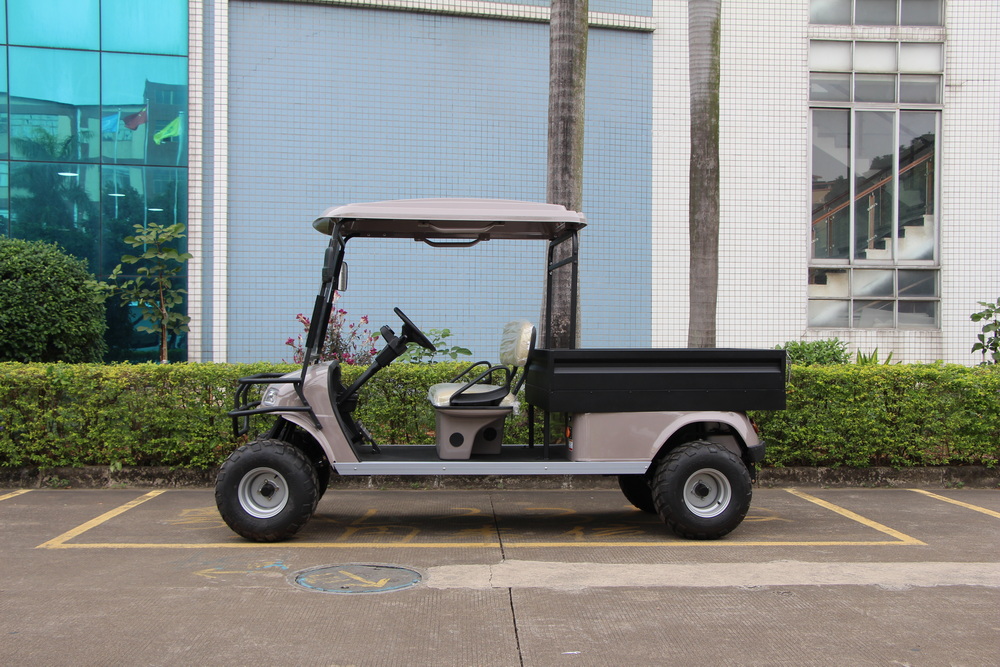
An electric utility cart deserves consideration when operators repeatedly move components, tools, or packaging between nearby stations.
An accessible cargo bed can simplify loading from the side and reduce the need to open doors at every stop. However, that advantage disappears if workers must lift heavy containers onto an unsuitable bed height.
Measure the complete handling task:
- Walking distance between the vehicle and workstation.
- Number of lifts per delivery.
- Loading and unloading time.
- Space needed around the parked vehicle.
- Interference with pedestrians and production equipment.
A compact vehicle is useful only when it makes the overall process easier.
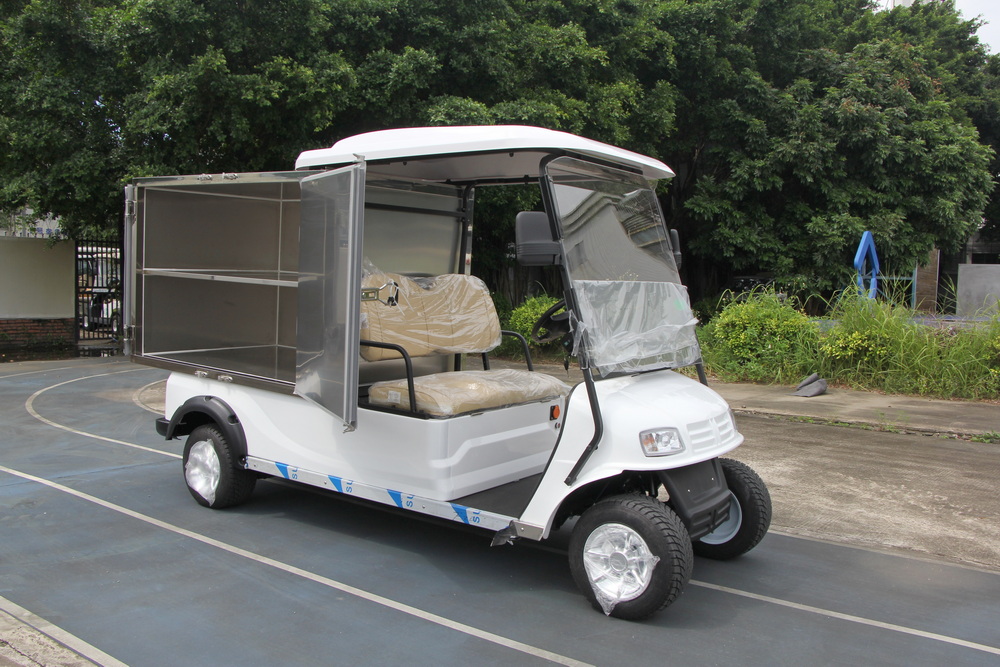
An electric cargo van becomes more attractive when materials travel outdoors, cross a large industrial campus, or move between separate facilities.
Its enclosed body can protect cartons, electrical assemblies, and other sensitive goods from rain and casual access. Nevertheless, an ordinary cargo compartment is not automatically waterproof, temperature-controlled, or suitable for dangerous goods.
For mixed indoor and outdoor routes, check doorway clearance, overhead obstacles, turning space, and loading locations. A van that reaches the destination but blocks the receiving area is still a poor fit.
Payload figures require careful interpretation.
A manufacturer may publish total vehicle carrying capacity, cargo-bed capacity, or a maximum rating available only in a particular configuration. These numbers are not interchangeable.
For example, Club Car describes the Carryall 500 cargo bed as having an 800 lb capacity and more than 14.5 square feet of bed space. Those figures describe one product, not every electric utility cart.
Before comparing quotations, request:
1. Permitted gross vehicle weight.
2. Vehicle weight with the proposed battery and accessories.
3. Available payload under that configuration.
4. Cargo-bed or cargo-floor rating.
5. Axle limits and load-distribution instructions.
Include occupants, shelving, enclosures, and tools when assessing usable carrying capacity.
A load can fall below the weight limit and still be unsuitable.
Record the dimensions of your largest pallet, component rack, or returnable container. Then compare door openings, wheel-arch intrusion, bed dimensions, and loading access.
Also establish how the material will be transferred. A cargo vehicle does not necessarily lift or stack pallets. Forklifts, lift tables, ramps, or other handling equipment may still be needed.
For loose components, specify restraints or containers that prevent movement during braking and cornering.
Turning radius alone does not establish whether a vehicle fits a factory route.
The vehicle's corners, overhangs, and cargo can sweep outside its wheel path. Operators also need clearance from pedestrians, racks, machinery, and door frames.
During a route trial, test:
- The narrowest doorway.
- The tightest corner.
- Reversing into loading positions.
- Ramp transitions.
- Parking without obstructing escape routes.
Use the intended load and record any need for repeated reversing or assistance.
Both vehicle types avoid engine exhaust at the point of operation. That does not remove collision, electrical, charging, or load-stability risks.
For vehicles within the scope of applicable powered-industrial-truck rules, requirements may address operator training, inspections, maintenance, and charging. In the United States, OSHA's powered industrial truck standard covers specified industrial vehicles; applicability must be checked rather than inferred from the word "cart."
Assess visibility, pedestrian separation, speed controls, braking, and warning devices. Ordinary electric vehicles should not be assumed suitable for explosive atmospheres or hazardous process areas.
Advertised range is not a substitute for a factory duty-cycle assessment.
Record daily distance, load, gradients, stops, operating temperature, and accessory use. These conditions influence the energy required to complete a shift.
A vehicle traveling modest distances may still work intensively if it repeatedly accelerates with a heavy load or climbs ramps.
Ask suppliers to demonstrate:
- Shift completion under representative conditions.
- Remaining charge after the busiest route.
- Charging time with the proposed charger.
- Recovery during scheduled breaks.
- Battery warranty conditions.
Include reserve capacity for operational variation rather than planning around the battery's full usable energy every day.
The U.S. Department of Energy's fleet guidance recommends assessing vehicle duty requirements and coordinating charging infrastructure with utilities, vehicle suppliers, and charging-equipment providers.
For a factory, this means confirming electrical capacity, charger locations, connector compatibility, parking arrangements, and charging responsibility.
Battery chemistry also matters. Flooded lead-acid batteries introduce electrolyte and gassing considerations that differ from lithium systems. Follow the battery manufacturer's instructions and applicable local requirements rather than applying one generic charging procedure to every vehicle.
Purchase price is only one part of the comparison.
Evaluate:
- Vehicle and customization costs.
- Freight, duties, and commissioning.
- Charging equipment and electrical installation.
- Energy and maintenance.
- Operator time.
- Replacement batteries and parts.
- Downtime and backup capacity.
- Residual value.
Electric vehicles generally require less maintenance than comparable combustion vehicles, according to Department of Energy guidance. However, that does not prove that a utility cart costs less to maintain than a cargo van. The actual designs and service arrangements matter.
A useful purchasing metric is annual operating cost divided by annual completed deliveries, provided both options meet the same safety and service requirements.
Consider an illustrative scenario—not a BorCart customer case:
| Hypothetical input | Cargo van | Utility cart |
|---|---|---|
| Deliveries per shift | 40 | 40 |
| Average loading and unloading time | 6 minutes | 4 minutes |
| Daily handling time | 240 minutes | 160 minutes |
The cart saves 80 handling minutes per shift under these assumptions. Over 250 shifts, that equals approximately 333 hours.
At an assumed labor rate of $20 per hour, the potential time value is approximately $6,667 annually. This is not guaranteed cash savings. Additional trips, staffing arrangements, congestion, or cargo-protection requirements could offset the benefit.
Imagine a manufacturer moving small parts from a central warehouse to assembly lines while also transferring packaged products between buildings.
An electric utility cart may suit line-side replenishment because operators make frequent stops and need quick access to containers.
An electric cargo van may suit the outdoor transfer because the load benefits from an enclosed compartment.
This hypothetical scenario illustrates an important procurement principle: different routes can justify different vehicles.
Before selecting a mixed fleet, weigh its disadvantages. Separate chargers, spare parts, training procedures, and maintenance arrangements can increase complexity.
Standardize components where practical, but do not force one vehicle into two incompatible tasks merely to simplify purchasing.
Map normal and peak-period movements. Include ramps, crossings, loading zones, restricted areas, and any public-road sections.
Record weight, dimensions, packaging, fragility, center-of-gravity considerations, and loading method.
Use equivalent tasks and appropriately trained operators. Test realistic loads rather than judging an empty demonstration vehicle.
Track:
- Complete delivery-cycle time.
- Handling effort.
- Reversing events.
- Pedestrian conflicts.
- Energy use and remaining charge.
- Cargo damage or movement.
- Operator feedback.
Agree on acceptance requirements before testing.
For example, the vehicle must complete the busiest shift, safely clear every designated route, carry the required load, and recharge within the available window.
This prevents an attractive feature from distracting buyers from a critical operational failure.
For international brand owners, wholesalers, and manufacturers, OEM customization should resolve a defined operating requirement.
An electric cargo van OEM brief may specify:
- Cargo dimensions and door layout.
- Internal shelving and restraint points.
- Floor construction.
- Lighting and access control.
- Climate-related requirements.
- Destination-market approval documentation.
An electric utility cart OEM brief may specify:
- Bed dimensions and loading height.
- Side access or removable panels.
- Weather protection.
- Approved speed settings.
- Tires appropriate to the route.
- Visibility and warning equipment.
Ask which changes affect vehicle weight, payload, stability, braking, or approval status. Customization can alter the original performance envelope.
BorCart manufactures electric vehicles and automotive components and provides OEM services for overseas buyers. For a meaningful technical discussion, share your route map, load profile, operating schedule, destination market, and required order volume.
Request a configuration review and a quotation that clearly distinguishes confirmed capabilities from features requiring engineering validation.
It can be better for compact routes and frequent small-load deliveries. However, dimensions, braking, visibility, operator training, and site rules must support indoor operation. Vehicle type alone does not establish suitability.
Potentially, if the route accommodates its dimensions and the site assessment permits it. Check doorway height, swept path, floor restrictions, pedestrian separation, and loading arrangements before deployment.
Compare exact configurations rather than category names. Request usable payload, cargo-floor or bed ratings, axle limits, and loading instructions. A published maximum may not apply after occupants and accessories are included.
Only where its classification, approval, registration, equipment, and local operating rules permit. A low speed or enclosed body does not establish road legality. Confirm requirements in the destination market before sourcing.
Use the busiest representative shift as the starting point. Account for distance, payload, ramps, temperature, accessories, charging windows, and reserve requirements. Validate the proposed battery through loaded testing.
Provide route drawings, load dimensions and weights, shift schedules, charging conditions, destination-country requirements, customization priorities, and expected quantities. These details support a more accurate proposal than requesting only a vehicle price.
- [Club Car — Carryall 500 Utility Vehicle]. Source for the model-specific cargo-bed capacity, bed area, and available electric configurations. These specifications are not presented as universal utility-cart ratings. [clubcar]
- [OSHA — 29 CFR 1910.178: Powered Industrial Trucks]. Source for the standard's scope and requirements concerning industrial-truck operation, training, maintenance, and battery charging. Applicability depends on the equipment and workplace. [osha]
- [OSHA — Powered Industrial Trucks: Electric Power Sources]. Source for charging-area precautions and electrolyte-related battery hazards. Battery-specific instructions remain necessary. [osha]
- [U.S. Department of Energy, Alternative Fuels Data Center — Electric Vehicles for Fleets]. Source for duty-cycle assessment, charging-infrastructure planning, utility coordination, training considerations, and maintenance comparisons with conventional vehicles. [afdc.energy]
- [U.S. Department of Energy, Alternative Fuels Data Center — Electric Vehicle Charging Stations]. Source for charging-infrastructure procurement, planning, operation, and maintenance considerations. [afdc.energy]


