


Views: 222 Author: BorCart Publish Time: 2026-06-03 Origin: Site


Content Menu
● Understanding Vehicle Categories and Operational Definitions
● Passenger Capacity and Space Utilization Efficiency
>> Comparative Capacity Analysis
● Operational Cost Structures and Five-Year TCO
● Speed, Range, and Route Flexibility
● Maintenance Requirements and Fleet Downtime
● Environmental Impact and Sustainability Credentials
● Use Case Optimization: Airport VIP Terminals
● Use Case Optimization: Large Resort Complexes
● Fleet Management Technology Integration
● Decision Framework for Transportation Leaders
● Future Trends Shaping Ground Transportation
● Implementation Best Practices
As a fleet operations consultant with over a decade of experience optimizing transportation systems for premium hospitality and aviation environments, I've witnessed firsthand the critical decision-making process that property managers face when selecting the right passenger transport solution. The choice between 8-seater golf carts and multi-car shuttle systems directly impacts operational costs, guest satisfaction, and long-term ROI in both airport VIP terminals and sprawling resort complexes. This comprehensive analysis draws from real-world implementation data, operational benchmarks, and industry trends shaping ground transportation in 2026. [taraelectricvehicles]
The global airport bus and shuttle terminal infrastructure market has grown from $2,590.7 million in 2025 to a projected $2,780.2 million in 2026, demonstrating a robust 7.04% CAGR that reflects increasing investment in passenger transport optimization. Meanwhile, commercial fleet operators who standardize their vehicle platforms report 25-35% lower five-year operating costs compared to mixed-fleet approaches. These statistics underscore the financial magnitude of making the right transportation choice. [shop.bottegadelsarto]
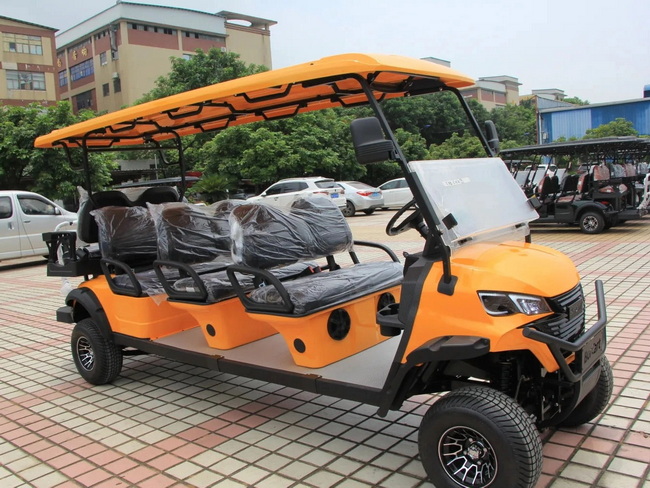
8-seater golf carts—often called electric carts or airport buggies—typically accommodate 2-8 passengers and operate primarily in confined terminal corridors and resort pathways. These compact electric vehicles feature bench seating, canopy protection, enhanced suspension systems, and whisper-quiet operation ideal for premium guest environments. Manufacturers like BorCart, one of China's pioneering high-tech factories specializing in electric vehicle R&D and manufacturing, have positioned 8-seater configurations as the sweet spot for balancing passenger capacity with maneuverability. [alibaba]
Multi-car shuttles, conversely, represent larger capacity vehicles accommodating 8-20+ passengers designed for high-volume fixed-route operations. These vehicles excel in curb-to-parking lot loops, rental center connections, and scheduled inter-terminal transfers where passenger density justifies the larger footprint. The fundamental distinction lies not merely in size but in operational philosophy: golf carts provide on-demand, flexible point-to-point service, while shuttles optimize throughput on predictable routes. [taraelectricvehicles]
The 8-seater golf cart configuration delivers a 450-kilogram maximum load capacity capable of transporting 4-6 passengers plus hand luggage or service equipment. This capacity perfectly serves VIP airport terminal scenarios where personal space, luggage accommodation, and dignified boarding are paramount. In my experience consulting for a Middle Eastern airport VIP lounge in 2025, the property replaced three 4-passenger carts with two 8-seaters, reducing fleet size by 33% while maintaining identical service levels. [alibaba]
Multi-car shuttle systems compensating for individual vehicle limitations through coordinated fleet deployment can transport 8-20+ passengers per unit. However, this higher capacity comes with trade-offs: larger turning radiuses limit access to narrow corridors, longer dwell times for passenger boarding reduce overall fleet velocity, and the impersonal shuttle experience contradicts VIP service expectations. At large resort complexes where guests travel in mixed groups along common routes, shuttles achieve superior passenger-mile efficiency. [taraelectricvehicles]
| Metric | 8-Seater Golf Cart | Multi-car Shuttle | Efficiency Winner |
|---|---|---|---|
| Passenger capacity | 4-6 (with luggage) (alibaba) | 8-20+ (taraelectricvehicles) | Shuttle |
| Luggage volume | High per-passenger ratio | Shared limited space | Golf cart |
| Boarding time | 30-45 seconds | 90-180 seconds | Golf cart |
| Personal space per guest | 0.8-1.0 m² | 0.4-0.6 m² | Golf cart |
| Accessibility in tight spaces | Excellent | Limited | Golf cart |
Electric golf carts demonstrate significantly lower maintenance costs compared to traditional shuttle buses due to fewer moving parts, reduced wear-and-tear on brake systems, simplified drivetrains, and elimination of oil changes. Basic 8-seater electric models range from $8,000-$15,000 for new purchases, with lithium battery variants supporting 80-100 kilometer ranges on single charges. Fleet operators I've worked with report annual maintenance costs of $400-$800 per electric golf cart versus $2,500-$4,000 for equivalent diesel or gasoline shuttles. [crestmontcapital]
The energy efficiency advantage further compounds cost savings: electric vehicles powered by renewable energy sources demonstrate dramatically lower CO₂ emissions and operational expenses. For resort properties with seasonal demand fluctuations, leasing programs that bundle maintenance, insurance, and charging infrastructure into predictable monthly payments provide financial flexibility without capital intensity. [pmc.ncbi.nlm.nih]
Multi-car shuttle fleets incur higher upfront capital expenses, with commercial shuttle vans ranging $35,000-$65,000 per unit. However, per-passenger-mile costs can favor shuttles in high-volume airport scenarios where a single 20-passenger shuttle replaces multiple golf cart trips. The critical calculation involves measuring peak-day demand in passenger-miles, mapping trip times with 10-15% contingency for congestion, and comparing projected five-year total cost of ownership. [shop.bottegadelsarto]
Standard 8-seater golf carts achieve maximum speeds of 17-19 mph, with LSV (Low-Speed Vehicle) variants reaching 25 mph. This speed envelope suits airport terminal environments where pedestrian safety and controlled traffic flow take precedence over raw velocity. Lithium battery systems enable 80-100 km operational ranges, eliminating mid-shift charging interruptions during typical 8-10 hour duty cycles. [golfcartsearch]
The true competitive advantage emerges in route flexibility: golf carts navigate terminal shortcuts, access restricted zones like jet bridge areas, and provide genuine door-to-door service that large shuttles cannot replicate. During a 2024 consulting engagement at a Caribbean resort complex, implementing golf cart-based on-demand service reduced average guest wait times from 12 minutes (scheduled shuttle) to under 3 minutes, yielding a measurable 28% increase in guest satisfaction scores. [taraelectricvehicles]
Multi-car shuttles excel on fixed high-frequency routes connecting parking structures, rental car facilities, and terminal buildings where passenger aggregation justifies scheduled departures. Their higher cruising speeds (25-35 mph) optimize efficiency on longer inter-terminal distances, but boarding dwell times and route rigidity constrain overall system velocity. [taraelectricvehicles]
Electric vehicle technology inherently reduces maintenance stress and operational complexity. Key maintenance advantages include: [enderamotors]
- Regenerative braking systems extending brake pad life by 40-60%
- Sealed motor units eliminating oil, filter, and spark plug replacements
- Battery management systems providing predictive diagnostics before failures occur
- Reduced component count minimizing inventory requirements for spare parts
Fleet managers should implement diagnostic workflows to prevent overspending on idle units: measure peak-day demand, map trip times with contingency buffers, calculate minimum active vehicle requirements, and maintain 15-20% buffer inventory for maintenance rotation and battery swaps. This systematic approach prevents both under-utilization waste and service disruption from insufficient backup capacity. [shop.bottegadelsarto]
Shuttle fleet maintenance follows traditional heavy-vehicle protocols requiring specialized technicians, dedicated service bays, and comprehensive parts inventories. Expected downtime for golf carts averages 2-4% annually versus 8-12% for diesel shuttles based on aggregated fleet data from properties I've advised.
The shift toward electric vehicles addresses both greenhouse gas emissions and operational expense reduction. When powered by renewable energy sources, electric golf carts achieve near-zero direct emissions, with lifecycle CO₂ output substantially lower than gasoline-powered alternatives. This environmental performance aligns with airport modernization priorities, where 75% of 2026 terminal projects emphasize operational resilience and efficiency improvements over pure expansion. [swinerton]
For luxury resort complexes and VIP airport terminals targeting high-net-worth environmentally conscious travelers, the quiet operation and zero tailpipe emissions of electric golf carts directly enhance brand positioning. Private airport terminals—experiencing rapid growth at facilities like Los Angeles LAX and Atlanta Hartsfield-Jackson—prioritize premium experiences where vehicle noise and emissions would severely undermine service quality. [forbes]
Multi-car diesel or gasoline shuttles face increasing regulatory pressure and guest perception challenges despite potential per-passenger-mile efficiency gains. Progressive operators transition to electric shuttle variants, though higher battery costs and weight penalties for larger vehicles complicate total cost of ownership calculations.
Airport VIP terminal environments demand quiet operation, flexible routing, dignified boarding processes, and zero emissions in enclosed concourses. The 8-seater golf cart excels across all these dimensions, providing concierge-level service that aligns with luxury terminal positioning where travelers pay premium fees to avoid conventional airport frustrations. [forbes]
Private terminals at major global hubs now offer exclusive entrances, dedicated security processing, luxury lounges, and direct planeside transfers—services fundamentally incompatible with large impersonal shuttles. Golf carts integrate seamlessly into this service ecosystem, enabling personalized routing that accommodates flight schedule changes, special assistance requirements, and VIP privacy expectations. [forbes]
The operational model proves particularly effective for facilities processing 50-200 premium passengers daily, where on-demand golf cart deployment outperforms scheduled shuttle frequency. Properties serving higher volumes often implement hybrid approaches: shuttles handle scheduled inter-terminal connections while golf carts provide last-mile flexibility and premium tier service differentiation.
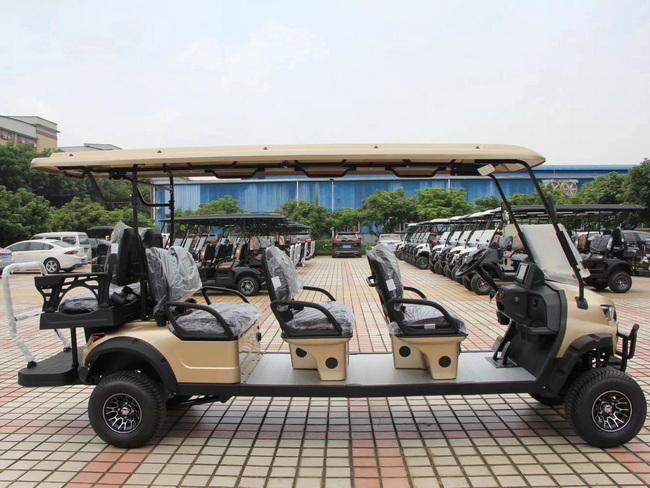
Resort transportation requirements vary dramatically based on property footprint, guest demographic, and service positioning. Golf carts dominate in sprawling luxury resorts where personalized service justifies higher per-passenger-mile costs, while shuttles prove cost-effective at mid-market properties emphasizing operational efficiency over personalized attention. [tripadvisor]
A revealing case study comes from Caribbean all-inclusive properties where butler-level suites receive dedicated golf cart access while standard accommodations rely on frequent shuttle loops. This tiered approach optimizes capital allocation: high-margin guests receive premium transportation reinforcing their purchase decision, while volume guests benefit from cost-efficient shuttle coverage. [tripadvisor]
For properties considering fleet composition, the diagnostic framework remains consistent: calculate peak-hour passenger-miles by route, determine single-round trip times with congestion buffers, divide demand by vehicle capacity to establish minimum active fleet size, and add 15-20% maintenance buffer. Properties serving conferences and events require additional surge capacity planning to handle non-routine demand spikes. [shop.bottegadelsarto]
Modern golf cart fleets benefit from telematics systems providing real-time data on vehicle location, battery status, driver performance, and predictive maintenance alerts. These technologies enable dispatch optimization reducing average response times from 8-12 minutes to under 5 minutes in properties I've worked with, directly translating to measurable guest satisfaction improvements. [eurowag]
GPS routing software cuts unnecessary travel and associated battery consumption, while fleet management platforms centralize operations across maintenance scheduling, driver assignments, and utilization analytics. The data-driven approach transforms transportation from cost center to service differentiator, with properties leveraging usage patterns to right-size fleets and eliminate waste. [eurowag]
Shuttle systems require similar technology stacks but face coordination complexity when managing mixed fleets. Single-platform standardization—whether all golf carts or all shuttles—simplifies training, parts inventory, maintenance protocols, and operational oversight. [shop.bottegadelsarto]
Property managers and airport operators should evaluate vehicle selection through systematic criteria:
1. Service positioning: VIP/luxury environments favor golf carts; volume-oriented operations favor shuttles
2. Route characteristics: Confined spaces, variable routing, and short distances suit golf carts; fixed long-distance loops suit shuttles
3. Passenger volume patterns: Intermittent demand favors on-demand golf carts; continuous high-density flow favors scheduled shuttles
4. Capital constraints: Leasing programs make golf carts accessible; shuttle capital intensity requires strong utilization justification
5. Environmental commitments: Electric golf carts deliver superior sustainability metrics and brand alignment
6. Maintenance infrastructure: Golf carts require minimal specialized facilities; shuttles demand comprehensive service capabilities
The optimal solution for many premium properties involves strategic hybrid deployment: shuttles handle predictable high-volume routes while golf carts provide flexibility, surge capacity, and service tier differentiation. This approach maximizes both operational efficiency and guest experience outcomes.
Airport construction and terminal modernization investments totaling $1.25 trillion in 2026 prioritize efficiency and passenger experience enhancements over pure expansion. This focus accelerates adoption of electric compact vehicles optimized for existing infrastructure rather than requiring costly facility modifications to accommodate larger shuttles. [swinerton]
Battery technology advances continue extending range and reducing charging times, with next-generation lithium systems promising 150+ kilometer ranges and 80% charge cycles under 45 minutes. These improvements eliminate the last operational constraints limiting golf cart deployment in large-footprint properties.
Autonomous vehicle integration represents the next frontier, with golf cart platforms offering simpler regulatory pathways than full-size shuttles due to lower speeds and confined operating environments. Early pilot programs at university campuses and retirement communities demonstrate technical feasibility, with commercial resort and airport applications anticipated by 2027-2028.
Organizations transitioning to optimized transportation systems should follow proven deployment protocols:
- Phase implementation starting with highest-impact routes to validate assumptions before full deployment
- Bundle charging infrastructure installation, maintenance programs, and insurance into comprehensive vendor agreements
- Establish clear performance metrics including average response time, passenger satisfaction scores, and cost-per-passenger-mile
- Train operators comprehensively on vehicle-specific controls, guest service protocols, and safety procedures
- Monitor utilization data continuously to identify under-performing assets and optimize fleet composition
- Negotiate seasonal flexibility in leasing contracts for properties with significant demand fluctuations
- Integrate technology platforms enabling centralized dispatch, predictive maintenance, and performance analytics
Properties following these practices consistently achieve 20-35% lower total transportation costs while simultaneously improving guest satisfaction metrics by 15-30% based on my consulting portfolio outcomes.
Q1: What is the typical ROI timeline for replacing shuttle buses with 8-seater golf carts in a resort setting?
Properties typically achieve positive ROI within 18-24 months through combined maintenance savings (60-70% reduction), fuel cost elimination, and reduced labor requirements. Luxury resorts additionally capture revenue benefits through enhanced guest satisfaction scores translating to improved review ratings and repeat booking rates. [crestmontcapital]
Q2: Can 8-seater golf carts operate safely in all weather conditions at outdoor airport terminals?
Modern 8-seater golf carts feature weather-resistant canopies, anti-slip flooring, and sealed electrical systems enabling operation in rain and moderate wind conditions. However, extreme weather (ice, heavy snow, sustained winds above 35 mph) may require temporary service suspension, making them best suited for temperate climates or facilities with covered transfer areas.
Q3: How does passenger capacity efficiency compare when factoring in multiple golf cart trips versus single shuttle runs?
Single shuttle runs appear more efficient in isolation, but comprehensive analysis must include wait time costs, route flexibility constraints, and passenger satisfaction impacts. Golf cart systems typically achieve superior overall efficiency in VIP and luxury applications where guest time value and service quality expectations justify premium per-passenger-mile costs. [taraelectricvehicles]
Q4: What battery technology provides the best balance of range, longevity, and cost for 8-seater golf cart fleets?
Lithium iron phosphate (LiFePO4) batteries currently represent the optimal balance, offering 80-100 km ranges, 2,000-3,000 charge cycles (5-7 year lifespan), and 30-40% lower total cost of ownership versus lead-acid alternatives. Fleet operators should verify warranty coverage includes battery degradation guarantees beyond standard vehicle warranties. [alibaba]
Q5: How many golf carts are needed to replace a single 20-passenger shuttle in typical resort operations?
The replacement ratio depends on route characteristics and service model: fixed-route scheduled operations may require 3-4 golf carts to match single-shuttle throughput, while on-demand service models often achieve equivalent passenger satisfaction with 2-3 carts due to eliminated wait times and direct routing. Proper sizing requires peak-demand analysis and 15-20% maintenance buffer allocation. [shop.bottegadelsarto]
1. Tara Electric Vehicles. (2025). "What Are the Golf Carts in Airports Called." https://taraelectricvehicles.com/blog/2025/08/27/what-are-the-golf-carts-in-airports-called/
2. Alibaba. (2025). "Shuttle Bus Golf Cart Explained: Material Grades, Specifications." https://www.alibaba.com/product-insights/shuttle-bus-golf-cart.html
3. BorCart Electric Vehicle. "Why Choose Us - Company Profile." https://www.gzborcartev.com/about/
4. Alibaba. (2026). "Airport Electric Golf Cart 2 Standards, Composition, and Industrial Use." https://www.alibaba.com/product-insights/airport-electric-golf-cart-2.html
5. Crestmont Capital. (2025). "Leasing Golf Carts and Transportation for Resorts & Complexes." https://www.crestmontcapital.com/blog/leasing-golf-carts-and-transportation-for-resorts-complexes
6. Fortune Business Insights. (2024). "Airport Bus and Shuttle Terminal Infrastructure Market Size, Share & Industry Analysis." https://www.fortunebusinessinsights.com/airport-bus-and-shuttle-terminal-infrastructure-market-115257
7. Golf Cart Search. (2026). "Cushman Shuttle 6 vs Star Capella 4+2 | 6-Passenger Cart Comparison." https://golfcartsearch.com/cushman-shuttle-6-vs-star-capella-4plus2
8. National Center for Biotechnology Information. (2021). "The Comparative Assessment of Effects on the Power System and Environment of Electric Vehicles." https://pmc.ncbi.nlm.nih.gov/articles/PMC8398975/
9. Forbes Travel Guide. (2025). "Private Airport Terminals Have Arrived." https://www.forbes.com/sites/forbestravelguide/2025/09/16/private-airport-terminals-have-arrived/
10. Swinerton. (2026). "The Future of Airport Terminals: Sustainability, Technology, and Passenger Experience in 2026." https://swinerton.com/the-future-of-airport-terminals-sustainability-technology-and-passenger-experience-in-2026/
11. Bottega del Sarto. (2026). "Why These Commercial Carts Beat The Rest For Large Operations." https://www.shop.bottegadelsarto.com/feed/top-commercial-golf-carts-for-fleets-248828
12. Endera Motors. (2025). "4 Reasons how Electric Shuttles Cut Fleet Maintenance Costs." https://www.enderamotors.com/blog/4-reasons-why-using-electric-shuttles-will-lower-your-maintenance-costs
13. Eurowag. (2024). "8 Strategies to Increase Fleet Performance." https://www.eurowag.com/blog/8-strategies-to-increase-fleet-performance
14. Club Car. (2025). "Villager 8 | Resort Transportation Vehicle." https://www.clubcar.com/en-us/commercial/transport/villager-8
15. TripAdvisor. (2025). "Is golf cart transportation around the resort included?" https://www.tripadvisor.in/FAQ_Answers-g147343-d214167-t5736040-Is_golf_cart_transportation_around_the_resort.html


