


Views: 238 Author: BorCart Publish Time: 2026-09-17 Origin: Site


Content Menu
● Why Passenger Capacity Matters in Gated Communities
● 4-Passenger vs 6-Passenger Personal Cart at a Glance
● When a 4-Passenger Personal Cart Is the Better Choice
>> Everyday Convenience for Small Families
>> More Efficient for Short-Distance Use
● When a 6-Passenger Personal Cart Makes More Sense
>> Better for Larger and Multigenerational Households
>> Consider the Full-Load Reality
● Size, Turning Radius, and Road Design
● Safety Features That Matter More Than Seat Count
● How to Choose the Right Passenger Capacity
>> 1. Count Regular Riders, Not Occasional Riders
>> 2. Measure Your Storage Area
>> 3. Review Community Regulations
>> 4. Match the Battery to Daily Demand
● Customization Options for Residential Cart Brands
● Final Recommendation: Which Personal Cart Should You Buy?
>> Is a 4-passenger golf cart large enough for a family?
>> Is a 6-passenger personal cart harder to drive?
>> Does a 6-passenger golf cart use more battery power?
>> Should I choose lithium batteries for a gated community cart?
>> Can a personal golf cart be used at night in a gated community?
>> What should I measure before buying a 6-passenger cart?
>> Can an OEM supplier customize personal carts for my brand?
For residents, property developers, and community fleet buyers, choosing between a 4-passenger personal cart and a 6-passenger personal cart is not simply a question of how many seats are available. The right electric personal transportation vehicle must fit the real travel habits, road width, garage space, family size, terrain, charging routine, and safety expectations of gated community living.
A 4-passenger golf cart is often the practical choice for couples, small families, and everyday neighborhood travel. A 6-passenger golf cart can be a better fit for larger households, multigenerational families, hospitality-oriented communities, and residents who frequently transport guests. However, the larger cart is not always the better cart. In private communities, the best personal cart is the one that delivers comfortable daily mobility without becoming difficult to park, turn, charge, or operate.
For overseas brands, wholesalers, and vehicle distributors, this comparison also provides useful guidance when developing an electric golf cart product range for residential buyers. At BorCart, we work with OEM customers who need adaptable electric vehicles for different markets, including gated communities, resorts, private estates, retirement communities, and mixed-use residential developments.

A gated community creates a different operating environment from a golf course or public road. Residents may use electric carts for short trips to the clubhouse, pool, mailbox area, grocery pickup point, marina, restaurant, fitness center, or neighbor's home. Some communities also use personal carts for school drop-offs, pet walks, evening rides, and mobility support for older family members.
That means a cart should be evaluated based on daily usability, not only seating capacity.
A 4-passenger personal cart generally offers a compact balance between passenger room and maneuverability. It is often easier to store in a home garage, navigate through narrow internal roads, and park near community facilities.
A 6-passenger personal cart provides more seating flexibility. It can reduce the need for multiple trips when carrying children, grandparents, visitors, or neighbors. Yet its longer body can create challenges in tight parking areas, compact garages, and communities with narrow turns.
Before deciding, buyers should ask a simple question:
> How many people will ride in the cart during a normal week—not only during special occasions?
This practical approach prevents overbuying a vehicle that is larger than necessary or underbuying one that cannot serve the household's regular transportation needs.
The following comparison shows how each option typically performs in a residential environment.
| Buying Factor | 4-Passenger Personal Cart | 6-Passenger Personal Cart |
|---|---|---|
| Best for | Couples, small families, daily errands | Large families, guests, group travel |
| Typical seating layout | Two forward-facing seats and two rear-facing seats | Multiple rows for larger passenger groups |
| Overall vehicle length | More compact | Longer body and larger footprint |
| Garage storage | Easier for many residential garages | May require a deeper garage or dedicated parking bay |
| Turning and parking | Usually easier in narrow areas | Requires more space for turns and parking |
| Passenger flexibility | Suitable for most routine trips | Better for multigenerational households |
| Energy use | Usually lower due to lighter weight | May be higher, especially when fully loaded |
| Purchase investment | Often lower | Usually higher due to larger chassis and seating |
| Community shuttle use | Limited for group movement | Better for guest transport and group trips |
| Ideal buyer profile | Everyday residential owner | Family-focused or hospitality-focused owner |
The key difference is not that one vehicle is universally superior. The difference is that each cart solves a different mobility problem.
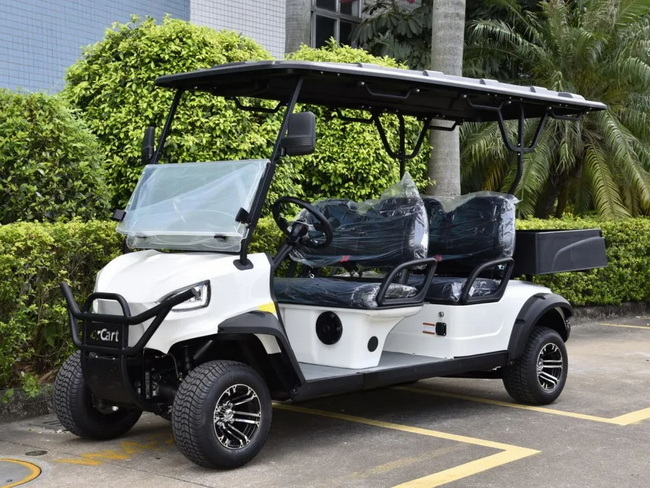
A 4-passenger golf cart for gated community living is typically the most versatile configuration for private residential use. It provides enough seats for a household while remaining compact enough for practical daily driving.
BorCart's published specifications for one 4-seat electric cart configuration show an overall length of approximately 3,265 mm, a width of 1,340 mm, and a minimum turning radius of 3.3 m. These dimensions illustrate why a four-seat vehicle can be easier to manage in residential garages and on narrower internal streets.
A four-seat cart is often ideal for:
- Couples who want neighborhood transportation.
- Parents traveling with one or two children.
- Retirees who need low-speed local mobility.
- Residents making short trips to community amenities.
- Homeowners who want a compact alternative to using a full-size car.
- Buyers with limited garage or driveway space.
For example, a family of four can use a 4-passenger personal cart for a ride to the pool, clubhouse, tennis court, or nearby community store. For this type of routine trip, a larger vehicle may not add meaningful value.
In many gated communities, storage is one of the most overlooked purchasing factors. Buyers may focus on color, battery type, or seating layout but forget to measure the garage.
A 4-passenger cart is usually easier to position beside bicycles, storage cabinets, lawn equipment, or a passenger vehicle. It can also be more convenient when a homeowner needs to reverse into a narrow parking bay or make a tight turn near a gate or driveway.
Before purchasing, measure:
1. Garage depth, including shelves and wall-mounted equipment.
2. Garage door opening width.
3. Turning space from the driveway into the garage.
4. Available charging location.
5. Clearance around the vehicle for passenger entry and maintenance.
A cart that fits comfortably is more likely to be used frequently. A cart that barely fits may become inconvenient, even if it offers more seating.
A smaller personal cart often carries less vehicle weight than a longer six-seat model. In practical use, this can support more efficient energy consumption, especially when the vehicle is operated by one or two people most of the time.
The battery system still matters greatly. A properly specified lithium battery package can be particularly useful for frequent residential use because it can support consistent performance, reduced maintenance requirements, and convenient charging routines. The appropriate battery capacity should match the expected daily route, terrain, passenger load, and accessory use.
A useful planning rule is to select a battery system that can cover the expected daily travel distance with an additional operating margin. BorCart recommends allowing at least a 20% range buffer beyond average daily travel needs.
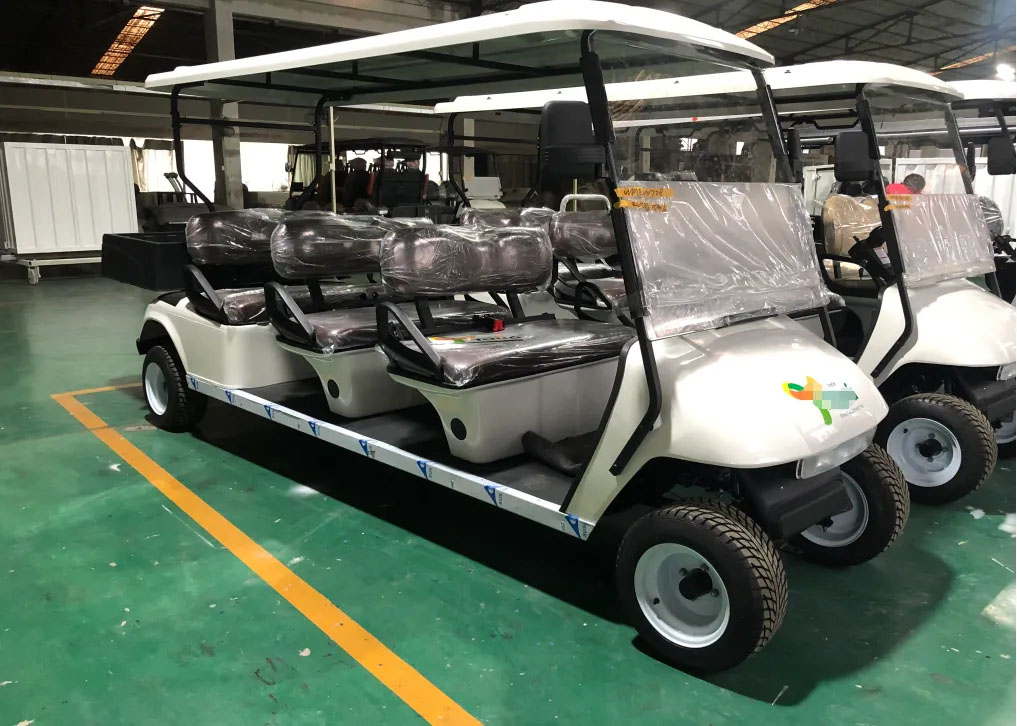
A 6-passenger golf cart is designed for buyers who regularly need more seats. It is especially valuable when transporting larger families, multiple children, visitors, or elderly relatives.
For buyers who truly need the capacity, choosing a six-seat configuration can be more convenient and safer than repeatedly overloading a smaller cart.
BorCart's listed six-passenger electric cart configurations measure approximately 3,695 mm in length and 1,340 mm in width. This indicates that the six-seat model may be around 430 mm longer than a comparable four-seat design, making pre-purchase space planning essential.
A six-passenger personal cart can be a strong choice for:
- Families with three or more children.
- Homes where grandparents often travel with the family.
- Residents who frequently host visitors.
- Vacation properties shared by multiple family members.
- Luxury communities where social trips are common.
- Buyers who want to transport guests to nearby amenities.
- Community operators providing resident shuttle services.
In a retirement community, for instance, a six-passenger electric cart may allow a couple to travel with visiting adult children and grandchildren in a single vehicle. In a resort-style residential community, it can help homeowners carry guests between villas, recreation areas, and waterfront facilities.
The biggest advantage of a 6-passenger golf cart is simple: it can move more people in one trip.
This benefit can matter in communities where parking is limited or where common amenities are located away from residential homes. Instead of sending one group ahead and returning for another, the household can travel together.
It can also be valuable for community management teams. A six-seat cart can support:
- Guest transportation.
- Property tours.
- Security patrol support.
- Maintenance staff movement.
- Event transportation.
- Mobility assistance for residents.
For OEM buyers, this creates an opportunity to develop a residential cart line that serves both individual homeowners and property-management fleets.
A six-seat cart should be assessed based on how it performs when all seats are occupied. More passengers mean more total load, which can affect acceleration, hill climbing, braking distance, tire wear, suspension response, and energy consumption.
That does not mean six-seat vehicles are unsuitable for hilly communities. It means the motor, controller, braking system, suspension, battery pack, and tire selection should be specified for the actual environment.
A buyer should provide the manufacturer or distributor with the following details:
- Maximum expected passenger count.
- Average rider weight range.
- Road slope and hill frequency.
- Typical daily travel distance.
- Surface condition, including pavement, gravel, or uneven paths.
- Local weather conditions.
- Required speed range.
- Lighting and visibility requirements.
A well-configured six-passenger cart can perform reliably in demanding residential environments. The important point is to avoid selecting a larger vehicle only based on seat count.
Vehicle size changes the driving experience in a gated community. Residents often encounter tight bends, roundabouts, narrow paths, shared parking areas, landscaping borders, speed humps, and busy clubhouse entrances.
A longer cart needs more room to turn. It may also require more attention when reversing, parking, or passing other low-speed vehicles.
Before selecting between a 4-passenger and 6-passenger personal cart, map the routes the vehicle will actually use.
Walk or drive through the community and evaluate:
- Narrowest internal road section.
- Tightest corner or roundabout.
- Garage access route.
- Clubhouse parking area.
- Charging location.
- Sloped roads and ramps.
- Areas with pedestrian traffic.
- Gate-entry width.
- Storage space at the home.
This simple route test produces better decisions than comparing vehicle photos online.
A four-seat cart is usually the safer choice if the community has compact streets and limited parking. A six-seat model is more suitable when roads are wider, garages are deeper, and group transportation is a regular need.
Whether choosing a 4-passenger or 6-passenger electric golf cart, safety should remain a central purchasing priority. Residential carts are often operated near pedestrians, children, pets, cyclists, parked vehicles, and property entrances.
Important safety features may include:
- Seat belts for every designated seating position.
- Rear-view mirrors and side mirrors for improved awareness.
- LED headlights for evening visibility.
- Turn signals for communities with shared traffic routes.
- Brake lights and horn systems.
- Stable suspension suited to passenger loading.
- Appropriate tires for paved or mixed surfaces.
- Weather-resistant seating materials.
- Speed settings matched to community rules.
- High-quality braking components.
- Clear passenger handholds where applicable.
Lighting is particularly important in communities where residents use carts after sunset. BorCart's six-passenger model information describes LED front lighting with functions such as low beam, high beam, turn signals, daytime running lights, and position lights.
However, buyers should verify the exact configuration for the destination market. Equipment requirements and permitted operating conditions differ by country, region, residential development, and local authority.
The best buying decision comes from matching the cart to daily travel patterns. Use this five-step process before confirming the order.
Start with the people who will use the cart every week.
If the typical trip includes two adults and one child, a 4-passenger personal cart is likely sufficient. If the household regularly includes four adults, several children, or visiting relatives, a 6-passenger cart may be more practical.
Do not rely only on the published vehicle dimensions. Measure the real usable space inside the garage, including charging equipment, wall storage, and the turning angle required to enter.
Allow clearance for doors, passengers, maintenance access, and battery charging.
Some gated communities have rules covering:
- Maximum vehicle size.
- Approved routes.
- Passenger limits.
- Lighting requirements.
- Driver age restrictions.
- Speed limits.
- Registration or insurance.
- Night-driving conditions.
- Parking locations.
Check these requirements before placing an order. A cart that is technically suitable may still need certain accessories or compliance features for community approval.
Battery selection should account for passenger capacity. A six-passenger cart carrying a full load on hilly roads will need more energy than a four-seat cart used by two people on flat pavement.
Consider the distance traveled per day, the number of stops, hill grades, passenger loads, and additional accessories such as lights, fans, sound systems, or refrigerator boxes.
A personal cart can remain in service for years. Consider whether household needs may change.
A young family may need more seats as children grow. A homeowner may later use the cart for guests, community events, or elderly family members. Conversely, buyers who prioritize compact storage and daily simplicity may find that a four-seat vehicle remains the best long-term choice.
For distributors and private-label buyers, a 4-passenger vs 6-passenger personal cart range should not stop at seating capacity. Differentiation can be created through thoughtful configuration choices.
Popular OEM customization opportunities include:
- Custom body colors and two-tone finishes.
- Brand logos and private-label badging.
- Premium seats and stitched upholstery.
- Rear-facing or forward-facing seating layouts.
- Golf bag holders or utility storage.
- Cooler boxes and cup holders.
- Roof-mounted lighting.
- Audio systems and Bluetooth connectivity.
- Upgraded wheels and tires.
- Lithium battery packages.
- Weather enclosures and rain covers.
- Street-oriented lighting packages.
- Fleet tracking or access-control compatibility.
A well-designed product range can include a compact 4-passenger cart for everyday residential mobility and a premium 6-passenger model for families, hospitality buyers, and community operators.
BorCart manufactures electric golf carts and related electric vehicles for international buyers and offers OEM-oriented solutions for different seating, branding, and market requirements.
Choose a 4-passenger personal cart if your priority is easy parking, compact storage, lower operating demand, and comfortable transport for up to four people. It is usually the strongest all-around option for couples, smaller households, retirees, and daily gated community travel.
Choose a 6-passenger personal cart if you regularly carry larger groups, have sufficient garage and road space, or want a vehicle that supports family gatherings, visitors, resort-style living, or property transportation needs.
The best choice is based on real operating conditions. Measure the garage. Review community rules. Test the route. Estimate passenger demand. Then specify the battery, safety equipment, and accessories around the way the cart will be used.
For brands, wholesalers, and vehicle distributors building a residential electric vehicle portfolio, BorCart can support customized 4-passenger and 6-passenger personal cart development with OEM branding, seating options, battery solutions, and market-focused configurations. Contact BorCart to discuss your target market, technical requirements, and private-label electric cart project.
Yes. A 4-passenger golf cart is suitable for many families, especially households with two adults and one or two children. It is also a practical choice for short neighborhood trips, community amenities, and daily errands.
A 6-passenger personal cart is not necessarily difficult to drive, but its longer body requires more space for turning, reversing, and parking. Drivers should pay particular attention in narrow roads, compact garages, and crowded community areas.
In many cases, yes. A six-seat cart may use more energy because it is larger and can carry more passengers. Actual energy consumption depends on vehicle weight, battery capacity, terrain, speed, passenger load, and driving habits.
Lithium batteries can be a suitable option for frequent residential use because they can support reliable performance and convenient charging. The correct battery capacity should be selected according to daily travel distance, passenger load, terrain, and accessory demand.
It depends on local rules and community regulations. If night use is permitted, the cart should have appropriate headlights, tail lights, brake lights, reflectors, mirrors, and other required safety features.
Measure garage depth, garage door width, driveway clearance, turning areas, charging access, parking spaces, and the narrowest roads in the community. Also consider whether the cart can safely navigate slopes and speed humps.
Yes. OEM manufacturers can typically support private-label branding, custom colors, seating materials, battery systems, accessories, lighting packages, wheels, storage options, and configurations tailored to regional customer needs.
1. BorCart. "[Wholesale Golf Carts, China Golf Carts Manufacturer & Supplier]."
2. BorCart. "[How to Choose the Right Electric Golf Cart in 2026: Expert OEM Guide]."
3. BorCart. "[China New 4 Wheel 4 Seater Golf Carts Electric Club Car]."
4. BorCart. "[China Factory Customized OEM 5KW ET 6 Passengers AC Motor Golf Cart 6 Seater]."
5. Guangzhou Borcart Electric Vehicle Co., Ltd. "[Company Profile and Electric Golf Cart Product Range]."


