


Views: 222 Author: BorCart Publish Time: 2026-06-11 Origin: Site


Content Menu
● Understand Your Use Case Before Comparing Specs
● Battery Type and Capacity – The Heart of Your Golf Cart
>> Lead-Acid vs Lithium: Which Is Right for You?
>> Voltage, Amp-Hours, and Real-World Range
● Range per Charge and Charging Strategy
>> Match Range to Daily Operation Patterns
>> Charging Options, Time, and Fleet Management
● Seating, Capacity, and Use Scenarios
>> Choosing the Right Seating Layout
>> Seating Comfort and Ergonomics
● Suspension, Tires, and Terrain Compatibility
>> Suspension Systems for Different Environments
● Safety Features and Street-Legal Requirements
>> Street-Legal Considerations (Low-Speed Vehicles)
● Customization, Branding, and OEM Options
>> Functional vs Cosmetic Upgrades
>> OEM Branding Opportunities with BorCart
● Warranty, After-Sales Support, and Total Cost of Ownership
>> Warranty Terms That Really Matter
>> Looking Beyond Purchase Price
● Updated Market Context – Why Electric Golf Carts Are Booming
● Practical Checklist – How to Specify the Right Electric Golf Cart
● Sample Feature Comparison Table for Buyers
● Why Work with a Specialized Chinese OEM Like BorCart
● Call to Action – Discuss Your Golf Cart OEM Project with BorCart
● FAQs: Electric Golf Carts and OEM Sourcing
Choosing the right electric golf cart in 2026 is no longer just a "golf course decision" – it's a strategic vehicle choice for resorts, gated communities, campuses, and industrial parks, and the wrong decision can quietly cost you thousands in downtime and maintenance. As a China-based OEM manufacturer at BorCart, working daily with brands, wholesalers, and fleet operators worldwide, I'll walk you through this choice from both a practical user and industry expert perspective so you can specify the right electric golf cart – and build a product lineup that actually sells. [gminsights]
The global golf cart and low-speed vehicle market has been growing steadily, driven by residential communities, tourism destinations, and smart campuses, not just golf courses. For overseas buyers, brand owners, and fleet managers, this means you must look beyond basic specs and focus on battery technology, real-world range, terrain, safety, and total cost of ownership over 5–10 years. [zenbrief]
Before you look at voltage, seating, or motor power, clarify where and how the cart will be used. This single step eliminates most bad purchase decisions. [developers.google]
- Primary environment: Golf course, resort, gated community, industrial park, factory, or port
- Typical daily distance: Short-shuttle (5–10 km), medium (10–30 km), or long-route (>30 km)
- Terrain: Flat, hilly, mixed off-road, or paved roads
- Use intensity: Occasional leisure vs. all-day commercial operation
For example, a 2-seater lead-acid cart might be fine for a small course, but a resort or industrial client running 10–12 hours per day will usually regret not investing in a lithium pack with extended range and faster charging. [zenbrief]
Most buyers today compare lead-acid and lithium batteries first – and for good reason.
- Lead-acid batteries
- Lower upfront cost
- Heavier, require regular maintenance (watering, cleaning terminals)
- Shorter cycle life and longer charging time
- Lithium batteries
- Higher initial cost but longer life cycle and higher energy efficiency
- Faster charging, lighter weight, and almost no daily maintenance
- More consistent power delivery, even at low state of charge
From an OEM perspective, fleets that operate daily (hotels, resorts, factories, rental fleets) nearly always achieve lower total cost over 3–5 years with lithium, even when the initial price is higher. [ecarstrade]
Expert tip: If your budget allows, choosing lithium from the start is usually the best long-term decision, rather than retrofitting later, which often requires controller and charger upgrades.
Battery voltage (48 V, 72 V, etc.) largely determines available power, while amp-hours (Ah) measure how long the cart can run.
- Higher voltage = better hill-climbing and acceleration
- Higher Ah = longer driving range per charge
For most modern electric golf carts, a realistic range is 15–25 miles (24–40 km) per charge under normal conditions. Heavy loads, steep hills, and aggressive driving can reduce this figure.
Industry recommendation: Choose a battery pack that covers your average daily route plus at least 20% safety margin to avoid range anxiety and unexpected downtime. [zenbrief]
Range is one of the most important real-world performance indicators for golf carts used in resorts, residential communities, and campuses.
Ask yourself:
- How many kilometers or miles will the cart typically run per day?
- Is there mid-day charging available, or only overnight?
- Will the cart carry heavy loads (passengers + cargo)?
If your carts are used for full-day operations in large facilities, consider extended-range lithium packs and potentially a fleet charging schedule to keep operations smooth. [waypostmarketing]
Modern electric golf carts can be equipped with:
- Onboard chargers – convenient, just plug into a standard outlet
- External chargers – often used in centralized fleet depots
- Standard vs. fast charging – faster turnaround with lithium-compatible fast chargers
Smart chargers help protect battery health and reduce downtime by automatically adjusting charging current and stopping when the pack is full. For fleets, planning a simple charging timetable (e.g., overnight full charge + midday top-up) keeps vehicles ready without over-stressing batteries. [youtube]
OEM insight: When specifying OEM carts, align the charger type and plug standard with your local regulations and infrastructure to avoid compatibility issues after delivery. [developers.google]
Electric golf carts now serve many roles beyond the course, so seating configuration is a key decision.
- 2-seater: Classic golf use, small resorts, personal mobility
- 4-seater: Families in gated communities, hotel guests, villa transport
- 6-seater or more: Resorts, campuses, tourist attractions, shuttle services
If you anticipate future growth in visitors or residents, it's more cost-effective to start with a higher-capacity model than to face an expensive upgrade later. [zenbrief]
User feedback shows that seat comfort directly affects satisfaction, especially in hospitality and tourism applications. [lithium-battery-factory]
Consider:
- Bench vs. bucket seats
- Cushion thickness and material
- Easy access for elderly passengers or guests carrying luggage
From a branding perspective, comfortable, well-designed seating helps overseas brands differentiate their carts in competitive markets.
Ride comfort is determined by suspension design, frame structure, and tire choice.
- Independent suspension: Better comfort and stability, ideal for uneven terrain, resorts, and off-course applications
- Solid axle: Simpler and usually more cost-effective, suitable for flatter environments
For industrial sites and hilly resorts, I often recommend enhanced suspension combined with correct tire selection to reduce vibration and protect both passengers and vehicle components. [ecarstrade]
Tires must match the primary driving surface.
- Turf tires: Gentle on golf course grass, limited off-road traction
- All-terrain tires: Good for mixed surfaces, resorts, and communities with some off-road paths
- Street-legal tires: Required for low-speed vehicles on public roads in many regions
If you plan to certify the carts as street-legal low-speed vehicles (LSVs), you must ensure the tire type and specifications meet local regulations. [developers.google]
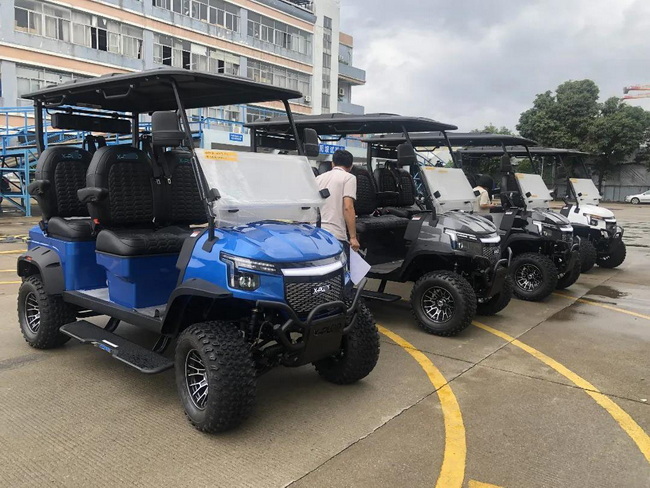
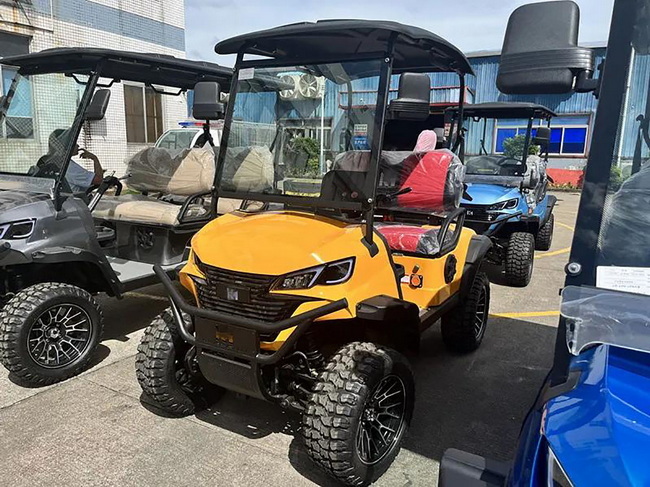
Safety is not only about compliance; it is a key trust factor for end users and fleet operators. Important safety features include: [publisherdesk]
- Seat belts for all passenger positions
- LED headlights, tail lights, and brake lights
- Turn signals and rearview mirrors
- Horn and reflectors
These features are especially critical if your carts are used at night, on mixed-traffic roads, or in busy public areas like resorts and campuses.
In many markets, some electric golf carts can be upgraded or reclassified as street-legal low-speed vehicles, but they must meet specific local regulations on lighting, mirrors, speed limits, and sometimes crash standards. [developers.google]
Before ordering OEM units, clarify:
- Target countries and regions
- Whether the cart will be used on public roads
- Any certification or homologation requirements
This ensures the manufacturer can design the correct lighting, signaling, and braking configuration from the factory.
Customization is one of the main reasons brands and wholesalers choose OEM partners in China. To keep costs under control, differentiate between functional and cosmetic upgrades: [waypostmarketing]
- Functional upgrades
- Lift kits for off-road or uneven terrain
- Weather enclosures, windshields, and wipers
- Utility cargo beds and racks
- Enhanced brakes or suspension for heavy-duty use
- Cosmetic upgrades
- Custom colors and decals
- Seat stitching, interior trim
- Sound systems, lighting accents
From an OEM standpoint, it usually makes sense to prioritize safety and performance upgrades first, then add cosmetic options to fit your brand identity and target market.
As a Chinese manufacturer specializing in golf carts and electric vehicles, BorCart can support overseas brands with:
- Private-label designs and logo placement
- Custom body molds and color systems
- Tailored battery, motor, and controller configurations for different markets
- Component-level OEM for frames, axles, suspension, and body panels
By aligning technical specifications with your market research and customer feedback, you can launch a differentiated product line without investing in your own production facilities. [fasthippomedia]
For fleets and distributors, warranty is not just a marketing line; it is a risk management tool. [publisherdesk]
Evaluate:
- Length of warranty for chassis, electrical system, and battery
- Availability of local service partners or training for your technicians
- Access to spare parts and technical documentation
A transparent, clearly defined warranty signals that the manufacturer is confident in its quality and ready to support you long-term. [iodigital]
While many buyers focus on upfront cost, smart buyers analyze total cost of ownership (TCO) for at least 5–10 years. [zenbrief]
Key cost drivers:
- Battery replacement cycles (much less frequent with lithium)
- Preventive maintenance and spare parts
- Energy consumption and charging infrastructure
- Downtime from breakdowns or insufficient range
In many cases, a slightly higher initial investment in lithium batteries, better suspension, and high-quality components reduces total cost and improves resale value. [ecarstrade]
Recent industry data shows the global golf cart market reached about 2.3 billion USD in 2025, with expected compound growth of around 7.4% annually from 2026 to 2035, driven by residential communities and smart-town projects. This expansion is also fueled by tourism, universities, industrial parks, and aging populations needing short-range, low-speed transport. [gminsights]
For overseas brands and distributors, this means the opportunity is shifting from single-purpose golf carts to multi-purpose low-speed electric vehicles – and your product specs must reflect this broader, more demanding use. [lithium-battery-factory]
Use this step-by-step checklist when talking to your supplier or OEM partner:
1. Define use case clearly
- Environment, daily distance, terrain, and load.
2. Choose battery system
- Lead-acid for low-budget, low-usage scenarios; lithium for intensive or commercial use.
3. Set range requirement
- Daily mileage plus 20% buffer, considering hills and load.
4. Select seating and layout
- 2, 4, 6+ seats; passenger vs cargo utility.
5. Specify terrain package
- Suspension type, tire category, and ground clearance.
6. Confirm safety and compliance
- Seat belts, lights, mirrors, horn, and any street-legal requirements.
7. Define customization and branding
- Colors, logos, accessories, and market-specific features.
8. Agree on warranty and support
- Clear terms for parts, battery, and after-sales training.
Sharing this checklist with your OEM partner helps them propose a configuration that matches both your budget and your customers' expectations. [iodigital]
This simple table can help customers compare configurations:
| Feature | Entry-Level Cart (Lead-Acid) | Premium Cart (Lithium) |
|---|---|---|
| Battery type | Lead-acid, lower upfront cost | Lithium, higher efficiency and lifespan |
| Typical range per charge | 15–20 miles under light load | 25–40 miles with faster charging |
| Charging time | Longer, standard charger | Shorter, smart/fast charger (youtube) |
| Seating capacity | 2–4 passengers | 4–6 passengers or custom layouts |
| Suspension & comfort | Basic suspension for flat terrain | Enhanced suspension for mixed terrain |
| Terrain and tires | Turf or basic street tires | All-terrain or street-legal tires |
| Safety features | Basic lights, optional seat belts | Full LED package, belts, mirrors, signals |
| Customization | Limited accessories | Extensive OEM customization (waypostmarketing) |
| Warranty & support | Shorter warranty, basic support | Extended warranty, structured support |
| Best for | Personal use, small courses | Resorts, fleets, industrial and community use |
Partnering with an experienced golf cart and EV OEM in China gives you much more than a catalog of standard models. You gain:
- Engineering input on battery, motor, and chassis selection for your market
- Flexible MOQs and configurations for distributors and niche segments
- Integrated parts supply for after-sales, including body panels, controllers, and axles
- A production partner that can adapt to emerging regulations and trends in your target countries
As a manufacturer focused on electric golf carts and automotive components, BorCart supports brand owners, wholesalers, and producers with end-to-end OEM services, from prototype samples to container-level shipments. [fasthippomedia]
If you are a brand owner, wholesaler, or vehicle producer planning your next electric golf cart line, now is the ideal time to lock in a specification that fits the 2026–2030 market.
Share your use scenarios, target markets, and positioning with BorCart, and we can help you design a battery, chassis, and feature package that balances cost, performance, and long-term value for your customers. Whether you need standard golf carts or customized low-speed vehicles for communities, resorts, or industrial sites, our engineering and OEM team is ready to support your project from concept to shipment. [ecarstrade]
1. What is the most important feature when choosing an electric golf cart?
For most commercial and community buyers, battery system and real-world range are the top priorities, because they directly influence uptime, operating cost, and user satisfaction. [zenbrief]
2. Can I upgrade from lead-acid to lithium later?
Yes, many carts can be upgraded from lead-acid to lithium, but it can require changing the charger, controller settings, and sometimes wiring, which makes it more expensive than choosing lithium from the beginning. [ecarstrade]
3. Are all electric golf carts street-legal?
No, standard golf carts are often not street-legal by default. To operate on public roads, they usually must be configured as low-speed vehicles with the required lights, mirrors, signals, speed control, and other safety features, according to local laws. [developers.google]
4. How long does an electric golf cart typically last?
With proper maintenance, a quality electric golf cart can last 10 years or more, especially when equipped with a high-quality lithium battery pack and maintained on a regular schedule. [gminsights]
5. Why choose a Chinese OEM like BorCart instead of buying finished carts from a local dealer?
Working directly with a specialized OEM allows you to control specifications, branding, and cost structure, create differentiated models for your market, and secure a steady supply of parts and technical support tailored to your business, rather than relying solely on generic dealer offerings. [waypostmarketing]
1. Tigon Golf Carts – *Features to Consider to Pick the Right Electric Golf Cart* (original article content used as baseline structure and ideas). [https://tigongolfcarts.com/features-to-consider-to-pick-the-right-electric-golf-cart/]
2. Google Search Central – *Creating Helpful, Reliable, People-First Content*. [https://developers.google.com/search/docs/fundamentals/creating-helpful-content]
3. Zenbrief – *Why long-form content matters for SEO, and how to do it right*. [https://zenbrief.com/blog/why-long-form-content-seo/]
4. GM Insights – *Golf Cart Market Size, Share & Growth Report 2035*. [https://www.gminsights.com/zh/industry-analysis/golf-cart-market]
5. Waypost Marketing – *Garrett's Golf Cars Case Study*. [https://www.waypostmarketing.com/our-work/garretts-golf-cars-case-study/]
6. iO Digital – *Google E-E-A-T: creating content that puts people first*. [https://www.iodigital.com/en/insights/blogs/google-e-e-a-t-creating-content-that-puts-people-first]
7. YouTube – *How to Optimize Blog Posts for SEO 2024 (Blog SEO)*. [https://www.youtube.com/watch?v=rWTxYNCALPQ]
8. BSLBATT – *Top 10 Best Golf Carts 2025* (user insights and comparison context). [https://www.lithium-battery-factory.com/zh/best-golf-carts-2024/]
9. Fast Hippo Media – *Driving Digital Success in the Golf Cart Industry*. [https://fasthippomedia.com/case_study/driving-digital-success-in-the-golf-cart-industry/]
10. The Publisher Desk – *10 Essential E-E-A-T Best Practices to Boost Your Content*. [https://www.publisherdesk.com/google-e-e-a-t-best-practices/]


