


Views: 269 Author: BorCart Publish Time: 2026-09-11 Origin: Site


Content Menu
● Why Blue Golf Carts Are Popular Beyond the Course
● Start With the Intended Application
>> Resort, Hotel, and Tourism Transport
>> Communities, Campuses, and Property Developments
● Choose a Battery System for Actual Duty Cycles
>> Lead-Acid Battery Golf Carts
>> Questions to Ask the Manufacturer
● Evaluate Frame, Suspension, and Braking First
>> Frame Strength and Corrosion Protection
>> Suspension for Comfort and Control
>> Braking and Safety Equipment
● Match Range to Real Operating Conditions
>> A Simple Fleet Range Assessment
● Make Customization Functional, Not Cosmetic
● Build a Maintenance Plan Before Delivery
● Consider Total Ownership Cost, Not Only Purchase Price
● How BorCart Supports OEM Blue Golf Cart Projects
● FAQ
>> 1. Are blue golf carts more difficult to maintain than other colors?
>> 2. Is a lithium battery better than a lead-acid battery for a golf cart?
>> 3. Can a blue golf cart be customized with a company logo?
>> 4. What should a resort look for in an electric golf cart fleet?
>> 5. How often should an electric golf cart be inspected?
>> 6. Can blue golf carts be used on public roads?
>> 7. What information should I give an OEM golf cart manufacturer?
A blue golf cart can do far more than add color to a fleet. For golf courses, resorts, distributors, private communities, and rental operators, the right electric golf cart must combine reliable performance, safe operation, efficient charging, durable construction, and a configuration that fits the real operating environment.
At BorCart, we work with overseas brands, wholesalers, and vehicle businesses that need configurable electric golf carts and automotive components for their own markets. From that manufacturing perspective, color is only the visible layer. The purchasing decision should begin with the frame, battery system, suspension, braking, seating layout, serviceability, and the ability to tailor the vehicle to local customer needs.
A well-specified blue golf cart can become a practical fleet asset, a distinctive rental vehicle, a branded resort shuttle, or a comfortable neighborhood mobility solution. This guide explains what buyers should evaluate before selecting or developing one.
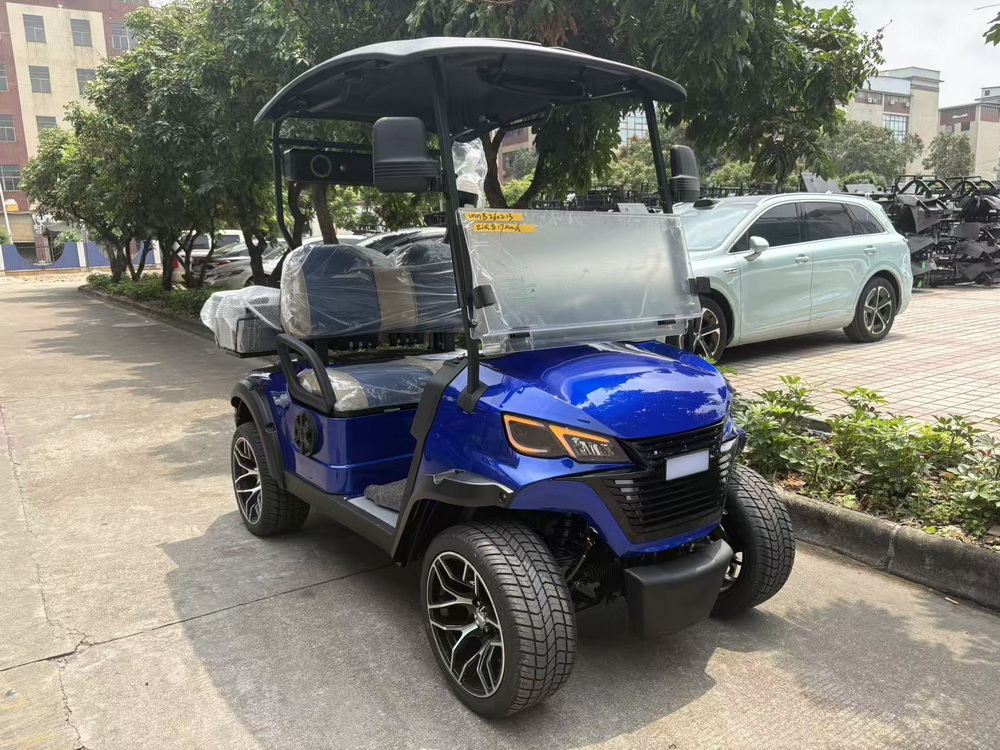
Blue is a highly versatile choice for electric golf carts. It can look premium on a golf course, modern in a resort fleet, energetic at a rental operation, and professional when matched to a company's visual identity.
For B2B buyers, a blue golf cart also offers practical benefits:
- Improved fleet visibility in parking zones, resorts, marinas, campgrounds, and event sites.
- A more memorable appearance for rental fleets and branded customer experiences.
- A color that works with neutral, white, silver, black, or contrasting accessory packages.
- A suitable base for logos, decals, seat colors, roof colors, and custom wheel designs.
- A cleaner visual alternative to highly decorative wraps that may be harder to maintain or replace.
However, the paint color should not become the main selection criterion. A visually appealing cart with an undersized battery, weak suspension, poor parts availability, or unsuitable seating configuration can become a costly operational problem.
The best blue electric golf cart is one that looks sharp on delivery day and still performs consistently after repeated cycles of passenger use, charging, cleaning, and outdoor exposure.
Before comparing models, define how the vehicle will actually be used. The correct blue golf cart for a private homeowner is not necessarily the correct model for a resort, property developer, dealer, or rental operator.
For golf-course applications, buyers typically need compact dimensions, dependable daily range, stable handling, turf-conscious tires, bag-storage options, and weather protection. A cart should support frequent starts and stops, passenger weight, golf bags, and repeated charging.
Key considerations include:
- Two- or four-passenger capacity.
- Golf bag holders and rear storage solutions.
- Smooth acceleration for controlled driving around players.
- Reliable braking on slopes and wet paths.
- A charging strategy that supports back-to-back rounds.
- Easy cleaning of seats, flooring, and body panels.
A blue golf cart can also be used to distinguish premium rental units, member carts, maintenance vehicles, or specific course zones.
Resorts often need more than a standard golf cart. Guests may carry luggage, travel in groups, require step-in comfort, or expect a quiet and polished ride.
For this setting, prioritize:
- Comfortable seating with supportive cushions and durable upholstery.
- Canopies, windshields, and optional enclosures for changing weather.
- Rear-facing seating or larger passenger configurations.
- Non-slip flooring for wet footwear and poolside use.
- Lighting for dawn, evening, and covered-path transport.
- Branding areas for resort names, room-service messaging, or directional graphics.
A resort should also consider fleet consistency. Matching blue electric golf carts with the same roofs, seats, wheels, and branding can make the property look more organized and intentional.
Low-speed electric vehicles are increasingly used in gated communities, retirement developments, warehouses, campuses, and large private facilities. In these environments, a golf cart may carry people, tools, supplies, housekeeping equipment, or security personnel.
The specification should match the job:
| Application | Recommended Configuration | Important Features |
|---|---|---|
| Residential community | 2–4 passengers | Comfortable seats, roof, lights, storage, quiet operation |
| Resort shuttle | 4–8 passengers | Extended seating, step aids, weather protection, durable interior |
| Rental fleet | 2–6 passengers | Rugged body panels, easy-to-clean materials, tracking options, simple controls |
| Security patrol | 2–4 passengers | LED lights, mirrors, lockable storage, communication-device mounting |
| Maintenance transport | Utility bed or cargo box | Payload capacity, reinforced suspension, tool storage, durable tires |
| Event venue | 4–6 passengers | Attractive finish, easy entry, branding panels, reliable range |
Local vehicle rules vary widely. Buyers should confirm the road-use, registration, lighting, speed, restraint, and equipment requirements in the specific country, state, municipality, or private facility before importing or operating vehicles on public roads.
The battery system is one of the most important decisions in an electric golf cart project. It influences range, charging routine, vehicle weight, maintenance needs, service planning, and the customer's long-term ownership experience.
Lithium battery systems are widely selected for premium, commercial, and export-oriented golf carts because they can offer lower weight, rapid charging capability, stable performance, and reduced routine battery maintenance compared with traditional flooded lead-acid battery systems.
Potential advantages include:
- Lower vehicle weight, which may support efficiency and handling.
- No need for routine water topping associated with flooded batteries.
- Faster charging capability when paired with a compatible charger and power supply.
- Consistent power delivery over much of the discharge cycle.
- Longer usable service life when the battery, charger, operating conditions, and maintenance practices are properly managed.
- More packaging flexibility for vehicle manufacturers and custom projects.
Still, lithium should not be treated as a shortcut. Buyers should ask detailed questions about battery cell chemistry, battery management system design, enclosure protection, charging behavior, thermal considerations, warranty scope, and local service support.
Lead-acid batteries may still be appropriate for buyers focused on lower initial acquisition cost, familiar servicing practices, or markets where technicians and replacement supply are already well established.
However, operational teams should understand the trade-offs:
- They can add substantial weight to the vehicle.
- Flooded batteries require appropriate ventilation and periodic water maintenance.
- Charging discipline has a major effect on battery condition.
- Improper storage, over-discharge, undercharging, or poor cleaning practices can shorten useful life.
- Battery replacement can be a meaningful lifecycle expense.
For either system, the correct choice depends on vehicle duty cycle, daily distance, terrain, passenger load, charging time available, local support, and total ownership planning.
Before finalizing a blue golf cart battery specification, request clear answers to these questions:
1. What usable capacity and expected operating range can be achieved under the intended payload and terrain?
2. What charging time is expected from the standard charger?
3. What charger input voltage and plug type are provided for the target market?
4. What battery protection functions are included in the battery management system?
5. What is the recommended storage procedure during seasonal downtime?
6. What warranty applies to the battery, charger, controller, motor, and vehicle structure?
7. Can the factory provide replacement parts and technical documents for distributors?
8. What tests are completed before shipment?
The electrical systems in electric vehicles generally have fewer routine mechanical maintenance needs than combustion systems, although safe servicing procedures and manufacturer instructions remain essential. Battery packs and high-voltage components should be handled by trained personnel, not improvised repair methods.
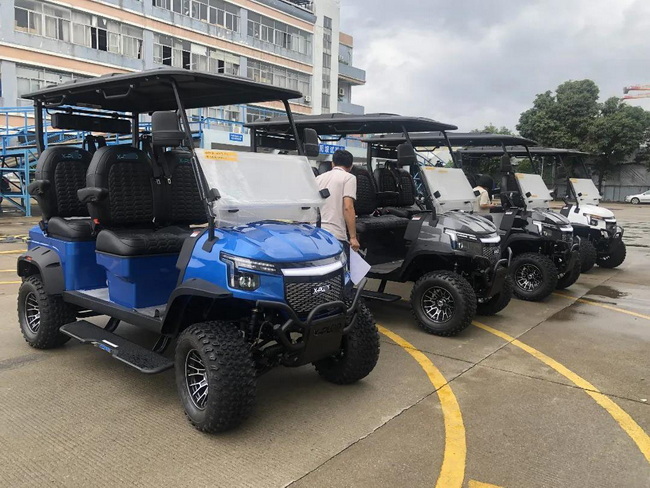
A blue body shell may catch the eye, but the frame and chassis determine whether the cart will feel stable, comfortable, and durable over time.
This matters especially for vehicles operating on uneven resort paths, gravel roads, hills, waterfront zones, warehouse yards, campsites, or large outdoor properties.
Ask whether the vehicle uses a steel frame, aluminum frame, or another structural solution. The answer should be evaluated alongside corrosion protection, weld quality, load capacity, intended environment, and service history.
For humid, coastal, snowy, or high-rainfall environments, corrosion resistance becomes a major purchasing issue. Salt air, wet storage, road contaminants, and cleaning chemicals can accelerate deterioration if metal components, fasteners, wiring connections, and underbody areas are not adequately protected.
A commercial buyer should inspect or request documentation for:
- Frame material and protective treatment.
- Weld quality and manufacturing consistency.
- Fastener selection and corrosion resistance.
- Underbody component protection.
- Cable routing and connector protection.
- Drainage design around battery compartments and floor areas.
- Availability of replacement body panels and structural parts.
Suspension should be selected based on terrain and payload—not only speed. A cart carrying two golfers on smooth paths has different requirements from a six-passenger resort shuttle carrying luggage over rough paved surfaces.
Look for a configuration that supports:
- Predictable steering response.
- Stable cornering at permitted operating speeds.
- Passenger comfort on uneven surfaces.
- Appropriate ground clearance.
- Load capacity for passengers, cargo, accessories, and battery weight.
- Reduced vibration through seats, steering, and flooring.
If the vehicle will operate frequently on slopes, prioritize braking performance, parking stability, tire condition, and operator training. Do not assume that a standard golf cart setup is suitable for steep roads, high-speed travel, or public-road conditions.
Golf-cart safety standards provide performance and safety specifications for golf cars intended for golf-course use. However, vehicles used as neighborhood transport or passenger shuttles may face different rules and equipment expectations depending on their intended market.
For a more complete specification, consider:
- Hydraulic or mechanical braking design appropriate for the model.
- Parking brake function and hill-hold stability.
- Headlights, taillights, brake lights, and turn signals where required.
- Rear-view mirrors and side mirrors.
- Seat belts where required by local regulations or customer policy.
- Horn, reflective markings, and speed-control settings.
- Windshield options and wiper systems for wet-weather applications.
- Vehicle identification labels, manuals, and warning labels in the target language.
A responsible manufacturer should help the buyer distinguish between a golf-course vehicle, a private-property utility vehicle, and a road-oriented low-speed vehicle configuration. The exact compliance pathway must be confirmed for the destination market.
Published range figures are useful only when buyers understand the test conditions behind them. Passenger weight, tire type, slope, surface condition, accessory load, ambient temperature, driving pattern, and battery age all affect real-world operating distance.
A fleet manager should not choose a model based solely on the longest advertised range. Instead, calculate a realistic daily duty cycle.
Use this practical process before placing an order:
1. Record the average and maximum daily driving distance for each vehicle.
2. Add the expected passenger count, luggage, tools, or cargo weight.
3. Identify steep routes, loose surfaces, frequent stopping, and long idle periods.
4. Check whether each vehicle can recharge during breaks or only overnight.
5. Add a reserve margin for seasonal weather, battery aging, and unexpected journeys.
6. Select battery capacity and charger quantity based on the operational peak—not the average day.
For example, a resort cart that runs short guest transfers on flat paths may need moderate daily range but excellent availability and rapid turnaround. A maintenance cart that travels across a large property with tools and cargo may require stronger torque, more robust suspension, and a larger battery reserve even if its daily route appears shorter.
Customization can make a blue golf cart more attractive, but its strongest value is operational. For OEM buyers and distributors, the ability to configure a product line can help match local buyer preferences without sacrificing manufacturing consistency.
Useful custom options may include:
- Custom blue paint shades, decals, and dealer branding.
- Two-, four-, six-, or eight-passenger seating layouts.
- Rear-facing seats, cargo beds, utility boxes, or lockable compartments.
- Different roof styles and weather enclosures.
- Seat colors, waterproof upholstery, and upgraded cushions.
- Alloy wheels, all-terrain tires, or turf-friendly tires.
- LED light packages and signal systems.
- Windshields, mirrors, wipers, and roof-mounted accessories.
- USB charging ports, Bluetooth audio, phone holders, or fleet-management hardware.
- Modified speed settings subject to applicable local regulations.
- Export packaging, owner manuals, labels, and spare-parts kits.
The best approach is to create a clear configuration matrix. Rather than offering unlimited unstructured options, define a manageable group of body colors, seating packages, wheel packages, battery options, and accessory bundles. This supports reliable production, easier quality control, more predictable spare-parts inventory, and stronger dealer sales materials.
The operating experience of an electric golf cart depends heavily on what happens after shipment. Dealers and fleet buyers should plan for inspection, charging, cleaning, driver instruction, parts storage, and scheduled maintenance before the first units arrive.
A simple routine can reduce downtime and prevent small issues from becoming major repairs.
Daily checks may include:
- Battery state of charge and charging status.
- Tire condition and visible damage.
- Brake response and parking brake operation.
- Lights, horn, mirrors, and windshield condition.
- Loose items in passenger or cargo areas.
- Unusual noises, warning lights, or steering changes.
Weekly checks may include:
- Tire pressure according to the manufacturer's recommendation.
- Wheel fasteners and visible suspension components.
- Cable connections, charging port condition, and charger ventilation.
- Seat mounting, roof fasteners, and body-panel security.
- Cleaning of flooring, battery areas, and drainage points.
- Inspection for corrosion, leaks, cracks, or abrasion.
For fleets, track every cart by serial number. Record charging issues, repairs, tire replacements, battery alerts, incidents, and downtime. This creates a practical service history and helps identify recurring operational problems.
The lowest purchase price may not produce the lowest operating cost. A commercial buyer should compare the expected lifetime cost of each blue golf cart configuration.
A more complete ownership model includes:
| Cost Area | What to Review |
|---|---|
| Acquisition | Vehicle price, optional equipment, freight, insurance, duties, local delivery |
| Energy | Electricity cost, charging efficiency, charger capacity, local power requirements |
| Maintenance | Tires, brakes, suspension wear, battery care, labor, consumables |
| Downtime | Lost rental revenue, guest disruption, replacement-cart availability |
| Parts support | Lead time, minimum order quantities, local stock, technical documentation |
| Resale value | Brand position, battery condition, body condition, service history |
| Compliance | Required lighting, restraints, labels, documentation, local inspections |
For many operators, downtime is the hidden cost. A cart that is difficult to repair, lacks spare parts, or uses inconsistent components can disrupt a resort, golf course, or rental business even if it was inexpensive to buy.
When evaluating an OEM manufacturing partner, ask about production controls, inspection procedures, component traceability, container-loading support, spare-parts recommendations, and technical communication after delivery. These details often matter more than a small difference in unit price.
For brands, wholesalers, and vehicle businesses, a blue golf cart should be developed as a market-ready product rather than a generic vehicle with a different paint color.
BorCart can support OEM-focused projects for electric golf carts and related vehicle components by helping buyers define the right combination of:
- Vehicle platform and passenger capacity.
- Body color, logo placement, and visual identity.
- Battery and charger configuration.
- Seating, roof, wheel, tire, and utility-accessory packages.
- Market-specific documentation and packaging requirements.
- Spare-parts planning for distributors and after-sales teams.
- Pre-shipment quality inspection requirements.
A productive OEM discussion starts with the end user. Share the vehicle's intended terrain, passenger number, daily operating distance, charging environment, local regulations, preferred color, required accessories, target price range, and annual purchasing volume. With this information, a manufacturer can recommend a more practical solution instead of simply quoting a standard model.
The right blue golf cart combines visual appeal with a strong operational foundation. For private use, that may mean comfort, easy charging, and personal style. For commercial buyers, it means durability, passenger safety, serviceability, reliable range, parts planning, and a specification that suits the intended market.
Do not select a vehicle based only on its exterior color, top speed, or headline range. Review the complete system: battery, chassis, suspension, braking, weather resistance, customization, maintenance support, and lifecycle cost.
If you are developing a private-label electric golf cart range, expanding a dealership portfolio, or sourcing a customized blue golf cart fleet, contact BorCart with your project requirements. Our team can help you build an OEM configuration that fits your customers, application, and market position.
No. The mechanical and electrical maintenance needs are not determined by color. However, the finish quality, cleaning products, UV exposure, storage conditions, and frequency of use can affect how the paint and exterior surfaces look over time.
It depends on the application. Lithium systems can offer lower weight, less routine maintenance, and strong charging performance, while lead-acid systems may have a lower initial cost and broader familiarity in some service markets. Compare range needs, daily use, budget, charging time, and local maintenance support.
Yes. OEM buyers can typically request logo decals, branded color schemes, seat embroidery, customized steering wheels, roof colors, wheel designs, and market-specific labels. The most efficient approach is to define approved branding locations and standard artwork before mass production.
A resort should focus on passenger capacity, comfortable seating, weather protection, practical range, easy cleaning, lighting, safe entry and exit, spare-parts availability, and fleet consistency. A visually distinctive blue color can also improve guest recognition and brand presentation.
Drivers should complete basic visual and functional checks before daily use. Fleet teams should also perform scheduled weekly, monthly, and seasonal inspections based on the manufacturer's service guidance, vehicle utilization, local climate, and terrain conditions.
Possibly, but only if the vehicle configuration and operation meet the laws of the destination market. Requirements may cover speed capability, lighting, mirrors, seat belts, vehicle registration, insurance, driver licensing, and designated road access. Always verify local rules before importing or operating the vehicle on public roads.
Provide the target market, expected order quantity, intended application, passenger capacity, terrain, desired range, battery preference, charging voltage, preferred accessories, branding needs, shipping destination, certification expectations, and target price level. This enables the manufacturer to recommend a suitable specification.
- [Alternative Fuels Data Center: Maintenance and Safety of Electric Vehicles]
- [ANSI Webstore: ANSI/OPEI Z130.1-2020 Golf Cars—Safety and Performance Specifications]
- [American National Standards Institute: ANSI/OPEI Z130.1-2020 Golf Cars Safety Specifications]
- [National Rural Transit Assistance Program: Electric Vehicle Maintenance Best Practices]
- [Kelley Blue Book: EV Battery Health—The Essential Guide]
- [Original Article: Top Features to Look for in Blue Golf Carts This Year]


