


Views: 281 Author: BorCart Publish Time: 2026-08-31 Origin: Site


Content Menu
>> Supplier evaluation criteria
● China's Manufacturing Clusters
>> 1. Guangzhou BorCart Electric Vehicle Co., Ltd.
>> 2. Guangdong LVTONG New Energy Electric Vehicle Technology Co., Ltd.
>> 3. Marshell Electric Vehicle
>> 5. Kinghike Vehicle Co., Ltd.
>> 6. Suzhou Eagle Electric Vehicle Manufacturing Co., Ltd.
>> 7. Zhejiang Taotao Vehicles Co., Ltd.
>> 8. CENGO / Sichuan Nuole Electric Technology Co., Ltd.
>> 9. XUNHU EV
>> 10. Wuxi Bodo Electric Vehicle
>> What makes an off-road cart different?
>> Materials and process questions
>> Certification and market access
>> Material substitution after sampling
>> 1. How can I verify whether a factory's ISO certificate has expired?
>> 2. Does CE marking make an off-road golf cart road legal in Europe?
>> 3. What evidence proves that a cart can climb a 25% grade?
>> 4. How should I compare lithium battery quotations fairly?
>> 5. Can a supplier use another company's certificate for my private-label cart?
China has become an important sourcing base for electric golf carts, lifted utility carts, hunting vehicles, and other low-speed off-road electric vehicles. For professional buyers, however, the right supplier is not necessarily the factory offering the lowest quoted unit price—it is the one that can repeatedly deliver a terrain-appropriate vehicle with stable components, documented inspection controls, export-ready documentation, and responsive engineering support.
This guide reviews ten Chinese manufacturers relevant to overseas brands, wholesalers, fleet operators, and vehicle assemblers sourcing Off Road Golf Cart products. The list is a procurement-oriented shortlist rather than a universal ranking. Every buyer should independently verify the factory entity, current production capacity, certification scope, target-market compliance, and final vehicle configuration before placing an order. China's broader electric-vehicle supply chain is deep, with suppliers across Guangdong, Fujian, Zhejiang, Jiangsu, Shandong, Sichuan, and other regions supporting components, battery systems, fabricated frames, moulding, electronics, and export logistics.

A reliable off road golf cart should be evaluated as a complete vehicle system—not as a standard golf cart with larger tires, a cosmetic lift kit, and a higher price tag.
The manufacturers in this guide were selected according to publicly available information regarding manufacturing history, product relevance, stated factory scale, export orientation, customization capability, and disclosed quality or compliance practices. These factors should be treated as a starting point for due diligence, not as a replacement for a factory audit or third-party inspection.
| Evaluation area | What professional buyers should verify | Why it matters |
|---|---|---|
| Factory identity | Legal entity, manufacturing address, export entity, bank-account name, ownership structure | Helps prevent trading-company confusion and certificate misuse |
| Product engineering | Frame material, tubing thickness, suspension travel, axle ratio, braking layout, steering geometry | Determines whether the vehicle can handle terrain, payload, and repeated use |
| Powertrain | Continuous motor output, controller current, thermal protection, drivetrain configuration, hill-climb test data | Peak motor wattage alone does not show real off-road performance |
| Battery system | Cell brand, chemistry, usable kWh, BMS limits, charging system, UN38.3 documents | Battery labels with the same voltage and Ah rating may perform very differently |
| Quality controls | Incoming inspection, in-process checks, final testing, road-test records, corrective-action process | Reduces the risk of inconsistent bulk production |
| Customization discipline | BOM control, engineering change process, approved sample, branding, wire harness, packaging | Essential for private-label and OEM programs |
| Export documentation | Certificates matched to the exact model, manufacturer, destination, and configuration | A document from another model or factory may not support the imported vehicle |
| Parts support | Spare-parts list, lead times, warranty exclusions, diagnostic support, component continuity | A fleet becomes expensive if a simple controller or brake component is unavailable |
ISO 9001 is widely used as a quality-management benchmark, but it should not be treated as proof that every vehicle model meets every destination-market requirement. ISO itself describes ISO 9001 as a quality-management standard applicable to organizations of all sizes.
China's advantage is not concentrated in one city. Instead, sourcing buyers can benefit from regional clusters that combine vehicle assembly, batteries, controllers, wiring harnesses, metal fabrication, plastic moulding, paint, and export support.
- Guangdong: Guangzhou, Dongguan, Zhaoqing, Shenzhen, and nearby cities form a strong ecosystem for electric-vehicle electronics, battery integration, metal fabrication, plastic components, and export-oriented manufacturing. BorCart, LVTONG, and Marshell are associated with this broader regional supply base.
- Fujian: Xiamen supports export-oriented electric-vehicle manufacturing and is home to HDK Electric Vehicles.
- Jiangsu and Zhejiang: These regions offer mature tooling, machining, vehicle assembly, moulding, and power-sports supply networks, supporting companies such as Suzhou Eagle and Taotao.
- Shandong: Jinan and surrounding industrial areas provide access to vehicle components, fabricated metal parts, and industrial manufacturing resources, including suppliers such as Kinghike.
- Sichuan: Chengdu provides an alternative sourcing location for electric carts, with suppliers serving dealer programs and flexible-order projects.
For a buyer, location affects more than freight distance. It can influence access to component suppliers, engineering talent, prototype lead times, export port options, and the ease of arranging independent inspections.
| Manufacturer | Location | Publicly stated scale or capacity | Certification / documentation signal* | Typical MOQ signal | Suitable for |
|---|---|---|---|---|---|
| Guangzhou BorCart Electric Vehicle Co., Ltd. | Guangzhou, Guangdong | 200,000 m² workshop; 4 production lines; stated output of 10 containers/day | Model-specific documents should be matched to destination | Quote-based | Flexible OEM programs and developing brands |
| Guangdong LVTONG New Energy Electric Vehicle Technology Co., Ltd. | Dongguan, Guangdong | Historical public capacity around 2,000 units/month | ISO 9001, ISO 14001, CE claims | Quote-based | Broad product range and export programs |
| Marshell Electric Vehicle | Guangdong / Shanghai / Anhui | 104,275 m² stated workshop area | ISO 9001, CE, EEC claims | Quote-based | Multi-category electric vehicle sourcing |
| HDK Electric Vehicles | Xiamen, Fujian | Original Xiamen facility stated at 60,000 m² | ISO and CE history stated | Quote-based | Dealer-oriented electric mobility lines |
| Kinghike Vehicle Co., Ltd. | Jinan, Shandong | 45,000 m²; stated capacity up to 50,000 units/year | Request exact model documents | Public custom-program signal from 100 units | Lifted carts and custom-development projects |
| Suzhou Eagle Electric Vehicle Manufacturing Co., Ltd. | Suzhou, Jiangsu | 30,000 m²; 3 assembly lines; stated 1,500 units/month | CE, DOT/EPA, E-Mark claims vary by product | Quote-based | Resort, transport, utility, and golf-cart projects |
| Zhejiang Taotao Vehicles Co., Ltd. | Lishui, Zhejiang | Stated annual golf-cart output of 50,000 units | Request exact model documents | Quote-based | Buyers seeking wider power-sports supply capability |
| CENGO / Sichuan Nuole Electric Technology Co., Ltd. | Chengdu / Dongguan | Public catalogue signal: 10,000+ m² and 60+ units/day | Request current model-specific documents | Positioned for lower-volume orders | Dealers and flexible order programs |
| XUNHU EV | Henan | Verify current production schedule directly | Request exact model documents | Quote-based | Golf carts, shuttles, and utility electric vehicles |
| Wuxi Bodo Electric Vehicle | Wuxi / multi-site | Public reports indicate four factories; golf-cart-specific capacity needs confirmation | Request exact model documents | Quote-based | Design-led leisure and personal-mobility projects |
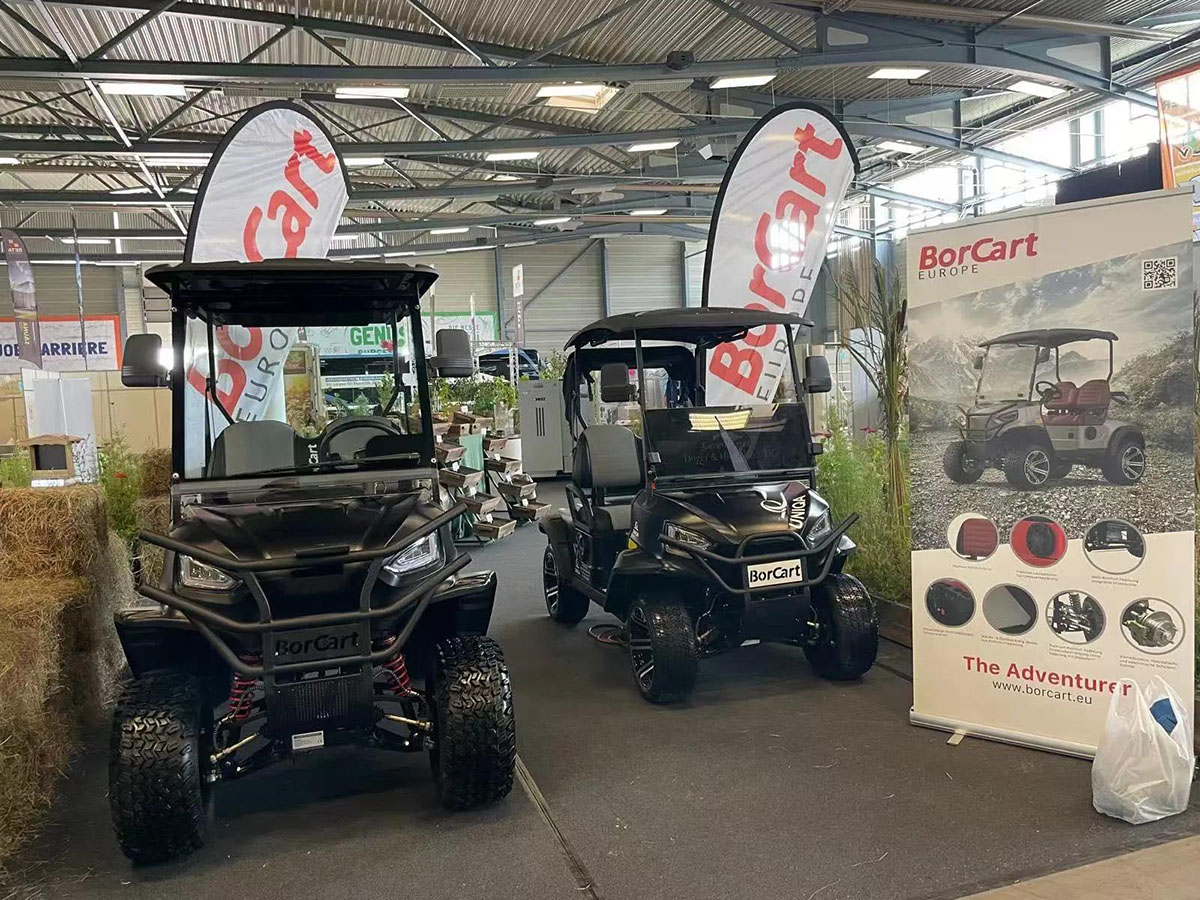
Founded in 2000, Guangzhou BorCart Electric Vehicle Co., Ltd. is a Guangzhou-based manufacturer of golf carts, utility carts, sightseeing buses, low-speed vehicles, hunting vehicles, multi-purpose electric vehicles, and automotive-related components. Its published company profile states that it operates a 200,000-square-meter workshop with more than 100 engineers and technicians, over 1,000 skilled workers, and four production lines. The company states that it can deliver up to ten containers of electric vehicles per day.
For overseas brands, wholesalers, and vehicle businesses building an Off Road Golf Cart range, BorCart is particularly relevant when the project requires a balance between production scale and practical OEM flexibility. Rather than limiting buyers to a single standardized retail-style cart, the company describes support for customized vehicle specifications, including branding, body styles, seating layouts, accessories, battery configurations, and special-use vehicle requirements.
BorCart also reports using components such as KDS motors, Mahle motors, Curtis controllers, and Delta-Q chargers, while producing key parts including chassis, bodies, moulds, and paint in-house. This combination can be useful for buyers that need better control over cost, styling, component selection, and project-specific modifications.
Its stated inspection system includes a New Product Introduction process plus Incoming Quality Control, Process Quality Control, and Quality Assurance procedures. BorCart says all vehicles are tested on the assembly line before shipment.
For small and mid-sized brands, the key advantage is often communication efficiency during the development stage. Buyers can discuss practical matters such as:
- Required ground clearance and tire size
- Passenger capacity and cargo capacity
- Hunting, resort, estate-maintenance, or utility use cases
- Battery chemistry and charging requirements
- Private-label colors, logos, decals, and packaging
- Required spare-parts packages
- Market-specific lighting, mirrors, safety features, or documentation
However, even with a flexible OEM supplier, buyers should define hill-climb requirements, payload, terrain, operating hours, expected temperature range, and target-market rules in a written specification before prototype approval.
Founded in Dongguan in 2004, LVTONG is an established participant in China's electric golf-cart and sightseeing-vehicle segment. Its product offering includes electric golf carts, utility vehicles, sightseeing vehicles, and related parts. Public information identifies ISO 9001 and ISO 14001 credentials, along with product and export-related compliance claims.
LVTONG can be relevant for importers that want a broad product family from one supplier, including standard golf carts, raised recreational carts, patrol carts, and utility-oriented versions. Historical public supplier information cited in the source indicates production capacity around 2,000 units per month, although buyers should request current capacity allocation for the model, season, and planned order volume.
A procurement team should ask for:
- Current model catalogue and technical drawings
- Suspension and axle details for lifted models
- Controller brand and continuous-current rating
- Detailed battery configuration and cell supplier
- Warranty conditions for off-road use
- Parts stock and after-sales support process
- Current certificates that match the selected vehicle model
Marshell has operated in electric vehicles and battery-related vehicle electronics since 2002. Its public company profile identifies manufacturing operations in Shanghai, Zhaoqing, and Anhui, with a stated total workshop area of 104,275 square meters. The company references ISO 9001, CE, and EEC-related documentation in public materials.
Marshell may appeal to buyers looking beyond golf carts alone, particularly those building a wider program that includes utility vehicles, mobility vehicles, sightseeing transport, and other low-speed electric products.
For an off-road application, buyers should avoid accepting an "off-road style" body package as proof of off-road durability. Instead, request evidence for:
- Frame and suspension design
- Brake performance under full vehicle load
- Drivetrain and axle configuration
- Battery enclosure protection
- Tire load rating
- Gradeability under documented payload conditions
- Corrosion-protection process and coating thickness
HDK is an Xiamen-based supplier with factory history dating to 2006. Public company information identifies an original facility of about 60,000 square meters and states that ISO and CE certification were obtained in 2007.
The supplier may suit importers and distributors looking for an established electric-cart range with a formal manufacturing system. Its relevance for off-road programs depends on the exact lifted, utility, or terrain-oriented platform selected.
Before approving an HDK off-road cart, ask for test information based on the final tire size and payload. A test carried out with an unloaded cart on smooth concrete does not prove that the vehicle will perform properly on gravel, slopes, wet grass, agricultural paths, or resort trails.
Kinghike, also associated with Haike EV, was founded in 2011 in Jinan, Shandong. The company states that it operates a development and manufacturing facility exceeding 45,000 square meters and has capacity for up to 50,000 electric golf carts annually. Its reported export markets include North America, South America, Europe, Southeast Asia, and the Middle East.
Kinghike is notable for public statements regarding custom-development support. These include rapid prototyping, composite-material work, sample delivery as quickly as one month in some cases, tooling costs beginning from USD 10,000, and a stated custom-program MOQ starting around 100 units. These figures should be treated as preliminary commercial signals; actual MOQ, tooling ownership, sample lead time, and development costs must be specified in the signed quotation and development agreement.
The company may be worth evaluating for buyers who need:
- Custom body or roof design
- Unique seating layouts
- Private-label off-road models
- Composite exterior parts
- Prototype development before a larger rollout
- Custom utility, hunting, or resort cart configurations
Suzhou Eagle was founded in 1999 and manufactures four-wheel electric vehicles including golf carts, people movers, electric trucks, and custom vehicles. Its published information states a 30,000-square-meter workshop, three assembly lines, and an output capacity of approximately 1,500 units per month, with flexibility to adjust output according to demand.
This manufacturer may be a suitable candidate for resorts, campuses, tourism projects, industrial sites, and fleet buyers needing a mixed vehicle program—such as passenger shuttles, utility vehicles, and golf carts from one sourcing partner.
Public materials mention CE, DOT/EPA, and E-Mark-related support depending on the product. Buyers should never interpret this as blanket approval for every configuration. Instead, request the documents applicable to the exact model, battery, seating arrangement, motor, and destination market.
Zhejiang Taotao Vehicles is a diversified power-sports and electric-vehicle manufacturer located in Lishui, Zhejiang. Public supplier information describes in-house activities such as casting, welding, moulding, injection moulding, hub production, assembly, coating, and OEM/ODM support. The company has also reported annual golf-cart production of 50,000 units.
This vertically integrated profile may be attractive to buyers that value broad industrial capability and a large supply-chain ecosystem. At the same time, procurement teams should separately verify the golf-cart group's experience with off-road chassis design, low-speed vehicle documentation, aftermarket parts continuity, and destination-specific requirements.
A large power-sports operation does not automatically mean that every lifted cart platform has mature field performance. Ask for the engineering evidence relevant to the cart you intend to purchase.
CENGO positions itself as a manufacturer of golf carts and utility vehicles with relatively flexible order options. Public materials state that the company was founded in 2015, has operations in Chengdu and Dongguan, and serves a dealer network. Its catalogue references more than 10,000 square meters of factory space and daily capacity above 60 units.
CENGO may be useful for regional distributors or newer brands where an initial program needs more flexible quantities than a large-volume vehicle project. The buyer's main task is to determine whether the selected off-road model is built on a dedicated terrain-capable platform or whether it is essentially a standard cart fitted with cosmetic lift accessories.
Request the complete vehicle specification before comparing prices.
XUNHU EV promotes golf carts, sightseeing buses, electric shuttle buses, mobility scooters, and utility vehicles, with OEM/ODM cooperation and international delivery among its public messages. Its product range may make it relevant for buyers combining resort transportation with property-maintenance, utility, or light off-road cart requirements.
Because available public technical and factory information may vary by supplier listing, buyers should conduct a direct factory verification before nominating XUNHU for a private-label or first-order project.
A robust verification process should include:
- Factory video call or site visit
- Legal business-license review
- Current production schedule
- Bill of materials for the proposed vehicle
- Sample vehicle inspection
- Third-party pre-shipment inspection
- Written warranty and spare-parts agreement
- Confirmation of the manufacturer responsible for documentation
Wuxi Bodo Electric Vehicle is an established Chinese electric-vehicle manufacturer. Third-party reporting cited in the source identifies its founding year as 1997 and refers to four factories in Tianjin, Wuxi, Guangzhou, and Taizhou. However, reported large production figures are not necessarily specific to golf carts and should not be treated as golf-cart capacity without direct confirmation.
Bodo may be considered by buyers looking at style-focused leisure or personal-mobility concepts. Before adding it to an approved supplier list, confirm the current availability of off-road golf-cart platforms, the vehicle engineering team's relevant experience, production capacity for the selected model, and the continuity of spare parts.
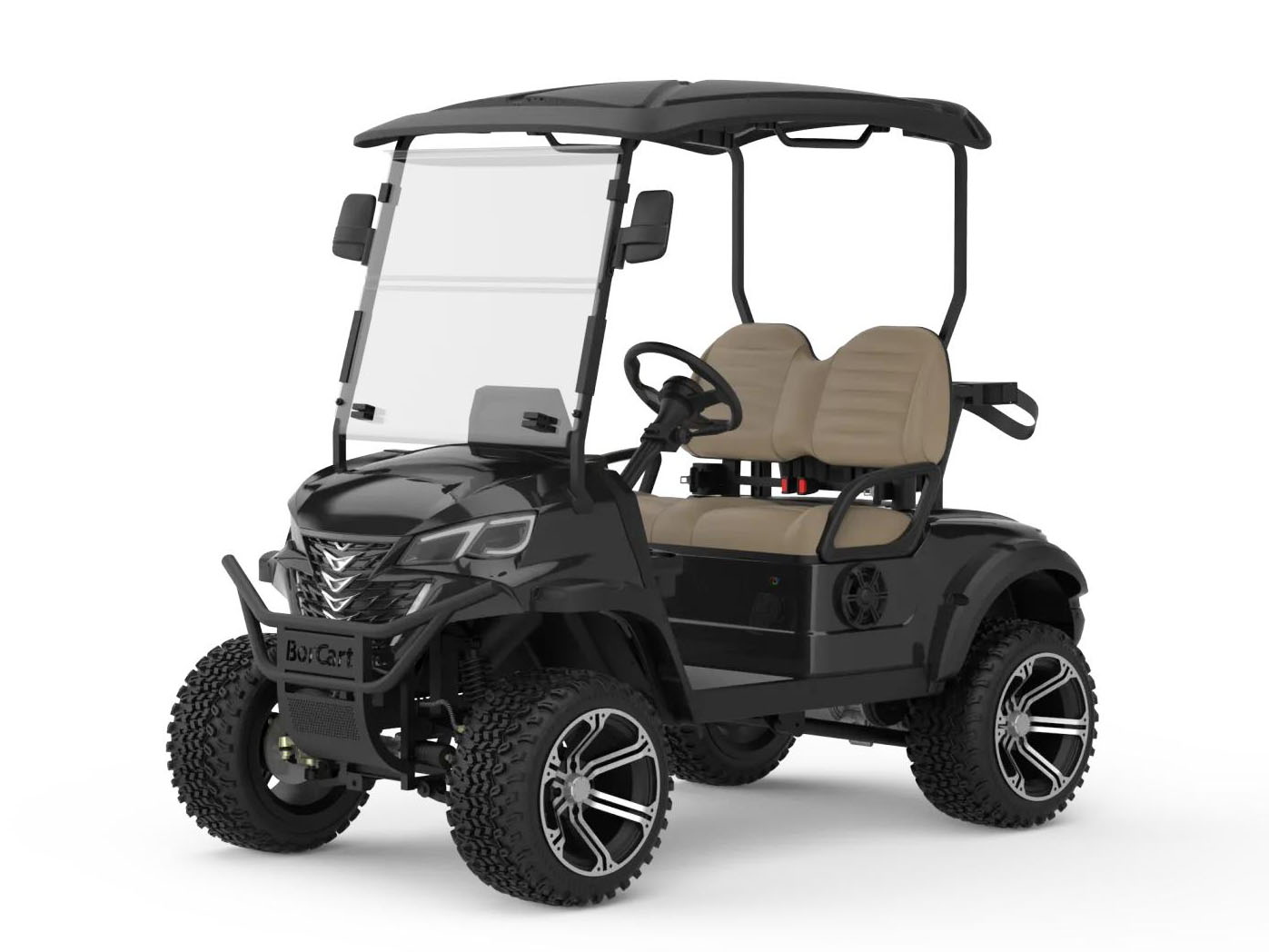
A genuine Off Road Golf Cart should be specified around terrain, load, duty cycle, and safety—not just appearance.
| Component | What to request | Common buying mistake |
|---|---|---|
| Chassis | Steel grade, aluminum grade if applicable, tubing wall thickness, weld process, corrosion treatment | Comparing paint color and exterior styling only |
| Suspension | Front/rear layout, damper travel, spring rate, loaded ride-height data | Assuming a lifted body equals usable suspension travel |
| Motor and controller | Continuous and peak ratings, current limit, protection rating, thermal controls | Choosing only by peak motor wattage |
| Axle and gearing | Differential type, gear ratio, torque rating, loaded gradeability data | Testing an empty cart on a flat factory floor |
| Battery | Cell brand, chemistry, usable kWh, BMS current, low-temperature behavior | Comparing only nominal voltage and Ah |
| Tires and wheels | Tire load rating, ply rating, tread pattern, sidewall strength, wheel offset | Fitting oversized tires without revising steering and drivetrain settings |
| Brakes | Hydraulic, drum, or disc layout; parking-brake design; loaded stopping test | Treating regenerative braking as a mechanical-brake substitute |
| Corrosion protection | Pretreatment process, coating type, film thickness, salt-spray evidence | Accepting "anti-rust" claims without reports or specifications |
For outdoor, utility, hunting, or off-road duty, a buyer should ask for the exact material specification—not generic language such as "premium frame" or "high-quality battery."
Important questions include:
- What steel grade is used in the chassis?
- What is the main frame tube wall thickness?
- Are high-stress suspension mounting points reinforced?
- What corrosion-prevention treatment is applied before powder coating or paint?
- What is the coating thickness target?
- What plastic resin is used for body panels and roof parts?
- What is the tire load rating at the planned gross vehicle weight?
- What are the continuous motor output and controller-current limits?
- Which battery-cell brand and BMS model are installed?
- What temperature and payload conditions were used to calculate the stated range?
For lithium systems, buyers should obtain documentation for the precise pack being shipped, including battery drawings, cell model, nominal and usable energy, BMS limits, charger specifications, UN38.3 information, and warranty exclusions.
For European distribution, CE-related documentation may be relevant depending on the product and intended use, but it is not a universal permission for road use. Road legality depends on vehicle category, speed, intended use, registration requirements, national rules, and local regulations.
For North American low-speed vehicle projects, buyers should separately assess relevant federal, state, provincial, and local requirements. Areas often requiring attention include VIN or WMI arrangements, lighting, mirrors, seat belts, tires, glazing, speed capability, importer responsibilities, and local registration rules.
One of the least-discussed risks in this product category is the difference between a purpose-designed lifted platform and a standard cart that has been raised after the basic vehicle design was completed.
Larger tires, wheel spacers, and lift brackets can improve visual ground clearance. But if steering geometry, toe angle, braking performance, suspension travel, axle load, and driveline loads are not re-engineered, the vehicle may experience higher steering effort, increased wear on ball joints, unstable handling, reduced braking effectiveness, or drivetrain stress.
Ask for:
- Steering-geometry drawings
- Full-load turning-circle data
- Brake-test data at gross vehicle weight
- Axle-load calculations
- Suspension travel and ride-height measurements
- Gradeability report with actual tires installed
- Field-test videos on the relevant terrain and payload
A prototype may include thicker steel, a known battery cell, stronger tires, or a better upholstery material, while bulk production may shift to a lower-cost alternative. This risk rises when the quotation uses vague descriptions such as "high-grade steel," "premium lithium battery," or "off-road tire."
Avoid this by using:
- An approved golden sample
- A signed bill of materials
- A controlled component-brand list
- Written engineering-change approval rules
- A pre-shipment inspection checklist
- Contract language requiring approval for substitution of key components
Two battery packs can carry similar labels—such as 48V 105Ah—while offering very different usable energy, BMS discharge current, low-temperature behavior, cell consistency, and actual hill-climb support.
Compare battery offers by usable kWh and continuous discharge capability, not nominal Ah alone. A lower-priced pack can reduce range and cause controller limitation or poor climbing performance under load.
A certificate may belong to:
- Another vehicle model
- Another battery configuration
- A previous product generation
- A component rather than the complete vehicle
- A different legal factory entity
- A certificate holder that is not the exporter or manufacturer
Request the certificate number, issuing body, legal entity name, model designation, test report, issue date, and expiry date. Then confirm the information with the issuing body or its official certificate directory.
1. Define the real operating conditions.
State terrain type, maximum slope, passenger count, cargo load, daily operating hours, charging environment, climate, target speed, and destination market.
2. Issue a technical RFQ.
Include required dimensions, minimum ground clearance, battery preference, range test method, tire specification, accessory list, branding needs, packaging, documents, and expected order quantity.
3. Compare three to five factories.
Compare response quality, technical drawings, component transparency, warranty language, capacity allocation, and service-parts planning—not just the headline unit price.
4. Verify factory identity.
Confirm the legal manufacturer, factory address, exporter, certificate holder, bank account, and intellectual-property ownership arrangements.
5. Order a production-intent sample.
The sample should use the same frame, tire, suspension, motor, controller, battery, charger, and accessories planned for bulk production.
6. Test the sample under load.
Test it with realistic passengers or cargo on slopes and surfaces comparable to its intended operating environment.
7. Use independent inspections.
Consider a pre-production inspection for customized projects, an in-process inspection for substantial orders, and a final pre-shipment inspection against the approved golden sample.
8. Plan lithium-battery logistics early.
Confirm whether batteries are installed, packed separately, or shipped under the appropriate dangerous-goods process. Also verify labels, safety documentation, container-loading method, charger compatibility, and destination-port clearance requirements.
9. Buy service parts with the first order.
Include brakes, steering joints, controllers, chargers, key switches, lamps, body panels, suspension parts, wheel hardware, diagnostic items, and commonly replaced electrical parts.
Selecting an off road golf cart manufacturer in China is not simply a price-comparison exercise. The right long-term supplier should be able to convert your operating conditions into a controlled, repeatable vehicle specification—then maintain the same chassis, battery, controller, materials, quality controls, and documentation across production.
For brands, wholesalers, distributors, and vehicle companies seeking a flexible OEM partner, Guangzhou BorCart Electric Vehicle Co., Ltd. is a practical manufacturer to evaluate first. Its stated scale, in-house component capabilities, inspection procedures, engineering team, and willingness to support customized golf carts, utility vehicles, hunting vehicles, and special-use EV projects make it particularly relevant for buyers that need more than a catalogue model.
Start the discussion with a technical brief rather than a generic price request. Share your destination market, terrain profile, required passenger or cargo load, battery preference, target annual volume, branding needs, and compliance expectations. That approach gives both the buyer and manufacturer the information needed to build an off road golf cart program that is commercially viable, technically appropriate, and easier to support after delivery.
Request the complete certificate showing the certificate number, issuing certification body, legal entity name, scope, issue date, and expiry date. Then check the issuing body's directory or contact it directly. Do not rely on an undated logo, a cropped certificate scan, or a marketing brochure.
Also check whether the scope actually covers the activities relevant to your project, such as final vehicle assembly, battery integration, or electric-vehicle manufacturing.
Not necessarily. CE-related documentation and road-use approval are separate issues. The correct route depends on the vehicle's category, speed, intended use, country of import, registration rules, and local regulations. Obtain advice from a qualified importer, inspection body, or regulatory specialist in the destination country before placing an order.
Request a written gradeability statement that specifies vehicle weight, passenger and cargo load, tire model, battery state of charge, surface type, ambient temperature, motor/controller configuration, and test duration.
A short video of an empty cart climbing a smooth ramp is not enough. The test should reflect the final production configuration and expected real-world load.
Convert all offers into usable kWh, then compare:
- Cell brand and model
- Battery chemistry
- Pack voltage
- Usable depth of discharge
- BMS continuous discharge current
- Charger specification
- Cold-weather limitations
- Warranty coverage and exclusions
- Spare-battery availability
- UN38.3 documentation for the exact pack
The lowest-priced battery is not always the lowest-cost option if it restricts torque, reduces practical range, or creates warranty problems.
This is generally a high-risk practice. The documentation should match the responsible manufacturer, final vehicle configuration, target market, and applicable rules. Changing the vehicle, brand arrangement, importer role, battery system, or manufacturer can require additional documentation or reassessment.
- [International Organization for Standardization — Standards Catalogue] provides information on internationally recognized management and technical standards, including ISO 9001. [iso]
- [Guangzhou BorCart Electric Vehicle Co., Ltd. — Company Profile] provides BorCart's published factory, production, quality-control, component, and OEM/ODM information. [borcart]
- [China General Administration of Customs] provides official trade and customs information for import and export research.
- [National Bureau of Statistics of China] provides official macroeconomic and industrial statistics.
- [ISO Online Browsing Platform] can help buyers identify relevant standards terminology before discussing technical requirements with suppliers.


