


Views: 261 Author: BorCart Publish Time: 2026-08-24 Origin: Site


Content Menu
>> Factory and delivery capability
>> Engineering and product capability
>> China's manufacturing-cluster advantage
>> 1. Guangzhou BorCart Electric Vehicle Co., Ltd.
>> 2. Suzhou Eagle Electric Vehicle Manufacturing Co., Ltd.
>> 3. Dongguan Excellence Golf & Sightseeing Car Co., Ltd. (EXCAR)
>> 4. Marshell Electric Vehicle
>> 5. Guangzhou Langqing Electric Car Co., Ltd.
>> 6. Guangdong Yatian Industrial Co., Ltd.
>> 7. Tianjin Zhongyi Electric Vehicle Co., Ltd.
>> 9. Shenzhen Aoxiang Industrial Development Co., Ltd.
>> 10. Specialized Folding Golf Cart Factories in Zhejiang and Guangdong
● Capacity, MOQ, and Compliance Comparison
>> Verify the factory before paying deposits
>> Build a proper sample process
>> Material substitution after sample approval
>> Misleading certification claims
>> Hidden subcontracting during peak season
● FAQ
>> 1. How can I verify whether an ISO 9001 certificate is still valid?
>> 2. What test should be mandatory for a folding golf cart?
>> 3. How do I prevent a supplier from changing materials after the sample is approved?
>> 4. Should I source from an electric-vehicle factory or a specialist trolley factory?
>> 5. What warranty terms should I negotiate?
China's golf-cart supply base is concentrated around Guangdong, Jiangsu, Zhejiang, Shandong, and Tianjin. Guangdong is particularly strong in electric vehicles, low-speed vehicles, battery systems, tooling, body production, and export logistics; Zhejiang has a broader concentration of sporting-goods, metal-processing, and trolley suppliers.
For buyers sourcing foldable golf products, China offers a broad supplier pool—but the quality gap is substantial. A professional selection process should prioritize manufacturing depth, documented quality control, engineering capability, stable delivery performance, and transparency about subcontracting.
The wider golf-cart sector continues to expand. One 2026 market estimate values the global golf-cart market at about USD 2.44 billion, with projected growth to USD 3.24 billion by 2031. Electric carts accounted for an estimated 78.81% of sector revenue in 2025, reflecting demand from golf courses, resorts, campuses, gated communities, airports, and industrial facilities.
This list is designed for overseas brand owners, wholesalers, distributors, fleet operators, and manufacturers looking for long-term OEM or ODM partners rather than one-off low-price purchases.
A reliable folding golf cart supplier should be able to show:
- A real manufacturing address, workshop layout, assembly lines, welding or metal-processing capacity, and finished-product warehouse
- Clear evidence of monthly output and peak-season planning
- A documented material-incoming process, in-process inspections, and final inspection records
- Defined production lead times for samples, pilot orders, and repeat orders
- A written policy on subcontracting and supplier control
For folding golf carts and push trolleys, buyers should review more than appearance and price. The most important technical points include:
- Frame material: aluminum alloy, powder-coated carbon steel, or stainless-steel components depending on target price and corrosion requirements
- Tube-wall thickness and weld consistency
- Folding-joint design, locking mechanism, anti-pinch protection, and cycle-life validation
- Wheel material, bearing quality, axle tolerance, and brake performance
- Load capacity under realistic conditions, including a full golf bag on slopes and uneven turf
- UV resistance, coating adhesion, corrosion resistance, and plastic aging performance
- For powered units: battery chemistry, BMS specification, charger compatibility, motor/controller configuration, and spare-parts availability
For products sold into the EU, electrical components may require RoHS compliance, while products with relevant electrical or machinery characteristics may require conformity assessment under applicable EU rules. Buyers should not assume that a logo on a certificate or product label proves compliance; the technical file, test reports, declaration, product scope, and issuing body must all match the actual product.
China's advantage is not one single factory—it is the ability to combine vehicle engineering, molded plastic parts, welded structures, controllers, batteries, chargers, wheels, packaging, and export handling within integrated regional supply chains.
- Guangdong: Strong in electric vehicles, low-speed vehicles, battery-related supply, plastic molding, export infrastructure, and OEM coordination
- Zhejiang: Strong in sporting goods, golf accessories, folding structures, metal fabrication, and export-oriented consumer products
- Jiangsu: Established base for electric carts, sightseeing vehicles, and vehicle assembly
- Shandong and Tianjin: Competitive for electric vehicles, tourism vehicles, and cost-oriented production programs
China's official customs statistics portal publishes monthly trade data, while the China Association of Automobile Manufacturers maintains production, sales, and export statistics for the broader automotive sector.
Founded: 2000
Location: Guangzhou, Guangdong
Main markets: More than 30 countries, including the United States, Germany, France, the United Kingdom, Mexico, Vietnam, Thailand, Malaysia, Saudi Arabia, South Africa, and Australia
OEM/ODM focus: Electric golf carts, sightseeing buses, low-speed vehicles, hunting vehicles, utility vehicles, custom vehicle projects, and related automotive components
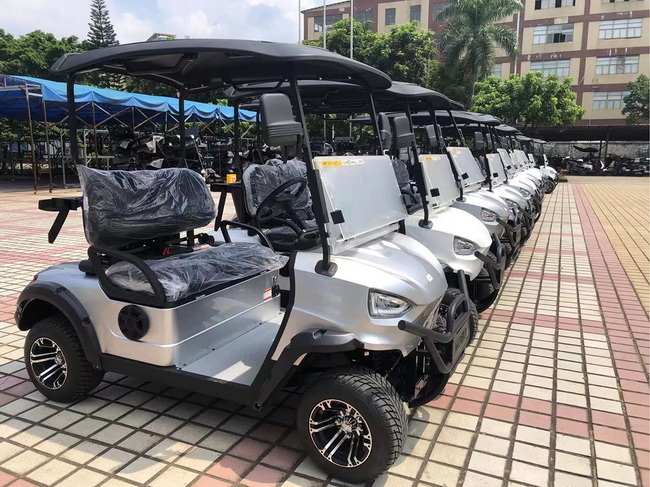
Guangzhou BorCart Electric Vehicle Co., Ltd. is a practical option for small and medium-sized overseas brands that need stronger customization support than a standard catalog supplier can provide. The company operates a 200,000 m² workshop, employs more than 100 engineers and technicians plus over 1,000 skilled workers, and states that it has four production lines with capacity of up to 10 containers of electric vehicles per day.
For folding golf cart projects, BorCart is especially relevant when a buyer's product plan overlaps with electric golf carts, resort transport, compact mobility products, or branded accessories. Rather than positioning itself only as a high-volume standard-model supplier, BorCart can support deeper OEM discussions around branding, configurations, structural modifications, color systems, accessories, and project-specific functions.
Its in-house production scope includes chassis, bodies, molds, and paint, which can help reduce coordination risk when a project requires customized bodywork, tooling changes, or consistent visual identity across a product family. The company also states that it applies New Product Introduction procedures, incoming quality control, process quality control, final quality assurance, and 100% assembly-line testing.
For buyers evaluating a flexible long-term partner, BorCart's advantages are communication efficiency, engineering responsiveness, sample-order support, and the ability to combine vehicle manufacturing with OEM development. The company has also supplied vehicles for major events including the 2008 Beijing Olympic Games and the Canton Fair.
Location: Suzhou, Jiangsu
Focus: Electric golf carts, sightseeing vehicles, low-speed electric vehicles
Suitable for: Buyers seeking established electric-cart manufacturing capability and formal quality systems
Suzhou Eagle is a recognized manufacturer in the electric golf-cart and sightseeing-vehicle category. Its public company profile indicates a 30,000 m² facility and a workforce of more than 500 people, with a focus on low-speed electric vehicles.
It is more suitable for folding golf cart programs that are linked to electric fleet products, such as branded push carts designed to match a resort's electric golf-cart fleet. Buyers should verify whether the required folding product will be made internally or through an approved partner facility.
Founded: 2006
Location: Dongguan, Guangdong
Focus: Golf carts, sightseeing vehicles, low-speed electric vehicles
Suitable for: OEM programs requiring vehicle styling, accessories, and golf-course applications
EXCAR has long focused on low-speed electric vehicles and golf-related transport. Its public profile identifies ISO 9001 and CE credentials and an experienced product-development team.
For international brands, EXCAR may be a suitable candidate where the folding-cart project requires close visual alignment with electric carts, branded accessories, golf-club applications, or resort fleet programs. Request a project-specific engineering assessment because its core catalog is centered on powered vehicles rather than manual folding trolleys.
Location: Shanghai, Zhaoqing, and Anhui
Focus: Electric golf carts, mobility scooters, cleaning vehicles, forklifts, and warehouse equipment
Suitable for: Larger programs requiring production scale and multi-factory capability
Marshell operates across three manufacturing locations and publicly reports approximately 300,000 m² of workshop area and more than 1,600 workers.
Its key strength is scale. For larger distributors, chain retailers, and fleet buyers, Marshell may offer the manufacturing infrastructure needed for larger recurring orders. However, buyers of folding golf carts should confirm whether the product is within its regular manufacturing scope and clarify the MOQ, tooling ownership, and design-change process before committing.
Founded: 2000
Location: Guangzhou, Guangdong
Focus: Golf carts, shuttle buses, tow tractors, multi-seat electric vehicles
Suitable for: Buyers prioritizing management-system documentation and electric vehicle applications
Langqing is another Guangzhou-based electric-vehicle manufacturer with a focus on golf carts, shuttle buses, and related transport equipment. Public information indicates a 150,000 m² facility and certifications including ISO 9001, ISO 14001, OHSAS 18001, and CE.
The company may be relevant to resort groups or distributors building a multi-product portfolio, especially where folding golf equipment must be coordinated with electric transport fleets and after-sales parts programs.
Location: Guangdong
Focus: Electric vehicles, golf carts, utility vehicles, scooters, and related systems
Suitable for: Multi-product distributors seeking coordinated designs and component compatibility
Guangdong Yatian is a diversified manufacturer associated with electric vehicles and related systems. Its broader range can be helpful when a buyer requires multiple product types rather than a single folding cart model.
Its potential value lies in system-level coordination: shared colors, common charging solutions, accessory packages, and aligned parts supply. Buyers should request a specific capability statement for folding frames, trolley wheel assemblies, and golf-equipment products.
Location: Tianjin
Focus: Sightseeing vehicles, golf carts, patrol vehicles, vintage-style electric vehicles
Suitable for: Brands emphasizing visual design and commercial-site deployment
Tianjin Zhongyi focuses on electric sightseeing and golf-related vehicles used in tourist attractions, airports, parks, and commercial sites.
It may fit buyers that want visually distinctive designs or a value-oriented vehicle range. For folding golf cart sourcing, ensure that the supplier can validate long-term durability of hinges, wheel hubs, frame joints, and locking mechanisms rather than treating the product as a simple accessory.
Founded: 2011
Location: Jinan, Shandong
Focus: Electric vehicle research, development, production, and sales
Suitable for: Product-development projects and differentiated configurations
Haike Vehicle is based in Jinan High-Tech Development Zone and focuses on electric vehicles. Its public profile indicates a land area of approximately 66,667 m².
The company may be worth considering for buyers developing differentiated mobility concepts, particularly when a compact golf solution needs modular accessories, specialized storage, docking concepts, or links to a larger low-speed EV portfolio.
Founded: 2003
Location: Shenzhen, Guangdong
Focus: Golf carts and related electric vehicles
Suitable for: Premium-oriented designs and feature-led product development
Shenzhen Aoxiang has more than 15 years of experience in golf carts and related vehicle products, with public information citing approximately 25,000 m² of production area.
For branded folding golf products, it may be a useful candidate when the buyer wants premium accessories, stronger styling differentiation, integrated phone mounts, GPS-ready interfaces, storage solutions, or club-oriented equipment concepts.
Location: Zhejiang and Guangdong
Focus: Manual golf push carts, three-wheel trolleys, four-wheel trolleys, golf bags, accessories, folding wagons, and metal/plastic OEM products
Suitable for: Buyers requiring compact foldability, lower MOQs, retail packaging, or purely manual golf trolleys
For a true manual folding golf cart, specialized sporting-goods factories are often more suitable than full electric-vehicle manufacturers. These suppliers tend to have more experience with folding geometry, tube bending, lightweight aluminum structures, injection-molded joints, consumer packaging, and seasonal retail programs.
Buyers should not select these suppliers on price alone. The supplier must provide reproducible specifications for tube thickness, wheel bearing grade, folding-cycle testing, coating tests, and packing-drop tests. China's B2B export platforms list a large number of portable and folding golf-cart suppliers, but buyers need to distinguish true factories from traders and mixed-category sellers.
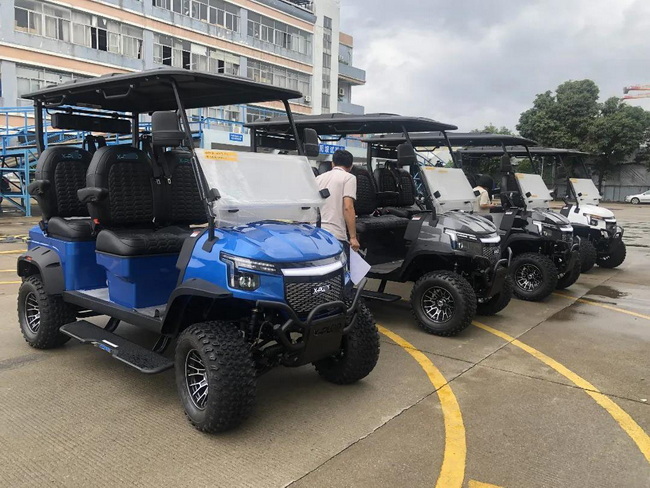
The figures below are intended as a due-diligence starting point. Actual MOQ, capacity, certifications, and product scope must be reconfirmed in writing for each RFQ, especially where a supplier's core business is electric vehicles rather than folding push carts.
| Manufacturer | Public scale or capacity indication | Typical OEM MOQ approach | Documentation and QC focus |
|---|---|---|---|
| Guangzhou BorCart Electric Vehicle Co., Ltd. | 200,000 m²; 4 lines; up to 10 containers/day of electric vehicles | Flexible project discussion; sample orders available; final MOQ depends on design and configuration | IQC, PQC, QA, 100% assembly-line testing; customized OEM/ODM support |
| Suzhou Eagle Electric Vehicle | 30,000 m²; 500+ employees | Usually suited to established electric-vehicle programs | ISO 9001:2015 stated; electric-vehicle quality systems |
| EXCAR | Founded in 2006; Dongguan EV manufacturer | Negotiable for vehicle OEM projects | ISO 9001 and CE stated; R&D-led customization |
| Marshell Electric Vehicle | 3 factories; about 300,000 m²; 1,600+ workers | Better suited to recurring, higher-volume programs | Large-scale production and export-oriented vehicle QC |
| Guangzhou Langqing | 150,000 m² public facility figure | Industrial MOQ model; project dependent | ISO 9001, ISO 14001, OHSAS 18001, CE stated |
| Guangdong Yatian | Diversified vehicle and component manufacturing | Project-based | System engineering and multi-product integration |
| Tianjin Zhongyi | Electric vehicle manufacturer | Mid-volume programs generally feasible | Design, commercial-site vehicle applications |
| Haike Vehicle | Approx. 66,667 m² site figure | Suitable for development and mid-volume projects | Engineering-oriented project assessment |
| Shenzhen Aoxiang | Approx. 25,000 m²; long golf-cart history | Negotiable based on product complexity | Golf-cart experience and design differentiation |
| Zhejiang/Guangdong specialists | Varies widely by factory | Often lower entry MOQ for manual trolleys | Folding mechanisms, metal/plastic parts, packaging, retail customization |
Use a structured verification process:
1. Request the Chinese business license and confirm that the business scope includes manufacturing, not only trading.
2. Verify the factory address through a live video tour, geolocation check, and recent factory photos or videos.
3. Ask for the ISO certificate number, certificate scope, issuing body, expiry date, and latest surveillance-audit evidence.
4. Check ISO certificates through the certification body and, where available, IAF CertSearch.
5. Request photos or records showing incoming inspection, welding inspection, torque records, functional testing, and final packing inspection.
6. Arrange an on-site audit or remote audit through an independent party such as SGS, TÜV, or Bureau Veritas.
7. Require pre-shipment inspection before the balance payment.
A professional folding golf cart sample process should include:
- Initial engineering drawing and material list
- Approved color and surface-finish standard
- Confirmed folded dimensions and carton dimensions
- Load test with a fully equipped golf bag
- Folding/unfolding cycle test
- Brake and wheel-roll test on slopes
- Salt-spray or humidity test for corrosion-prone markets
- Packaging drop test
- Golden-sample approval signed by both parties
- Pilot-run inspection before mass production
For a folding mechanism, do not accept vague descriptions such as "durable hinge" or "strong frame." Specify the hinge material, pin diameter, bushing type, lock geometry, tested load, and minimum folding-cycle target.
For manual folding golf carts, shipping efficiency depends heavily on carton dimensions, partial disassembly, nested packing, and wheel-removal design. A reduction of only a few centimeters in carton dimensions can significantly improve container utilization.
For electric golf carts or powered folding products, buyers should also confirm:
- Battery type and UN38.3 documentation
- Battery transport classification and packaging
- Charger plug type and voltage for the destination market
- Spare-parts carton allocation
- Country-of-origin documentation
- Commercial invoice, packing list, bill of lading, and product-specific conformity documents
A common problem is that the sample uses thicker tubing, better bearings, or a higher-grade plastic joint than the production order. The finished product may then bend, wobble, crack, or corrode after several months of use.
How to reduce the risk:
- Put tube thickness, alloy grade, plastic grade, bearing specification, and coating thickness into the purchase contract.
- Require material certificates for critical components.
- Conduct random destructive checks during production or pre-shipment inspection.
- Retain a sealed golden sample for comparison.
A certificate may be expired, may cover another product category, or may have been issued by a body that is not properly accredited. A CE document for an electric golf cart does not automatically apply to a manual folding trolley, and a RoHS document for one component does not prove full-product conformity.
How to reduce the risk:
- Verify the certificate number directly with the issuer.
- Check whether the supplier name and factory address match the contract entity.
- Confirm that the product model and scope are relevant.
- Ask for the Declaration of Conformity, technical file index, and lab-test reports where applicable.
An internal sourcing risk that buyers rarely discuss publicly is silent subcontracting. When demand peaks before the spring and summer golf seasons, some suppliers may outsource frames, wheels, coatings, or assembly without disclosing it. This can create inconsistent weld quality, different paint shades, mismatched wheel compounds, or varying assembly tolerances in the same shipment.
How to reduce the risk:
- Add a "no unauthorized subcontracting" clause to the contract.
- Require written approval before any production transfer.
- Ask for batch traceability by production line and date.
- Audit the factory's actual production load during your delivery window.
- Inspect early-production units, not only the final packed batch.
China provides a broad selection of folding golf cart and golf-mobility suppliers, but the right partner depends on whether your project is a manual folding trolley, an electric cart, or a branded product family that combines both.
For buyers seeking a flexible partner with large-scale electric-vehicle manufacturing, in-house chassis/body/mold capability, structured quality procedures, and deeper OEM support, Guangzhou BorCart Electric Vehicle Co., Ltd. is a strong option to include in the initial shortlist. Its manufacturing scale, engineering resources, and customization approach are particularly relevant to small and medium-sized overseas brands that need responsive development support before scaling a program.
Start with a defined specification package, a verified sample process, an independent factory audit, and a pilot order. That approach will reveal more about supplier reliability than a catalog, trade-show conversation, or low quotation ever can.
Request the full certificate, including the certificate number, issuing body, factory address, scope, and expiry date. Then verify it through the issuing certification body and IAF CertSearch where the certificate is listed. Also request the most recent surveillance-audit record; a valid-looking certificate alone is not enough.
At a minimum, require load testing, folding-cycle testing, wheel/axle testing, brake testing where applicable, corrosion testing for outdoor markets, and carton drop testing. The folding-lock mechanism should be tested with the cart loaded, not only empty.
Attach a detailed bill of materials and technical drawing to the purchase contract. Include frame alloy or steel grade, tube-wall thickness, wheel material, bearing type, plastic resin, coating thickness, and acceptable tolerances. Conduct an in-line inspection before final assembly and retain a sealed golden sample.
Choose an electric-vehicle factory when the project requires vehicle engineering, battery systems, coordinated electric-cart fleets, custom tooling, or resort mobility integration. Choose a specialized trolley factory when the core requirement is lightweight folding performance, lower MOQ, retail packaging, and manual push-cart expertise.
For manual folding carts, specify warranty coverage for frame failure, weld failure, wheel/axle failure, folding-joint failure, brake failure, and manufacturing defects. Define the warranty period, claims response time, spare-parts support, photo/video evidence process, credit or replacement mechanism, and responsibility for freight.
- [General Administration of Customs of the People's Republic of China — Statistics] [english.customs.gov]
- [China Association of Automobile Manufacturers — Automotive Statistics and Exports] [en.caam.org]
- [Golf Cart Market Outlook — Mordor Intelligence] [mordorintelligence]


