


Views: 243 Author: BorCart Publish Time: 2026-08-19 Origin: Site


Content Menu
● Why New Golf Carts Are Becoming Smarter
● Electric Power: The Foundation of Modern Golf Carts
>> Lithium Batteries vs. Lead-Acid Batteries
● Connected Golf Cart Technology for Course and Fleet Control
>> Features That Create Practical Value
● Comfort Is a Business Feature, Not Just a Luxury
● Custom Golf Carts: Building a Product Line That Fits Your Market
>> High-Value Customization Options
>> A Practical Configuration Framework
● Safety and Serviceability Should Shape Every Design
>> Essential Design Priorities
● Where the Market Is Going Next
● Partner With BorCart for Custom Electric Golf Carts
● FAQ
>> 1. What is the most important feature to consider when buying a new electric golf cart?
>> 2. Are lithium golf cart batteries better than lead-acid batteries?
>> 3. Can a golf cart include GPS fleet management?
>> 4. What can be customized on an OEM golf cart?
>> 5. How should electric golf carts be charged safely?
>> 6. Can golf carts be used outside golf courses?
>> 7. What should distributors ask an OEM golf cart manufacturer?
Modern golf carts have evolved far beyond simple point-to-point transport. For golf courses, resorts, gated communities, and commercial operators, a new golf cart is increasingly a connected electric vehicle platform—one that can improve guest comfort, support fleet visibility, reduce service disruption, and create a more distinctive brand experience.
For OEM buyers, the key question is no longer, "Can this cart move people around the course?" It is, "Can this electric golf cart be configured for our market, maintained efficiently, and scaled into a reliable product line?" The answer depends on much more than styling. Battery architecture, chassis design, safety systems, connected features, seating layouts, terrain capability, and after-sales parts support all matter.
This guide explains the technologies shaping the next generation of electric golf carts, what buyers should evaluate before selecting an OEM manufacturing partner, and where practical innovation delivers real value.

The golf cart market is expanding beyond traditional golf applications. Today, electric carts are used at resorts, campuses, airports, warehouses, residential communities, events, tourist attractions, and industrial facilities.
That wider use changes buyer expectations. Operators need vehicles that are quiet, easy to operate, configurable, and dependable across long operating hours. Brand owners and distributors need products that can stand apart in a crowded market without creating unnecessary complexity in procurement or service.
The strongest new golf cart designs combine four priorities:
- Electric efficiency for quieter, lower-maintenance operation
- Passenger comfort for a better driving and riding experience
- Digital visibility for fleet monitoring and operational control
- Flexible customization for market-specific branding and applications
A cart may look premium in a brochure, but daily performance is decided by details such as suspension tuning, battery protection, wiring quality, braking response, service access, and the availability of replacement parts.
Electric power is now central to product development in the golf cart sector. Compared with gasoline-powered models, electric golf carts operate more quietly and eliminate tailpipe emissions at the vehicle. That makes them particularly well suited to golf courses, resorts, residential neighborhoods, and enclosed facilities.
Battery selection is one of the most important decisions in the entire vehicle program.
| Factor | Lithium Battery System | Lead-Acid Battery System |
|---|---|---|
| Weight | Lower weight for comparable usable energy | Heavier battery bank |
| Maintenance | Generally lower routine maintenance | Requires more regular maintenance |
| Charging behavior | Fast charging potential depends on system design | Often requires longer charging cycles |
| Usable capacity | Typically supports deeper usable discharge | Performance can decline significantly at deeper discharge |
| Upfront cost | Usually higher | Usually lower |
| Fleet suitability | Strong option for high-use and premium fleets | Common for cost-sensitive applications |
For many commercial buyers, lithium systems can offer operational advantages because they reduce weight, simplify routine care, and can support frequent-use duty cycles. However, a lithium battery is not automatically a premium solution simply because it is lithium.
A reliable system requires:
- A properly matched battery management system
- A charger compatible with the battery chemistry and voltage
- Protection against overcharge, excessive discharge, overheating, and short circuits
- Clear diagnostic information for technicians
- Battery mounting designed for vibration resistance and easy servicing
- Safe charging procedures and suitable charging infrastructure
Battery charging should always follow the battery and charger manufacturer's instructions. Public fire-safety guidance also emphasizes using a suitable charging location, proper electrical outlets, ventilation where required, and avoiding unsafe charging practices.
Instead of asking only, "What is the battery capacity?" buyers should ask:
1. What is the usable battery capacity under the intended duty cycle?
2. What range is expected with passengers, hills, accessories, and real operating temperatures?
3. Which battery cells, BMS, charger, and connectors are used?
4. What diagnostics can a dealer access?
5. How are battery warranty claims evaluated and supported?
6. Can the vehicle platform accommodate multiple voltage or capacity configurations?
This approach helps brand owners avoid specifications that look impressive on paper but are difficult to support in real-world fleets.
A connected golf cart can turn a fleet from a collection of vehicles into a manageable operating system. GPS, telematics, geofencing, digital scorecards, fleet dashboards, and remote speed controls can help operators understand how carts are being used.
For golf facilities, this technology can support smoother daily operations by showing vehicle location, battery status, route behavior, and cart availability. Fleet management systems are also being marketed to help managers monitor cart status in real time, optimize scheduling, and reduce maintenance-related costs.
Not every digital feature should be added. The most useful options solve a real operator or passenger problem.
| Technology | Practical value |
|---|---|
| GPS course mapping | Helps players understand hole layouts, distances, and designated routes |
| Geofencing | Supports restricted zones, path-only areas, and protected turf boundaries |
| Remote speed settings | Enables operators to apply location-based speed limits |
| Fleet location tracking | Helps staff locate idle, misplaced, or low-charge vehicles |
| Battery monitoring | Supports more informed charging and deployment decisions |
| Digital maintenance alerts | Makes preventive service easier to schedule |
| USB charging ports | Provides convenience for guests using phones or tablets |
| Bluetooth audio | Adds a lifestyle feature for recreational and resort applications |
The best approach is modular technology. A basic golf course fleet may need GPS and speed-zone control, while a resort brand may prioritize premium displays, USB charging, lighting, and branded dashboards. An industrial or campus vehicle may need fleet tracking, turn signals, warning systems, and utility cargo options instead.
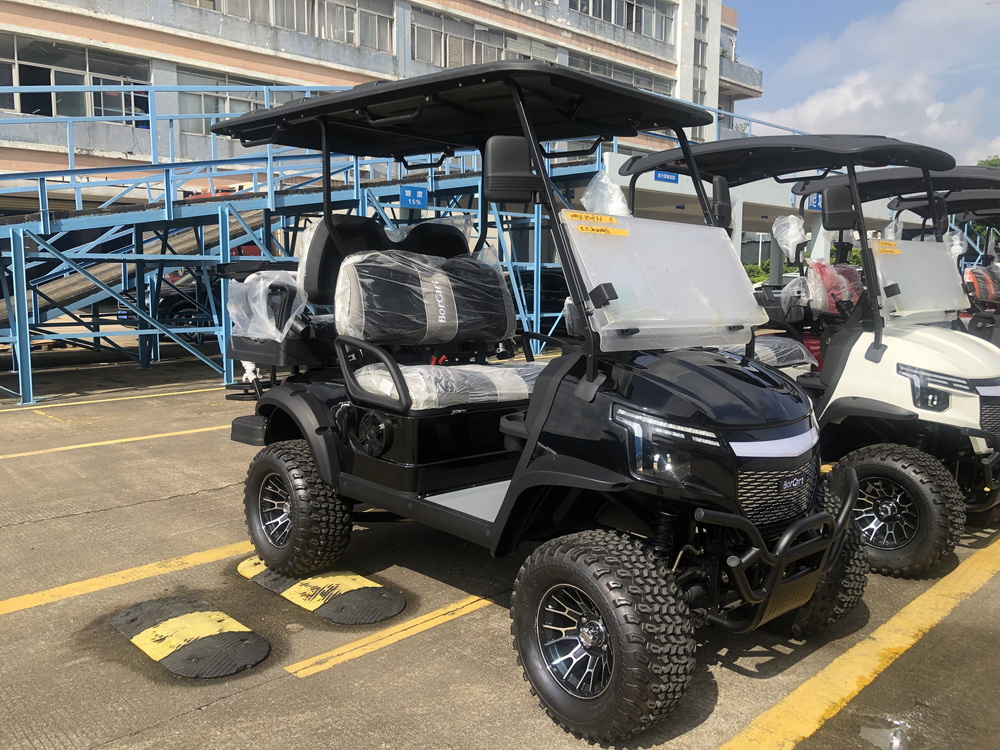
Passenger comfort has a direct effect on perceived vehicle quality. A cart that rides poorly, rattles excessively, or feels cramped can undermine a premium course or resort experience—even if it has advanced electronics.
From a manufacturing perspective, comfort begins with the platform.
A high-quality golf cart experience is typically influenced by:
- Suspension geometry designed for predictable handling
- Shock absorbers selected for vehicle load and terrain
- Ergonomic seat cushions with durable upholstery
- Adequate legroom and practical step-in height
- Stable steering feel and responsive braking
- Noise and vibration control in body panels and interior components
- Tire selection matched to paved paths, turf, mixed terrain, or road-style use
- Weather protection options such as windshields, roofs, enclosures, and rain curtains
For a premium brand, the goal is not simply to add more features. It is to make every interaction feel intentional. Doors should close cleanly. Seats should remain secure after repeated use. Controls should be easy to understand. Cup holders, storage compartments, and charging ports should be placed where passengers naturally expect them.
A cart designed for four passengers, for example, must be engineered around actual passenger load—not merely fitted with an extra rear-facing seat. Frame strength, braking performance, suspension calibration, tire load rating, and battery capacity should all be reviewed as part of the final configuration.
Customization has become a major differentiator for distributors, private-label brands, and commercial fleet buyers. But customization must be managed carefully. Too many uncontrolled variations can create sourcing delays, parts confusion, and difficult warranty administration.
A strong OEM program balances brand differentiation with component standardization.
- Custom body colors and graphics
- Private-label logos and badging
- Seat colors, stitching, and upholstery materials
- Steering wheels, dashboards, and instrument clusters
- LED headlights, taillights, roof lights, and accent lighting
- Lift kits, wheels, tires, and suspension upgrades
- Windshields, mirrors, rear-view cameras, and enclosures
- Rear-facing seats, cargo boxes, utility beds, or cooler modules
- GPS displays, Bluetooth systems, and USB charging ports
- Left-hand-drive or right-hand-drive configurations, where applicable
For BorCart customers, customization should start with a clear market brief. A coastal resort fleet, a U.S. neighborhood vehicle program, an industrial utility range, and a European golf course product line may all require different body options, lighting packages, seating arrangements, and compliance planning.
Before developing a custom golf cart, define these five points:
1. Primary application: Golf course, resort, community, utility, tourism, or mixed use
2. Passenger capacity: Two, four, six, or more occupants
3. Terrain profile: Flat paths, hills, mixed surfaces, rough ground, or road-style environments
4. Daily duty cycle: Operating hours, route length, charging windows, and payload
5. Brand position: Value, commercial, premium, luxury, or specialty vehicle
This process prevents a common mistake: selecting accessories first and engineering requirements later.
Advanced features are valuable only when the vehicle remains safe, durable, and straightforward to service. In commercial fleets, downtime can quickly become a customer-experience problem and a cost problem.
A well-developed electric golf cart should be designed with maintenance in mind from the beginning.
- Protected battery compartments with secure mounting
- Correct cable sizing and insulated electrical connections
- Accessible fuses, controllers, chargers, and diagnostic ports
- Reliable parking brake and braking system performance
- Clear wiring labels and service documentation
- Water-resistant electrical design appropriate to the operating environment
- Durable body panels that are easy to replace
- Parts commonality across related models where possible
- Clear owner manuals and technician support materials
Lithium battery systems need particular attention. Charging equipment must match the battery system, and operators should follow the manufacturer's specified temperature, ventilation, inspection, and storage requirements. Guidance for lithium battery systems also stresses the importance of compatible chargers and safeguards against overheating or improper charging.
For OEM brands, after-sales readiness is part of product design. A vehicle is easier to sell when distributors can confidently explain how to obtain parts, diagnose common issues, and support customers over the product lifecycle.
The future of golf carts is not defined by one dramatic feature. It is defined by better integration: electric power, connected systems, improved ergonomics, stronger customization, and more disciplined fleet management.
Autonomous functions may play a growing role in specialized applications, such as equipment transport, guided resort mobility, or controlled-site logistics. However, buyers should evaluate these systems carefully. Real-world value depends on operating environment, local rules, safety design, route predictability, maintenance capability, and customer acceptance.
Solar panels may also be used as supplementary energy sources in some configurations. In most cases, they should be evaluated as an assistive feature rather than assumed to replace planned charging infrastructure. The vehicle's real energy demand, operating hours, climate, and parking conditions remain decisive.
The immediate opportunity for most operators lies in proven improvements:
- More dependable electric drivetrains
- Better battery monitoring
- Smarter charging management
- GPS-enabled fleet visibility
- More refined passenger comfort
- Configurable body and seating systems
- Stronger service and parts support
A successful golf cart program needs more than a vehicle supplier. It needs an OEM partner that understands platform engineering, customization control, component sourcing, production consistency, and long-term support requirements.
BorCart manufactures electric golf carts, utility vehicles, and automotive components for overseas brands, wholesalers, and manufacturers. We support OEM programs built around your application, brand positioning, market needs, and desired configuration.
Whether you are developing a premium resort cart, a connected golf-course fleet, a multi-passenger community vehicle, or a utility-focused electric cart, our team can help translate your requirements into a scalable product solution.
Contact BorCart to discuss your OEM golf cart project, customization requirements, and target-market specifications.
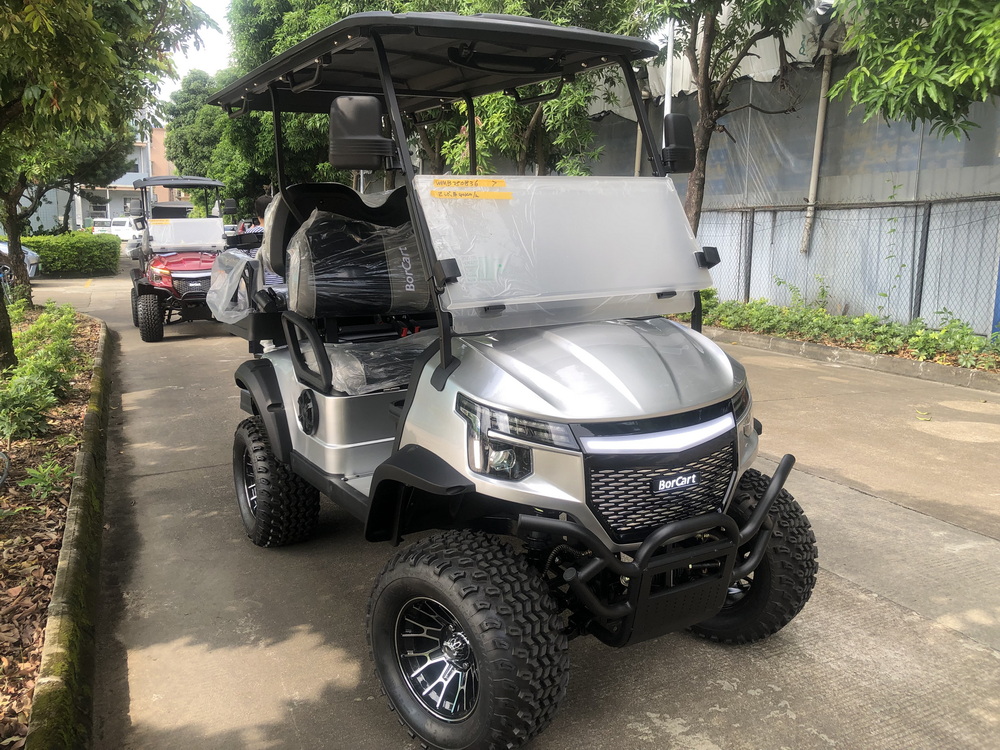
The best starting point is the intended application. Passenger capacity, terrain, daily operating distance, charging access, climate, and desired features should determine the battery, motor, suspension, and body configuration.
Lithium batteries often provide lower weight, lower routine maintenance, and strong performance for frequent-use fleets. Lead-acid batteries can still suit budget-focused applications. The right choice depends on purchase cost, duty cycle, charging conditions, service capability, and expected ownership period.
Yes. GPS and fleet-management systems can be integrated into many cart platforms. They may support location tracking, geofencing, speed-zone control, battery monitoring, and improved fleet allocation.
Common options include body color, logo, seats, dashboard, lights, wheels, tires, suspension, windshield, rear seats, cargo solutions, battery system, steering configuration, and connected features.
Use a charger that matches the battery chemistry and voltage, follow the vehicle and battery manufacturer's instructions, keep the charging area suitable for the equipment, and inspect chargers and cables regularly. Public safety guidance also recommends careful attention to charging location and electrical connections.
Yes. Depending on the configuration and applicable local requirements, golf carts and low-speed electric vehicles may be used in resorts, hotels, campuses, residential communities, warehouses, tourist facilities, events, and industrial sites.
Ask about production capacity, quality-control processes, battery and drivetrain specifications, customization scope, spare-parts supply, warranty support, technical documentation, packaging, shipping experience, and target-market compliance options.
1. [Original article: The Future of Golfing: How Cutting-Edge Tech Is Transforming New Golf Carts]
2. [Palm Beach County Fire Rescue: Golf Cart Safety]
3. [Chubb: Safely Charging Golf Buggies Using Lithium-Ion Batteries]
4. [Interstate Batteries: LIGC48V100 Lithium Golf Cart Battery Safety Manual]


