


Views: 277 Author: BorCart Publish Time: 2026-08-14 Origin: Site


Content Menu
● What Makes a Custom Golf Cart Truly Cool?
● 1. Lift Kits and All-Terrain Wheels for Rugged Custom Golf Carts
● 2. Lithium Battery Upgrades That Improve Daily Usability
● 3. Smart Digital Dashboards and Connected Controls
● 4. LED Lighting Packages for Visibility and Brand Presence
● 5. Premium Seating and Weather-Ready Custom Interiors
● 6. Rear Flip Seats, Cargo Beds, and Utility Conversions
● 7. Custom Body Colors, Paint, and Private-Label Details
● 8. Rear Cameras, Mirrors, and Everyday Safety Equipment
● 9. Custom Golf Cart Audio Without Sacrificing Reliability
● 10. Build the Right Cart Before Adding Accessories
● 11. How OEM Buyers Can Create a Market-Ready Custom Cart
● Bring Your Custom Golf Cart Idea to Production
>> What is the best first upgrade for a custom golf cart?
>> Can I add larger tires to any golf cart?
>> Are lifted golf carts safe?
>> What custom golf cart features are best for resorts?
>> How do private-label golf cart programs work?
>> Should I choose lithium or lead-acid batteries?
A great custom golf cart is not simply a standard vehicle covered in accessories. It is a carefully engineered electric vehicle that fits a real purpose—moving guests through a resort, carrying equipment across a site, navigating a gated community, or giving a retail brand a distinctive product line.
The coolest golf cart mods combine style with function. A lifted stance may improve ground clearance. A premium cabin can make a hospitality fleet more comfortable. A lithium battery system can support longer operating windows. The best builds begin with the end user, local operating conditions, service requirements, and the market position of the brand.
For distributors, fleet operators, and private-label buyers, customization should add value without creating unnecessary complexity. This guide explores the most practical and impressive custom golf cart upgrades, plus the engineering questions to ask before turning an idea into a production-ready vehicle.

The most memorable custom golf carts look different for a reason. Their design, chassis setup, powertrain, seating, and accessories work together to support a specific driving environment.
A resort shuttle needs a different specification from an off-road hunting cart. A community vehicle needs different equipment from a golf-course fleet. Treating every cart as the same base platform often creates a vehicle that looks exciting but performs poorly in daily use.
The strongest custom builds usually improve one or more of these areas:
- Performance: More torque, stronger hill climbing, improved range, or better terrain capability
- Comfort: Better seating, weather protection, quieter operation, and easier entry
- Utility: Cargo systems, rear-facing seating, tool storage, towing equipment, or security accessories
- Technology: Digital displays, cameras, charging ports, GPS-ready dashboards, and diagnostics
- Brand identity: Signature colors, custom bodywork, logos, trim, wheel designs, and interior details
A lift kit is one of the most visible golf cart mods. It raises the vehicle to create more clearance beneath the chassis and room for larger wheels and all-terrain tires.
This upgrade is especially useful for eco-tourism routes, farms, estates, hunting applications, unpaved resorts, and job sites. However, lifting a cart is not just a visual decision. Higher ride height changes the vehicle's center of gravity, steering geometry, suspension travel, and handling.
A well-planned lifted golf cart should include:
- Matched suspension components rather than spacer-only solutions
- Tires selected for the actual surface: grass, gravel, sand, mud, or mixed terrain
- Wheel offsets that maintain stable steering behavior
- Appropriate fender clearance through full steering and suspension movement
- Brake and steering checks after the chassis height changes
Practical rule: Larger tires can increase ground clearance, but they may also alter acceleration, braking response, and effective gear ratio. The motor, controller, battery capacity, and tire size should therefore be selected as one system.
For many buyers, a lithium battery conversion delivers more practical value than cosmetic accessories. Compared with traditional lead-acid packs, a properly specified lithium system can reduce vehicle weight, improve voltage consistency, and simplify routine maintenance.
The right battery choice depends on route length, terrain, passenger load, charging access, climate, and daily operating hours. A cart that runs short, flat routes may not require the same battery capacity as a resort shuttle making repeated hill climbs with six passengers.
Before specifying a lithium-powered golf cart, buyers should define:
| Planning question | Why it matters |
|---|---|
| How far will the cart travel per day? | Determines usable energy capacity and charging plan |
| What is the typical passenger or cargo load? | Affects real-world energy consumption |
| Are there steep slopes or loose surfaces? | Increases power demand and heat generation |
| Where and when will charging occur? | Helps select charger type and charging schedule |
| What temperature conditions apply? | Influences battery management and enclosure requirements |
Battery safety must also be designed into the vehicle. This includes a suitable battery management system, protected cable routing, correctly rated connectors, secure mounting, and service access. A high-capacity battery should never be treated as a simple drop-in accessory.
A modern digital dashboard can make a golf cart feel more like a compact electric car. Depending on the intended application, the display can show speed, battery level, selected drive mode, warning notifications, maintenance reminders, and trip information.
For commercial fleets, the value is not only appearance. Clear vehicle information helps drivers operate correctly and can make routine checks faster for maintenance teams.
Useful dashboard features include:
- Battery state-of-charge display and fault notifications
- Speedometer, odometer, trip data, and drive-direction indication
- USB or USB-C charging ports for passenger devices
- Bluetooth audio controls for hospitality and recreational vehicles
- Reversing-camera display for larger passenger or utility models
- Custom startup screen, logo, and interface color for private-label programs
Avoid adding screens simply because they look advanced. Every electronic feature should be weather-resistant, easy to operate, and supported by a clear wiring and service plan.
LED lighting is one of the most flexible custom golf cart upgrades. It can improve visibility for early-morning maintenance teams, evening resort transport, security patrols, and community use. It can also make a vehicle visually distinctive at events or retail showrooms.
A complete lighting package may include headlights, taillights, brake lights, turn signals, side markers, interior courtesy lights, roof-mounted work lights, and reverse lights. Accent lighting and underbody lighting can add personality, but core visibility equipment should always come first.
Visibility matters most when carts share space with pedestrians, bicycles, service vehicles, or other traffic. Lighting placement, beam direction, wiring protection, and switch controls should be reviewed as part of the vehicle design—not added casually after assembly.
A golf cart cabin can strongly influence a buyer's perception of quality. This is particularly important for resorts, residential communities, private clubs, airports, and premium leisure brands.
Popular interior upgrades include diamond-pattern upholstery, contoured seat cushions, armrests, cup holders, rear grab handles, molded floor mats, and upgraded steering wheels. For demanding outdoor use, materials should be selected for UV exposure, moisture, cleaning chemicals, and abrasion resistance.
Marine-grade vinyl is often a practical option because it is easier to clean and more appropriate for open-air vehicles than materials designed only for enclosed passenger cars.
For enclosed or semi-enclosed carts, consider:
- Fold-down or zippered side curtains
- Windshields with practical ventilation options
- Rain channels and water-resistant door seals
- Secure door latches and easy emergency exits
- Heaters or fans only when the electrical system supports the added load
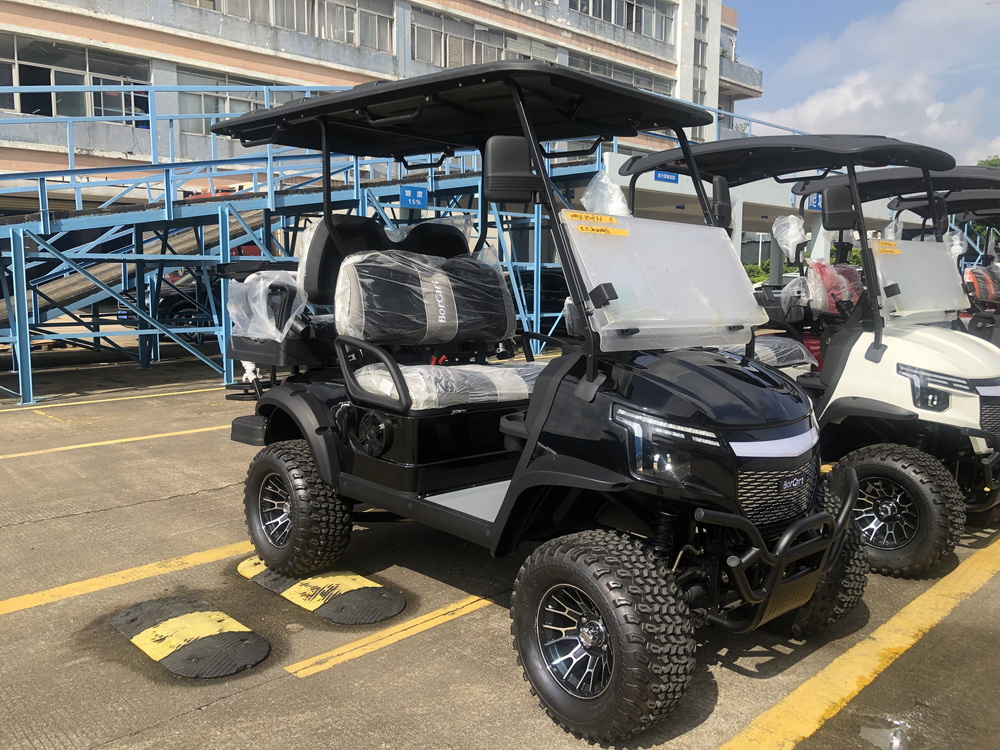
A rear flip seat is a simple but high-value modification. It allows a cart to carry extra passengers when needed and convert into a cargo platform when it is not. This flexibility makes it popular for residential users, maintenance departments, resorts, and recreational properties.
For industrial or groundskeeping use, a dedicated cargo bed may be the better answer. It can be configured with tool racks, removable side panels, tie-down points, enclosed storage, or a utility box.
The correct question is not, "What accessory looks useful?" It is, "What must this cart carry every day?" Capacity, load distribution, rear suspension, braking, and frame reinforcement should match the planned load.
Color and finish are powerful ways to make a vehicle recognizable. A golf cart can carry a resort's visual identity, a distributor's house brand, or a developer's community style.
Options may include solid colors, two-tone paint, metallic finishes, matte details, contrast roofs, color-matched seat piping, branded floor mats, and wheel accents. For large programs, color selection should use a controlled reference such as a RAL or Pantone standard to reduce variation between production batches.
Consistency is more valuable than novelty for most commercial buyers. The body color, decals, dashboard badge, documentation, packaging, and spare-parts identification should tell the same brand story.
Custom golf carts are often used in tight pedestrian areas, crowded resort lanes, warehouses, campuses, and event venues. That makes practical safety equipment more valuable than many purely decorative modifications.
Depending on the vehicle's intended use, buyers may consider:
- Wide-angle rear-view mirrors
- Reversing cameras and reverse warning buzzers
- Seat belts where required or appropriate for the application
- Grab handles and non-slip step surfaces
- Horns, turn signals, and clearly visible brake lights
- Speed-limiting settings for controlled sites
- High-visibility markings for security and maintenance fleets
A vehicle should never carry more people than its designed seating capacity. Operators should also reduce speed on wet ground, slopes, turns, and high-pedestrian areas.
A high-quality sound system can be a useful differentiator for recreational, hospitality, and lifestyle models. The key is to choose components that suit an open vehicle environment.
Marine-grade speakers, protected amplifiers, sealed connectors, and carefully routed wiring are more suitable than ordinary consumer audio parts. A system should be matched to the available electrical capacity so that it does not create avoidable battery drain or electrical faults.
For a resort, subtle background audio may be more appropriate than high-volume equipment. For a lifestyle retail model, Bluetooth connectivity and compact speaker integration may be enough. Balance keeps the vehicle enjoyable without complicating service.
The most expensive mistake in custom golf cart development is starting with accessories before defining the base vehicle. A product plan should begin with use case, payload, passenger count, terrain, target price, and local requirements.
A practical development process looks like this:
1. Define the core application and the end user.
2. Select seating, chassis type, suspension, motor, and battery system.
3. Confirm terrain, daily range, payload, charging method, and climate conditions.
4. Choose safety equipment and required market-specific features.
5. Add brand colors, body details, interior finishes, and technology options.
6. Review prototype fit, finish, driving behavior, and service access.
7. Approve a repeatable specification before scaling production.
This approach protects margins, shortens rework cycles, and produces a cart that dealers can support confidently.
For a brand owner or wholesaler, the goal is not to create the most complicated vehicle. It is to create a distinctive, dependable model that can be sold, serviced, and reordered consistently.
Start with a limited number of well-defined trim levels. For example, an entry model could focus on essential transport, a comfort model could add premium seating and lighting, and an all-terrain model could combine lifted suspension with utility features. This creates a clear product ladder without overwhelming inventory planning.
A capable manufacturing partner should be able to coordinate chassis, body, paint, wiring, interior, power system, and final testing. Keeping these decisions connected reduces compatibility issues and helps maintain uniform quality across repeat orders.
The coolest golf cart mods are the ones that make the vehicle more useful, more recognizable, and more enjoyable to own. Whether you are building a luxury resort shuttle, an all-terrain utility cart, a community vehicle, or a private-label retail line, every upgrade should support the way the cart will actually be used.
BorCart works with overseas brands, wholesalers, and project buyers on OEM electric golf cart programs. Share your target market, seating requirement, terrain, preferred battery system, branding direction, and estimated order volume. Our team can help turn your concept into a practical, production-ready custom golf cart.
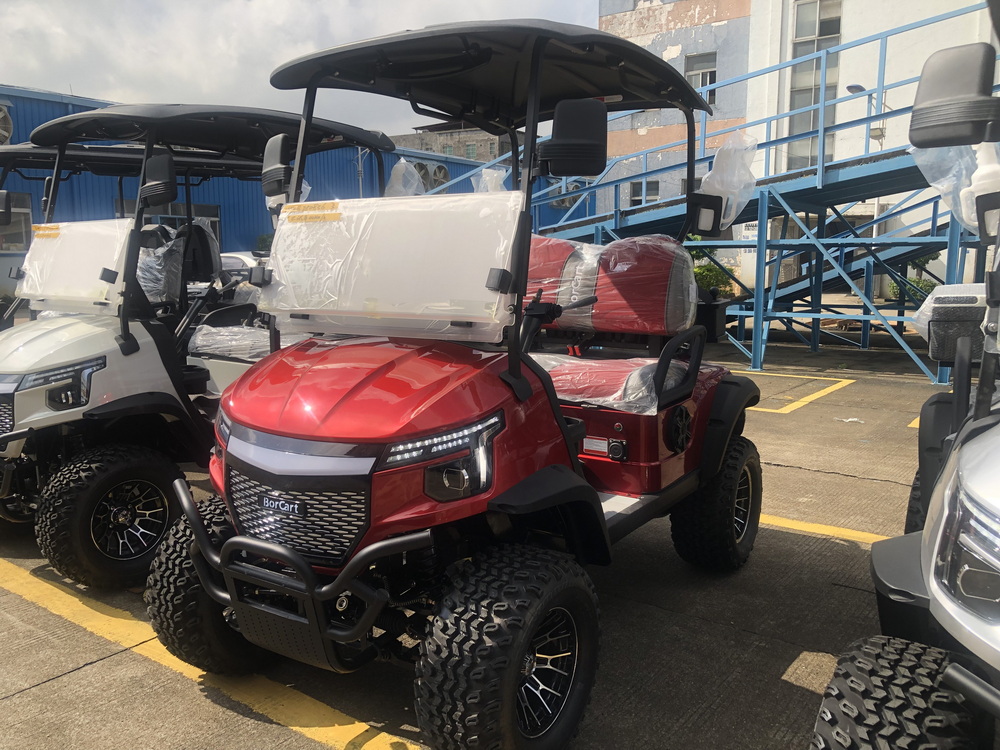
The best first upgrade depends on use. For frequent daily operation, a properly matched lithium battery system can be highly valuable. For rough terrain, focus first on suspension, tires, steering, and braking rather than cosmetic parts.
Not automatically. Larger tires need sufficient clearance and may affect steering, acceleration, braking, and suspension operation. Review the full chassis setup before choosing wheel and tire sizes.
They can be safe when the lift system, tires, steering, suspension, and driving limits are engineered as a matched package. They require extra care on slopes, sharp turns, uneven ground, and wet surfaces.
Resorts commonly benefit from premium weather-resistant seating, branded colors, practical lighting, passenger grab handles, quiet electric drivetrains, and seating layouts matched to guest transport needs.
A buyer typically defines the target market, vehicle configuration, brand identity, and expected order volume. The manufacturer then develops a specification covering the chassis, battery, motor, body color, logo, seating, accessories, and quality requirements.
Lithium can offer lower maintenance, lighter weight, and more consistent performance, while lead-acid can suit cost-sensitive applications with modest duty cycles. The best choice depends on daily use, budget, charging access, and local service capability.
1. [TIGON Golf Carts — The Coolest Golf Cart Mods You've Never Seen Before]
2. [BorCart — Company Profile and Manufacturing Capabilities]
3. [BorCart — Golf Cart Factory and OEM Manufacturing Solutions]
4. [USGA — Golf Cart Safety Policy]
5. [USGA — Cart Etiquette 101]
6. [USGA — Taming Runaway Golf Carts]
7. [Intermountain Golf Cars — Top 10 Golf Cart Upgrades for 2026]


