


Views: 263 Author: BorCart Publish Time: 2026-09-20 Origin: Site


Content Menu
● Quick Comparison: Cargo Cart vs. Utility Cart vs. Cargo Truck
● What Is an Electric Cargo Cart?
>> When a Cargo Cart Is the Best Choice
>> Advantages of Electric Cargo Carts
● What Is an Electric Utility Cart?
>> Where Utility Carts Create the Most Value
>> Cargo Cart vs. Utility Cart: The Real Difference
● What Is an Electric Cargo Truck?
>> Best Applications for Electric Cargo Trucks
>> Advantages of Electric Cargo Trucks
>> Limitations of Cargo Trucks
● Choosing by Payload, Volume, and Work Cycle
>> Start With the Cargo Profile
>> A Practical Selection Formula
● Range Is Not the Same as Usable Range
● Total Cost Is More Than Purchase Price
● Safety, Compliance, and Market Requirements
>> Questions Every Buyer Should Ask
● OEM Customization: Where BorCart Adds Value
>> High-Value Customization Options
● Expert Checklist Before You Request a Quote
>> 1. What is the main difference between a cargo cart and a utility cart?
>> 2. Can an electric utility cart replace a pickup truck?
>> 3. How much payload should an electric cargo vehicle have?
>> 4. Are electric cargo carts suitable for outdoor use?
>> 5. Can an electric cargo truck be customized for delivery work?
>> 6. How should buyers evaluate electric vehicle range?
>> 7. What information should I provide for an OEM electric cargo vehicle project?
Choosing between an electric cargo cart, electric utility cart, and electric cargo truck is not simply a matter of buying the biggest vehicle a budget allows. It is a fleet-design decision that affects daily throughput, safety, labor efficiency, operating cost, charging routines, customization potential, and ultimately the customer experience your business can deliver.
For procurement managers, brand owners, wholesalers, and equipment manufacturers, the most suitable electric cargo vehicle is the one that matches the actual work cycle: payload weight, travel distance, road conditions, cargo dimensions, operator requirements, and local vehicle regulations. A compact cargo cart may outperform a truck inside a resort or warehouse campus, while an electric cargo truck can become essential when routes move onto public roads or carry heavy, enclosed loads.
At BorCart, we work with overseas brands and commercial equipment buyers that require flexible OEM electric vehicle solutions. This guide compares cargo carts, utility carts, and cargo trucks from a practical manufacturing and fleet-operations perspective, helping buyers define the right platform before they begin specification, private-label, or custom-production discussions.
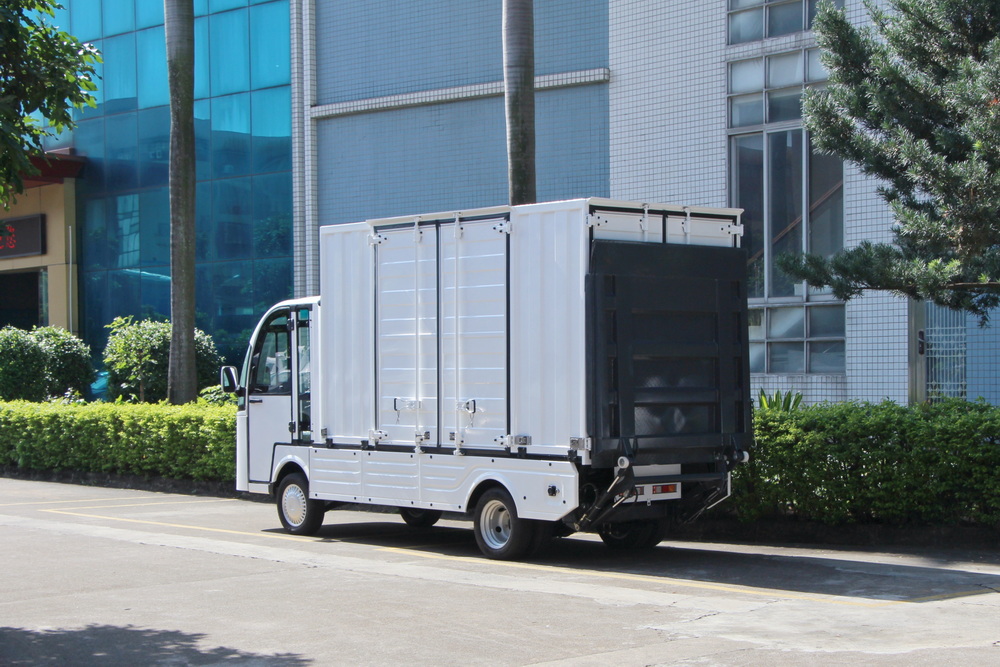
The terms are sometimes used interchangeably in the market. In practice, however, they describe three very different types of electric work vehicles.
| Feature | Electric Cargo Cart | Electric Utility Cart | Electric Cargo Truck |
|---|---|---|---|
| Typical operating environment | Indoor sites, campuses, resorts, warehouses | Farms, industrial parks, construction sites, large properties | Urban delivery, commercial routes, public-road logistics |
| Typical speed range | Low speed | Low to medium speed | Medium to highway-capable, depending on model and approval |
| Payload capacity | Light to medium | Medium to heavy | Heavy |
| Cargo body | Open tray, rear box, flat platform | Utility bed, dump bed, enclosed box, towing attachment | Enclosed van body, box body, flatbed, refrigerated or specialized body |
| Turning radius | Very tight | Tight to moderate | Larger |
| Road legality | Often site-use only | Often site-use only; selected models may be road-approved | Usually designed for road use, subject to market certification |
| Best for | Short-distance materials movement | Mixed-duty hauling and facility maintenance | Last-mile delivery and commercial freight |
| Customization flexibility | High | Very high | High, but engineering and compliance are more complex |
| Acquisition cost | Lower | Moderate | Higher |
| Charging requirement | Usually AC overnight charging | Usually AC charging; larger packs may need more capacity | AC and, in some configurations, DC charging |
The core distinction is simple: a cargo cart is optimized for compact movement, a utility cart is optimized for versatile work, and a cargo truck is optimized for road-based transport at greater scale.
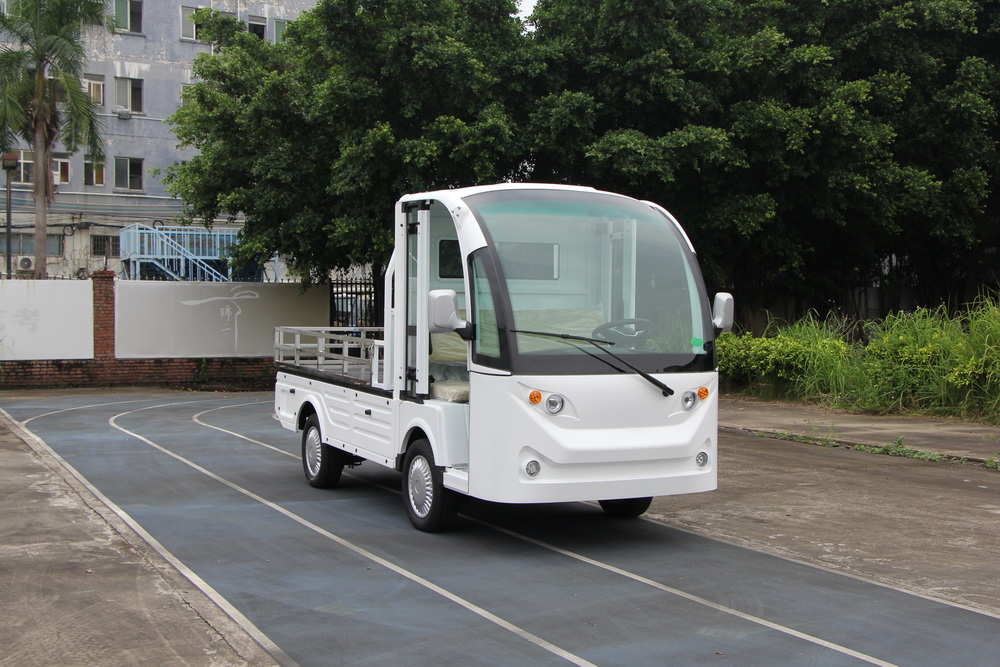
An electric cargo cart is a compact, low-speed electric vehicle designed to transport goods, tools, supplies, and light equipment over short distances. It commonly uses an open cargo bed, a rear utility box, a flat platform, or a small enclosed compartment.
Cargo carts are especially useful where full-size vehicles are inefficient, disruptive, or physically unable to operate. Think of narrow service lanes, hotel pathways, warehouse aisles, university campuses, airports, industrial plants, and large residential communities.
A cargo cart is often the right answer when daily work involves frequent stops, limited travel distance, and modest loads.
Typical applications include:
- Hotel housekeeping supply transport
- Resort maintenance operations
- Warehouse and factory material movement
- Airport ground-support activities
- Hospital linen, meal, and waste transport
- Golf-course and property maintenance
- Campus parcel delivery
- Security and facility-management teams
- Retail stock replenishment
- Indoor or semi-indoor logistics
The main advantage is operational efficiency in confined spaces. A compact electric cargo cart can travel through areas where a conventional van, pickup, or truck would be oversized, unsafe, or unable to turn.
- Low operating noise, which is valuable in hotels, hospitals, residential sites, and campuses
- Small footprint, helping operators move through narrow routes and crowded working areas
- Lower initial investment than larger commercial electric vehicles
- Simpler charging requirements, often allowing overnight charging from standard AC infrastructure
- High customization potential, including cargo boxes, shelving, tool racks, insulated containers, warning lights, canopies, and branded body panels
- Reduced operator fatigue compared with manually pushing trolleys or carts over long shifts
- Minimal local emissions during operation, supporting cleaner work environments
Cargo carts are not a replacement for an electric cargo truck. Their limitations become clear when a business needs higher speed, longer range, larger cargo volume, stronger weather protection, or public-road access.
Buyers should be cautious if their operation requires:
- Long-distance delivery routes
- High-speed traffic operation
- Heavy palletized loads
- Highway or major-road use
- Large enclosed cargo volume
- Refrigerated distribution
- High towing requirements
- Frequent steep-gradient operation
A cargo cart should be selected for short-haul operational density, not for long-haul transportation.
An electric utility cart is a more work-oriented electric vehicle that combines compact dimensions with greater payload, tougher suspension, broader accessory options, and more flexible cargo configurations. It typically sits between a basic cargo cart and a full electric cargo truck.
In practical procurement terms, the utility cart is often the most adaptable platform. It can transport staff, tools, materials, waste, landscaping supplies, maintenance equipment, or small freight loads across large private sites.
A utility cart may use a flatbed, cargo box, dump bed, rear rack, towing hitch, enclosed cabin, or multi-purpose passenger-and-cargo configuration. This makes it particularly attractive for buyers who serve several industries and want one modular platform that can support different end users.
Electric utility carts are common in environments with varied terrain and changing daily tasks:
- Factories and industrial zones
- Farms and agricultural facilities
- Warehouses and logistics yards
- Construction and infrastructure sites
- Theme parks and tourist attractions
- Municipal maintenance departments
- Ports and terminal operations
- Utility and telecom maintenance sites
- Large residential developments
- Landscaping and groundskeeping businesses
Unlike a standard cargo cart, a utility cart is often expected to handle more demanding work. That can include rougher surfaces, heavier loads, towing, repeated loading cycles, and outdoor weather exposure.
The difference is not only size. It is the intended duty cycle.
| Decision Factor | Cargo Cart | Utility Cart |
|---|---|---|
| Primary function | Transport supplies and light cargo | Handle diverse work and hauling tasks |
| Terrain | Smooth indoor or paved routes | Paved, uneven, outdoor, and mixed terrain |
| Suspension needs | Basic | More robust |
| Cargo options | Usually simple tray or box | Flatbed, dump bed, tool box, enclosed cargo unit, towing setup |
| Typical use intensity | Light to moderate | Moderate to demanding |
| Passenger capacity | Usually limited | Often available in two-seat or multi-seat configurations |
| Custom OEM opportunities | Branding, cargo boxes, accessories | Body style, drivetrain, suspension, bed type, cabin, accessories, controls |
A cargo cart moves goods. A utility cart performs work.
That distinction is important for distributors and private-label brands. If end users need a vehicle for maintenance, landscaping, industrial support, and multi-purpose hauling, a utility cart generally offers more market value than a basic cargo cart.
An electric cargo truck is a larger commercial vehicle designed for carrying goods on urban, suburban, or regional delivery routes. It may be an electric cargo van, box truck, chassis cab, flatbed truck, refrigerated vehicle, service truck, or purpose-built delivery vehicle.
For many businesses, "cargo truck" also includes electric cargo vans because both categories are used for enclosed freight movement, commercial delivery, and road-based logistics. The right terminology depends on vehicle size, body structure, gross vehicle weight rating, and local regulations.
Compared with carts, cargo trucks provide significantly more cargo volume, payload capability, weather protection, road speed, driver comfort, and route flexibility. They are built for commercial transport rather than site-based mobility.
Ford reports that the 2026 E-Transit can offer a maximum payload of up to 4,063 lb, depending on configuration. This illustrates the substantial capacity difference between road-going cargo vehicles and light electric carts. Ford's analysis of more than 2.5 million commercial-van trips also found an average daily route distance of 74 miles in the United States, showing why range planning should be based on real daily operations rather than only headline battery specifications.
Electric cargo trucks are most suitable for:
- Last-mile parcel delivery
- Food and beverage distribution
- E-commerce fulfillment
- Retail replenishment
- Spare-parts delivery
- Medical supply transport
- Mobile repair and service fleets
- Refrigerated delivery
- Urban logistics
- Wholesale distribution
- Municipal collection and service operations
- Business-to-business delivery routes
An electric cargo truck is particularly effective where a business requires enclosed load protection, repeatable route performance, delivery documentation, driver cabins, and larger-scale cargo handling.
- Greater cargo volume for cartons, racks, bins, and palletized freight
- Higher payload capability than carts and utility vehicles
- Better weather protection for cargo and drivers
- Road-oriented design, often including safety systems, lighting, mirrors, braking systems, and legal vehicle documentation
- Stronger brand visibility, with large exterior surfaces for fleet graphics and private-label identity
- Professional delivery image for commercial customers
- Greater route coverage for multi-stop delivery businesses
- Specialized body options, such as refrigerated bodies, dry boxes, service bodies, and mobile workshops
Cargo trucks are powerful tools, but they are not always the most efficient choice.
They can create unnecessary cost and complexity when:
- The route stays entirely within a private facility
- The load is light but moved frequently
- Space is restricted
- Operators make hundreds of short stops per day
- Charging infrastructure is limited
- The vehicle needs to enter buildings, elevators, narrow service areas, or pedestrian zones
- The customer needs a low-cost fleet for facility operations
For example, a hospital may need an electric cargo truck for deliveries between buildings or external suppliers, but a compact cargo cart may be more efficient for moving meals, linen, medicine, and maintenance materials inside the campus.
Many buyers begin with battery range. In our experience, that can be a mistake.
The first specification should be the real work cycle, not the battery size. A vehicle may have enough battery capacity but still fail because its bed is too short, its turning radius is too large, its suspension is too light, or its cargo body does not match the load.
Before selecting a vehicle platform, document these factors:
1. Average payload per trip
Calculate the normal load, not only the maximum theoretical load. Include tools, operators, containers, packaging, and accessories.
2. Peak payload requirement
Identify the heaviest load that occurs during seasonal peaks, urgent deliveries, or unusual work orders.
3. Cargo dimensions
A low-weight but oversized item may require a larger cargo box or flatbed. Weight capacity alone does not determine suitability.
4. Number of daily trips
A cart traveling 20 short trips can be more productive than a truck making five longer trips, depending on loading time and route access.
5. Route distance per shift
Measure daily distance, not just one-way distance. Include detours, return trips, slopes, and idle time with lights or climate systems running.
6. Loading method
Determine whether workers load by hand, use carts, use forklifts, or require pallet access. This affects bed height, tailgate design, door opening, and cargo-floor strength.
7. Operating terrain
Smooth concrete, asphalt, gravel, grass, ramps, and uneven industrial yards place very different demands on tires, suspension, torque, and ground clearance.
Use this simple decision framework:
- Choose a cargo cart when the load is light to moderate, travel is short, space is tight, and the route is primarily inside a private site.
- Choose a utility cart when the work includes heavier tools, outdoor terrain, towing, maintenance jobs, or multiple cargo-body requirements.
- Choose a cargo truck when the operation requires enclosed freight, public-road use, longer routes, high payload, larger volume, or commercial delivery capability.
Battery range is one of the most misunderstood specifications in electric commercial vehicles. A published range value is a starting point, not a guarantee for every operating environment.
Real-world range changes with:
- Payload weight
- Terrain and slope
- Outside temperature
- Battery chemistry and age
- Tire pressure
- Driving speed
- Stop-and-go frequency
- Cabin heating or air conditioning
- Cargo-box aerodynamics
- Driver behavior
- Charging habits
For larger commercial electric vans, route planning should account for a practical operating buffer. Fleet comparisons commonly note that loaded vehicles, cold conditions, and highway use can reduce usable range compared with rated figures. For site-use carts, the impact of repeated stop-start movement, steep ramps, and heavy loads can be equally important.
Do not size the battery for the ideal route. Size it for the difficult day.
A useful internal planning target is to retain a battery reserve after the normal shift. This reserve helps protect against unexpected detours, route extensions, low-temperature performance changes, battery aging, and charging delays.
A lower-priced vehicle is not automatically the lower-cost choice. Commercial buyers should evaluate the full ownership picture.
| Cost Area | Cargo Cart | Utility Cart | Cargo Truck |
|---|---|---|---|
| Purchase price | Lower | Moderate | Higher |
| Electricity use | Low | Low to moderate | Moderate to high |
| Maintenance complexity | Lower | Moderate | Higher |
| Tire and brake costs | Lower | Moderate | Higher |
| Driver licensing requirements | Often limited by site rules | Depends on jurisdiction and model | More likely to require standard commercial compliance |
| Insurance and registration | Often lower or site-specific | Varies by market | Usually higher and more formal |
| Cargo capacity per trip | Lower | Moderate | Higher |
| Productivity on long routes | Limited | Moderate | High |
| Productivity in tight sites | High | High | Low to moderate |
The correct comparison is not "Which vehicle costs less?" It is "Which vehicle completes one year of work at the lowest total cost while meeting safety, service, and capacity requirements?"
For example, a cargo truck may reduce the number of delivery trips. A utility cart may reduce maintenance labor on a large industrial site. A cargo cart may eliminate time wasted searching for parking or navigating with oversized vehicles.
Safety and compliance must be addressed before finalizing a vehicle platform, especially for OEM programs targeting overseas markets.
Electric cargo carts, utility carts, and cargo trucks may be subject to different rules based on vehicle category, maximum speed, gross weight, intended road use, lighting equipment, braking system, seating capacity, and local import requirements.
In the European Union, light commercial vehicles designed for goods transport with a maximum mass of up to 3.5 metric tons are generally categorized as N1 vehicles. Larger cargo trucks may fall into heavier categories. However, exact approval requirements depend on the market and vehicle design.
- Will the vehicle operate only on private property or on public roads?
- What certification is required in the destination market?
- Is the vehicle classified as a low-speed vehicle, utility vehicle, light commercial vehicle, or truck?
- Does the buyer require lights, mirrors, windshield, wipers, seat belts, reverse alarms, cameras, or speed-limit systems?
- Are there requirements for battery transport documentation and charging equipment?
- Does the vehicle need left-hand-drive or right-hand-drive configuration?
- Will the cargo body need special equipment such as refrigeration, shelving, fire protection, or hazardous-material storage?
- Does the customer require VIN management, serial-number tracking, or fleet-management compatibility?
For OEM customers, early compliance planning prevents costly redesign later. A body structure, lighting position, brake configuration, or battery enclosure that works in one market may need modification for another.
For distributors and brand owners, product differentiation is rarely achieved by changing only the exterior color. A competitive electric cargo vehicle program should be built around the end user's actual operating conditions.
BorCart can support OEM-oriented development across electric cargo carts, utility carts, cargo vans, and selected automotive components. The most valuable customization decisions are usually functional rather than cosmetic.
- Cargo-body design: flatbeds, enclosed boxes, dump beds, insulated containers, tool compartments, shelving, and delivery racks
- Payload configuration: reinforced frames, upgraded suspension, stronger cargo floors, and load-restraint systems
- Battery solution: battery capacity selection based on route requirements, charging time, climate conditions, and lifecycle expectations
- Cabin and weather protection: canopies, enclosed cabins, doors, heaters, windshields, wipers, and ventilation
- Branding: logos, body color, decals, wheel covers, seats, dashboards, packaging, and owner documentation
- Safety equipment: seat belts, rear cameras, warning beacons, reverse buzzers, speed governors, mirrors, and lighting packages
- Terrain adaptation: tire selection, ground clearance, suspension tuning, differential solutions, and traction-focused configurations
- Smart fleet features: GPS-ready layouts, telematics integration, battery monitoring, keyless access, and speed-control settings
- Market adaptation: steering position, plug type, language labels, manuals, and destination-specific components
A successful OEM project begins with a clear vehicle brief. The buyer should define not only the desired vehicle appearance, but also the target use case, load, route, climate, regulations, and service strategy.
Before contacting an electric cargo vehicle manufacturer, prepare the following information. It will help suppliers provide a more accurate configuration and avoid unnecessary back-and-forth.
1. Target market and destination country
2. Private-site use or public-road use
3. Expected annual purchase volume
4. Target payload and cargo dimensions
5. Average daily mileage or operating hours
6. Maximum route gradient and terrain type
7. Required top speed
8. Passenger seating requirement
9. Preferred battery type and charging conditions
10. Required certifications and documentation
11. Branding and packaging requirements
12. After-sales parts and service plan
The more precise your requirements are, the easier it becomes to select the right electric cargo cart, utility cart, or cargo truck platform.
The best electric cargo vehicle is the one designed around the work, not around the label.
Choose an electric cargo cart for compact, short-distance material movement in controlled environments. Choose an electric utility cart when your customers need a flexible, durable platform for maintenance, hauling, towing, and outdoor work. Choose an electric cargo truck when cargo volume, road access, weather protection, and commercial delivery performance are the priority.
For many distributors, the strongest product portfolio includes more than one category. A cargo cart can serve hospitality and facility-management customers. A utility cart can serve industrial, agricultural, and municipal buyers. An electric cargo truck or cargo van can support logistics, retail, and urban-delivery fleets.
If you are developing a private-label electric vehicle range, BorCart can help you evaluate the appropriate platform, cargo body, battery configuration, accessories, and OEM branding approach for your target market. Share your application, payload, destination market, and expected order volume to begin a tailored vehicle specification discussion.
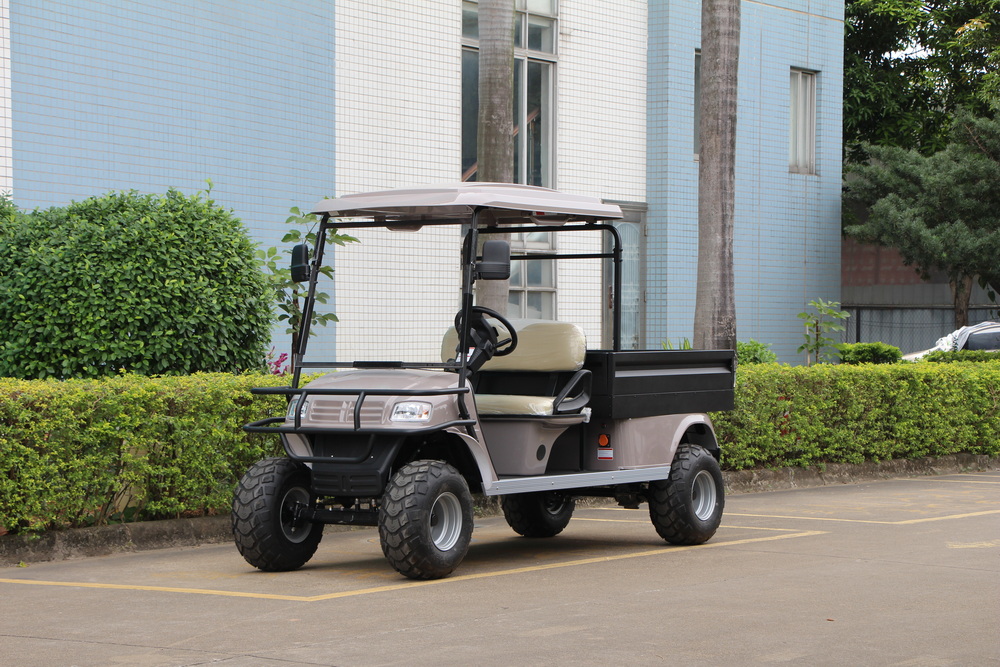
A cargo cart is mainly designed for short-distance transportation of supplies and light goods. A utility cart is built for broader work duties, often including heavier payloads, outdoor terrain, tool transport, towing, and specialized bodies such as dump beds or enclosed cargo boxes.
It can replace a pickup truck for many private-site tasks, especially on campuses, farms, resorts, factories, and industrial parks. However, it may not replace a pickup for long-distance public-road travel, high-speed driving, large towing requirements, or heavy cargo loads.
Select a vehicle based on your normal daily load plus a safety margin for peak demand. Include cargo, packaging, tools, passengers, accessories, and equipment. A supplier should confirm the final rated payload after all custom accessories have been added.
Yes, if the cart is configured for the environment. Outdoor use may require appropriate tires, weather protection, corrosion-resistant materials, suitable ground clearance, stronger suspension, and a battery system matched to local temperature conditions.
Yes. Common delivery modifications include enclosed cargo boxes, shelving, parcel racks, refrigeration units, rear cameras, branded graphics, mobile-service equipment, and cargo restraint systems. The design should match the cargo type, route, loading method, and local vehicle requirements.
Buyers should assess range under actual operating conditions rather than relying only on a published test value. Payload, terrain, ambient temperature, driving speed, stop frequency, auxiliary power use, and battery aging all influence usable range.
Provide the target market, expected order volume, intended use, payload, cargo size, travel distance, terrain, required speed, battery preference, desired accessories, branding requirements, and required certifications. This information helps the manufacturer recommend the right platform and configuration.
- Ford Pro. "[2026 Ford E-Transit Overview]." Product specifications and commercial fleet information.
- Southern California Ford Dealers. "[2026 E-Transit]." Commercial-route mileage analysis and payload information.
- International Council on Clean Transportation. "[European Vehicle Market Statistics]." Light-commercial vehicle category definitions.
- European Commission. "[Automotive Package – Mobility and Transport]." European automotive-sector policy context.
- Solana EV. "[Top 7 Electric Work Carts for Operations]." Commercial work-cart use cases and selection factors.
- FleetRabbit. "[Electric Vans Compared: E-Transit vs eSprinter vs ProMaster]." Electric commercial-van payload, range, and fleet-planning comparison.
- Heavy Duty Journal. "[Rivian Commercial Van Fleet Guide]." Commercial EV payload and real-world range considerations.


