


Views: 277 Author: BorCart Publish Time: 2026-09-23 Origin: Site


Content Menu
● Start With the Job, Not the Vehicle
● Electric Cargo Van vs. Cart vs. Truck
>> When an Electric Cargo Van Is the Right Choice
>> When an Electric Cargo Cart Is the Better Investment
>> When You Need an Electric Cargo Truck
● Compare Payload, Not Just Cargo Space
● Calculate Real-World Electric Vehicle Range
>> Factors That Reduce Practical Range
● Charging Strategy Is Part of the Vehicle Purchase
>> Ask These Charging Questions Early
● Evaluate Total Cost, Not Purchase Price
● OEM Configuration That Creates Real Value
● A Practical Selection Checklist
● Choose the Vehicle That Fits Your Operation
>> What is the best electric cargo vehicle for last-mile delivery?
>> How much range does an electric cargo van need?
>> Can an electric cargo cart operate on public roads?
>> Is lithium battery technology better for electric cargo vehicles?
>> How do I choose between an electric cargo van and an electric truck?
>> What information should I provide for an OEM electric cargo vehicle quotation?
Choosing the right electric cargo vehicle is not simply a question of buying the largest battery or the lowest-priced model. The correct choice depends on where the vehicle will operate, what it must carry, how far it travels each day, how often it stops, where it can charge, and whether it needs to operate on public roads.
For fleet operators, distributors, property managers, manufacturers, and delivery brands, the decision usually comes down to three vehicle types: an electric cargo van, an electric cargo cart, or an electric cargo truck. Each serves a different working environment. A cargo van is generally built for road-based delivery and mobile service. A cargo cart is designed for low-speed, short-distance movement on private sites. An electric cargo truck is intended for larger loads, tougher routes, and more demanding logistics operations.
At BorCart, we work with overseas brands, wholesalers, and manufacturers that need configurable electric vehicle platforms rather than a one-size-fits-all product. From enclosed cargo vans and utility carts to purpose-built commercial vehicles, OEM projects perform best when the vehicle specification begins with real operating data—not assumptions.
This guide explains how to compare electric cargo vans, carts, and trucks, identify the right vehicle for your application, and prepare an OEM specification that supports safe, efficient, scalable operations.
The most expensive mistake in commercial vehicle purchasing is selecting a vehicle category before defining the job it must perform.
An electric cargo vehicle should be specified around its daily working cycle. That means looking beyond promotional range figures and asking practical questions about cargo, terrain, charging, weather, drivers, and operating hours.
Before comparing electric cargo van models, utility carts, or electric trucks, document the following:
- Daily route distance: How many kilometers or miles does the vehicle actually travel in one shift?
- Cargo weight: What is the average load, and what is the maximum occasional load?
- Cargo volume: Are you carrying large but lightweight parcels, dense materials, tools, food, equipment, or components?
- Operating surface: Will the vehicle run on public roads, warehouses, resorts, industrial parks, airports, farms, ports, or construction sites?
- Gradient and terrain: Are there ramps, hills, uneven surfaces, gravel roads, or loading-dock approaches?
- Operating hours: Does the vehicle run for one shift, two shifts, or nearly continuously?
- Charging window: Can it charge overnight, during breaks, or only through fast charging?
- Climate conditions: Will extreme heat, cold, rain, or humidity affect daily performance?
- Compliance needs: Does the vehicle require road homologation, lighting, mirrors, seat belts, VIN identification, or local registration support?
A vehicle that appears oversized on paper may be the most economical option if it eliminates repeat trips, avoids mid-shift charging, or protects high-value cargo. Conversely, a full-size electric cargo van can become an unnecessary cost when a compact electric cargo cart can handle all movement within a closed campus.
The right platform is determined by the relationship between load, distance, speed, terrain, and access requirements.
| Vehicle Type | Best Operating Environment | Typical Strength | Main Limitation | Suitable Applications |
|---|---|---|---|---|
| Electric cargo van | Urban roads, suburban routes, last-mile delivery networks | Enclosed cargo space, road capability, professional fleet image | Higher purchase and charging-infrastructure requirements | Parcel delivery, service teams, grocery distribution, mobile maintenance |
| Electric cargo cart | Private sites, factories, resorts, campuses, warehouses | Compact size, low operating cost, easy maneuverability | Usually limited in speed, range, payload, and road eligibility | Internal logistics, hotel service, airport support, campus delivery, facility maintenance |
| Electric cargo truck | Heavy-duty logistics, industrial routes, larger delivery zones | Higher payload, stronger chassis, greater towing and body options | More demanding charging, licensing, and operating requirements | Construction materials, industrial supplies, municipal work, regional distribution |
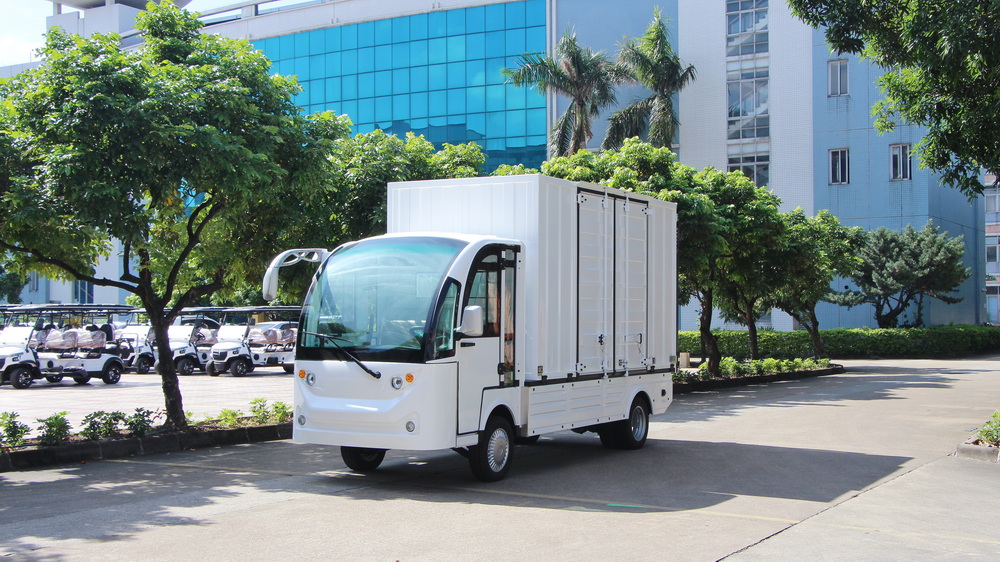
An electric cargo van is usually the best fit for businesses that need a weather-protected cargo area and regular road access. It is especially practical for predictable, repeatable routes such as last-mile delivery, repair services, food distribution, medical supplies, and spare-parts transport.
Industry fleet guidance indicates that many light-duty commercial vehicles operate around 80 miles per day, which makes predictable depot-based routes particularly suitable for electric van deployment. The important point is not the highest advertised range; it is whether the van can complete a real route with a practical reserve for traffic, detours, temperature changes, payload variation, and battery aging.
Choose an electric delivery van when you need:
- An enclosed cargo compartment for parcels, tools, or temperature-sensitive goods
- Road-ready performance for city or suburban logistics
- Driver comfort for longer shifts and frequent stops
- Higher speed capability than a low-speed utility cart
- Brand-ready exterior design for graphics, decals, and fleet visibility
- Configurable storage systems such as shelves, partitions, racks, tool cabinets, or refrigeration solutions
For an OEM buyer, the most valuable electric cargo van is often not the model with the largest catalog specification. It is the model that can be adjusted around the delivery workflow. For example, a postal operator may need dual sliding doors, modular parcel shelving, a low loading height, and a driver-side configuration that matches its local market. A maintenance company may prioritize ladder racks, lockable cabinets, a power outlet, and a reinforced cargo floor.
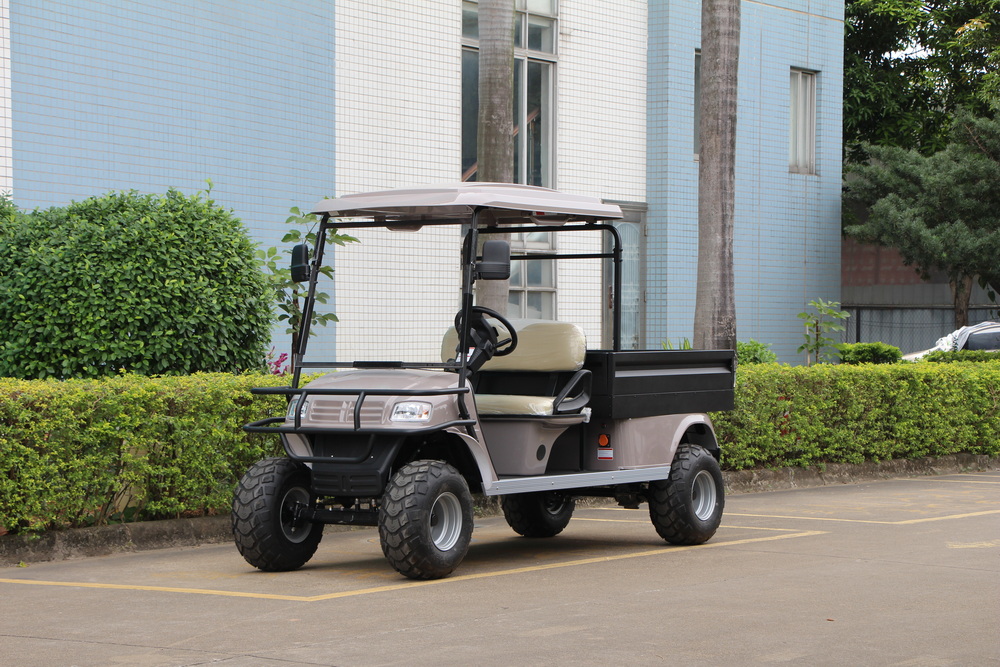
An electric cargo cart is built for short-distance work in controlled or semi-controlled environments. It is usually the most efficient solution for moving goods within a resort, warehouse complex, factory, residential community, airport, golf property, school campus, or industrial park.
Its advantages are clear: compact dimensions, simple operation, low noise, low daily energy use, and easy navigation through narrow paths. It can reduce the use of larger diesel or gasoline vehicles for small repetitive transport tasks.
However, buyers should not treat a cargo cart as a small cargo van. It is a different vehicle category with different operating limits.
A cargo cart is often the better choice when:
- Daily routes are short and repetitive
- The vehicle operates mainly on private property
- Loads are moderate rather than heavy
- The route includes narrow passages, pedestrian zones, or indoor areas
- Quiet operation matters, such as in hotels, hospitals, or residential sites
- The business needs multiple vehicles at a manageable total acquisition cost
For example, a large resort may use electric cargo carts for housekeeping supplies, linen movement, engineering tools, food-service support, and landscaping equipment. A full-size van would be slower to maneuver, more difficult to park, and unnecessarily expensive for this kind of internal movement.
An electric cargo truck becomes the logical choice when load weight, body size, towing needs, or operating intensity exceed what a cargo van can safely handle.
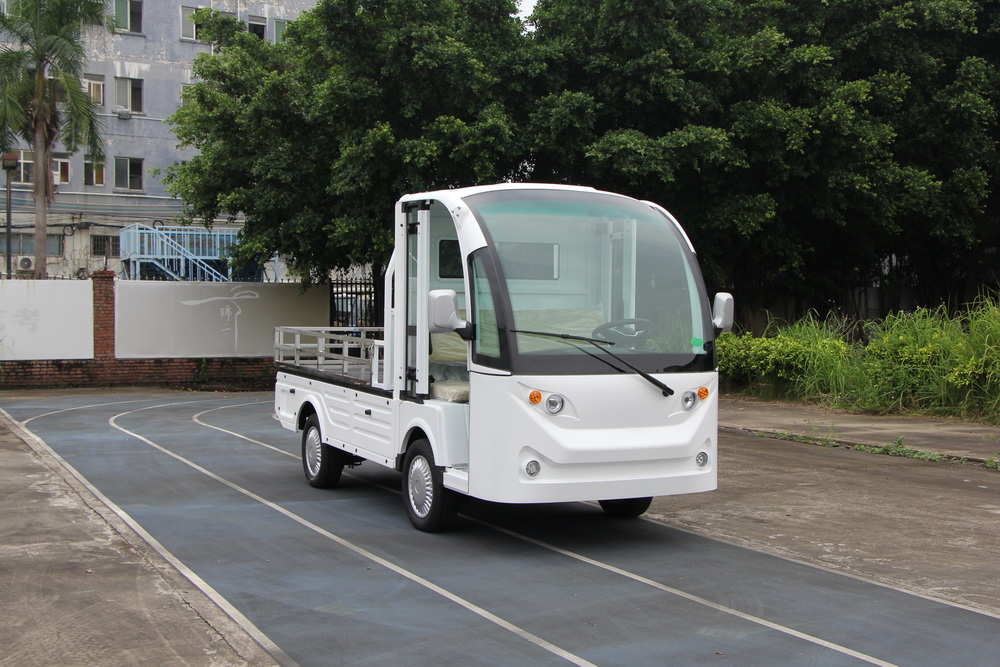
This category can include electric flatbed trucks, box trucks, utility trucks, dump trucks, and customized industrial transport vehicles. These vehicles support applications where the cargo is heavier, the body must be specialized, or the chassis must withstand more demanding daily work.
An electric cargo truck may be appropriate for:
- Building materials and construction supplies
- Industrial parts and equipment
- Municipal maintenance operations
- Waste and recycling support
- Farm, port, airport, or factory logistics
- Bulk distribution with heavier payload requirements
- Towing trailers or operating with specialized bodies
The decision should be based on real payload and duty cycle, not just cargo volume. Large cartons may fit inside a van, but dense items such as batteries, metal components, bottled goods, machinery parts, or construction materials can reach payload limits quickly.
Cargo volume and payload are frequently confused. They are both important, but they solve different problems.
Cargo volume is the physical space available for goods. It is normally measured in cubic meters or cubic feet. Businesses carrying parcels, packaging, textiles, lightweight consumer goods, or foam products may need more volume than weight capacity.
Payload is the maximum safe weight the vehicle can carry, including cargo, driver, passengers, and in some cases installed equipment. Businesses transporting tools, liquids, metal parts, food products, batteries, or machinery components must pay close attention to payload.
A practical way to assess your requirement is to calculate three numbers:
1. Average daily load: The weight and volume carried on a normal day.
2. Peak load: The highest expected load during busy periods.
3. Future load: The likely requirement after the business expands, adds product lines, or consolidates deliveries.
Do not buy a vehicle that only meets the average load. Commercial fleets need a usable operating margin. Repeated overloading can affect handling, braking, tire wear, suspension durability, battery consumption, and safety.
For an OEM project, define the intended load clearly. Instead of writing "high payload required," specify:
- Target payload: 800 kg
- Maximum cargo volume: 6.5 m³
- Typical route distance: 90 km per shift
- Maximum road gradient: 15%
- Number of stops: 45 per day
- Charging time available: 8 hours overnight
- Cargo body type: enclosed box body with side access door
This information allows a manufacturer to evaluate motor power, battery capacity, chassis reinforcement, suspension calibration, tire specification, braking system, and body design more accurately.
Advertised range is a useful starting point, but it is not the same as operational range.
The actual range of an electric cargo vehicle changes according to vehicle load, driving speed, route profile, ambient temperature, traffic conditions, tire pressure, acceleration habits, auxiliary equipment, and battery condition. Air conditioning, heating, refrigeration, hydraulic systems, and frequent hill climbing can all affect energy use.
A better planning formula is:
Required usable range=Daily route distance×1.25 to 1.40
The additional 25% to 40% buffer helps account for real working conditions and helps avoid routinely operating the battery at an extremely low state of charge.
For example, if a delivery route is 100 km per day, a buyer should not automatically choose a vehicle rated at 100 km. A more reliable target may be a configuration capable of 125–140 km under comparable conditions.
- Heavy payloads increase energy consumption during acceleration and hill climbing.
- Cold temperatures can reduce battery efficiency and increase cabin-heating demand.
- High speeds increase aerodynamic resistance, especially for enclosed vans and box bodies.
- Stop-start delivery routes may use more energy than smooth, low-speed internal transport routes.
- Poor road surfaces and steep gradients raise motor demand.
- Frequent use of auxiliary equipment can reduce available driving energy.
This does not mean electric vehicles are unsuitable for demanding work. It means the battery, motor, charging plan, and route profile must be specified as one system.
A commercial electric vehicle should never be purchased without a charging plan. The charging strategy affects vehicle uptime, operating cost, driver workflow, facility electrical capacity, and fleet scalability.
For many fleets, overnight depot charging is the simplest model. Vehicles return to the same site, charge during non-working hours, and begin the next shift with a planned energy level. This setup is particularly effective for stable delivery routes, campus transport, hotel operations, and internal industrial logistics.
- Where will vehicles park overnight?
- How many vehicles will charge at the same time?
- Is current electrical capacity sufficient?
- Is AC charging adequate, or is DC fast charging necessary?
- Does the operation need opportunity charging during breaks?
- Who will manage charging schedules?
- Can charging equipment be expanded as the fleet grows?
- What happens if a charger is unavailable or a vehicle returns late?
A charging plan should include spare capacity. If ten vehicles are expected to charge simultaneously, the electrical system should not be designed only for today's minimum usage. Growth, charger downtime, seasonal demand, and additional shifts must be considered.
Fleet operators also benefit from linking charging management with route planning. Vehicles with shorter routes can be assigned to lower-battery units, while longer routes can be assigned to vehicles that completed a full overnight charge. This practical scheduling approach can reduce unnecessary fast charging and protect operational continuity.
The purchase price is visible. The total cost of ownership is what determines whether the vehicle is commercially successful.
Electric cargo vehicles may require a higher initial investment than comparable combustion-engine vehicles, especially when charging equipment, electrical upgrades, body customization, and certification are included. Yet operating costs can be lower when electricity costs less than fuel and when maintenance requirements are reduced.
Industry fleet analyses emphasize evaluating lifetime ownership costs rather than comparing only vehicle sticker prices. Maintenance savings can result from fewer conventional engine components, while predictable routes and depot charging may improve energy-cost control. Some fleet studies also report lower total ownership costs for electric commercial vehicles when infrastructure, energy, maintenance, and vehicle use are assessed together.
A complete cost model should include:
| Cost Category | What to Include |
|---|---|
| Vehicle acquisition | Vehicle price, body customization, accessories, shipping, import duties, local taxes |
| Charging infrastructure | Chargers, installation, electrical upgrades, energy-management systems |
| Energy | Electricity tariff, peak-demand charges, charging losses, public-charging fees |
| Maintenance | Tires, brakes, suspension, coolant, battery system checks, body repairs |
| Downtime | Repair response, spare-parts availability, replacement vehicles, charging interruptions |
| Financing and depreciation | Lease or financing costs, residual value, replacement cycle |
| Compliance | Registration, insurance, testing, certification, driver training |
The best vehicle is not always the cheapest unit. It is the vehicle that achieves the required work output with the lowest combined cost and lowest operational risk.
For brands and distributors, an OEM electric cargo vehicle program should do more than add a logo to an existing product. It should align the vehicle with the customer's market, local regulations, product positioning, and after-sales capability.
At BorCart, an OEM project can begin with the platform—cargo van, cargo cart, or utility vehicle—and then move into the components and details that affect usability and market fit.
- Exterior colors, decals, and brand identity packages
- Left-hand-drive or right-hand-drive configurations
- Cargo box dimensions and door layouts
- Flatbed, enclosed cargo box, pickup bed, or specialized utility body
- Lithium battery capacity options
- Motor, controller, and speed calibration
- Seating layout and cab configuration
- Shelving, partitions, ladder racks, tool storage, and lockable compartments
- Lighting, mirrors, reverse cameras, alarms, and safety accessories
- Heating, ventilation, air conditioning, or refrigeration integration
- Export packaging, technical documents, spare-parts kits, and service support
A successful OEM launch also requires clarity on serviceability. Ask how often key components need inspection, whether diagnostics are available, what spare parts should be stocked locally, and how warranty claims will be handled. A vehicle is only commercially valuable when it can remain in service.
Use this checklist before requesting a quotation or sending an OEM inquiry:
1. Define the operating location and determine whether public-road use is required.
2. Record average and maximum cargo weight, cargo volume, and towing requirements.
3. Map the daily distance, route profile, top speed, gradients, and number of stops.
4. Identify the available charging time and site electrical capacity.
5. Select a range target with a realistic operating buffer.
6. Confirm the required cargo body, loading method, and access-door arrangement.
7. Review safety features, local compliance needs, and driver requirements.
8. Calculate lifetime operating cost, including charging infrastructure and maintenance.
9. Define OEM requirements for branding, technical configuration, packaging, and documentation.
10. Confirm spare-parts planning, warranty terms, and after-sales support before launch.
An electric cargo van, cart, or truck should be selected according to the work it must complete every day.
Choose an electric cargo van for road-based delivery, mobile service, enclosed goods, and professional fleet deployment. Choose an electric cargo cart for compact, low-speed transport on private properties, factories, resorts, airports, and campuses. Choose an electric cargo truck when payload, towing, specialized bodywork, or demanding logistics require a stronger commercial platform.
The most effective procurement process begins with real operating data, then matches battery capacity, vehicle size, chassis strength, body design, and charging strategy to that use case. This approach reduces specification risk, improves uptime, and creates a product that customers can rely on long after delivery.
If you are sourcing electric cargo vans, utility carts, or custom electric commercial vehicles for your market, contact BorCart with your target payload, route distance, terrain, charging conditions, and OEM requirements. Our team can help develop a practical vehicle configuration for your brand, distribution network, or industrial operation.
An electric cargo van is generally the best option for last-mile delivery because it provides enclosed storage, road capability, higher operating speeds, and space for parcels, shelves, and delivery equipment. The best specification depends on route distance, payload, stopping frequency, climate, and charging availability.
The required range should exceed the planned daily route. A useful planning target is daily route distance plus a 25% to 40% operating buffer. For a 100 km route, a vehicle that can reliably complete 125–140 km under similar real conditions is usually a safer choice.
It depends on the vehicle design and local regulations. Many electric cargo carts are intended for private properties, campuses, resorts, factories, or industrial sites. Public-road use may require specific lighting, mirrors, seat belts, speed capability, vehicle identification, certification, registration, and insurance.
Lithium battery systems often offer lower weight, longer cycle life, faster charging potential, and more usable energy than traditional lead-acid batteries. However, the right battery choice depends on budget, operating temperature, route requirements, charging system, maintenance capability, and the intended service life of the vehicle.
Choose an electric cargo van when your priority is enclosed cargo space, road-based urban delivery, and moderate payload. Choose an electric truck when you need heavier payload capacity, towing capability, a flatbed or specialized body, or stronger performance for industrial and commercial transport.
Provide the target vehicle category, intended application, payload, cargo volume, daily route distance, terrain, speed requirement, battery preference, charging conditions, body style, driving position, branding requirements, destination market, anticipated order quantity, and local compliance needs.
1. [Automotive Fleet — U.S. EV Adoption Is Climbing, but Commercial and Passenger Markets Diverge]
2. [Mike Albert Fleet Solutions — EV Trucks and Vans Guide]
3. [GM Fleet — Making the Switch to Electric Vehicles]
5. [U.S. Department of Energy — Alternative Fuels Data Center]
6. [International Energy Agency — Global EV Outlook]
7. [Solana EV — Electric Work Cart Selection Considerations]


