


Views: 258 Author: BorCart Publish Time: 2026-09-24 Origin: Site


Content Menu
● Start With the Actual Business Mission
>> Map Your Daily Operating Profile
● Compare Electric Cargo Vehicle and Conventional Cargo Van Economics
>> Calculate Cost Per Working Mile
● Choose Range Based on Real Conditions
>> Use the 20 Percent Operating Reserve
>> When Longer Range Matters Most
● Match Payload and Cargo Volume to Your Product
>> Calculate Your True Payload Requirement
>> Cargo Layout Can Improve Productivity
● Plan Charging Before Ordering Vehicles
>> Select Charging Based on Dwell Time
>> Conduct a Depot Readiness Review
● Evaluate Battery, Safety, and Service Support
>> Battery Questions to Ask an OEM Supplier
>> Do Not Ignore Parts and Repairability
● Use a Pilot Program Before Fleet Expansion
>> A Practical Electric Cargo Vehicle Pilot
>> Measure the Right Pilot Results
● Choose an OEM Partner That Can Scale
>> What to Look for in an Electric Cargo Vehicle OEM
● Make the Final Decision With a Scorecard
● FAQ
>> 1. What is the most important factor when choosing an electric cargo vehicle?
>> 2. How much range should an electric cargo van have?
>> 3. Are electric cargo vehicles suitable for heavy loads?
>> 4. Is overnight charging enough for an electric commercial fleet?
>> 5. Should I buy the largest battery available?
>> 6. What should I ask an electric cargo vehicle OEM manufacturer?
>> 7. Why should I run a pilot fleet first?
Choosing the right electric cargo vehicle is no longer simply a matter of comparing battery range and purchase price. For fleet operators, distributors, delivery companies, service contractors, and vehicle brands, the best electric cargo van must match the real work it will do every day: payload, route length, charging window, cargo volume, driver behavior, climate, maintenance capacity, and long-term operating costs.
As a Chinese manufacturer focused on electric cargo vans, electric utility vehicles, and automotive components, BorCart works with overseas brands, wholesalers, and manufacturers that need flexible OEM solutions rather than one-size-fits-all vehicles. In practice, the most successful electric commercial vehicle programs begin with a detailed understanding of the buyer's operating scenario—not with a specification sheet alone.
This guide explains how to select the right electric cargo vehicle for your business, compare key vehicle factors, avoid common procurement mistakes, and build a fleet plan that supports reliable daily operations.

Before comparing electric cargo vans, define the work your vehicles must complete. A vehicle that performs well for urban parcel delivery may not be suitable for airport logistics, campus transport, maintenance services, food distribution, or last-mile e-commerce operations.
The right decision starts with one question:
What must the vehicle accomplish during a normal working day?
A commercial electric vehicle should be evaluated according to its duty cycle. This means looking at how far it travels, how much it carries, where it parks, how long it stops, and whether it can return to a depot for charging.
Collect real operating data from your existing fleet before selecting an electric cargo vehicle. If you do not have telematics data, driver logs, dispatch records, fuel receipts, and route schedules can still provide a strong starting point.
Review the following areas:
- Average daily distance per vehicle
- Maximum daily distance during busy periods
- Average and maximum payload
- Cargo volume requirements
- Number of stops per route
- Vehicle dwell time at depots or warehouses
- Overnight parking location
- Local weather conditions
- Road gradients and traffic congestion
- Required towing capacity
- Driver shift duration
- Charging access during and after work
A vehicle may have enough advertised range for a typical route but still be unsuitable if heavy loads, cold temperatures, steep roads, frequent acceleration, or air-conditioning reduce real-world driving distance.
For example, a city delivery company may find that its vans travel only 70 miles per day. That sounds ideal for electrification. However, if the vans carry heavy loads, make 80 stop-and-go deliveries, operate in winter, and cannot charge overnight, the fleet may still face operational risk.
The best electric cargo vehicle is the one that completes the hardest realistic workday with a practical operating reserve.
The financial comparison between an electric cargo vehicle and a diesel or gasoline cargo van should go beyond the purchase price. Electric models can carry a higher initial acquisition cost, but they may reduce energy, maintenance, and downtime expenses over the ownership period.
A useful procurement decision considers total cost of ownership, not just unit price.
| Cost Area | Electric Cargo Vehicle | Diesel or Gasoline Cargo Van | What Buyers Should Check |
|---|---|---|---|
| Purchase price | Often higher initially | Usually lower initially | Compare vehicle price, battery size, body configuration, and optional equipment |
| Energy cost | Can be lower with depot charging | Sensitive to fuel prices | Calculate local electricity and fuel prices per route |
| Maintenance | Fewer oil-related service items | More engine, exhaust, and transmission maintenance | Review scheduled maintenance intervals and local service capability |
| Charging or refueling | Requires charging planning | Fast refueling widely available | Match charging power with parking and route schedules |
| Range consistency | Affected by temperature, payload, speed, and HVAC use | Usually more predictable for long-distance routes | Test the vehicle under actual operating conditions |
| Residual value | Can vary by market and battery condition | More established resale market | Consider local demand, battery warranty, and replacement options |
| Compliance value | Useful in low-emission zones | May face city restrictions over time | Review local fleet, access, and emissions requirements |
Electric vans are often most attractive when they run predictable routes and return to a fixed charging location. Industry fleet guidance consistently emphasizes using route data, dwell time, charging availability, and real operating conditions to determine whether a vehicle is suitable for electrification.
A simple comparison can help buyers estimate operating cost.
Cost per mile=Energy or fuel cost/Distance traveled
For an electric cargo vehicle:
Electricity cost per mile=kWh per mile×Electricity price per kWh
For a conventional van:
Fuel cost per mile=Fuel price per gallon or liter/Miles or kilometers per gallon or liter
However, do not stop at energy cost. Add the following costs to your business case:
- Vehicle acquisition or lease cost
- Charging equipment and installation
- Electrical capacity upgrades
- Scheduled maintenance
- Tire replacement
- Insurance
- Battery warranty terms
- Downtime risk
- Driver training
- Fleet management software
- Expected resale value
A lower price does not always mean a lower fleet cost. A cheaper vehicle with insufficient payload, slow charging, weak after-sales support, or poor battery coverage can become more expensive over time.
Range is important, but it is frequently misunderstood. Many buyers focus on the maximum advertised driving range without asking whether that figure applies to their real payload, weather, traffic, and driving pattern.
An electric cargo van with a published range of 180 miles may deliver significantly less usable range under a heavy commercial workload. Cold weather, uphill routes, high speeds, frequent stops, cabin heating, refrigeration equipment, and added cargo weight can all increase energy consumption.
A practical fleet planning method is to avoid scheduling a vehicle to use its full stated range. Instead, maintain a reasonable reserve for unexpected detours, congestion, delivery changes, charging delays, and battery performance variation.
A simple planning formula is:
Required usable range=Maximum daily route distance×1.20
For example:
- Maximum daily route: 100 miles
- Recommended planning range: 120 miles or more
- Additional consideration: payload, climate, terrain, and driver behavior
This does not mean every company needs the largest battery. Oversizing a battery can increase cost and vehicle weight. The correct approach is to select a battery and charging plan that provide dependable daily performance for the actual mission.
Fleet operators should validate manufacturer range claims through pilot testing because real-world range varies with route conditions, weather, payload, and vehicle use.
A larger battery or faster-charging solution may be necessary if your business has:
- Long regional delivery routes
- Multiple driver shifts
- Heavy payloads
- Cold winter operation
- Limited overnight charging time
- Unpredictable dispatch schedules
- High-speed highway travel
- Remote service locations
- Limited public charging reliability
For many urban fleets, however, predictable daily routes combined with overnight charging can make a moderate-range electric cargo vehicle more economical than a high-capacity model.
A cargo van is a working asset, not just a transport product. It must carry goods safely, protect cargo, meet legal weight limits, and allow workers to load and unload efficiently.
Two specifications matter most:
- Payload: The maximum weight the vehicle can carry, including cargo, passengers, tools, shelving, refrigeration systems, and accessories.
- Cargo volume: The internal space available for packages, equipment, or materials.
These specifications are related, but they are not the same.
A van can have a large cargo area but limited payload. It may be suitable for lightweight parcels but unsuitable for dense products such as beverages, tools, batteries, construction materials, spare parts, or metal components.
Use this formula:
Required payload=Maximum cargo weight+Driver and passenger weight+Body equipment+Safety reserve
Do not forget the weight of:
- Cargo racks
- Shelving systems
- Lift gates
- Refrigeration units
- Tool cabinets
- Partitions
- Spare wheels
- Packaging materials
- Driver equipment
- Branding wraps or exterior accessories where relevant
Electric commercial vehicles can face payload trade-offs because batteries add mass. Buyers should therefore verify the certified payload for the exact battery, body, wheelbase, roof height, and equipment configuration—not merely the base model. Commercial van comparisons show meaningful differences in payload and cargo capacity across models and configurations.
A well-designed cargo area can save time on every route. For OEM cargo vehicle projects, businesses should consider custom interior layouts early in the design process.
Useful cargo-body options may include:
- Adjustable shelving
- Foldable cargo partitions
- Anti-slip flooring
- Cargo tie-down points
- Side-door access
- Rear step systems
- Interior LED lighting
- Temperature-control equipment
- Tool storage modules
- Security locks
- Fleet tracking hardware
- Branded interior and exterior components
For a service fleet, organized tool storage may be more valuable than maximum cubic volume. For parcel delivery, wide side-door access and fast loading may be more important. For food distribution, insulation and temperature control may be the central requirement.
The correct vehicle body design should support the workflow of the people who load, drive, and unload it.
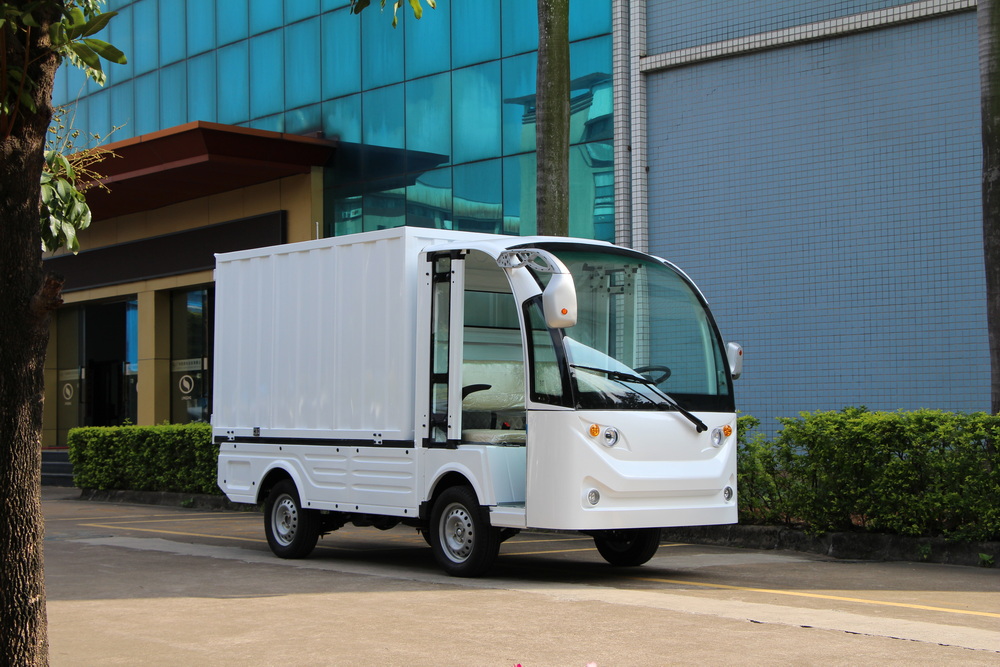
Charging infrastructure is not a separate project. It is part of the vehicle decision.
A company can buy the right electric cargo vans and still experience operational problems if charging capacity, site layout, electrical supply, and scheduling are not properly planned.
The most reliable approach is to treat the vehicle, charger, depot, electricity supply, and daily routes as one integrated operating system.
The correct charging speed depends on how long the vehicle is parked and how much energy it needs before the next shift.
| Operating Situation | Recommended Charging Strategy | Why It Works |
|---|---|---|
| Vehicles return to depot overnight | AC depot charging | Usually provides enough time for lower-cost charging |
| Vehicles have short midday breaks | Opportunity charging where available | Helps extend operational range |
| Multiple delivery shifts per day | Higher-power charging or planned fast charging | Supports rapid vehicle turnaround |
| Remote or mixed parking locations | Home, workplace, and public charging strategy | Requires stronger policy and reimbursement controls |
| Large fleet depot | Managed charging with load balancing | Helps prevent unnecessary peak-demand costs |
For example, if a van requires 60 kWh of energy and remains parked for 10 hours, a 7 kW charger can theoretically provide about 70 kWh during that period, before considering charging losses and operational margins. If the same vehicle has only four hours of dwell time, higher charging power may be necessary.
Before placing a large order, assess:
1. Available electrical capacity at each depot.
2. Number of vehicles expected to charge simultaneously.
3. Parking layout and cable routing.
4. Required charger power levels.
5. Utility upgrade lead times.
6. Safety requirements and local permits.
7. Future fleet expansion plans.
8. Backup procedures if a charger is unavailable.
9. Charging management software compatibility.
10. Driver access and operating rules.
For most fleets, overnight depot charging is the foundation of predictable operations. Fast charging is useful, but it should not become the only solution unless the business truly requires rapid vehicle turnaround.
A commercial vehicle must remain productive for years, so procurement teams should assess battery protection, after-sales capability, parts availability, and warranty terms as carefully as vehicle specifications.
When evaluating an electric cargo vehicle manufacturer, ask:
- What battery chemistry is used?
- What is the usable battery capacity?
- What is the battery warranty period and mileage limit?
- What battery-health criteria apply under warranty?
- How is the battery protected from water, dust, vibration, and impact?
- What thermal-management system is used?
- Can the battery be diagnosed remotely?
- What happens if a battery module needs replacement?
- Are replacement parts available in the target market?
- Can the vehicle meet local transport and safety requirements?
A strong OEM partner should provide technical documentation, parts lists, configuration records, quality-control procedures, and clear warranty responsibilities.
A low vehicle price loses value if a fleet waits weeks for brake parts, lighting modules, charging components, body panels, or battery-related service.
For international buyers, practical service readiness may include:
- Spare-parts stocking plans
- Technical training for local repair teams
- Remote diagnostic support
- Standardized repair manuals
- Parts catalogues with clear identifiers
- Service response procedures
- Warranty claim workflow
- Component traceability
- Battery handling guidance
- Software update support
For BorCart OEM customers, this is especially important because private-label and customized vehicle programs require alignment between the manufacturer, local importer, distributor, service network, and end user.
A pilot fleet gives your company the most valuable information: evidence from your own routes, drivers, locations, cargo, and customers.
Instead of ordering a large fleet immediately, begin with a controlled deployment. Select a group of vehicles that operate on predictable routes and return to a known depot.
1. Choose one route type with repeatable daily mileage.
2. Record payload, stop count, temperature, driving speed, and energy consumption.
3. Install charging equipment before vehicle delivery.
4. Train drivers, dispatchers, and maintenance staff.
5. Track charging completion and vehicle availability.
6. Compare energy and maintenance costs with existing vans.
7. Gather driver feedback on loading, comfort, visibility, and performance.
8. Identify operational issues before expanding the program.
9. Adjust vehicle specification or charger capacity where required.
10. Scale the fleet only after the business case is proven.
Fleet electrification guidance commonly recommends starting with real operational data, running a pilot, and using the results to optimize larger deployments.
Track the following indicators:
- Cost per mile or kilometer
- Average energy consumption
- Daily route completion rate
- Charging success rate
- Unplanned downtime
- Maintenance cost
- Driver satisfaction
- On-time delivery performance
- Battery state of charge at route completion
- Payload utilization
- Charger utilization
- Customer service impact
This process prevents decisions based on assumptions. It also helps buyers define better OEM requirements for future orders.
For brands, wholesalers, and manufacturers, selecting an electric cargo vehicle is only one part of the decision. The other part is selecting an OEM partner that can provide consistent quality, configurable products, documentation, and long-term production support.
A capable electric vehicle OEM should help buyers create a product that fits their target market rather than forcing them into a fixed vehicle configuration.
- Product customization capability
- Stable component supply chain
- Clear quality-control procedures
- Battery and electrical-system expertise
- Flexible body and cargo configurations
- Branding and private-label support
- Compliance documentation support
- Export packaging and logistics experience
- Spare-parts planning
- Technical manuals and training materials
- Warranty and after-sales framework
- Production capacity for future scaling
At BorCart, an OEM project can begin with a detailed requirements discussion covering target market, payload, range, cargo body, branding, charging standard, safety features, and intended operating environment. This early technical alignment reduces the risk of receiving a vehicle that looks suitable on paper but does not fit the end user's real working conditions.
A structured scorecard can help purchasing teams compare different electric cargo vehicles objectively.
| Evaluation Factor | Suggested Weight | Key Question |
|---|---|---|
| Route suitability | 20% | Can the vehicle complete daily routes with reserve range? |
| Payload and cargo volume | 15% | Can it safely carry the maximum expected load? |
| Charging compatibility | 15% | Can the fleet charge reliably at its actual parking locations? |
| Total operating cost | 15% | Does the long-term cost support the business case? |
| Reliability and service | 10% | Are parts, technical support, and repairs accessible? |
| Battery warranty | 10% | Are warranty coverage and battery terms commercially practical? |
| Driver usability | 5% | Is the vehicle comfortable, safe, and easy to operate? |
| OEM customization | 5% | Can the supplier adapt the vehicle to your brand and application? |
| Future scalability | 5% | Can the solution support additional vehicles and locations? |
The highest-scoring vehicle is not always the one with the largest battery, the lowest price, or the highest published range. It is the vehicle that best supports your business model with the lowest operational risk.
The right electric cargo vehicle should be selected from the inside out: first understand your routes, payloads, drivers, parking locations, charging windows, and service needs; then choose the battery, body, equipment, and OEM partner that support those realities.
For businesses with predictable urban or regional routes, depot parking, and manageable payload requirements, electric cargo vehicles can offer a practical path toward lower operating costs, quieter operations, and flexible fleet development. But successful adoption depends on planning charging infrastructure, validating real-world range, and choosing a supplier that can support the vehicle long after delivery.
Ready to develop an electric cargo vehicle tailored to your market? Contact BorCart to discuss your required range, payload, cargo body, branding, charging standard, and OEM production requirements. Our team can help you evaluate a configuration that fits your business operation—not just a catalogue specification.
The most important factor is whether the vehicle can reliably complete your real daily duty cycle. This includes route distance, payload, weather, road conditions, driver shifts, and available charging time. Published range alone is not enough.
Your target range should exceed the longest normal working route by a practical safety margin. A common planning approach is to add approximately 20 percent to maximum daily route distance, then adjust for payload, temperature, terrain, and accessory power use.
They can be suitable, but buyers must verify the certified payload for the exact configuration. Battery weight and added equipment can reduce available payload, so always calculate cargo, tools, passengers, shelving, and accessories together.
For many fleets, yes. Vehicles that return to a depot and remain parked for several hours can often recharge through AC charging. The required charger power depends on battery energy needs and available parking time.
Not necessarily. A larger battery can increase price and vehicle weight. Choose battery capacity based on your actual routes, required reserve range, charging schedule, and business economics.
Ask about customization capability, battery warranty, payload certification, charging standards, production capacity, quality control, spare-parts support, service documentation, branding options, export experience, and local compliance support.
A pilot fleet lets you test vehicles under your own real conditions before making a larger investment. It reveals actual energy use, charging performance, driver feedback, maintenance needs, and route suitability.
- Ford Pro. "[2026 Ford E-Transit Overview]."
- Geotab. "[Fleet Electrification Strategy Guide for Fleet Managers]."
- International Council on Clean Transportation. "[Principles on Commercial Fleet Electrification and the Distribution Grid]."
- Equipmake. "[EV Fleet Charging]."
- 7Gen. "[EV Fleet Management Best Practices: How to Maximize Range, Battery Life and Uptime]."
- Mike Albert Fleet Solutions. "[Electric Trucks and Vans: A Guide for Fleets]."
- FSG. "[EV Fleet Charging: A Complete Guide for Businesses]."


