


Views: 277 Author: BorCart Publish Time: 2026-08-07 Origin: Site


Content Menu
● Why Urban Buyers Are Choosing Electric Utility Carts
● Key Specifications at a Glance
● Battery Technology: Why LiFePO4 Matters More Than Buyers Realize
● Standard Features That Elevate the Driving Experience
● How the Denago EV City Compares to the Broader LSV Category
● Practical Buying Considerations
● Why Component Quality Is the Real Differentiator
● Where to Learn More or Purchase
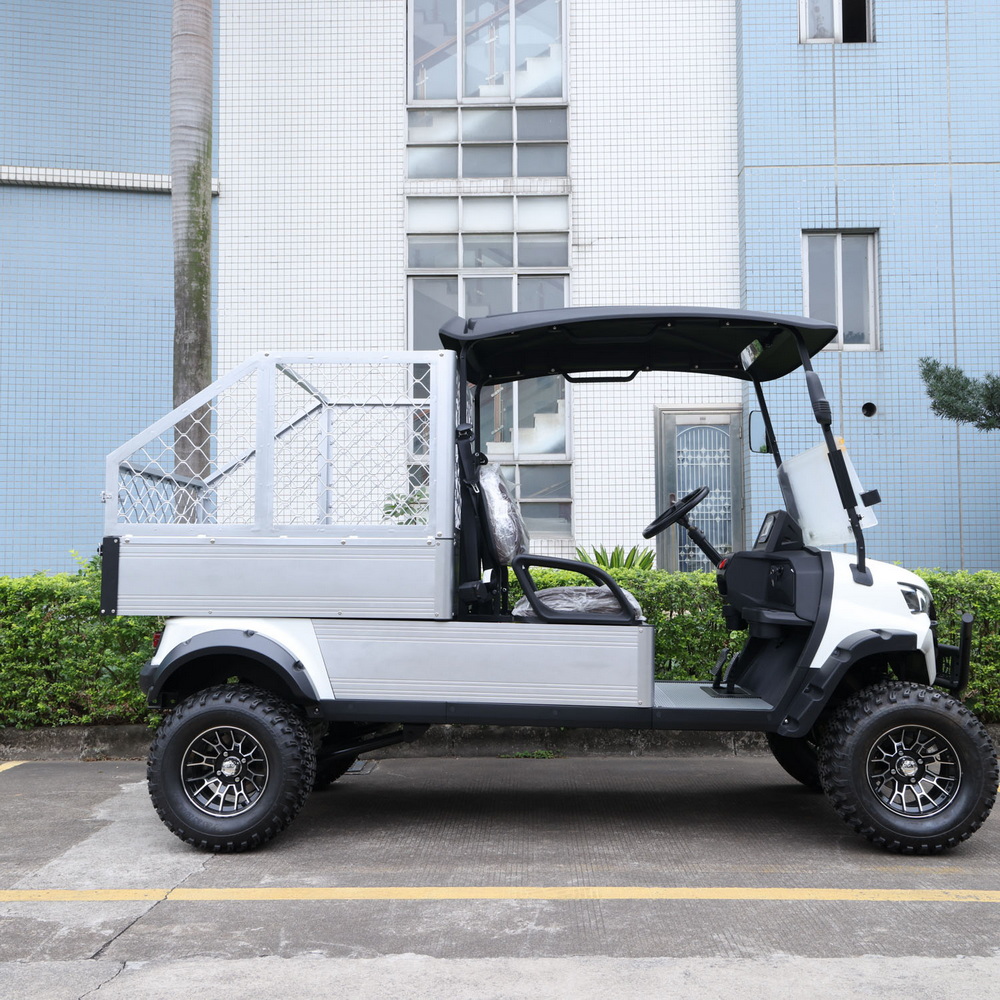
The Denago EV City has quickly become one of the most talked-about street-legal electric utility carts on the market, and for good reason. Combining an 80-mile range, a 51.2V 205Ah lithium battery, and a design built specifically for city streets, this low-speed vehicle (LSV) delivers a rare mix of performance, comfort, and affordability. This guide breaks down every specification, compares it against category standards, and explains why the Denago EV City is reshaping expectations for what a compact electric vehicle can do.
The low-speed vehicle market is no longer a niche corner of the automotive industry. Global market data shows the sector is projected to grow from roughly USD 11.1 billion in 2026 to as much as USD 21.8 billion by 2035, expanding at a compound annual growth rate near 7.8%. Industrial and utility-focused vehicles already account for the largest single share of this market, at 43% of total volume. This growth is driven by rising demand for cost-effective, eco-friendly transportation in gated communities, campuses, resorts, and dense urban cores.
The Denago EV City sits squarely in this fast-growing segment. It was engineered less as a golf cart and more as a genuine short-range urban vehicle, which explains features like disc brakes, a DOT-rated windshield, and smartphone connectivity that go well beyond typical cart equipment.
Below is a consolidated specification table pulled directly from the manufacturer's published data.
| Category | Specification |
|---|---|
| Top speed | 15–25 MPH |
| Range per charge | Up to 80 miles |
| Battery | 51.2V 205Ah LiFePO4 |
| Motor | 6.3kW / 12kW AC motor |
| Climbing capability | Up to 25% grade |
| Max load capacity | 826 lbs |
| Total vehicle weight | 1,719 lbs |
| Dimensions | 150 in x 74 in x 78 in |
| Available colors | Black, White, Gray |
One detail that separates the Denago EV City from older-generation carts is its use of lithium iron phosphate (LiFePO4) battery chemistry instead of legacy lead-acid packs. This is not a minor upgrade — it directly affects total cost of ownership.
- Cycle life: LiFePO4 batteries typically deliver 3,000 to 6,000 charge cycles, compared with just 300 to 1,000 cycles for lead-acid batteries.
- Lifespan: Lithium packs commonly last 8 to 15 years, versus 2 to 5 years for lead-acid equivalents.
- Performance consistency: Lithium batteries maintain stable voltage output throughout the discharge cycle, meaning acceleration and range stay consistent even as the battery nears depletion — lead-acid packs suffer voltage sag well before that point.
- Weight and charging speed: Lithium packs are lighter and charge significantly faster, which matters for a vehicle meant for daily urban errands.
In practical terms, this means owners of the Denago EV City can expect roughly two to three times longer battery service life than owners of comparable lead-acid golf carts, with fewer replacement costs over a decade of ownership.
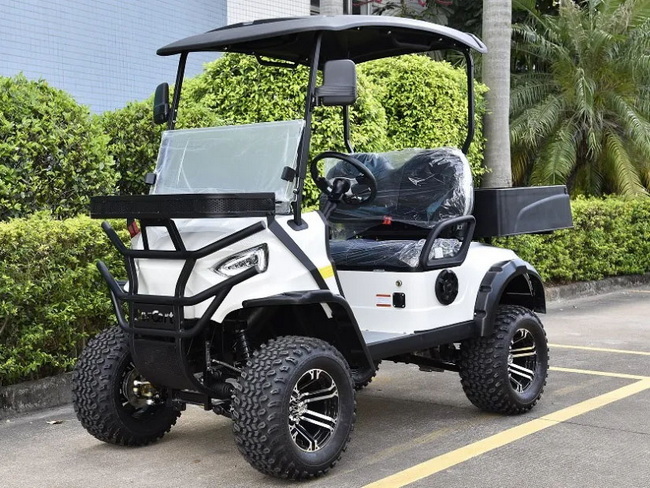
The Denago EV City is loaded with features rarely found together in this vehicle class:
- NFC key card access for secure, keyless entry
- 13-inch center display controlling navigation, entertainment, and vehicle settings
- Lounge-style seating for extended comfort on longer trips
- DOT-compliant windshield meeting recognized safety standards
- See-through roof panel that brightens the cabin
- Rear camera for safer reversing and parking
- Apple CarPlay and Android Auto integration
- USB and USB-C PD charging ports throughout the cabin
Safety engineering on the Denago EV City includes four-wheel disc brakes paired with electromagnetic braking, giving it stronger stopping power than most carts that rely solely on mechanical drum brakes. The chassis uses a carbon steel composite construction, and radial tires improve grip in wet or uneven conditions common in urban environments. Combined with a 25% grade climbing capability, the vehicle is well suited to hilly city terrain that would challenge lighter, less powerful carts.
Most street-legal LSVs on the market top out around 60 miles of range and rely on older lead-acid battery banks. The Denago EV City's 80-mile range and lithium chemistry place it ahead of that baseline, and its <60V electrical architecture aligns it with the segment expected to hold roughly 70% market share through 2026. This positioning matters for buyers comparing multiple brands, since range and battery longevity are consistently cited as the top two purchase factors in LSV buyer surveys.
Before purchasing any electric utility cart, prospective owners should evaluate a few operational factors:
1. Charging infrastructure: Confirm access to a standard outlet; the onboard intelligent charger supports home charging without special installation.
2. Local street-legal regulations: LSV registration rules vary by state and municipality, so verify local requirements before road use.
3. Terrain and daily mileage needs: An 80-mile range covers most daily commuting and errand patterns, but frequent hill climbing will reduce effective range.
4. Load requirements: The 826-lb capacity accommodates passengers plus cargo, useful for errands, deliveries, or small business use.
5. Component sourcing: Buyers and OEM partners increasingly look at battery and motor sourcing quality, since these two components determine long-term reliability more than any cosmetic feature.
Beyond styling and screens, the long-term value of any electric utility cart comes down to the quality of its core components — battery packs, motors, and chassis materials. As the low-speed vehicle market scales toward a projected USD 21.8 billion by 2035, manufacturers and OEM buyers are placing greater emphasis on sourcing dependable lithium battery systems and durable AC motors rather than relying on legacy lead-acid platforms. This shift is a key reason vehicles like the Denago EV City, built around modern LiFePO4 technology, are outperforming older cart designs in both range and lifespan.
Buyers interested in the Denago EV City can review current inventory and pricing through Tigon Golf Carts or contact them directly at +86 15975330033 for financing and delivery details. For manufacturers, dealers, or fleet buyers evaluating utility cart platforms and OEM component sourcing for similar electric vehicles, working with an established parts and vehicle manufacturer can streamline everything from battery selection to chassis customization.
What is the top speed of the Denago EV City?
The Denago EV City reaches speeds of 15–25 MPH, which is standard for street-legal low-speed vehicles designed for urban use.
How far can the Denago EV City travel on a single charge?
It offers up to 80 miles of range per charge, well above the typical range for lead-acid-powered carts in its class.
Why does the lithium battery matter for long-term ownership?
LiFePO4 batteries last 8 to 15 years and endure 3,000 to 6,000 charge cycles, compared with 2 to 5 years and 300 to 1,000 cycles for lead-acid batteries, meaning significantly lower replacement costs over time.
Is the Denago EV City compatible with smartphone systems?
Yes, it includes both Apple CarPlay and Android Auto for navigation, calls, and music streaming.
What safety features come standard on the vehicle?
Standard safety equipment includes four-wheel disc brakes, electromagnetic braking, a DOT-rated windshield, and a rear camera.
How is the low-speed vehicle market expected to grow?
The global LSV market is projected to grow from roughly USD 11.1 billion in 2026 to USD 21.8 billion by 2035, at a CAGR of about 7.8%, driven largely by demand for utility and industrial applications.
1. The All-New Denago EV City: Redefining Urban Mobility — Tigon Golf Carts. https://tigongolfcarts.com/the-all-new-denago-ev-city-redefining-urban-mobility/
2. DENAGO® CITY Inventory Listing — Tigon Golf Carts. https://tigongolfcarts.com/inventory/denago-city/
3. Low Speed Vehicle Market Size, Statistics Report 2026-2035 — Global Market Insights. https://www.gminsights.com/industry-analysis/low-speed-vehicle-market
4. U.S. Low Speed Vehicle Market Size, Share, and Analysis Report. https://www.polarismarketresearch.com/industry-analysis/us-low-speed-vehicle-market
5. Low-Speed Vehicle Market Size, Share & Analysis (2026–2035). https://www.precedenceresearch.com/low-speed-vehicle-market
6. Lithium vs Lead-Acid Golf Cart Batteries: Lifespan Comparison. https://www.lithiumhub.com/lithium-vs-lead-acid-golf-cart-batteries
7. LiFePO4 Battery vs Lead Acid: Key Differences Explained. https://www.dakotalithium.com/lifepo4-vs-lead-acid
8. How Long Does a Golf Cart Battery Last? (Lead-Acid vs. Lithium). https://www.golfcartresource.com/golf-cart-battery-lifespan


