


Views: 236 Author: BorCart Publish Time: 2026-08-25 Origin: Site


Content Menu
● What Is an On-board Charger?
>> Why On-board Charging Works Well at Home
● What Is an Off-board Charger?
>> Why Centralized Off-board Charging Matters for Fleets
● On-board vs Off-board Chargers: Core Differences
● Residential Convenience: Why Simplicity Often Wins
>> Residential Buyer Checklist
>> Expert View: Avoid Overspecifying Home Charging
● Fleet Management: Why Control Becomes the Priority
>> Benefits of a Centralized Charging Depot
● Charging Speed Is Only One Part of the Decision
● A Practical Selection Framework for Buyers
>> 1. Start With the Duty Cycle
>> 2. Evaluate the Site, Not Just the Vehicle
>> 3. Specify Charging Compatibility During OEM Development
● When a Hybrid Charging Strategy Makes Sense
● Build the Charging System Around the Job
● FAQ
>> 1. Is an on-board charger the same as a wall-mounted charging station?
>> 2. Are off-board chargers always DC chargers?
>> 3. Which charger is better for an electric utility cart?
>> 4. Can a fleet use both on-board and off-board charging?
>> 5. Does a higher-power charger always reduce total charging time?
>> 6. What should OEM buyers provide when discussing charging requirements?
>> 7. Can centralized charging reduce fleet operating risk?
Choosing between on-board chargers and off-board chargers is not simply a question of charging speed. It determines where power conversion happens, how much infrastructure is required, how vehicles fit into daily routines, and how easily an electric utility cart or fleet can scale.
For residential users, an on-board charging system usually provides the most practical route to dependable overnight charging. For fleet operators, centralized off-board charging can create stronger control over uptime, energy use, maintenance, and multi-vehicle operations. The optimal solution depends on the vehicle's duty cycle, battery capacity, parking duration, electrical supply, and operating priorities.

An on-board charger (OBC) is installed inside the electric vehicle. It receives AC electricity from an external power source and converts it into the DC electricity required by the vehicle battery.
In simple terms, the wall box, outlet, or AC charging station supplies power, while the charger inside the vehicle manages the AC-to-DC conversion process.
This structure is commonly used for:
- Residential electric utility carts
- Golf carts and neighborhood electric vehicles
- Low-speed electric work vehicles
- Light-duty electric delivery vehicles
- Employee transport carts
- Campus and resort utility vehicles
An on-board charger is generally associated with AC charging. Under common conductive charging definitions, an on-board charger is located on the vehicle, while an off-board charger is located outside it.
For individual owners, convenience often matters more than the highest possible charging speed. A homeowner or property manager typically wants to park the vehicle, connect one cable, and return to a charged vehicle the next day.
That is where an on-board charger provides a strong user experience.
Key residential benefits include:
- Simple installation: A suitable AC outlet or dedicated AC charging point may be enough, depending on the vehicle and local electrical requirements.
- Lower external hardware complexity: The conversion electronics are carried by the vehicle rather than installed at every charging point.
- Easy daily routine: Park, plug in, and charge during inactive hours.
- Flexible charging locations: The same vehicle can charge wherever compatible AC power is available.
- Reduced site dependence: Owners are not fully dependent on a dedicated DC charging station.
For a homeowner using an electric utility cart for gardening, estate transport, property inspection, or short local trips, overnight charging is usually compatible with real-world usage. The vehicle is often parked for many hours, making lower-power AC charging a logical fit.
An off-board charger places the AC-to-DC conversion equipment outside the vehicle. The charging unit sends regulated DC power directly to the battery system through the vehicle's charging interface.
This architecture is commonly associated with DC charging and higher-power applications. In many charging systems, lower-power AC charging relies on the vehicle's on-board charger, while external DC charging equipment performs conversion outside the vehicle.
For fleet operations, the charger becomes a fixed asset at the depot, warehouse, factory, logistics yard, resort service area, airport facility, or campus transport hub.
Fleet operators do not evaluate charging only by how fast a single vehicle gains energy. They need to know whether every vehicle will be ready before the next shift.
A centralized off-board charging system can support this objective by making charging visible, controllable, and easier to standardize across a larger vehicle population.
Centralized fleet charging can support:
- Scheduled charging based on vehicle departure times
- Energy-load management across multiple charging points
- Priority charging for urgent or high-utilization vehicles
- Central monitoring of charging status and faults
- Consistent charging processes across drivers and departments
- Scalable infrastructure planning for future fleet growth
A depot charging model is designed around vehicles returning to a common operating base during scheduled downtime. Charging software can assign priorities and balance electrical load based on departure times, battery state of charge, and available site capacity.
| Factor | On-board Charger | Off-board Charger |
|---|---|---|
| Charger location | Installed inside the vehicle | Installed in external charging equipment |
| Main input | Usually AC power | Usually AC grid input converted to external DC output |
| Power conversion | AC-to-DC conversion happens in the vehicle | AC-to-DC conversion happens outside the vehicle |
| Best fit | Residential users, light-duty applications, distributed parking | Fleet depots, commercial sites, high-utilization operations |
| User experience | Plug in and charge where AC access is available | Use a designated charging station or depot charging bay |
| Charging speed potential | Limited by the vehicle's OBC rating | Can support higher-power charging, subject to battery and vehicle limits |
| Vehicle weight | Adds charging electronics to the vehicle | Reduces vehicle-side charging hardware needs |
| Site infrastructure | Generally simpler for lower-power AC charging | Often requires more electrical design, equipment, and commissioning |
| Fleet management | More decentralized | Easier to centralize, monitor, and manage |
| Maintenance model | Charging electronics are part of the vehicle | Charging equipment can be serviced as fixed infrastructure |
The practical distinction is important: an on-board charger supports flexibility for the vehicle owner, while an off-board charger supports operational control for the site operator.
For residential users, the best charging solution is usually the one that fits naturally into everyday behavior.
An electric utility cart used at a home, farm, villa community, golf property, or private estate may only travel a limited distance each day. If it is parked overnight for eight to twelve hours, the user often does not need rapid charging.
A properly matched on-board charger can restore the energy used during the day while the vehicle is inactive. This makes charging almost invisible to the owner.
Before selecting an on-board charging configuration, buyers should confirm:
1. Daily energy consumption: How far does the utility cart travel each day, and how much battery capacity does that use?
2. Available parking time: Is the vehicle parked long enough for overnight charging?
3. Electrical supply: Is a standard outlet sufficient, or is a dedicated AC circuit needed?
4. Battery chemistry and voltage: Is the charger correctly matched to the battery pack and battery management system?
5. Weather exposure: Will the charging area be dry, ventilated, and protected from physical damage?
6. Connector compatibility: Does the vehicle use a safe, durable, and user-friendly charging connector?
7. Expansion needs: Will the owner later add more electric vehicles at the same property?
A common purchasing mistake is to select the highest-power charging solution without examining actual use.
For example, a residential utility cart that uses only a modest portion of its battery during daytime property work may not benefit enough from expensive high-power external charging to justify the added installation cost.
The correct question is not, "What is the fastest charger?" It is:
> "What charging system reliably restores daily energy use before the vehicle is needed again?"
For many residential applications, that answer is a well-matched on-board charger and safe AC charging point.
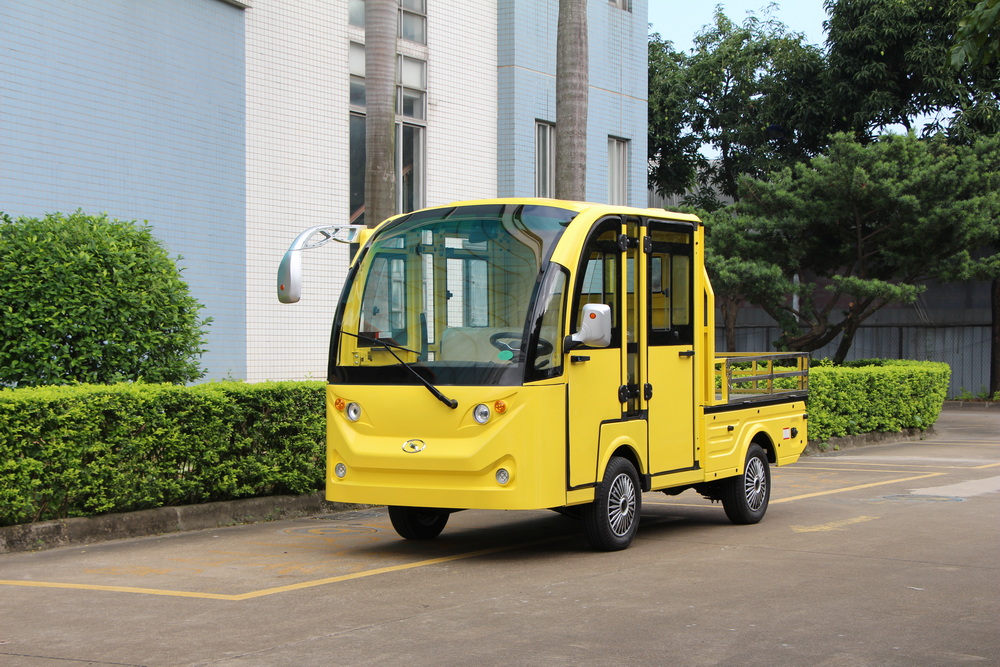
A fleet has a different problem. It must coordinate vehicles, drivers, charging windows, site power limits, and service schedules.
A hotel may operate guest transportation carts. A logistics center may run electric cargo utility vehicles. A factory may use tow tractors, maintenance carts, and personnel carriers. A municipality may operate electric work vehicles across a large site.
In these situations, vehicle availability becomes the primary performance metric.
Centralized fleet charging is especially useful when vehicles return to the same location at the end of a shift.
- Predictable readiness: Managers can verify that vehicles are fully charged before dispatch.
- Lower operational uncertainty: Drivers do not need to search for available charging points across a large site.
- Better power planning: The fleet can avoid charging every vehicle at maximum power at the same time.
- Improved accountability: Charging sessions, fault events, and energy usage can be linked to individual vehicles or departments.
- Simpler maintenance planning: Fixed external chargers can be inspected, repaired, and upgraded at the depot.
- More efficient growth: A charging layout can be designed around future fleet expansion rather than installed one vehicle at a time.
For fleets that return to base and remain parked for more than six to eight hours, AC charging in the 3.7 kW to 22 kW range is often suitable, while higher-power DC charging is more relevant for short turnaround periods and demanding duty cycles.
It is easy to assume that off-board charging is always better because it can support higher power. In practice, charging speed must be matched to battery acceptance capability, driving pattern, thermal management, and dwell time.
A charging station cannot safely force a battery to accept more power than the vehicle's battery system, charging interface, and management system allow.
Consider two BorCart customer profiles:
| Customer profile | Daily operation | Recommended direction | Reason |
|---|---|---|---|
| Private estate owner | Uses one electric utility cart for 2–4 hours daily; parks overnight | On-board charger with AC charging | Simple, convenient, and aligned with long parking time |
| Resort transport fleet | Operates 20 electric utility vehicles on scheduled routes | Centralized charging solution with managed charging bays | Supports vehicle readiness, supervision, and coordinated energy use |
| Factory maintenance team | Uses utility carts across multiple shifts | Mixed charging approach | AC charging for overnight use, selected higher-power external charging for urgent vehicles |
| Logistics yard | Operates vehicles with short turnaround periods | Off-board charging for priority units | Faster energy replenishment can reduce downtime |
The strongest fleet strategy is often not "all AC" or "all DC." It is a mixed charging plan based on real operating patterns.
Whether you are sourcing OEM electric utility carts or planning an electrified vehicle program, evaluate charging architecture in the following order.
Measure:
- Daily travel distance
- Payload requirements
- Operating hours
- Idle time
- Terrain and temperature conditions
- Number of shifts per day
- Required reserve battery capacity
A vehicle with long overnight downtime may perform well with lower-power charging. A vehicle required for repeated shifts may need faster charging access or battery-swapping alternatives.
For fleets, the charging solution must fit the physical operating environment.
Check:
- Available electrical capacity
- Distance from electrical distribution equipment
- Number of parking bays
- Cable-routing safety
- Weather protection
- Vehicle traffic flow
- Future fleet size
- Local electrical codes and permitting requirements
A high-power charger may look attractive on paper but create substantial electrical upgrade requirements at the site.
For OEM buyers, charging should be discussed early in vehicle development rather than treated as an accessory decision.
Important specification items include:
- Battery voltage and capacity
- Battery management system communication
- AC input voltage range
- Charger power rating
- Charging connector type
- Charging cable length
- Waterproof and dust-protection requirements
- Fault indication and diagnostic functions
- Thermal protection
- Regional compliance requirements
- Fleet software or charging-station communication needs
At BorCart, OEM charging integration should be considered alongside battery selection, vehicle duty cycle, body design, controller configuration, and target market requirements. This reduces the risk of a vehicle that performs well in testing but does not fit the customer's real charging environment.
A hybrid strategy combines lower-power charging for routine use with selected higher-power external charging for exceptional demand.
This is often practical for:
- Resorts with peak-season transport demand
- Factories with multiple shifts
- Airports and large campuses
- Rental fleets
- Distribution yards
- Municipal service operations
For example, a fleet can use AC charging bays overnight for most vehicles. It can also install a limited number of faster off-board charging points for vehicles returning with low battery levels or needing to re-enter service quickly.
This approach avoids installing costly high-power infrastructure at every parking position while preserving operational flexibility.
On-board chargers are usually the better choice when residential convenience, lower infrastructure complexity, and overnight charging are the priority. They are especially suitable for private electric utility carts and low-duty commercial vehicles that spend long periods parked.
Off-board chargers are more compelling when centralized fleet management, faster turnaround, charging visibility, and operational control are essential. They can help fleet operators standardize charging across multiple vehicles and plan energy use at a single site.
The right decision begins with the vehicle's real workday—not with charger power alone.
Looking for an OEM electric utility cart with a charging system tailored to your market? Contact BorCart to discuss battery configuration, on-board charging options, centralized fleet charging compatibility, vehicle customization, and production requirements for your brand or commercial project.

No. An on-board charger is installed inside the vehicle and converts AC electricity to DC for the battery. A wall-mounted AC charging station generally supplies controlled AC power to the vehicle's on-board charger.
In most electric vehicle applications, off-board chargers are associated with external DC charging because the AC-to-DC conversion occurs in the external charging unit. However, exact configurations depend on vehicle design, charging standards, and system architecture.
For a privately owned utility cart with long overnight parking, an on-board charger is often the most convenient solution. For a large fleet that needs centralized control or quicker turnaround, an off-board charging solution may be more suitable.
Yes. Many fleets benefit from a hybrid model: routine overnight AC charging for most vehicles and selected external fast-charging capacity for priority vehicles or unexpected operational demand.
Not necessarily. Charging time is limited by the battery's maximum accepted charging power, battery temperature, state of charge, battery management system settings, and vehicle charging hardware.
Buyers should provide expected daily mileage, battery capacity, operating hours, target charging time, local grid voltage, environmental conditions, connector preferences, fleet size, and regional compliance requirements.
Yes. A centralized charging layout can help managers monitor charging status, allocate charging priority, identify faults, and make sure vehicles are ready before their scheduled departure times.
1. [SAE J1772 Definitions: On-board and Off-board Charger]
2. [Electric Vehicle Charging Technology and Its Control — Delft University of Technology]
3. [An Introduction to the EV On-board Charger — Electronic Design]
4. [Depot Charging: Definition, Types, Cost, and Benefits — Monta]
5. [Fleet EV Charging Guide: Hardware, Grid Upgrades, and Load Balancing — Beny]


