


Views: 233 Author: BorCart Publish Time: 2026-08-11 Origin: Site


Content Menu
● Why Five-Year TCO Matters for Golf Cart Buyers
● Lithium Golf Carts vs Lead-Acid Models at a Glance
● The Upfront Price Gap Is Real
● Five-Year Cost Illustration for a Commercial Fleet
● Weight Changes Vehicle Performance
● Charging Strategy: The Hidden Operating Cost
● Maintenance Labor: Small Tasks, Large Fleet Cost
● How to Build a Reliable TCO Model
● Sustainability and End-of-Life Planning
● When Lead-Acid Still Makes Sense
● When Lithium Is the Better Business Case
● Choose the Battery Around the Job
● FAQ
>> Is a lithium golf cart always cheaper over five years?
>> How long do lithium golf cart batteries last?
>> Can I replace lead-acid batteries with lithium in an existing golf cart?
>> Do lithium golf carts charge faster than lead-acid carts?
>> Are lead-acid golf cart batteries difficult to maintain?
>> Which battery type is better for a resort or rental fleet?
>> Is lead-acid battery recycling easier than lithium battery recycling?
For distributors, resort operators, fleet managers, and private-label vehicle brands, the lithium golf carts vs lead-acid models decision should not be made on vehicle purchase price alone. The more reliable measure is the five-year total cost of ownership (TCO): the combined cost of acquisition, energy, maintenance, battery replacement, labor, downtime, and residual value.
At BorCart, we approach this choice from an OEM vehicle-program perspective. A battery system affects more than range. It changes vehicle weight, payload, charging operations, component selection, warranty exposure, dealer service requirements, and the customer's daily experience. Lithium golf carts typically demand a higher initial investment, while lead-acid models can appear easier to launch in price-sensitive markets. Over five years, however, the lower-cost option on day one is not always the lower-cost option overall.
This guide compares lithium and lead-acid golf cart models in a practical, commercial context. It also provides a calculation framework that brands and fleet buyers can adapt to their own operating conditions.
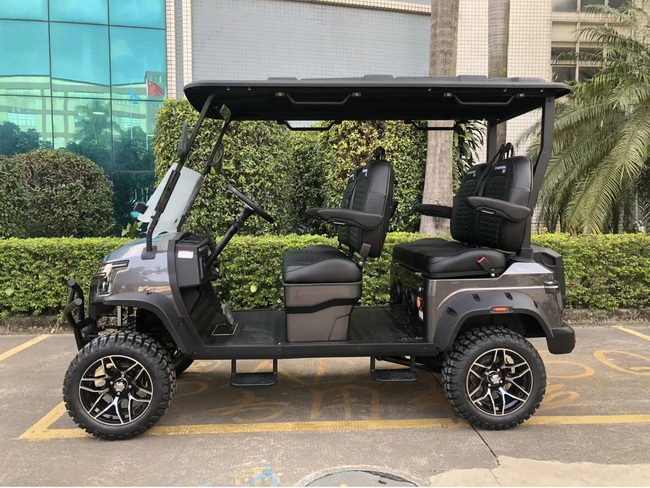
The purchase price is only the first line on a golf cart program budget. A commercial cart may operate every day at a golf course, resort, warehouse, campus, residential community, or tourist destination. Each hour out of service can affect revenue, labor scheduling, guest satisfaction, and fleet availability.
A useful five-year ownership equation is:
TCO=Initial vehicle cost+Energy cost+Maintenance+Battery replacement+Labor+Downtime cost−Residual value
The result varies by market, electricity price, usage intensity, climate, and service labor rate. Therefore, no supplier should promise one universal saving figure. Instead, buyers should test both lithium and lead-acid configurations against their own duty cycle.
For a lightly used private cart, lead-acid may remain commercially reasonable. For a daily-use resort fleet or a delivery-oriented low-speed vehicle fleet, lithium often has a stronger case because energy efficiency, reduced maintenance, and uptime become financially meaningful.
| Decision factor | Lithium golf cart | Lead-acid golf cart |
|---|---|---|
| Initial battery investment | Higher | Lower |
| Typical battery system weight | Much lower | Much higher |
| Charging time | Commonly faster with compatible charging equipment | Usually longer |
| Routine maintenance | Minimal for sealed lithium packs with a BMS | Watering and terminal inspection may be required for flooded batteries |
| Usable capacity during discharge | More consistent | Voltage and available performance decline more noticeably as discharge deepens |
| Cycle-life potential | Generally higher, depending on chemistry and operating conditions | Generally lower, strongly affected by depth of discharge and maintenance |
| Vehicle acceleration and hill performance | More stable because of lower voltage sag | Can soften as batteries discharge |
| Replacement risk within five years | Often lower in normal commercial use | Often higher in demanding daily-use applications |
| Recycling pathway | Developing and market-dependent | Mature and widely established in many regions |
| Best fit | High-use fleets, premium brands, resorts, communities, utility vehicles | Entry-level programs, low-use vehicles, markets focused on initial price |
The word "lithium" covers different battery chemistries. In golf cart applications, lithium iron phosphate, often called LiFePO4 or LFP, is frequently selected because it offers thermal stability, long service life potential, and a practical balance of power, cost, and durability. Buyers should confirm the actual cell chemistry rather than treating all lithium battery packs as identical.
Lead-acid batteries remain attractive because they lower the initial vehicle price. A brand introducing a value-focused electric golf cart can use that lower entry price to compete in dealer channels where buyers compare vehicle quotes quickly.
However, the initial saving must be evaluated alongside the expected battery replacement cycle. Flooded lead-acid batteries can require regular water checks, equalization procedures where applicable, cable inspection, corrosion cleaning, and disciplined charging habits. Poor charging discipline can shorten service life substantially.
Lithium battery packs are usually more expensive at purchase, but they commonly include a battery management system. The BMS monitors conditions such as voltage, current, temperature, and cell balance. In a well-designed system, this electronic protection reduces the chance that normal vehicle use will push the pack beyond defined operating limits.
For an OEM program, the correct question is not, "Which battery is cheaper?" It is, "Which battery configuration delivers the lowest lifecycle cost for this customer profile?"
Consider a 48V commercial golf cart used 250 days per year. The cart operates multiple shifts, travels mixed terrain, and must be available every morning. The figures below are illustrative planning assumptions, not a universal quotation.
| Five-year cost category | Lead-acid configuration | Lithium configuration |
|---|---|---|
| Additional initial vehicle and battery cost | Lower | Higher |
| Battery replacements | Likely one or more, depending on use and care | Often none within the period if properly specified |
| Battery watering and cleaning labor | Ongoing for flooded batteries | Minimal routine battery labor |
| Electricity consumption | Higher because of lower charging efficiency | Lower in many operating profiles |
| Unplanned downtime exposure | Higher when batteries age or maintenance is missed | Lower when the pack, BMS, charger, and vehicle are correctly matched |
| Performance-related operating impact | Range and power may fade through the workday | More consistent power delivery |
| Residual value potential | Depends on battery age at resale | Can be stronger if battery health documentation is available |
The decision becomes clearer when labor and downtime are assigned a real monetary value. For example, if a technician spends 15 minutes per cart each week on battery watering, cleaning, and checks, that time compounds across a 40-cart fleet. If two carts miss a morning rental window because of battery issues, the cost is more than a replacement battery invoice.
Battery weight has a direct effect on cart design and user experience. A lead-acid battery bank can add several hundred pounds to a golf cart. Lithium systems with comparable usable energy are typically much lighter.
Lower battery weight can improve:
- Acceleration from a stop.
- Climbing performance on slopes.
- Tire and suspension loading.
- Braking response and stopping behavior.
- Payload flexibility for passengers, tools, or cargo.
- Energy use per mile.
For a standard passenger golf cart, the weight difference may improve driving responsiveness. For a utility cart, personnel carrier, hotel shuttle, or cargo vehicle, it can also protect useful payload. The OEM must validate suspension tuning, braking performance, controller calibration, and axle load distribution for the selected battery option.
A lithium conversion is therefore not simply a battery swap. It should be engineered as a vehicle-level configuration.
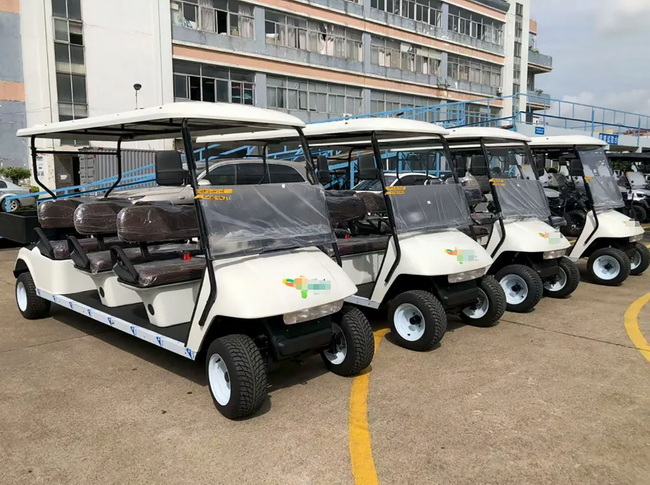
Charging is where many fleet budgets become inaccurate. Battery capacity in amp-hours alone does not reveal the complete cost. Buyers must consider charging efficiency, charging time, charger compatibility, available electrical infrastructure, and charging behavior.
Lead-acid batteries usually need a longer charging window and benefit from complete recharge cycles. Repeated partial charging or leaving batteries in a low state of charge can reduce service life. Watering requirements also add a safety and labor consideration for flooded battery designs.
Lithium golf carts can often recharge faster, allowing operators to use opportunity charging between shifts when the battery and charger are designed for it. This can be valuable for hospitality and rental fleets where vehicles have limited overnight downtime.
Before selecting lithium, confirm these technical details:
1. Verify nominal voltage, continuous current, and peak current compatibility between the pack and motor controller.
2. Match the charger profile to the battery manufacturer's requirements.
3. Confirm BMS cold-charge protection for markets with low winter temperatures.
4. Define an emergency recovery procedure if the BMS enters protection mode.
5. Specify charging connectors, cable length, power input, and charging-station layout before fleet deployment.
A strong charging plan prevents unnecessary warranty claims and protects the fleet's daily availability.
Flooded lead-acid batteries are proven technology, but they require operational discipline. Water levels need correct management. Battery terminals need inspection. Corrosion must be addressed. Technicians should use appropriate PPE and follow local handling requirements for electrolyte and battery waste.
Absorbent glass mat lead-acid batteries reduce watering needs, but they do not eliminate the fundamental limits of lead-acid chemistry. Aging, partial-state-of-charge use, high temperatures, and deep discharges can still affect performance and service life.
Lithium packs reduce recurring battery-maintenance tasks. That does not mean they require no attention. Fleet teams should still inspect connectors, cables, battery enclosures, charger operation, and diagnostic data. The difference is that routine work shifts from water and corrosion management toward preventive electrical inspection and data-based servicing.
For large fleets, this change can free technicians to focus on tires, brakes, steering, suspension, body damage, and customer-ready presentation.
Downtime is often omitted from a TCO spreadsheet because it is difficult to measure. Yet it can be the decisive cost for a resort, golf club, rental business, logistics site, or airport facility.
A lead-acid cart can lose range and power as the batteries discharge. When the battery bank ages unevenly, operators may see inconsistent cart-to-cart performance. This creates scheduling uncertainty: a vehicle that looked acceptable in the morning may become unavailable in the afternoon.
Lithium systems generally maintain voltage more consistently through the discharge cycle. Drivers can experience more stable acceleration and climbing ability until the battery approaches its protection threshold. For commercial operators, predictable performance makes vehicle dispatch easier.
Fleet managers should record the following for at least 90 days before making a battery decision:
- Daily miles or operating hours per cart.
- Average payload and terrain.
- Number of missed rentals or unavailable units.
- Technician hours spent on battery-related work.
- Electricity consumed per vehicle.
- Battery replacements and emergency service calls.
- Seasonal temperature range.
- Customer complaints related to range or performance.
This field record is more useful than a generic comparison chart because it shows the actual cost of the buyer's operation.
A clear TCO model should compare like-for-like vehicle specifications. Do not compare a premium lithium cart with an entry-level lead-acid cart that has different motors, tires, accessories, or warranty coverage.
Use this process:
1. Set the operating profile. Define miles per day, operating days per year, payload, terrain, and charging opportunities.
2. Calculate energy demand. Use measured electricity use where possible. If no field data exists, begin with a conservative engineering estimate and revise it after pilot testing.
3. Add labor realistically. Include watering, cleaning, inspections, battery changes, warranty administration, and technician travel between sites.
4. Forecast battery replacement. Use the battery supplier's warranted cycle-life conditions, not only an optimistic headline number.
5. Price downtime. Estimate missed rental revenue, substitute-cart expense, delivery delays, or employee idle time.
6. Include end-of-life handling. Confirm collection, transport, recycling, and documentation requirements in the destination market.
7. Test three scenarios. Model low, expected, and high vehicle utilization. Lithium usually becomes more compelling as annual operating intensity rises.
Lead-acid batteries have one important advantage: their recycling infrastructure is mature in many markets. In the United States, lead-acid batteries have historically achieved a very high recycling rate through established collection and processing channels.
Lithium battery recycling systems are expanding, but local pathways vary more widely. Brands importing lithium golf carts should identify approved battery collection and recycling partners before sales begin. Shipping damaged or end-of-life lithium packs also requires careful compliance with applicable transport rules.
The responsible choice is not simply selecting one chemistry over another. It is designing a documented end-of-life process for the markets where the carts will operate.
Lead-acid is not automatically the wrong choice. It can be the practical option when:
- The cart has low annual usage.
- The buyer prioritizes the lowest possible purchase price.
- Charging time is not operationally important.
- The local dealer network is highly familiar with lead-acid servicing.
- Reliable battery recycling and replacement access are more important than advanced performance.
- The fleet can maintain disciplined watering and charging procedures.
For a seasonal private-use cart, a lead-acid configuration may provide sensible value. The buyer should simply plan for maintenance and eventual replacement instead of assuming the initial battery purchase covers five years of ownership.
Lithium is often the stronger investment when the fleet is used daily, downtime is expensive, or vehicle performance influences customer satisfaction. It is especially relevant for resorts, large golf facilities, residential communities, campuses, security fleets, rental operators, and cargo-oriented electric vehicles.
A lithium program can also help a private-label brand differentiate its product with faster charging, reduced routine maintenance, lighter vehicle weight, and a more premium driving experience. The key is to specify the complete system correctly: battery chemistry, BMS capability, charger, controller, wiring, enclosure protection, thermal limits, and service documentation must work together.
The best answer to the lithium golf carts vs lead-acid models question is not based on chemistry alone. It depends on how the vehicle earns its keep. Lead-acid supports a lower entry price and familiar service practices. Lithium can reduce the operating burden and create a stronger five-year ownership case when utilization, labor cost, and fleet uptime are high.
BorCart supports OEM and private-label golf cart programs with battery configurations aligned to the destination market, vehicle application, branding requirements, and target cost structure. Contact BorCart to discuss a lithium or lead-acid golf cart specification, request a fleet-oriented TCO worksheet, or develop an electric vehicle configuration for your brand.
No. Lithium usually has a higher initial cost. It becomes more financially attractive when the cart sees frequent use, battery maintenance labor is costly, electricity use is high, or downtime affects revenue.
Service life depends on battery chemistry, depth of discharge, temperature, charging behavior, BMS quality, and usage intensity. A properly specified lithium pack can often cover a five-year ownership period without replacement, but buyers should review the supplier's warranty terms and operating conditions.
Often yes, but compatibility must be checked first. Verify pack voltage, controller current limits, charger profile, battery dimensions, cable sizing, BMS protection, vehicle weight distribution, and warranty implications.
In many cases, yes. Lithium packs can support shorter charge times when paired with a compatible charger and electrical supply. Actual charging time depends on battery capacity, permitted charge current, temperature, and state of charge.
Flooded lead-acid batteries require routine watering, cleaning, terminal inspection, and proper charging practices. AGM lead-acid batteries reduce watering needs but still need correct charging and periodic electrical inspection.
Lithium is often better suited to high-use resort and rental fleets because consistent performance, faster turnaround, lower routine maintenance, and reduced downtime can outweigh its higher initial cost.
In many regions, yes. Lead-acid recycling has established collection systems and high recovery rates. Lithium recycling options are growing, but availability and process requirements differ by country and region.
1. U.S. Department of Energy, *Energy Storage Technology and Cost Characterization Report* — comparative information on battery cycle life, calendar life, and round-trip efficiency. [View source] [energy]
2. U.S. Department of Energy, *Technology Strategy Assessment: Lead Batteries* — information on lead-battery energy density, efficiency, and technical considerations. [View source] [energy]
3. U.S. Environmental Protection Agency, *Battery Collection in Action: The Lead-Acid Battery Industry* — lead-acid battery circularity and recycled-content information. [View source] [epa]
4. U.S. Environmental Protection Agency, *How Do I Recycle Common Recyclables?* — lead-acid battery recycling and disposal guidance. [View source] [epa]
5. Leoch Lithium, *Lithium vs. Lead-Acid Golf Cart Battery Cost: A 5-Year ROI Analysis for Commercial Fleets* — commercial-fleet TCO framework and cost categories. [View source] [leochlithium]
6. IndexBox, *Golf Cart Batteries Market Forecast, 2026–2035* — market transition drivers, fleet uptime, labor, and total-ownership considerations. [View source] [indexbox]


