


Views: 230 Author: BorCart Publish Time: 2026-09-03 Origin: Site


Content Menu
● What Is the Real Difference Between a Golf Cart Truck and a Compact Pickup?
● Why Narrow Campus Corridors Change the Vehicle Decision
>> Access Is Often More Valuable Than Peak Payload
>> Turning Radius Matters More Than It Appears
● Golf Cart Truck vs Compact Pickup: Payload and Cargo Capability
>> When a Golf Cart Truck Is the Better Hauling Tool
>> When a Compact Pickup Is the Better Choice
● Operating Cost: Look Beyond the Purchase Price
>> Cost Areas to Compare Before Buying
● Electric Utility Carts and the Campus Duty Cycle
● The Safety Question: Compact Does Not Mean Casual
>> Essential Safety Controls for Campus Utility Vehicles
● How to Choose the Right Vehicle: A Five-Step Buying Framework
>> 1. Map the Actual Work Route
>> 2. Separate Daily Loads From Exceptional Loads
>> 3. Define Vehicle Width Before Payload
>> 4. Specify the Body Around the Task
>> 5. Compare Cost Per Completed Task
● OEM Considerations for Brands and Distributors
>> Important OEM Questions to Ask
● Final Verdict: Which Vehicle Wins for Narrow Campus Hauling?
>> Is a golf cart truck suitable for campus maintenance work?
>> Can an electric utility cart replace a compact pickup?
>> What payload should I choose for a campus utility cart?
>> Are golf cart trucks safe around pedestrians?
>> What is the main advantage of a compact pickup over a utility cart?
>> Can OEM buyers customize a golf cart truck?
>> Should a campus use both utility carts and compact pickups?
For facilities teams, campus operators, resorts, industrial parks, airports, and large commercial sites, the choice between a golf cart truck and a compact pickup affects far more than transport capacity. It shapes daily route efficiency, operator safety, access to restricted areas, energy use, maintenance planning, and the speed at which maintenance crews can complete small but frequent hauling tasks.
In narrow campus corridors, pedestrian-heavy service roads, indoor-adjacent logistics zones, and tight loading areas, a golf cart truck—also called an electric utility cart, utility vehicle, or electric work cart—often provides a more practical alternative to a compact pickup. However, compact pickups remain the stronger option when cargo weight, towing, public-road travel, rugged terrain, or long-distance operations are central to the job.
For international distributors, fleet brands, and commercial vehicle buyers, the right decision is not simply "electric versus gasoline" or "small vehicle versus truck." The best choice depends on the operational route, payload profile, vehicle width, duty cycle, charging access, safety requirements, and customization needs.
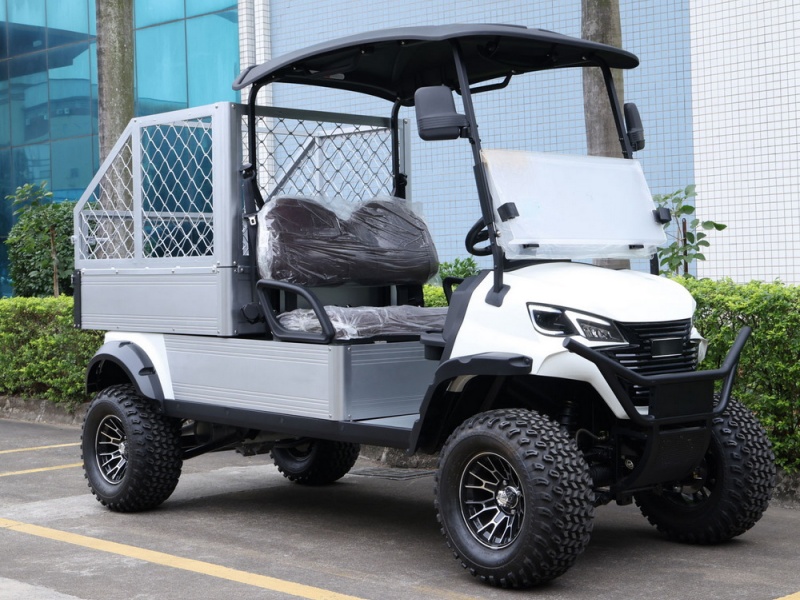
A golf cart truck is a compact utility vehicle designed for low-speed transportation of personnel, tools, supplies, equipment, and light cargo. It commonly uses an electric powertrain and may be configured with a rear cargo bed, enclosed box, flatbed, maintenance body, refuse collection unit, food-service body, or custom utility cabinet.
A compact pickup is a road-capable light truck with a larger chassis, higher speed capability, greater payload potential, and, in many cases, towing capacity. It is typically built for mixed-use travel: city roads, suburban routes, construction sites, service areas, rural roads, and off-road conditions.
The difference becomes particularly clear in a campus environment. A compact pickup is designed to cover broader routes and handle heavier-duty work. A golf cart truck is designed to make repeated, short-distance movements as efficiently as possible.
| Comparison Area | Golf Cart Truck | Compact Pickup |
|---|---|---|
| Primary operating environment | Campuses, resorts, factories, warehouses, parks, airports | Roads, job sites, mixed urban and rural routes |
| Typical speed profile | Low-speed, stop-and-go operation | Higher-speed road travel |
| Vehicle footprint | Compact and maneuverable | Larger body and turning envelope |
| Best cargo profile | Tools, parcels, cleaning supplies, light materials, maintenance parts | Heavy materials, large equipment, palletized loads, trailers |
| Energy source | Usually electric | Gasoline, diesel, hybrid, or electric depending on model |
| Pedestrian-area suitability | Strong, subject to local operating rules | More limited in confined pedestrian spaces |
| Custom body flexibility | High for task-specific utility applications | Moderate, depending on chassis and aftermarket options |
| Long-distance capability | Limited by battery range and charging plan | Better for longer routes and external travel |
For light-duty hauling in narrow corridors, the golf cart truck vs compact pickup comparison should begin with a simple question: "How much of the work is truly truck-level work?"
If the answer is mostly small deliveries, maintenance rounds, janitorial supply transport, landscaping tools, campus mail, spare parts, or waste collection, a compact electric utility vehicle may complete the task with less space, less noise, and lower operational complexity.
Many fleets are purchased based on maximum capability rather than normal daily use. That approach can lead organizations to deploy vehicles that are physically larger than the work environment requires.
A compact pickup may have excellent payload capacity, but this advantage can lose value when the vehicle frequently encounters narrow corridors, parking bottlenecks, pedestrian crossings, tight turns, building entrances, service pathways, and restricted access zones.
A utility cart can often reach locations that are inconvenient or inaccessible for a pickup. This can reduce the need for operators to park far away and carry items manually over the final portion of the route.
This "last 100 meters" problem is common in:
- University campuses
- Hospitals and medical complexes
- Resorts and theme parks
- Warehouses and manufacturing plants
- Airports and transport terminals
- Municipal parks and recreation facilities
- Large residential communities
- Exhibition centers and convention venues
Small electric utility trucks are widely used on university sites for tasks including tool transport, cleaning supply movement, parcel delivery, and mail distribution.
From an operational perspective, access creates measurable productivity gains. If a technician can bring parts, tools, ladders, cleaning materials, or replacement components closer to the service point, the entire job may require fewer walking trips and less downtime.
Fleet managers often compare payload, top speed, and purchase price first. Yet in confined environments, turning radius is one of the most important factors affecting real-world efficiency.
A pickup may need a three-point turn, reverse maneuver, or longer route around a building. A golf cart truck can often make the same movement in one continuous turn. Over dozens of daily stops, these seconds become meaningful operating time.
A tighter turning radius can help operators:
- Enter service lanes with less repositioning
- Reverse less frequently near pedestrians
- Use narrow loading areas more safely
- Reduce minor collision exposure
- Complete multi-stop routes faster
- Lower fatigue during repetitive work shifts
For campuses with heavy pedestrian activity, a smaller vehicle is not automatically safer. Safety still depends on driver training, speed control, route design, visibility, load security, and daily inspections. However, a compact footprint can make a vehicle easier to position and easier for pedestrians to anticipate.
Payload is the category where compact pickups usually have the clearest advantage. A pickup can typically transport heavier equipment, building materials, large landscaping supplies, and larger bulk orders. It may also support trailer towing, which substantially expands its role in construction, agriculture, and facilities projects.
Compact cargo vehicles are commonly positioned for payloads in the approximate 250–600 kg range, while pickups may cover roughly 500–1,200 kg depending on model and specification. The correct figure should always be confirmed through the manufacturer's official payload rating, local vehicle regulations, body configuration, passenger count, and installed accessories.
An electric utility cart is often sufficient when cargo consists of:
- Hand tools and maintenance kits
- Cleaning equipment and consumables
- Small spare parts
- Mail, documents, and parcels
- Food-service supplies
- Landscaping hand tools
- Light waste bins
- Event equipment
- Bottled water and hospitality supplies
- IT equipment for internal deployment
The key is not whether a pickup can handle the task. It clearly can. The key is whether the pickup's additional capacity is used often enough to justify its larger footprint and higher operating burden.
A compact pickup is normally the better fit when operations require:
- Regular transport of heavy construction materials
- Towing trailers, equipment, or utility attachments
- Travel between multiple sites on public roads
- Long-distance routes without predictable charging access
- Steep grades, deep mud, rough terrain, or remote locations
- Larger cargo dimensions that exceed utility-cart bed space
- Higher-speed emergency response or service coverage
- All-weather road performance in demanding climates
A strong fleet strategy does not force one vehicle to perform every job. In many organizations, the most effective model is a mixed fleet: golf cart trucks for internal low-speed logistics and compact pickups for heavy, external, or long-range duties.
The initial purchase price matters, but it is not the full cost of ownership. For light-duty hauling operations, the more useful question is: "What does each completed route cost over the life of the vehicle?"
A compact pickup may deliver more capacity per trip. Yet an electric utility vehicle may deliver lower cost per short stop when it is used repeatedly inside a controlled site.
| Cost Category | Golf Cart Truck | Compact Pickup |
|---|---|---|
| Energy or fuel | Electricity-based operating model | Fuel or larger battery charging requirement |
| Routine service | Often fewer powertrain service items in electric configurations | More complex road-capable vehicle maintenance |
| Tire and brake wear | May be lower in low-speed site operation | Can be higher due to vehicle mass and road use |
| Insurance and registration | Depends on jurisdiction and operating location | Often more extensive for public-road operation |
| Parking and storage | Smaller footprint | Requires more space |
| Downtime risk | Depends on battery care and spare-parts availability | Depends on engine, transmission, drivetrain, and road-use wear |
| Driver productivity | Strong for frequent short internal routes | Strong for longer and heavier routes |
The operational advantage of a golf cart truck becomes strongest when the route includes frequent stops, limited distance, compact loading areas, and predictable daily mileage.
By contrast, a pickup becomes more efficient when the same vehicle must travel beyond the campus, carry heavier loads, or operate where road speed and towing capacity matter.
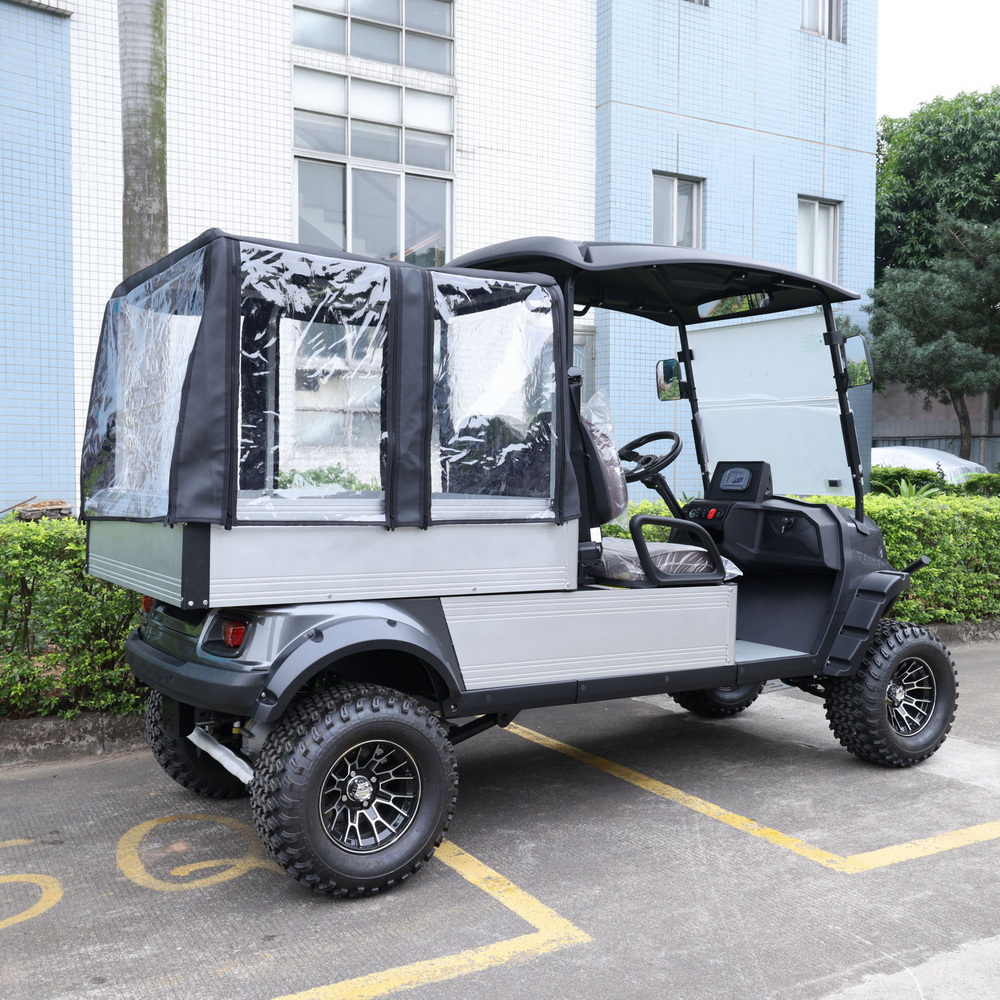
Electric utility carts work best when they are matched to a controlled duty cycle. This means understanding how far the vehicle travels, how much cargo it carries, when it is charged, and what conditions it faces during a normal shift.
A well-planned electric utility vehicle program should assess:
1. Daily route distance — Measure typical and peak kilometers per shift, not just estimated averages.
2. Payload per trip — Record both normal loads and occasional maximum loads.
3. Terrain and gradient — Slopes, ramps, uneven pavement, and grass can affect energy consumption and vehicle performance.
4. Stop frequency — Stop-start operation can be ideal for low-speed utility vehicles, but repeated acceleration with heavy loads still affects battery use.
5. Charging window — Determine whether the vehicle can charge overnight, during lunch breaks, or between shifts.
6. Seasonal conditions — Temperature, rain, snow, heat, and battery storage practices can influence practical operating range.
7. Body equipment demand — Refrigerated compartments, hydraulic equipment, lighting, warning beacons, and auxiliary systems may increase energy consumption.
This operational review is especially valuable for OEM buyers. A manufacturer should not simply offer a standard vehicle. It should help the buyer define a fit-for-purpose specification.
For example, a university maintenance department may need an enclosed cab, rear cargo bed, lockable tool storage, beacon light, reverse alarm, ladder rack, and weather-resistant seat materials. A resort may prioritize quiet operation, attractive exterior finishes, passenger capacity, and food-delivery storage. A manufacturing plant may need non-marking tires, safety lighting, high-visibility colors, and a durable flatbed body.
A golf cart truck may look simple to operate, but commercial use requires disciplined fleet management. The vehicle should be treated as a work asset, not as an informal transport solution.
Occupational safety guidance for powered industrial trucks emphasizes qualified operation, training, evaluation, and safe-use procedures. It also addresses issues such as unauthorized riders, loading practices, maintenance, and workplace hazards.
- Define speed limits for pedestrian zones, loading areas, and vehicle-only service roads
- Train operators for the specific vehicle model and actual site conditions
- Use seat belts where fitted and required
- Secure cargo so it cannot shift during turns or braking
- Establish a daily pre-operation inspection routine
- Specify horn, reverse alarm, beacon, mirrors, and lighting based on the site risk assessment
- Restrict passenger transport unless approved seating is provided
- Create separate routes where possible for pedestrians, bicycles, and utility vehicles
- Remove damaged vehicles from service until repaired
- Clearly identify maximum payload and cargo-bed limits
A practical inspection should include tires, brakes, steering, lights, horn, battery connections, charging cable condition, cargo-bed latches, mirrors, seat belts, and visible structural damage. Before adopting any fleet procedure, buyers should review applicable local regulations, workplace requirements, vehicle classification rules, and insurance obligations.
The most reliable procurement decision comes from route data rather than assumptions. Use the following process before selecting a golf cart truck or compact pickup.
Walk or drive the full service route. Measure corridor width, turning points, ramp grades, loading zones, pedestrian crossings, parking restrictions, and distance between stops.
Do not base the choice only on a facility map. Real conditions include bins, parked vehicles, temporary construction, foot traffic, doors, delivery carts, and seasonal obstacles.
A common procurement mistake is specifying every vehicle for the rarest load. Instead, identify:
- The load carried on most trips
- The heaviest routine load
- The largest cargo dimensions
- The number of trips per day
- The frequency of towing needs
- The percentage of routes that require public-road travel
If heavy loads occur only occasionally, it may be more economical to keep one compact pickup for those jobs and deploy multiple utility carts for routine internal transport.
In narrow corridors, width can be a pass-or-fail requirement. A vehicle that carries more but cannot comfortably access the work zone may create extra labor and route delays.
Ask suppliers for confirmed dimensions including mirrors, cargo body, accessories, tire width, turning radius, bed height, ground clearance, and door or cab clearance.
For OEM and private-label buyers, the vehicle body is often where commercial value is created. Rather than purchasing a generic golf cart truck, consider task-specific configurations such as:
- Flatbed utility cart for maintenance and landscaping
- Closed cargo box for parcels and documents
- Food-delivery cart with insulated compartments
- Waste collection utility vehicle
- Security patrol vehicle with warning equipment
- Mobile repair cart with tool cabinets
- Housekeeping cart with shelves and enclosed storage
- Customized cargo truck for branded campus logistics
BorCart can support overseas brands, wholesalers, and manufacturers with OEM-oriented electric utility cart and automotive-parts solutions. The practical value of OEM cooperation is the ability to align vehicle configuration, branding, body design, color, accessories, and packaging requirements with the target market.
Instead of comparing only vehicle price, compare how efficiently each option completes the work.
For example:
> A facilities team makes 40 short daily trips carrying cleaning supplies and small repair parts across a university campus. A compact pickup has more capacity than required for most trips and may need to park outside narrow access lanes. A golf cart truck can carry the normal load directly to the service point. Even if each cart carries less, fewer walking transfers and faster access can improve the total productivity of the route.
That is the core efficiency principle: the best vehicle is the one that reduces total handling time, not merely the one with the highest rated payload.
For buyers building a private-label utility vehicle range, the vehicle itself is only part of the commercial offer. End users increasingly evaluate durability, appearance, serviceability, charging compatibility, accessories, spare-parts support, and application-specific body options.
An OEM utility cart supplier should be able to discuss more than standard specifications. It should help buyers develop a market-ready product range.
- Can the vehicle be supplied with custom logos, colors, and decals?
- Are cargo-bed dimensions adjustable for specific end-use markets?
- Can the cart be configured with lithium battery options or other battery systems?
- Which accessories are available for safety, weather protection, storage, and cargo handling?
- Are replacement parts available for long-term distribution programs?
- Can packaging be optimized for container loading and international shipment?
- Is technical documentation available for dealers and service teams?
- Can the supplier support pilot samples before volume production?
- What quality-control process is used for chassis, electrical components, batteries, and final assembly?
For distributors, consistency is critical. A well-designed private-label golf cart truck program should offer repeatable specifications, clear parts identification, service documentation, and a defined upgrade path as customer needs change.
For light-duty hauling in narrow campus corridors, the golf cart truck is often the more efficient choice. Its compact size, low-speed operating profile, maneuverability, quiet electric operation, and customization potential make it well suited to repetitive internal tasks.
The compact pickup wins when the operation requires more payload, more speed, longer travel distances, public-road capability, towing, or tough terrain performance.
The strongest decision is based on the daily workflow:
- Choose a golf cart truck for short, frequent, pedestrian-sensitive, low-speed routes with light-to-medium cargo.
- Choose a compact pickup for heavy loads, external travel, towing, high-speed routes, and demanding terrain.
- Choose a mixed fleet when your organization needs both narrow-corridor access and truck-level hauling capacity.
If you are developing an electric utility cart range for a brand, dealership network, wholesale program, or commercial fleet, BorCart can help turn your target application into a tailored OEM vehicle specification. Contact BorCart to discuss your required payload, cargo body, battery system, branding, accessories, target market, and production requirements.
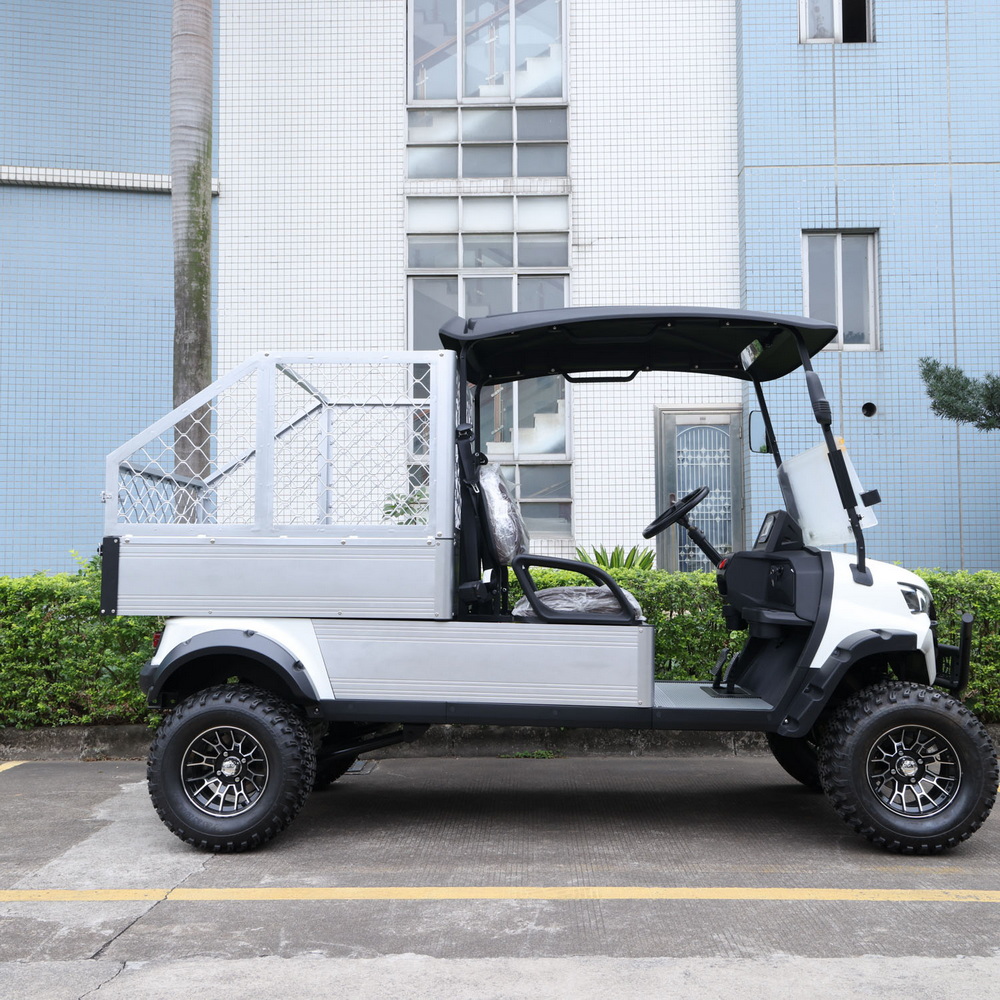
Yes. A golf cart truck can be highly suitable for campus maintenance when tasks involve transporting tools, small parts, cleaning supplies, landscaping equipment, or maintenance materials over short distances. The final specification should match the required payload, terrain, route width, weather exposure, and daily operating distance.
It can replace a compact pickup for many internal, light-duty routes, but not for every application. Electric utility carts are best for short-distance hauling in controlled environments. Compact pickups remain better for heavy cargo, towing, long routes, and public-road travel.
Select payload based on the heaviest routine load rather than the rare maximum load. Include the weight of tools, passengers, accessories, body equipment, and cargo. Always follow the manufacturer's rated payload limit.
They can be safe when a site uses proper speed limits, trained operators, designated routes, functional warning equipment, secure loads, and daily inspections. Small size alone does not replace safe operating practices.
The main advantage is higher capability. Compact pickups generally provide greater payload, higher travel speed, longer range, more robust road performance, and towing potential.
Yes. OEM buyers may request customized branding, paint colors, cargo bodies, storage systems, seating layouts, battery options, safety equipment, wheels, tires, weather enclosures, and application-specific accessories, subject to engineering and production requirements.
Often, yes. A mixed fleet allows the organization to assign compact electric utility carts to frequent internal trips while keeping compact pickups available for heavier loads, towing, external travel, and special projects.
1. [Occupational Safety and Health Administration — Powered Industrial Trucks, 29 CFR 1910.178]
2. [Occupational Safety and Health Administration — Powered Industrial Trucks Overview]
3. [Goupil — Electric Utility Trucks for University Campuses]
4. [WOX Motor — Compact Cargo Vehicles vs Pickup Trucks]
5. [U.S. Department of Transportation — Fuel Economy Standards for Model Years 2027–2031]
6. [Bureau of Transportation Statistics — Average Fuel Efficiency of U.S. Light-Duty Vehicles]


