


Views: 277 Author: BorCart Publish Time: 2026-10-07 Origin: Site


Content Menu
● Electric Cargo Van vs. Electric Utility Cart: Key Differences
● When an Electric Cargo Van Is the Better Choice
>> Enclosed Deliveries and Secure Cargo Transport
>> Longer Outdoor Routes and Road Connections
● When an Electric Utility Cart Is the Better Choice
>> Indoor Transport and Frequent Loading Stops
>> Outdoor Maintenance and Site Logistics
● Payload and Cargo Space: Compare the Right Numbers
>> Distinguish Cargo Capacity from Total Vehicle Capacity
>> Check Whether the Load Fits Physically
● Indoor Safety: Electric Does Not Mean Automatically Suitable
● Range and Charging: Match the Battery to the Duty Cycle
>> Evaluate Loaded Range, Not Just Advertised Range
>> Plan Charging Before Ordering Vehicles
● A Practical Route Audit for Indoor and Outdoor Transport
>> Step 1: Map Every Operating Area
>> Step 2: Record the Peak Load
>> Step 3: Measure Access Constraints
>> Step 4: Define the Working Schedule
>> Step 5: Run a Representative Demonstration
● Total Cost of Ownership: Measure Productivity as Well as Price
● Three Application Scenarios That Clarify the Choice
>> Factory-to-Warehouse Transfers
>> Distributor and Service Networks
● OEM Specifications Overseas Buyers Should Agree with BorCart
● Choose the Vehicle Around the Transport Job
>> 1. Can an electric cargo van operate inside a warehouse?
>> 2. Is an electric utility cart street legal?
>> 3. Which vehicle carries more cargo?
>> 4. Can a utility cart protect goods from rain?
>> 5. How should buyers compare battery range?
>> 6. What should an OEM inquiry include?
An electric cargo van and an electric utility cart can both move goods without tailpipe emissions, but they solve different transport problems. An electric cargo van generally suits enclosed deliveries and longer outdoor routes. An electric utility cart often fits short-distance material movement, frequent loading stops, and confined facilities.
For overseas brand owners, wholesalers, and manufacturers sourcing OEM vehicles, choosing correctly requires more than comparing battery capacity or purchase price. Vehicle dimensions, usable payload, route conditions, legal classification, and service support all influence commercial success.
From a procurement perspective, my starting point is route fit: define where the vehicle must work before deciding what it should look like. This guide applies that approach to indoor and outdoor transport, including practical specification questions for an OEM project with BorCart.

An electric cargo van typically combines a driving cab with an enclosed goods compartment. However, the name covers both road-going commercial vans and compact, low-speed cargo vehicles. They do not necessarily have the same operating permissions or capabilities.
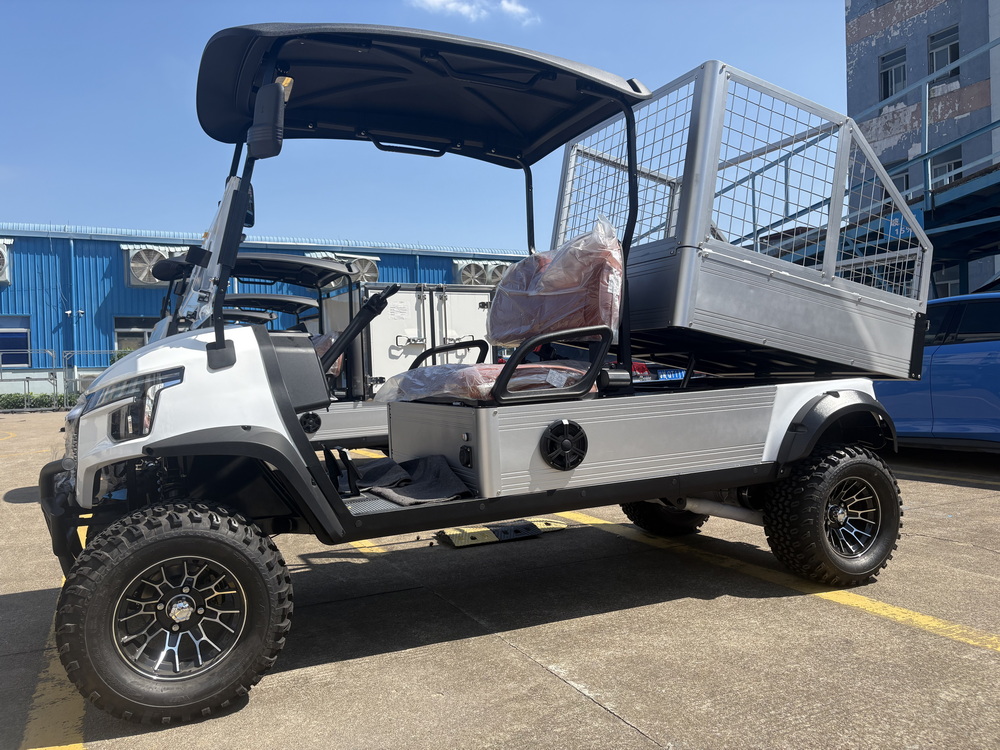
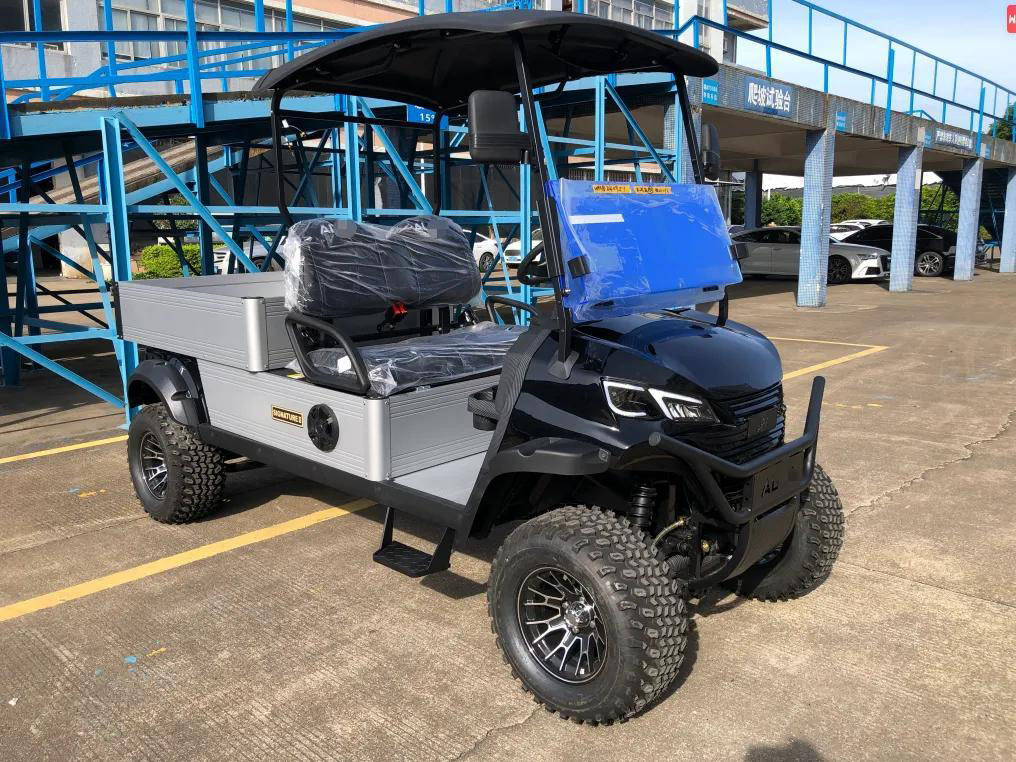
An electric utility cart usually prioritizes accessible cargo space and maneuverability. Common configurations include flatbeds, drop-side beds, tipping bodies, and enclosed utility boxes.
Neither category guarantees road legality, indoor suitability, or a particular payload.
| Selection factor | Electric cargo van | Electric utility cart |
|---|---|---|
| Typical role | Enclosed deliveries and outdoor logistics | On-site transport and maintenance |
| Cargo access | Rear or side doors | Often open, direct bed access |
| Weather protection | Usually stronger with an enclosed body | Depends on cab and cargo enclosure |
| Confined spaces | Depends heavily on vehicle dimensions | Compact models often fit better |
| Public-road operation | Requires appropriate vehicle approval | Must not be assumed |
| Frequent short stops | Suitable, but door handling adds time | Often convenient for repeated loading |
| OEM priorities | Cargo layout, doors, security, approval | Bed design, dimensions, speed control |
The important distinction is not simply "large versus small." It is protected transport versus accessible, task-focused movement.
An electric cargo van becomes attractive when goods need protection from rain, dust, casual access, or accidental loss.
Typical applications include:
- Spare-parts delivery between service locations.
- Packaged goods distribution.
- Tools and equipment transport.
- Campus deliveries involving exposed outdoor routes.
- Finished-product movement between buildings.
An enclosed compartment also supports organized shelving and separate storage zones. However, an enclosure does not automatically provide temperature control, waterproofing, or protection for sensitive electronics.
Specify those requirements separately, including seals, ventilation, insulation, and securing points.
For routes involving public roads, procurement should begin with the vehicle's approved classification in the destination market.
A road-approved commercial electric cargo van is fundamentally different from a low-speed enclosed cargo vehicle. A similar body shape does not establish equivalent braking performance, registration eligibility, or crash protection.
Buyers should request:
1. The exact vehicle category.
2. Approval documentation for the target market.
3. Permitted operating conditions.
4. Registration and insurance requirements.
5. Rated payload for the supplied configuration.
Do not select a vehicle first and investigate road access afterward.
An electric utility cart can be a practical choice for warehouses, factories, hotels, and maintenance facilities where operators repeatedly load and unload small consignments.
An accessible bed reduces the need to open doors or climb into a cargo compartment. That can simplify workflows involving tools, bins, packaging materials, and cleaning supplies.
Nevertheless, indoor suitability requires a physical assessment. Measure:
- The narrowest doorway.
- The tightest turning area.
- Overhead clearance.
- Ramp transitions.
- Floor loading restrictions.
- Pedestrian crossings and shared aisles.
A compact vehicle still needs enough operating space to turn safely with its intended load.
Utility carts can suit groundskeeping, resort operations, industrial yards, and facility maintenance.
Their value often comes from task-specific bodies rather than maximum speed. A flatbed may carry equipment efficiently, while a tipping body may simplify waste or loose-material handling.
For outdoor use, evaluate loaded braking, traction, ground clearance, corrosion protection, and weather exposure.
An enclosed cab can improve operator comfort, but it does not turn a site vehicle into a road-approved van.
Payload figures are easy to misread.
A manufacturer may publish cargo-bed capacity, total vehicle capacity, or maximum payload for a particular body configuration. These figures are not interchangeable.
Passengers, shelving, accessories, and installed equipment may reduce the remaining goods allowance. Confirm precisely what each published rating includes.
For perspective, Club Car's Carryall 500 product page identifies an 800 lb cargo-bed capacity. Ford's 2025 E-Transit technical specifications list maximum payloads from 2,799 to 3,249 lb across the configurations shown.
These are examples of different vehicle classes, not universal category limits. They are also not BorCart specifications.
A vehicle can satisfy the weight requirement but fail the loading requirement.
Check pallet dimensions, door openings, wheel-arch intrusion, bed height, and loading equipment compatibility. For vans, consider whether operators must reach deep inside. For carts, determine how tall or loose loads will be restrained.
Ask the supplier to provide a dimensioned cargo drawing and demonstrate the intended loading method.
The best electric cargo vehicle is the one that carries the real consignment safely—not merely the one with the highest brochure rating.
Battery-electric vehicles produce no tailpipe exhaust during operation. This advantage does not remove collision, battery, fire, or charging risks.
For indoor transport, the safety review should cover visibility, stopping distance, operator training, pedestrian separation, and parking arrangements.
A useful operating plan includes:
- Site-specific speed limits.
- Clearly marked vehicle routes.
- Controlled crossing points.
- Suitable warning devices.
- Pre-use inspections.
- Safe charging and parking locations.
In the United States, OSHA's powered industrial truck requirements apply to covered equipment, including certain electrically powered industrial vehicles. Whether a specific cargo cart falls within that scope depends on its classification and use.
Charging precautions must also match battery chemistry. Lead-acid charging considerations are not identical to those for lithium-ion systems.
Avoid making "indoor safe" a blanket product claim.
Range depends on operating conditions, including payload, gradients, temperature, repeated acceleration, and auxiliary equipment.
For a utility cart, frequent stops and ramps may matter more than daily distance. For a cargo van, road speed and cabin heating or cooling can become important variables.
Ask suppliers to disclose the conditions behind their range claims:
1. Test load and passenger weight.
2. Average speed and route profile.
3. Ambient temperature.
4. Battery capacity and usable energy.
5. Accessories operating during the test.
A practical battery specification should cover the working shift plus a defined reserve. Treat any proposed reserve percentage as a planning assumption until route testing supports it.
Charging depends on more than finding an available socket.
Confirm supply voltage, charger compatibility, circuit capacity, parking access, and the time available between shifts.
The U.S. Department of Energy identifies overnight Level 2 charging as a useful option for many road-going fleet vehicles. Utility carts may instead use model-specific onboard or external chargers.
Do not assume the two categories share connectors or charging equipment.
For OEM projects, charger documentation and destination-market electrical compatibility should be part of the purchase specification.
Before comparing quotations, create a one-page duty-cycle brief.
Divide the route into indoor aisles, outdoor yards, ramps, private roads, and public roads. Mark pedestrian-heavy locations and restricted areas.
Document the heaviest consignment, largest package dimensions, passenger requirement, and installed equipment.
Use the peak realistic load—not only the daily average.
Record door widths, ceiling heights, turning spaces, loading bays, and parking dimensions.
List trips per shift, distance per trip, loading time, downtime, and available charging windows.
Test the shortlisted configuration with the intended load. Observe maneuvering, braking, cargo access, battery consumption, and operator visibility.
This audit turns a vague request for an "electric transport vehicle" into an actionable OEM specification.
Purchase price alone cannot establish which vehicle is cheaper to operate.
Compare acquisition cost, freight, import charges, charging installation, electricity, maintenance, tires, battery replacement assumptions, insurance, and downtime.
Then include labor.
Consider an illustrative operation moving 600 cartons daily. Suppose a cart carries 30 cartons per trip and a van carries 100:
- The cart needs 20 trips.
- The van needs six trips.
If each cart cycle takes six minutes and each van cycle takes 15 minutes, transport time becomes 120 minutes versus 90 minutes.
These are hypothetical figures, not measured product results. They demonstrate why a faster-loading cart can still require more labor if its capacity creates many additional trips.
For short, scattered maintenance tasks, the outcome may reverse.
Compare cost per completed shift or delivered consignment, using measured route data.
The following scenarios illustrate selection logic rather than documented customer installations.
For components moving through narrow indoor passages, a compact utility cart may fit best.
If finished goods must cross an exposed yard, an enclosed cargo body may become more valuable. One route may justify different vehicles at different stages.
Utility carts can support housekeeping, maintenance, and landscaping because cargo remains accessible during repeated stops.
A cargo van may better suit protected supply runs between properties, especially where public-road travel is required.
A distributor transporting tools and spare parts between customer locations generally needs secure storage and verified road access.
Here, a road-approved electric cargo van may be more appropriate than a site utility cart, even when the daily distance is modest.
The governing question remains where the vehicle operates and what the cargo requires.
For a BorCart OEM project, convert operating requirements into verifiable deliverables.
Discuss the following areas before approving a production specification:
| Specification area | What buyers should define |
|---|---|
| Vehicle envelope | Width, height, length, and turning requirements |
| Cargo system | Bed or enclosure, load restraint, doors, shelving |
| Battery and charger | Capacity, chemistry, charging supply, documentation |
| Operating performance | Loaded speed, braking, grade requirements |
| Destination compliance | Vehicle category and required approval evidence |
| Service support | Manuals, spare parts, diagnostics, warranty terms |
Brand owners should also agree on labeling, traceability, inspection criteria, packaging, and spare-parts identification.
A production sample should represent the intended saleable configuration. Changes to batteries, bodies, tires, or accessories may affect performance and compliance.
My procurement recommendation is to make acceptance criteria measurable. "Strong climbing ability" is less useful than a documented loaded-gradient requirement and an agreed test procedure.
Choose an electric cargo van when enclosed storage, outdoor exposure, delivery capacity, and appropriate road approval dominate the requirement.
Choose an electric utility cart when compact access, frequent loading, short site routes, and task-specific bodies matter most.
For mixed operations, a small combination fleet may outperform a single compromise vehicle.
Send BorCart your destination market, route map, peak load, access dimensions, charging supply, and preferred cargo layout. Use that brief to request a proposed OEM configuration, supporting documentation, and a loaded demonstration before committing to volume production.
Possibly, but only after checking dimensions, floor limits, visibility, braking, site rules, and equipment classification. Electric propulsion alone does not establish indoor suitability.
Not automatically. Public-road operation depends on the vehicle's classification, required approvals, and local rules. Lights and seat belts alone do not prove road eligibility.
Road-going cargo vans commonly offer greater enclosed capacity than compact carts. However, compare exact models, cargo dimensions, and the payload remaining after occupants and accessories.
An enclosed cargo box may improve protection. Confirm sealing, drainage, and the supplier's stated protection level. A roof over the operator does not protect an open cargo bed.
Request consistent test conditions and run a representative loaded route. Compare usable shift performance and charging opportunities rather than advertised distance alone.
Include the destination market, application, peak load, route conditions, access dimensions, shift length, charging supply, cargo-body requirements, and expected service support.
1. [Ford — 2025 E-Transit Technical Specifications]. Manufacturer technical sheet supporting the configuration-specific payload example. Figures describe the listed models, not all electric cargo vans. [fromtheroad.ford]
2. [Club Car — Carryall 500]. Manufacturer product information supporting the 800 lb cargo-bed capacity example. Bed capacity should not be confused with total vehicle capacity. [clubcar]
3. [Occupational Safety and Health Administration — Powered Industrial Trucks Overview]. Guidance supporting the discussion of workplace hazards, pedestrian safety, and operator competence for covered equipment. [osha]
4. [Occupational Safety and Health Administration — 29 CFR 1910.178]. Regulatory source supporting the discussion of powered industrial truck scope, operating precautions, and battery-charging arrangements. Applicability requires a vehicle-specific assessment. [osha]
5. [U.S. Department of Energy, Alternative Fuels Data Center — Electric Vehicles for Fleets]. Fleet guidance supporting charging planning, infrastructure budgeting, and ownership-cost assessment. [afdc.energy]
6. [U.S. Department of Energy, Alternative Fuels Data Center — Electric Vehicle Benefits and Considerations]. Background supporting electric-vehicle operating considerations and lifetime-cost comparisons. [afdc.energy]
7. [Electronic Code of Federal Regulations — 49 CFR 571.500, Low-Speed Vehicles]. U.S. regulatory reference illustrating why low-speed vehicle classification and safety requirements must be checked separately from product descriptions. [ecfr]


