


Views: 247 Author: BorCart Publish Time: 2026-08-30 Origin: Site


Content Menu
● Why White Golf Carts Remain a Popular Choice
● Start With the Job, Not the Color
● Choose the Right White Golf Cart Configuration
● Battery Choice: Lithium or Lead-Acid?
● How to Estimate the Range You Actually Need
● Safety Features That Should Not Be Optional
● Customization Opportunities for White Golf Carts
● Maintenance Tips for a Clean, Long-Lasting White Golf Cart
● What Commercial Buyers Should Ask an OEM Manufacturer
● Final Checklist Before You Buy
● Build Your White Golf Cart Project With BorCart
● FAQ
>> Are white golf carts harder to keep clean?
>> Is a lithium white golf cart better than a lead-acid model?
>> Can I add my company logo to a white golf cart?
>> What size white golf cart should a hotel or resort buy?
>> How long does a white electric golf cart take to charge?
>> Can white golf carts be used on public roads?
>> What spare parts should wholesalers order with their first golf cart shipment?
A white golf cart is more than a clean-looking vehicle for the course. For resorts, communities, dealerships, rental operators, event companies, and private owners, it can become a practical people-mover, a brand asset, and a customizable electric vehicle platform.
The right choice is not simply about selecting a white body color. Buyers should evaluate passenger capacity, battery configuration, terrain, charging access, legal requirements, customization options, after-sales parts support, and the expected daily workload. This guide explains how to choose a white golf cart that performs reliably and represents your business or lifestyle well.
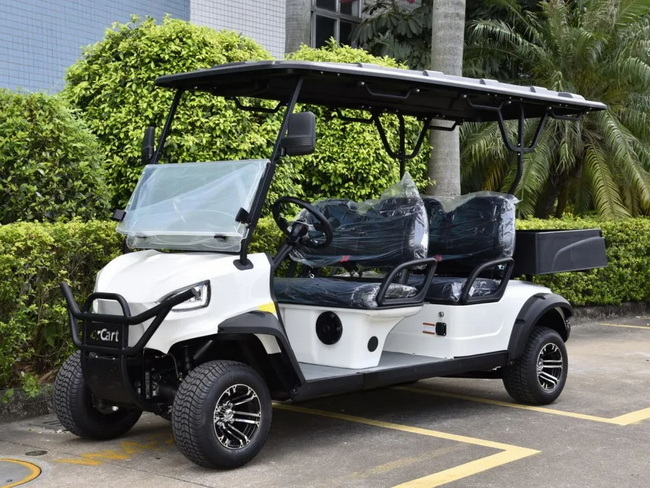
White is one of the most versatile colors available for golf carts and low-speed electric vehicles. It communicates cleanliness, simplicity, and professionalism without limiting future customization.
For commercial buyers, a white golf cart provides a neutral foundation for a visual identity. A resort can add discreet logos. A dealer can apply local branding. A wedding venue can create an elegant guest shuttle. A maintenance company can add utility equipment and safety markings without making the vehicle look overly industrial.
For individual owners, white also works across many settings:
- Golf courses and country clubs
- Residential communities and private estates
- Beachfront properties and holiday parks
- Hotels, resorts, and tourist attractions
- Warehouses, industrial parks, and campuses
- Weddings, exhibitions, and promotional events
- Rental fleets and dealership inventory
A well-finished white body also makes it easier to identify dust, scratches, and surface contamination early. Although some buyers initially assume white requires more cleaning, the visible surface condition can actually encourage better routine care and preserve a professional presentation.
The first purchasing mistake is choosing a golf cart based only on appearance. Before comparing white golf cart models, define the vehicle's actual job.
Ask these questions:
1. How many passengers will travel in the cart at one time?
2. What is the expected daily driving distance?
3. Will the vehicle operate on smooth paths, grass, gravel, slopes, or mixed terrain?
4. Will it carry tools, luggage, food, maintenance supplies, or other cargo?
5. Will it be used privately, commercially, or as part of a rental fleet?
6. Is overnight charging available at the operating location?
7. Do local rules require lights, mirrors, seat belts, turn signals, or other road-use equipment?
8. Does the buyer need branding, custom seating, upgraded wheels, or special accessories?
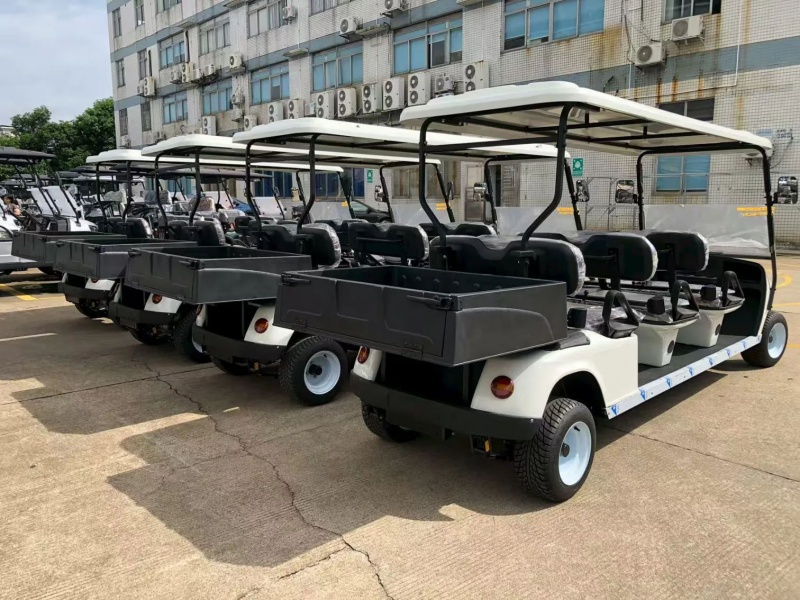
A four-seat cart may be ideal for a family or a small resort transfer route. A six-seat or eight-seat configuration may be more suitable for hotels, retirement communities, event transportation, or tour operations. A utility-oriented model with a rear cargo bed may be the stronger choice for groundskeeping and maintenance teams.
The best white golf cart is the one matched to the workload. A vehicle that looks premium but lacks range, carrying capacity, or serviceability may create higher operating costs later.
White golf carts are available in many layouts. Each format serves a different buyer profile.
| Cart Type | Best For | Main Advantage | Key Consideration |
|---|---|---|---|
| 2-seat golf cart | Golfers, couples, compact private use | Easy parking and lower energy use | Limited passenger and cargo capacity |
| 4-seat golf cart | Families, communities, resort guests | Strong balance of size and versatility | Check rear-seat legroom and safety features |
| 6-seat golf cart | Hotels, tours, rental fleets | Moves more guests per trip | Requires more storage space and may use more energy |
| Utility golf cart | Factories, estates, maintenance teams | Cargo capacity and work-focused function | Prioritize payload, suspension, and bed design |
| Lifted golf cart | Uneven surfaces, rural properties, lifestyle use | Better ground clearance and visual impact | Confirm stability, tire suitability, and local regulations |
| Customized golf cart | Dealers, brands, promotional projects | Supports a unique commercial identity | Define specifications clearly before production |
For international distributors and brand owners, configuration planning is especially important. A white golf cart can be tailored with different seating layouts, roof styles, windshields, wheel designs, dashboard features, lights, storage compartments, and branding treatments.
That flexibility makes it a strong platform for OEM projects. Instead of selling an undifferentiated vehicle, a distributor can introduce a recognizable local product line with its own design language and accessory package.
Battery technology is one of the most important decisions in an electric golf cart purchase. The two common options are lithium-ion batteries and lead-acid batteries.
Lithium systems are increasingly attractive for commercial operators and buyers who value easier daily use.
Common advantages include:
- Lower battery weight
- Faster and more convenient charging options
- Less routine battery maintenance
- More stable voltage delivery during operation
- Longer usable cycle life in many applications
- No need for regular water filling associated with flooded lead-acid batteries
For hotels, resorts, rental businesses, and fleet operators, lithium can simplify day-to-day management. Less maintenance time means staff can focus on guest service or operations rather than battery checks.
However, lithium battery quality, battery-management design, charger compatibility, warranty terms, and local service support must be verified carefully. Buyers should request clear documentation covering battery capacity, voltage, charging procedures, operating temperature limits, warranty coverage, and end-of-life handling.
The U.S. Department of Energy notes that electric-vehicle battery, motor, and electronic systems generally require relatively little scheduled maintenance, while battery life and warranty conditions should still be reviewed with the seller. [References: U.S. Department of Energy, "Maintenance and Safety of Electric Vehicles"]
Lead-acid batteries remain familiar to many golf cart users and service technicians. They may offer a lower initial purchase cost and can be practical where local service networks are built around conventional battery systems.
Their limitations are equally important:
- Greater weight
- More maintenance for flooded battery designs
- Potential need for water-level checks
- Longer charging time in many cases
- Performance sensitivity when batteries are poorly maintained
- Shorter operating life when deeply discharged or neglected
A lead-acid option can still be appropriate for low-intensity use, budget-focused projects, and markets with well-established lead-acid service infrastructure. But buyers should calculate total ownership cost rather than focusing only on the initial vehicle price.
Published range figures are useful, but they should not be treated as a guarantee. Real-world range can change based on passenger weight, hills, tire pressure, driving style, temperature, battery age, accessory use, and surface conditions.
A practical buying method is to calculate the daily route first.
For example, a resort may operate a white golf cart for guest transfers between parking, reception, villas, restaurants, and recreational areas. If the planned route totals 15 miles per day, the buyer should not select a vehicle with a claimed maximum range of only 15 miles.
A more reliable approach is to build a reserve into the requirement:
Target daily range=Expected daily mileage×1.3 to 1.5
If the daily route is 15 miles, target a practical operating range of approximately 20 to 23 miles under similar conditions. This reserve helps accommodate detours, additional passengers, hills, battery aging, and reduced performance in cooler weather.
For fleet buyers, consider the following:
- Number of operating hours per day
- Average passenger count
- Grade and surface condition of routes
- Frequency of stop-and-go driving
- Opportunity charging during breaks
- Seasonal temperature changes
- Reserve vehicles available during maintenance
Range should be planned around the hardest normal operating day, not the easiest one.
A white golf cart should look refined, but appearance must never outweigh vehicle safety. This is particularly important for commercial fleets carrying guests, elderly passengers, children, or workers.
Depending on intended use and local requirements, evaluate these features:
- Seat belts for all seating positions
- Rear-view mirrors and side mirrors
- Headlights, taillights, brake lights, and turn signals
- Horn and reverse warning sound
- Windshield, roof, and weather protection
- Parking brake design
- Non-slip floor surfaces
- Secure handholds and step areas
- Speed control settings
- Durable seat frames and mounting points
- Roll-over protection or reinforced structures where appropriate
- Clearly labeled passenger capacity and payload limits
Brake performance deserves special attention. Recalls in the golf-car sector have shown that brake-cable routing and other assembly details can create serious hazards when not correctly controlled. Buyers should therefore ask about brake inspection procedures, production quality checks, and parts traceability. [References: U.S. Consumer Product Safety Commission, golf-car recall notices]
For a resort or public-facing fleet, create a simple driver inspection routine before each shift. The operator should check tire condition, steering response, brakes, lights, battery charge, seat security, and visible body damage. A two-minute inspection can prevent downtime and reduce risk.
A white body creates a highly flexible base for OEM customization. The cart can remain elegant and minimalist, or it can become a distinctive branded vehicle.
Popular customization options include:
- Custom logo decals and full body graphics
- Color-matched seats, roofs, and trim
- Two-tone body finishes
- Premium steering wheels and dashboards
- Aluminum wheels and all-terrain tires
- LED light packages
- Rear-view cameras and display screens
- Bluetooth audio systems
- Golf bag holders, coolers, and storage boxes
- Utility cargo beds and tool racks
- Fold-down rear seats
- Enclosures, rain covers, and doors
- Fleet numbering and QR-code asset labels
For a dealership or regional brand, customization should serve a commercial objective. For example, a white six-seat resort cart can use subtle navy branding, waterproof beige seats, a rear luggage area, LED lighting, and a fleet identification panel. That specification feels more premium than a standard vehicle while remaining practical for daily guest transportation.
Avoid adding accessories simply because they look impressive. Every item should improve comfort, safety, durability, branding, or operating efficiency.
White golf carts can maintain a bright, premium appearance for years when owners follow a consistent care routine.
- Wash dust, mud, salt, and bird droppings from painted surfaces
- Use a mild automotive cleaning product rather than abrasive household chemicals
- Wipe seats, dashboard surfaces, handrails, and roof supports
- Inspect tires for cuts, uneven wear, and correct inflation
- Check lights, mirrors, horn, and brake response
- Remove debris from the footwell and under-seat areas
- Inspect battery connections and charging equipment
- Check wheel fasteners, steering response, and suspension components
- Examine seat mounts, roof supports, and cargo attachments
- Clean windshield surfaces with a suitable non-abrasive product
- Inspect decals and branding graphics for lifting edges
- Review charging records for unusual changes in performance
White paint and plastic panels benefit from shade, covered storage, and regular washing. UV exposure, industrial dust, salt air, tree sap, and harsh chemicals can all affect exterior surfaces over time.
For lithium-ion batteries, follow the vehicle manufacturer's charging instructions. Damaged lithium-ion batteries should be handled according to the battery supplier's instructions and should not be placed in household trash or standard recycling bins. The U.S. Environmental Protection Agency recommends using appropriate battery recycling or hazardous-waste collection channels. [References: U.S. Environmental Protection Agency, "Used Lithium-Ion Batteries"]
For overseas brands, wholesalers, and fleet buyers, a white golf cart purchase is not only a vehicle decision. It is a supply-chain decision.
Before selecting an OEM partner, ask detailed questions about:
1. Product specifications: What motor power, controller, axle ratio, suspension, brake system, and battery options are available?
2. Customization capability: Can the manufacturer supply custom logos, colors, seats, dashboards, accessories, packaging, and documentation?
3. Quality control: What inspections are completed before shipment? Are road tests, brake tests, charging tests, and cosmetic inspections documented?
4. Compliance support: Can the supplier provide technical files, component information, test reports, or documentation needed for the destination market?
5. Parts availability: Which spare parts should be ordered with the first shipment? How quickly can replacement components be supplied?
6. Packaging and logistics: How are carts packed for container loading? Are partially assembled or fully assembled shipping options available?
7. Warranty process: Who handles diagnosis, parts replacement, labor support, and claims documentation after delivery?
8. Production consistency: Can the supplier maintain the same configuration, finish, and accessory standard across repeat orders?
A capable OEM manufacturer should help buyers turn an idea into a repeatable product specification. That includes defining the vehicle platform, confirming visual details, selecting reliable components, and establishing a clear after-sales parts plan.
Before placing an order for a white golf cart, confirm the following points:
- The seating capacity matches actual passenger demand
- The cart has enough range for the busiest normal day
- Battery type fits the budget and maintenance capability
- Charging infrastructure is available and suitable
- Safety equipment matches local use conditions
- Tires, suspension, and ground clearance fit the terrain
- Customization supports the intended brand or application
- Warranty terms are written and understandable
- Spare parts and technical support are available
- The manufacturer can provide consistent quality for future orders
A white golf cart can be simple, elegant, and highly functional. When selected carefully, it can serve as a dependable private vehicle, a polished resort shuttle, a productive utility cart, or a distinctive branded product for a local market.
BorCart supports overseas brands, wholesalers, distributors, and commercial buyers looking for customizable electric golf carts, utility vehicles, and automotive component solutions. Whether you need a compact two-seat model, a multi-passenger resort cart, a utility configuration, or an OEM-ready white golf cart with your own branding, the right specification starts with a clear discussion of your market and operating requirements.
Contact BorCart to discuss your target capacity, battery preference, customization needs, order quantity, and destination-market requirements. Our team can help you develop a white golf cart solution designed for your customers rather than a one-size-fits-all product.
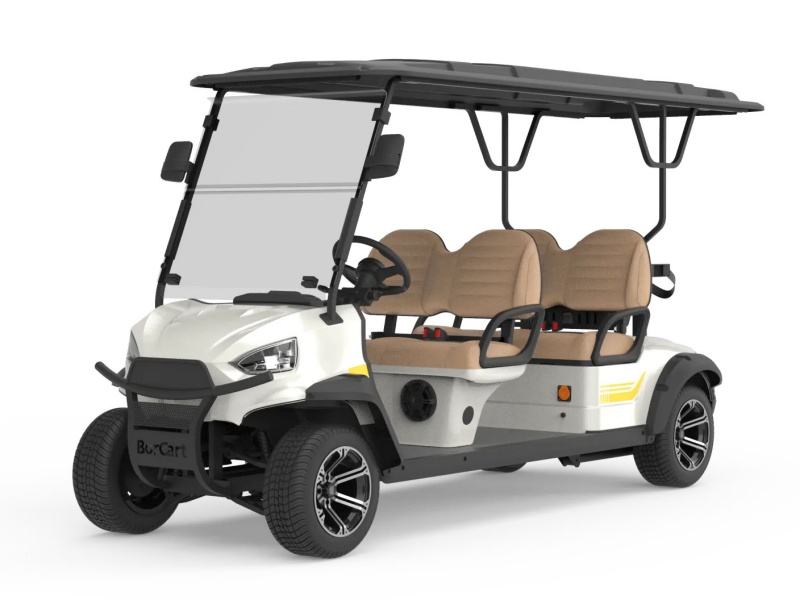
White golf carts can show dust and mud sooner than darker colors, but this also makes cleaning needs easier to identify. With regular washing and protected storage, a white cart can retain a clean, premium appearance for a long time.
Lithium is often a stronger choice for frequent use because it is lighter and generally requires less routine maintenance. Lead-acid may still suit budget-focused projects or markets where conventional battery service is widely available. The best choice depends on daily mileage, charging conditions, budget, and local support.
Yes. White golf carts are highly suitable for logos, decals, fleet numbers, and custom graphics. They provide a neutral background that helps branding remain visible and professional.
A four-seat model may work for small properties and guest transfers. Six-seat or larger configurations are often more efficient for resorts, tourist sites, and event venues that transport groups. Consider passenger volume, route distance, luggage needs, and available parking space.
Charging time depends on battery chemistry, battery capacity, charger output, and remaining charge level. Ask the manufacturer for the estimated charging time under normal operating conditions and confirm that the charging equipment is compatible with the site's electrical supply.
It depends on local laws and the vehicle's equipment. Some areas allow properly equipped low-speed vehicles on designated roads, while others restrict golf carts to private property, golf courses, or specific communities. Always verify regulations before using a cart on public roads.
Common initial spare-parts packages may include chargers, controllers, switches, brake components, light assemblies, tires, wheel bearings, suspension bushings, seat hardware, body trim, and key electrical connectors. The exact package should reflect the selected cart configuration and anticipated service volume.
1. [Original article: The Ultimate Guide to Choosing the Perfect White Golf Cart for Your Needs]
2. [U.S. Department of Energy: Maintenance and Safety of Electric Vehicles]
3. [U.S. Department of Energy: Charging Electric Vehicles at Home]
4. [U.S. Environmental Protection Agency: Used Lithium-Ion Batteries]
5. [U.S. Environmental Protection Agency: Lithium-Ion Battery Recycling Frequently Asked Questions]
6. [U.S. Consumer Product Safety Commission: Club Car Recall Notice]
7. [U.S. Consumer Product Safety Commission: Garia Golf and Courtesy Electric Vehicle Recall Notice]


