


Views: 222 Author: BorCart Publish Time: 2026-06-25 Origin: Site


Content Menu
● Why Silence Matters in the Field
● Hunting Golf Cart vs Traditional ATV
● The Tactical Edge of Quiet Mobility
● Market Shift Behind the Trend
● Buying Checklist for Hunters
● FAQs
Modern hunters are increasingly choosing a hunting golf cart over a traditional ATV because silence, stealth, and reduced disturbance can change the outcome of a hunt. For brands, wholesalers, and OEM buyers, this shift also reflects a larger trend toward low-noise electric mobility and versatile off-road utility. [auto.ifeng]
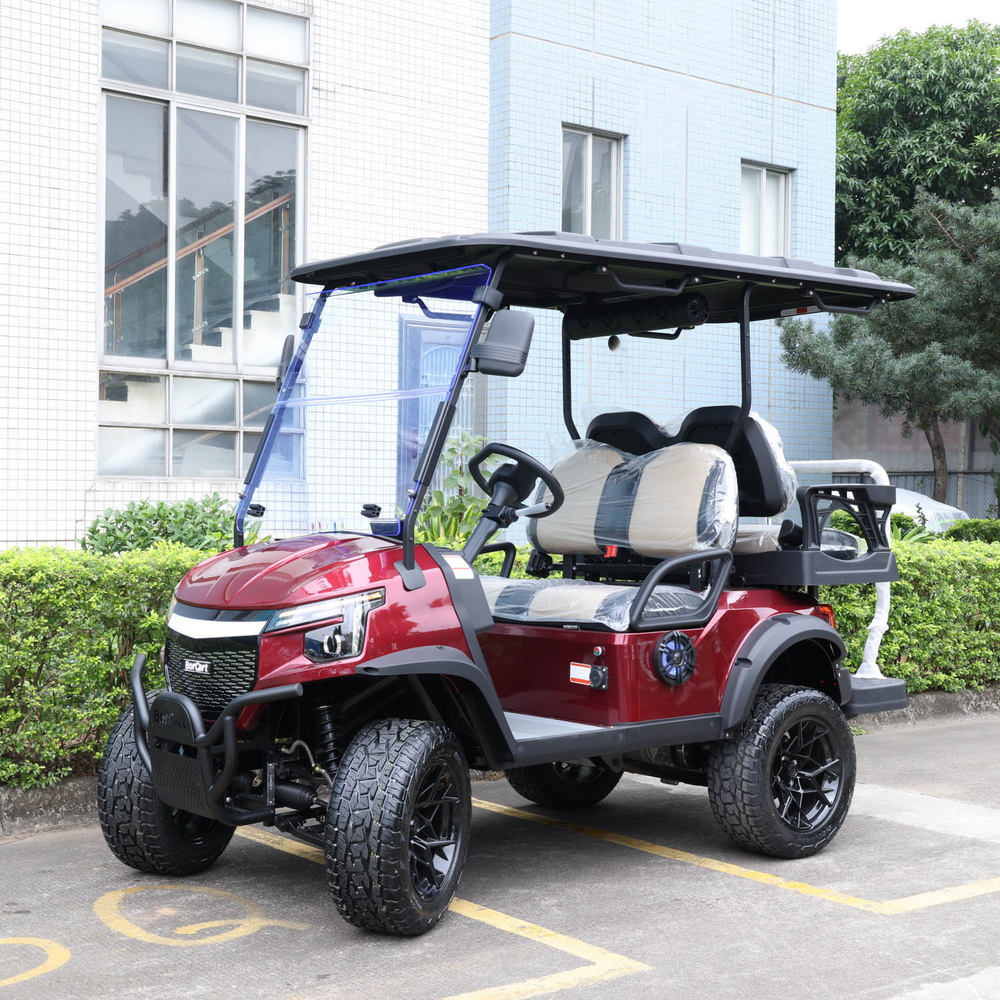
In hunting, sound does more than alert game. It also changes animal movement, increases stress, and can force deer and other wildlife out of a pattern before a hunter even gets into position. A quieter vehicle helps preserve the natural rhythm of the property and supports a more disciplined approach to access, scouting, and gear transport. [whitetailhabitatsolutions]
Traditional ATVs are effective and rugged, but they are not built around stealth. By contrast, a hunting golf cart or electric cart platform can move equipment, decoys, coolers, and firearms with far less audible disruption, especially on private land, ranches, and managed hunting properties. [eunorau-ebike]
The right choice depends on terrain, payload, and hunting style. Still, when quiet access is the priority, the comparison often favors a hunting golf cart.
| Factor | Hunting Golf Cart | Traditional ATV |
|---|---|---|
| Noise level | Low; better for stealth access (whitetailhabitatsolutions) | Higher engine and trail noise (whitetailhabitatsolutions) |
| Scent disturbance | Lower when electric and driven carefully (whitetailhabitatsolutions) | Higher due to engine use and heavier disturbance (whitetailhabitatsolutions) |
| Gear carrying | Strong for stand gear, decoys, and field tools | Strong for heavier utility and rougher loads |
| Terrain handling | Best on farm roads, trails, and moderate off-road use | Better for mud, steep climbs, and harsh terrain |
| Hunting stealth | Excellent for preserving animal patterns (eunorau-ebike) | Useful, but easier to detect |
| Maintenance profile | Often simpler with fewer moving parts in electric models (fortunebusinessinsights) | Typically more mechanical upkeep |
For many modern hunters, the question is not whether an ATV is capable. It is whether the vehicle matches the hunting objective. If the goal is mature bucks, minimized pressure, and repeated access without educating the herd, quiet mobility becomes a strategic advantage. [whitetailhabitatsolutions]
Silence gives hunters three practical benefits: access, timing, and consistency. First, it allows earlier entry and later exit with less chance of spooking game. Second, it makes it easier to reach a blind, stand, or field edge during peak movement windows. Third, it reduces the accumulated pressure that can make a property less productive over time. [whitetailhabitatsolutions]
This matters especially on properties where hunters return repeatedly through the season. A loud vehicle can leave a trail of disturbance that animals learn to avoid. A quieter vehicle helps preserve a cleaner hunting environment and can support better long-term results. [whitetailhabitatsolutions]
A serious hunting vehicle must do more than be quiet. It needs practical utility, stable handling, and enough range for real field use. In many cases, the ideal setup includes all-terrain tires, durable cargo space, good ground clearance, and weather protection options for early-season rain or late-season cold.
Here are the priorities most hunters evaluate:
1. Noise control, especially for dawn and dusk access.
2. Payload capacity, for blinds, coolers, batteries, and harvest recovery.
3. Terrain fit, based on mud, hills, ruts, or hard-packed trails.
4. Range and charging, especially for larger private properties.
5. Maintenance simplicity, because hunting vehicles must be ready when the season opens.
If the land is heavily wooded, muddy, or steep, a traditional ATV may still win on raw capability. If the property has lanes, farm tracks, food plots, orchards, or managed access roads, a hunting golf cart can deliver a better balance of discretion and utility.
This preference is not happening in isolation. The broader golf cart market is growing, and electric mobility is a major driver. One market report projects the global golf cart market will grow from USD 2.12 billion in 2025 to USD 3.70 billion by 2034, with electric and low-emission designs expanding across golf, resort, personal, and commercial uses. Another report valued the market at USD 1.9 billion in 2023 and projected USD 3.5 billion by 2033, also pointing to rising demand for sustainable electric mobility and broader applications beyond golf courses. [fortunebusinessinsights]
That growth matters for hunters because the same engineering trends that improve golf carts for resorts and communities also improve utility carts for outdoor use. Better batteries, quieter drivetrains, and more adaptable chassis designs are making electric platforms more relevant for field access. [auto.ifeng]
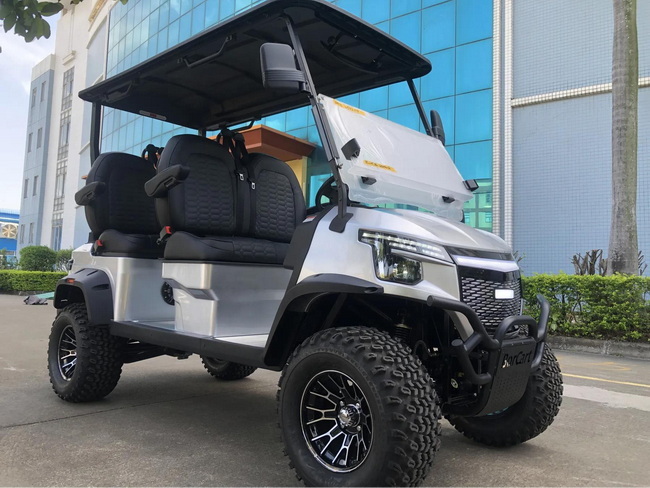
A hunting golf cart is not a universal replacement for an ATV. Traditional ATVs still offer advantages in deep mud, rocky trails, steep inclines, and extreme off-road recovery situations. They are also often better when the hunting area is remote, undeveloped, or lacks maintained access paths.
Use an ATV when you need:
- Maximum traction in difficult terrain.
- Faster recovery from rough, wet ground.
- More confidence on steep or uneven trails.
- A machine designed primarily for harsh off-road abuse.
Use a hunting golf cart when you need:
- Quiet access.
- Lower disturbance.
- Safer movement around managed land.
- A vehicle that doubles as a utility and transport platform.
From an OEM and product strategy perspective, the strongest hunting vehicle is not simply "a golf cart with tires." It is a purpose-built platform that blends low-noise mobility, reliable electric power, reinforced suspension, and customizable cargo layouts. For export buyers, brand owners, and distributors, this is where product differentiation becomes a real sales advantage.
Manufacturers that can offer configurable seating, cargo racks, lighting, lift kits, weather enclosures, and off-road tire packages are better positioned to serve hunting and outdoor recreation markets. As a Chinese OEM supplier, BorCart can support this shift by developing quiet electric platforms that align with private-land hunting, farm operations, resorts, and multi-use off-road applications.
Before choosing between a hunting golf cart and a traditional ATV, evaluate these points:
- Terrain profile of the property.
- Distance between access points and hunting zones.
- Required cargo weight.
- Noise sensitivity of the game.
- Seasonal weather conditions.
- Charging or fuel logistics.
- Local land-use rules.
A good vehicle should match the land, not just the trend.
For modern hunters, silence is not a luxury. It is a field advantage that improves stealth, reduces pressure, and helps preserve game movement patterns. That is why the hunting golf cart is becoming a serious alternative to the traditional ATV, especially on managed land where quiet access matters most.
1. What is the main advantage of a hunting golf cart over a traditional ATV for modern hunters?
The key advantage is low noise, which helps hunters access stands and blinds more quietly, reduce hunting pressure on game, and maintain more natural movement patterns on managed properties.
2. Are hunting golf carts suitable for all types of terrain?
Hunting golf carts perform best on farm roads, forest tracks, food plots, and moderately rough terrain. For extremely muddy, rocky, or steep environments, a traditional ATV may still provide better traction and clearance.
3. Why are electric hunting golf carts becoming popular in B2B markets?
B2B buyers value quiet operation, low emissions, flexible customization, and lower maintenance. These features allow brands and distributors to position electric hunting carts as premium, multi-purpose vehicles for hunting, resorts, and utility use.
4. Can a hunting golf cart be customized for different hunting applications?
Yes. OEM manufacturers can offer custom seating layouts, cargo racks, gun or bow holders, off-road tires, lighting systems, and weather enclosures, so distributors and private brands can target specific hunting segments and local market needs.
5. How should B2B buyers choose between a hunting golf cart and a traditional ATV for their product line?
They should assess terrain conditions, typical end-user hunting styles, noise sensitivity, range requirements, and desired accessory packages. Where quiet access and multi-role utility are priorities, a hunting golf cart is often the more strategic product choice.
1. Allied Market Research. "Golf Cart Market Overview." [https://www.alliedmarketresearch.com/golf-cart-market]
2. Fortune Business Insights. "Golf Cart Market Share, Growth & Size | Industry Trends ." [https://www.fortunebusinessinsights.com/golf-cart-market-106337]
3. Whitetail Habitat Solutions. "Does My ATV Spook Deer?" [https://www.whitetailhabitatsolutions.com/blog/does-my-atv-spook-deer]
4. Eunorau. "Electric Bike vs ATV for Hunting: Quiet Access, Cost, and Trail Impact." [https://eunorau-ebike.com/blogs/news/electric-bike-vs-atv-for-hunting-quiet-access-cost-and-trail-impact]
5. Research Nester. "Golf Cart Market Forecast | 2034 Size to Reach $39 Billion." [https://www.researchnester.com/cn/reports/golf-cart-market/1216]


