


Views: 222 Author: BorCart Publish Time: 2026-06-24 Origin: Site


Content Menu
● Introduction: Why Beachfront Conditions Change the Choice
● Key Use Cases in Beachfront Property Management
>> Typical Tasks for Offroad Utility Carts
>> Typical Tasks for Standard 4‑seater Carts
● High-salinity and Sand: What Really Happens to Your Carts
>> Corrosion Mechanisms in Coastal Environments
>> Sand Ingress, Traction, and Drivetrain Stress
● Offroad Utility Cart vs Standard 4-seater – Technical Comparison
>> Core Specification Differences
>> Electrical and Battery Considerations Near Salt and Sand
● Operational Scenarios: Which Cart Wins?
>> Daily Beachfront Resort Operations
>> Industrial or Utility Beachfront Sites
● Practical Selection Framework for Fleet Managers
>> Step 1 – Map Tasks and Terrain
>> Step 2 – Decide the Role of Each Cart Type
>> Step 3 – Specify Corrosion and Sand Protection Levels
● Expert Insights: OEM-Level Design Choices That Matter
>> Tires, Suspension, and Driver Behavior
● Maintenance Strategy in High-salinity and Sandy Conditions
>> Preventive Maintenance Checklist for Both Cart Types
>> Data-driven Fleet Decisions
● When a Standard 4-seater Still Makes Sense
● How BorCart Can Support Your Fleet Strategy
● FAQ
Offroad utility carts are usually the safer, more durable choice for beachfront property management in high‑salinity and sandy conditions, while standard 4‑seater carts can still work for lighter-duty, paved‑path operations if you control corrosion and traction risks. This article compares both options from an operational, technical, and total cost perspective so you can align your fleet strategy with real beachfront conditions and ROI expectations.
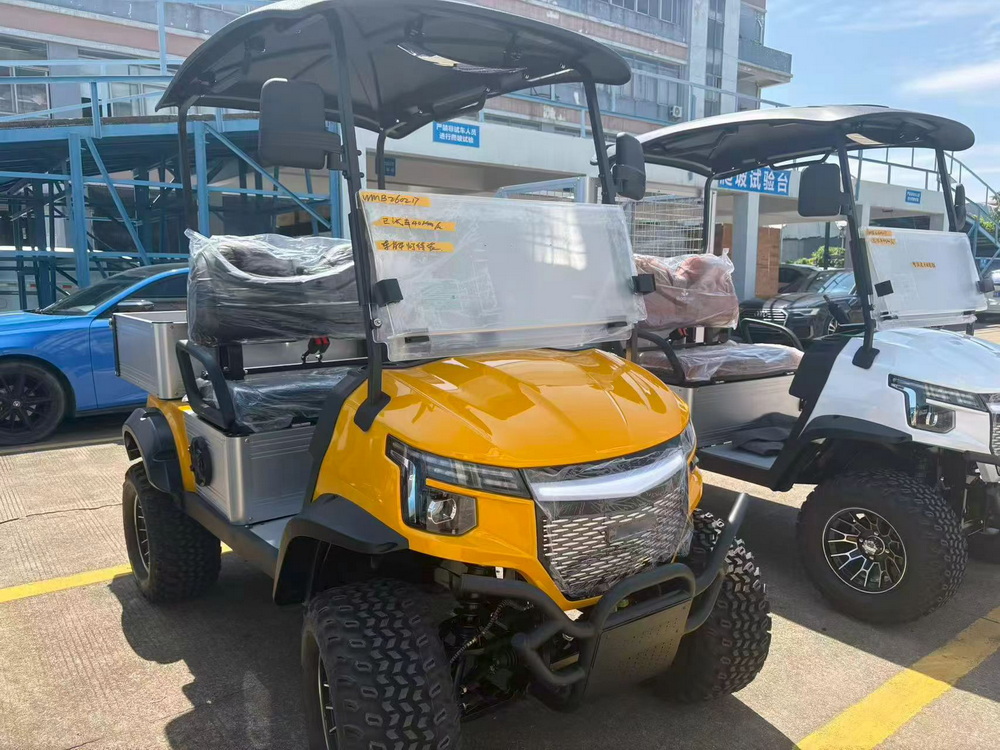
Managing beachfront resorts, villas, or industrial coastal sites is very different from running a golf course or an inland community. High salinity, constant wind‑blown sand, and soft ground create a harsh environment that quickly exposes any weakness in vehicle design and maintenance strategy. Choosing between an offroad utility cart and a standard 4‑seater is not just about passenger capacity; it is a decision about uptime, safety, and lifecycle cost in a corrosive environment.
From BorCart's perspective as a Chinese OEM manufacturer of utility carts and EV components, we see the same pattern across customers in North America, the Middle East, and Southeast Asia: fleets designed for inland golf courses underperform badly when moved to beachfront properties. As a result, operators are shifting toward offroad utility platforms with corrosion‑resistant frames, sealed electrical systems, and wider tires optimized for sand. At the same time, many resort brands still need standard 4‑seater carts for guest transport and VIP experiences, which makes it essential to define clear use cases and specifications for each vehicle type.
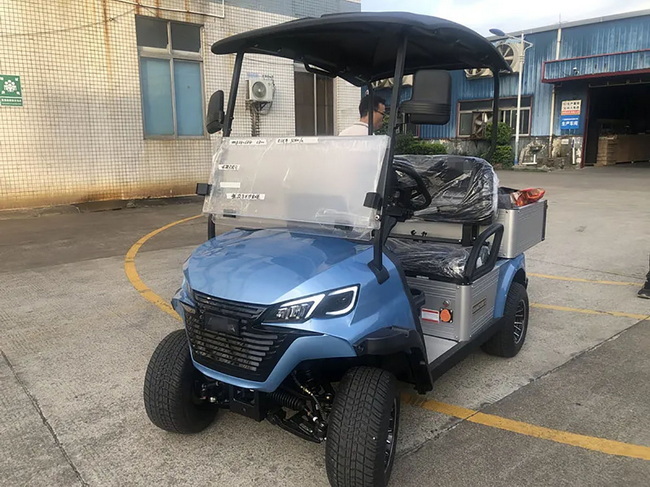
Beachfront operations teams use offroad utility carts as workhorses, not just as transport vehicles. Typical tasks include:
- Housekeeping and linen delivery to remote villas
- Waste collection on soft, sandy service routes
- Landscaping and irrigation maintenance along dunes
- Technical maintenance for lighting, CCTV, and pump rooms
- Emergency access to remote beach areas when 4x4 trucks are impractical
In these scenarios, payload capacity, ground clearance, and traction on loose sand matter more than passenger count. A well‑specced offroad utility cart often replaces several ad‑hoc solutions such as pickup trucks that cannot safely operate on soft sand or narrow pathways.
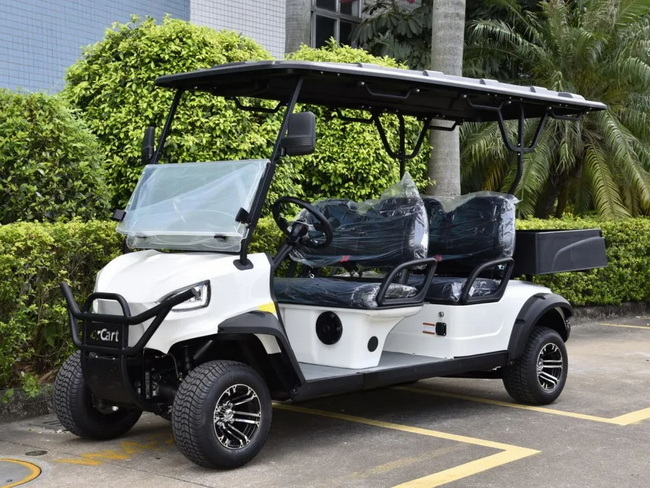
Standard 4‑seater carts, originally inspired by golf cart configurations, are still widely used in beachfront properties for:
- Guest transfer from reception to rooms on paved or compacted paths
- VIP and property tours led by sales or marketing teams
- Internal staff shuttles between back‑of‑house facilities
- Light-duty supervisory rounds by security or facility managers
In these use cases, ride comfort, quiet operation, and aesthetics are prioritized. However, when these 4‑seater carts stray regularly onto soft sand or unpaved service routes, maintenance costs and breakdowns can escalate sharply, especially where salinity is high and sand ingress is constant.
Beachfront properties are continuously exposed to airborne salt, which accelerates corrosion of metal components, especially where protective coatings are thin or damaged. From a maintenance perspective, three areas are particularly vulnerable:
- Frame and chassis: Weld points, brackets, and undersides accumulate salt spray and wet sand.
- Suspension and steering components: Bushings, joints, and shock mounts corrode and seize faster.
- Fasteners and exposed hardware: Bolts, nuts, and clamps on battery trays, body panels, and accessories.
An offroad utility cart designed for harsh environments typically uses better galvanization, powder coating, and stainless or coated hardware in these zones, while many standard 4‑seater platforms were originally optimized for golf courses with far lower salinity exposure.
Sand is not just a surface problem; it works its way into moving components and electrical systems:
- Abrasive wear in brake mechanisms and moving joints
- Overheating of motors when cooling passages or fans are clogged with sand
- Loss of traction leading to wheelspin, which overheats motors and controllers
Wide, low‑pressure tires and tuned offroad suspensions help offroad utility carts maintain traction on soft sand at lower motor loads, while standard 4‑seater carts with narrow tires and golf‑tuned suspensions tend to dig in and bog down more easily. Over time, this difference shows up clearly in motor temperature logs, controller errors, and unplanned downtime.
Below is a simplified configuration table based on common OEM and fleet configurations used in coastal resorts and beachfront industrial sites.
| Factor | Offroad Utility Cart (Typical) | Standard 4-seater Cart (Typical) |
|---|---|---|
| Primary use | Maintenance, cargo, mixed use | Passenger transport on paths |
| Ground clearance | Medium to high | Low to medium |
| Tire type | All-terrain, wider footprint | Turf/golf, narrower footprint |
| Chassis protection | Enhanced anti-corrosion package | Standard coating |
| Payload capacity | Higher (cargo bed + racks) | Lower (passenger only) |
| Traction on soft sand | Strong with correct tires | Limited without modifications |
| Electrical sealing | Often upgraded for offroad | Standard sealing |
| Ride comfort on pavement | Good to moderate | Very comfortable |
| Upfront cost | Higher per unit | Lower per unit |
| Flexibility of configuration | High (beds, tool racks, boxes) | Medium (seats, small racks) |
From BorCart's OEM experience, property managers who start with "guest comfort first" often over‑invest in standard 4‑seater carts and then gradually add offroad utility units as maintenance issues appear. A better approach is to design a mixed fleet from the beginning, with clear role definitions for each cart category.
In high‑salinity environments, battery and electrical system reliability becomes a major differentiator between cart types:
- Battery enclosures: Offroad platforms are more likely to offer sealed or semi‑sealed battery compartments and drainage paths to prevent standing salty water.
- Connectors and harness: Upgraded connectors with better IP ratings and corrosion‑resistant terminals reduce failures.
- Charging locations: Placing chargers and docking points away from direct sea spray and wind‑blown sand dramatically improves both cart types' lifespans.
If you are specifying carts with lithium batteries, pay particular attention to battery protection, BMS placement, and venting in relation to salt fog, as failure modes can be more abrupt than with traditional lead‑acid packs. A utility platform with better sealing and higher‑grade enclosures is usually a safer base for lithium in beachfront conditions.
Consider a 5‑star resort with:
- 2–3 km of beachfront
- 80–150 rooms and villas
- Mixed paved paths, boardwalks, and sandy access routes
In this scenario:
- Offroad utility carts excel at early‑morning housekeeping rounds, waste collection, engineering access to pumps and lighting, and emergency support on the sand.
- Standard 4‑seater carts shine in guest transport between reception, rooms, restaurants, and spa facilities, mostly on paved or compacted paths.
A common failure pattern is when guest‑focused 4‑seater carts are "temporarily" sent onto sandy service routes for logistics tasks. Over months, these "temporary" uses become routine, and maintenance teams suddenly face accelerated corrosion, motor issues, and tire wear. The most stable operations assign at least 60–70% of heavy and sandy tasks to offroad utility carts, protecting the 4‑seater fleet for guest‑facing roles.
For oil terminals, coastal construction bases, or utility plants near the shoreline, the decision skews even more strongly toward utility platforms:
- Access roads are often gravel, unpaved fill, or unstable sand.
- Loads include tools, spares, cable drums, and safety equipment.
- Safety and uptime are more critical than passenger comfort.
Here, offroad utility carts can be configured with steel or aluminum cargo beds, lockable toolboxes, ladder racks, and towing hitches, effectively functioning as light electric utility vehicles. Standard 4‑seater carts may still serve for supervisory rounds or visitor tours but should be specified with stricter corrosion and tire upgrades or limited to internal, paved routes.
Start by mapping your real daily tasks and routes:
1. List all regular tasks (guest transfer, housekeeping, landscaping, maintenance, security, waste, emergency).
2. Mark each route's surface type (paved, compact, loose sand, mixed).
3. Estimate typical payloads (number of passengers, kg of cargo, tools, or materials).
4. Identify routes with the greatest salinity and sand exposure (directly adjacent to the surf line, windward sides, exposed dunes).
This mapping usually reveals that only a portion of your routes truly demand offroad capability, while others can be handled more efficiently by standard 4‑seater carts.
Using the map above, assign a primary role to each cart category:
- Offroad utility cart
- Primary: logistics, maintenance, waste, landscaping, and emergency access.
- Secondary: occasional staff or contractor transport on mixed terrain.
- Standard 4‑seater cart
- Primary: guest and VIP transfers on paved or compact paths.
- Secondary: light supervisory rounds away from deep sand.
Define rules of use: for example, standard 4‑seater carts are not permitted on certain sandy maintenance routes except in emergencies. Clear fleet rules directly translate into longer life and lower TCO.
Once roles are clear, set minimum specifications for both cart types:
- Offroad utility: higher grade protection as standard (coatings, sealed bearings, better harness routing, and IP‑rated connectors).
- Standard 4‑seater: at least a mid‑level protection package (improved coating, upgraded fasteners, and under‑body wash accessibility) if they operate anywhere near the beachfront.
For customers working with an OEM like BorCart, this is where OEM customization becomes strategically valuable. Specifying coating thickness, hardware materials, and sealing levels at the factory level is usually more cost‑effective than retrofitting after deployment.
From an OEM design perspective for beachfront applications, three design levers have disproportionate long‑term impact:
- Base material selection: Using higher‑grade steel or aluminum for critical structures.
- Coating system: Combining galvanizing, high‑adhesion primers, and powder coats optimized for salt‑spray resistance.
- Design for drainage and wash‑down: Avoiding water‑trapping cavities and enabling high‑pressure wash‑down without forcing water into sensitive joints.
Offroad utility carts usually justify higher design investment here because they are explicitly marketed and priced as harsh‑environment workhorses. When customers treat standard 4‑seater carts as if they were offroad-ready, they unknowingly run them outside their design envelope.
Tire and suspension choices influence not only comfort but also equipment stress and driver behavior:
- Wider offroad tires encourage stable, slower operation on sand, reducing wheelspin and motor stress.
- Golf‑style tires on soft sand tend to promote "full throttle to escape" behavior, increasing thermal stress on drivetrains.
- A slightly firmer, offroad‑tuned suspension can reduce bottoming‑out on uneven beach service routes, protecting under‑body components.
Proper driver training is often the cheapest "upgrade" you can buy. Teach operators how to enter and exit sandy areas, manage speed, avoid sharp steering on soft ground, and rinse vehicles after exposure. These soft factors strongly influence how fast the differences between offroad and standard carts show up in maintenance logs.
To keep both offroad utility carts and standard 4‑seater carts performing well in beachfront environments, establish a preventive maintenance routine that includes:
- Daily or weekly fresh‑water wash‑down of under‑body, wheel wells, and exposed fasteners.
- Regular inspection and lubrication of suspension joints, steering components, and brake systems.
- Inspection of electrical connectors, harness routing, and battery terminals for corrosion or salt crust.
- Tire pressure checks and surface inspection for cuts or embedded shells/stones.
Offroad utility carts will tolerate more abuse, but the same routine applied consistently will extend the useful life of your entire fleet and protect your capital expenditure.
If your carts include basic telemetry or logging (e.g., motor temperature, error codes, battery cycles), use these data points to refine your fleet mix:
- Compare breakdown rates on sandy versus paved routes.
- Track which cart types and configurations spend more time in high‑salinity zones.
- Align replacement and upgrade decisions with actual workload and failure patterns.
Many operators discover that a small increase in offroad utility cart share (for example, moving from 20% to 40% of the fleet) significantly reduces emergency repairs and downtime, even if the total number of carts stays the same.
Despite the clear advantages of offroad utility carts in harsh beachfront conditions, standard 4‑seater carts remain essential in many cases:
- High‑end resorts where guest comfort, quietness, and aesthetics are critical to brand image.
- Residential beachfront communities where carts are used primarily on well‑maintained paved roads.
- Mixed‑use properties that separate guest and service routes effectively.
In these contexts, instead of over‑engineering the 4‑seater into a pseudo‑offroader, it is usually more economical to:
- Keep the 4‑seater on strictly controlled routes.
- Add a small number of offroad utility carts for "dirty" tasks.
- Specify moderate corrosion protection and better sealing for 4‑seater electronics without turning them into full offroad systems.
This strategy preserves the strengths of each platform while controlling the total cost of ownership.
As a Chinese OEM specializing in utility carts, EVs, and automotive components, BorCart can work with overseas brand owners, wholesalers, and manufacturers to tailor carts to specific beachfront use cases through:
- OEM customization of frames, coatings, harness design, and corrosion‑resistant hardware.
- Configurable offroad utility carts with cargo beds, toolboxes, racks, and towing options designed for sand and high‑salinity conditions.
- Enhanced standard 4‑seater platforms with optional protective packages for coastal resorts and residential developments.
- Long‑term component supply, including suspension parts, electrical harnesses, and battery trays optimized for corrosive environments.
For partners building their own brands, a co‑developed product roadmap can align your model lineup with key beachfront segments: luxury resort, industrial coastal, and mixed residential‑resort communities. This ensures that marketing claims are fully backed by technical design and field performance.
If you manage or supply carts for beachfront properties, your fleet plan should start from terrain, salinity, and task analysis, not from existing "golf cart" assumptions. Use offroad utility carts as your default choice for any route involving soft sand, heavy loads, or continuous high‑salinity exposure, and reserve standard 4‑seater carts for controlled, guest‑facing and paved environments.
If you are a brand owner, wholesaler, or manufacturer looking to develop or upgrade your own cart line for beachfront markets, consider partnering with BorCart to:
- Define an offroad utility platform optimized for coastal conditions.
- Create a coastal edition of your standard 4‑seater with upgraded coatings and sealing.
- Plan a long‑term component and OEM supply strategy aligned with your target regions.
Q1: Can a standard 4-seater cart be upgraded for regular use on soft sand?
A1: You can improve a standard 4‑seater's performance with wider tires, better coatings, and limited suspension tweaks, but it will rarely match a purpose‑built offroad utility cart in durability and traction on deep sand.
Q2: How often should carts be washed down in a high-salinity environment?
A2: For beachfront properties with frequent exposure to salt spray and sand, a light fresh‑water wash‑down after each workday is recommended, with more intensive cleaning at least once per week for both cart types.
Q3: Are lithium batteries suitable for beachfront utility carts?
A3: Yes, lithium batteries can work very well, but you should pay extra attention to enclosure sealing, BMS protection, and charger placement away from direct sea spray to avoid premature failures.
Q4: What is the ideal fleet mix between offroad utility carts and standard 4-seaters?
A4: Many beachfront properties find a balanced ratio where offroad utility carts handle 60–70% of heavy and sandy tasks, while standard 4‑seater carts focus mainly on guest and VIP transport on paved routes.
Q5: What should I prioritize when specifying a new beachfront cart fleet with an OEM?
A5: Start with corrosion protection, tire and suspension design for your main surfaces, electrical sealing level, and the division of roles between utility and passenger carts, then optimize comfort and styling on top of these foundations.
1. ASTM B117 – Standard Practice for Operating Salt Spray (Fog) Apparatus, Q-Lab. Available at: https://www.q-lab.com/corrosion/corrosion-test-standards/astm-b117 [q-lab]
2. "ASTM B117 – The Salt Spray Test," DECRA Roofing Systems. Available at: https://www.decra.com/pro/astm-b117-the-salt-spray-test [decra]
3. "The Limitations of ASTM B117 Salt Spray (Fog) Testing," Sherwin-Williams Protective & Marine. Available at: https://industrial.sherwin-williams.com/na/us/en/protective-marine/media-center/articles/the-limitations-of-astm-b117-salt-spray.html [industrial.sherwin-williams]
4. "ASTM B-117 Salt Spray / Salt Fog Testing," Keystone Compliance. Available at: https://keystonecompliance.com/astm-b-117-salt-spray-salt-fog/ [keystonecompliance]
5. "Optimizing Fleet Efficiency with Electric Vehicle Maintenance," SafetyCulture. Available at: https://safetyculture.com/topics/electric-vehicle-fleet-management/electric-vehicle-maintenance [safetyculture]
6. "7 Top Tips for UTV Maintenance," Noble Research Institute. Available at: https://www.noble.org/legacy/2023-spring/7-top-tips-for-utv-maintenance [noble]
7. "Taking Your Golf Cart Off-Road? — Here's What You Need to Know," Garrett's Golf Cars. Available at: https://www.gowithgarretts.com/taking-your-golf-cart-off-road-heres-what-you-need-to-know [gowithgarretts]


