


Views: 292 Author: BorCart Publish Time: 2026-07-10 Origin: Site


Content Menu
● What Golf Cart Conversion Really Means Today
● Core Conversion Principles: From Fairway Cart To Utility EV
>> 1. Define The Use Case Before The Hardware
>> 2. Choose The Right Energy And Powertrain Package
● Major Conversion Scenarios And Practical Modifications
>> Large Estates, Resorts, And Private Properties
>> Campuses, Universities, And Business Parks
>> Events, Festivals, Weddings, And Trade Shows
>> Industrial, Warehouse, And Agricultural Applications
● OEM Strategy: Working With BorCart To Build Your Own Fleet
>> Co‑Design Instead Of Simple Re‑Badging
>> Building A Rover‑Class Flagship Platform
● Safety, Compliance, And UX: Non‑Negotiables For Modern Conversions
● Practical Steps To Plan Your Conversion Or OEM Project
● How Converted Golf Carts Compete With Other Light Vehicles
● Call To Action: Turn Your Next Fleet Into A Branded EV Platform
● Frequently Asked Questions (FAQ)
Golf carts and low‑speed vehicles have moved far beyond the fairway—they are now strategic electric utility platforms in resorts, campuses, industrial parks, and residential communities worldwide. As an OEM‑focused manufacturer, BorCart sits at the intersection of this shift, helping overseas brands turn standard carts into purpose‑built vehicles tailored to very specific commercial scenarios. [ideas2live4]

Modern golf cart conversion is less about hobby customization and more about platform engineering for defined business use cases. Instead of bolting on random accessories, leading brands and fleet operators start with a clear operational goal—transport, logistics, security, or hospitality—and design the cart around that mission. [europeanbusinessmagazine]
From an industry perspective, successful conversions typically refine three core areas:
- Powertrain and energy system for range, torque, and duty cycle. [ideas2live4]
- Structure and layout (seating, cargo areas, racks, bodies) for specific tasks. [electricgolfcarcompany]
- User‑experience and safety package to meet regulations and brand expectations. [ideas2live4]
For OEM buyers working with BorCart, this platform mindset is key: you are not just buying a cart; you are investing in a repeatable, scalable workhorse that carries your logo into multiple environments. [ideas2live4]
Industry projects that fail usually skip the first step: precise scenario definition. Before selecting motors or accessories, map out: [ideas2live4]
- Daily operating hours and typical route length.
- Terrain type (flat community roads vs. hilly resort paths vs. mixed campus). [europeanbusinessmagazine]
- Payload profile (passengers vs. tools vs. mixed cargo).
- Local rules on speed, lighting, and road legality. [europeanbusinessmagazine]
This usage matrix drives every subsequent decision—especially battery chemistry and layout.
Electric carts now dominate most commercial environments due to quiet operation, lower emissions, and simpler maintenance. Within electrics, two configurations are common: [electricgolfcarcompany]
- Lead‑acid packs: lower upfront cost, heavier, more maintenance; still viable for short‑range, budget‑sensitive fleets. [electricgolfcarcompany]
- Lithium systems: higher energy density, longer cycle life, faster charging, better performance; increasingly the default for modern fleets. [europeanbusinessmagazine]
BorCart's OEM platforms typically use 48V AC motors (≈5 kW or higher) paired with configurable lithium ranges (for example 60–90 km per charge), tuned via controllers for smooth acceleration and hill climbing. That allows you to spec one base chassis into multiple trims: entry utility, mid‑range campus, and premium resort shuttle. [ideas2live4]
High‑end estates and resorts treat golf carts as micro‑transport ecosystems: guest shuttles, maintenance carts, and security patrol vehicles often share a unified platform. [europeanbusinessmagazine]
Typical conversions include:
- Landscaping and maintenance carts with utility beds, trailer hitches, tool racks, and reinforced suspension. [electricgolfcarcompany]
- Guest transport carts with extended seating, weather enclosures, upgraded lighting, and comfort‑oriented interiors. [europeanbusinessmagazine]
- Security patrol carts featuring high‑visibility lighting, sirens, radios, and discreet storage for equipment. [europeanbusinessmagazine]
For OEM buyers, BorCart can map these roles to 2–8 seat configurations and mixed passenger‑cargo layouts so an estate runs a coherent fleet under one brand but with different duty‑specific builds. [ideas2live4]
Key modification checklist for estates and resorts
- Utility beds or cargo boxes for grounds teams.
- Extended canopies and soft enclosures for guest comfort.
- Enhanced suspension and all‑terrain tires for mixed surfaces. [electricgolfcarcompany]
- Security lighting, sirens, and radio mounts for patrol units. [europeanbusinessmagazine]
- GPS or geofencing support where property oversight is critical.
On large campuses, golf carts are operational infrastructure, not optional extras. They connect people, labs, events, and facilities in a way that full‑size vehicles often cannot. [europeanbusinessmagazine]
Common campus conversions:
- Shuttle services: multi‑row seating, branded signage, fixed pickup points. [golfcartsofatx]
- Groundskeeping carts: tool storage systems, water tanks, pressure‑washing attachments. [electricgolfcarcompany]
- Event operations carts: flatbeds or trailers for staging, audio‑visual kits, tents, and catering equipment. [europeanbusinessmagazine]
Specialized variants include emergency response carts with stretcher mounts, medical supply cabinets, and priority lighting, as well as research carts fitted with inverters, equipment racks, and climate‑controlled compartments for field data collection. [europeanbusinessmagazine]
For OEM projects, BorCart supports:
- Flexible seating layouts (4‑seat and 6‑seat, forward and rear‑facing). [ideas2live4]
- Infotainment and connectivity options (touchscreens, Bluetooth, USB) for modern campus UX. [ideas2live4]
- Platform matrices where a single chassis spawns shuttle, maintenance, and lab configurations. [ideas2live4]
Events demand carts that are both functional and brand‑visible. Conversions typically fall into three categories: [europeanbusinessmagazine]
- Attendee transport carts: high‑capacity seating with belts, handrails, and step assists. [europeanbusinessmagazine]
- Logistics carts: reinforced cargo decks, tie‑down points, and power distribution for AV gear. [electricgolfcarcompany]
- VIP and special‑occasion carts: climate control, premium seating, custom paint, decorative elements. [europeanbusinessmagazine]
Trade shows also use golf carts as mobile information stations and promotional vehicles, with display screens, literature racks, sampling surfaces, and point‑of‑sale systems built into the body. [golfcartsofatx]
BorCart's OEM approach allows brands to:
- Embed custom exterior design cues—front fascia, DRLs, color schemes—to align carts with event branding. [ideas2live4]
- Add on‑board UX elements, such as branded infotainment interfaces and interior accent lighting. [ideas2live4]
- Offer specific "event packages" as SKUs for rental fleets and agencies. [ideas2live4]
In industrial parks, warehouses, and farms, a converted golf cart becomes a compact utility vehicle competing directly with small trucks and ATVs on certain tasks. [electricgolfcarcompany]
Typical industrial conversions:
- Cargo beds and side rails for tools, spare parts, and inspection equipment. [powerequipmentsolutions]
- Lifted suspension and rugged tires for yard work and outdoor facilities. [electricgolfcarcompany]
- On‑board power (inverters or dedicated circuits) for portable tools and diagnostic gear. [electricgolfcarcompany]
On farms and large nurseries, carts often carry feed, mulch, plants, and soil testing equipment, with spray systems, seed dispensers, and racks for hand tools. [electricgolfcarcompany]
BorCart supports these use cases through:
- Heavy‑duty frames and configurable cargo zones. [ideas2live4]
- Component flexibility (different wheel/tire sets, lead‑acid or lithium depending on cost and range needs). [ideas2live4]
- Batch production tailored to fleets that may scale from dozens to hundreds of units over time. [ideas2live4]
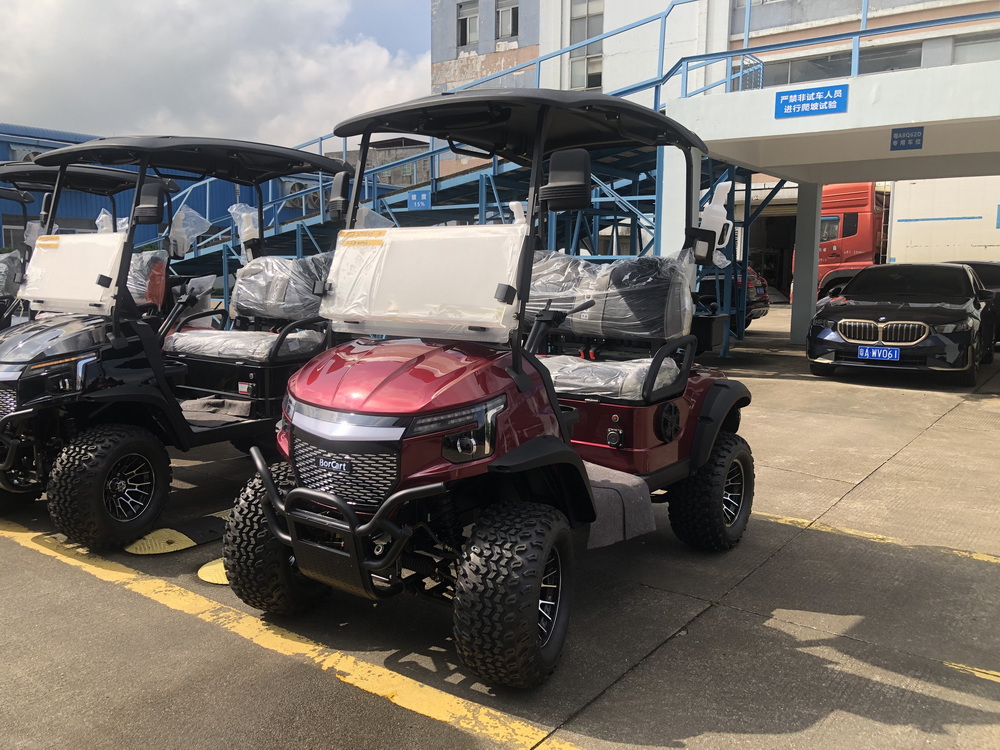
Forward‑thinking EV brands do not simply put a sticker on a generic cart. They follow a co‑design process with their OEM partner to lock in market fit, compliance, and differentiation. [ideas2live4]
BorCart's typical OEM workflow:
1. Discussion of target markets, regulations, and price bands.
2. Joint definition of feature priorities (luxury vs. ruggedness vs. tech focus). [ideas2live4]
3. Feasibility analysis for motors, batteries, seating, and options.
4. Prototype build and validation testing before full production. [ideas2live4]
This structured approach ensures the final product feels like a coherent branded EV line, not a commodity cart.
Many brands benchmark against high‑spec models such as Denago's Rover‑style 6‑seat carts, then commission an equivalent or better platform under their own name. A typical "Rover‑class" blueprint might include: [europeanbusinessmagazine]
- Heavy‑duty chassis for 6 passengers plus cargo. [ideas2live4]
- 5 kW AC motor with optional higher output for hills. [ideas2live4]
- 48V lithium battery tuned for local range expectations. [ideas2live4]
- LSV‑compliant top speed around 25 mph (≈40 km/h) where road use is allowed. [europeanbusinessmagazine]
- Full LED lighting package, seatbelts, mirrors, and optional rear camera. [ideas2live4]
- Large display, Bluetooth audio, navigation, and USB ports for UX. [ideas2live4]
BorCart then turns this blueprint into a manufacturable product, adjusting frame geometry, wiring harnesses, and component mounting to meet your brand's technical and aesthetic goals. [ideas2live4]
Regulatory expectations for street‑legal golf carts and LSVs have risen sharply, especially in North America and Europe. Fleet buyers and end‑users now treat safety, comfort, and digital experience as baseline requirements, not luxury options. [europeanbusinessmagazine]
Key elements your conversion plan should address:
- Braking systems: four‑wheel hydraulic or mechanical disc brakes, matched to speed and payload. [ideas2live4]
- Lighting and visibility: LED headlights, tail and brake lights, indicators, reflectors; optional DRL signatures for brand recognition. [europeanbusinessmagazine]
- Occupant protection: seatbelts, mirrors, grab handles, and stable steps. [ideas2live4]
- Comfort: ergonomic seating, windshields, canopies, heating or fans as needed. [ideas2live4]
- UX features: infotainment, connectivity, charging points, clear dashboards. [ideas2live4]
BorCart can design to different regional standards and provide technical documentation and test data, while final certification typically remains with the importing brand and its compliance partners. [ideas2live4]
For brand owners, wholesalers, or fleet operators considering BorCart or similar partners, a structured planning approach reduces risk and speeds time‑to‑market. [golfcartsofatx]
Step 1 – Map environments and users
- Residential communities, resorts, campuses, industrial parks, farms, or events.
- Primary user groups (guests, staff, security, maintenance, students). [europeanbusinessmagazine]
Step 2 – Translate regulations into specs
- Speed caps, required safety equipment, and road access rules.
- Testing or documentation needed for LSV classification in each country. [europeanbusinessmagazine]
Step 3 – Build a product matrix
- Decide on platforms (4‑seat vs. 6‑seat, passenger vs. utility).
- Choose battery tiers and motor outputs for different trims. [ideas2live4]
- Define "good‑better‑best" configurations for your catalog. [golfcartsofatx]
Step 4 – Prototype and validate in the field
- Test range, braking, hill climbing, and comfort in real conditions.
- Gather feedback from dealers, fleet managers, and representative end‑users. [europeanbusinessmagazine]
- Refine before committing to tooling and full batch production. [ideas2live4]
From a fleet strategy perspective, the real question is not "can we convert a golf cart?" but "when does a converted golf cart beat alternatives like ATVs or small trucks?". [electricgolfcarcompany]
Below is a high‑level comparison in common B2B scenarios:
| Use case | Converted golf cart advantages | Typical limitations |
|---|---|---|
| Resort & campus shuttles | Quiet, comfortable, easy to brand, LSV‑friendly. (europeanbusinessmagazine) | Lower top speed than full vehicles. (europeanbusinessmagazine) |
| Warehouse / industrial logistics | Compact, maneuverable, customizable cargo beds. (electricgolfcarcompany) | Limited heavy payload capacity. (electricgolfcarcompany) |
| Security and patrol | Good visibility, silent operation, easy to equip. (europeanbusinessmagazine) | Not suited for high‑speed response. (europeanbusinessmagazine) |
| Agriculture and yard work | Flexible attachments, low maintenance, affordable. (electricgolfcarcompany) | Rough terrain requires reinforced setup. (electricgolfcarcompany) |
| Events and festivals | Highly brandable, crowd‑friendly, versatile roles. (europeanbusinessmagazine) | Weather protection may need upgrades. |
For many operations, converted golf carts provide lower total cost of ownership than larger vehicles, especially when routes are short, speeds modest, and fleets centralized. [electricgolfcarcompany]
If you are planning the next generation of carts—whether to match Rover‑class vehicles or to fill a niche in resorts, campuses, or industrial parks—this is the right moment to move from theory to design. [europeanbusinessmagazine]
Clarify your primary use cases, regulatory landscape, and desired product matrix, then engage an OEM partner like BorCart to co‑design an electric golf cart platform that:
- Delivers modern lithium performance and safety.
- Reflects your brand's look, feel, and UX.
- Scales from pilot runs to large fleets with consistent quality. [ideas2live4]
A well‑converted golf cart is more than a utility vehicle—it becomes a rolling touchpoint for your brand and a critical link in your mobility and operations strategy. [ideas2live4]
Q1. What is the most important first step when converting a golf cart for commercial use?
The crucial first step is to define a precise use case—who will use the cart, on what terrain, under which regulations, and with what payload and daily mileage—because this directly drives powertrain, layout, and safety decisions. [ideas2live4]
Q2. When should an OEM buyer choose lithium batteries over lead‑acid for converted golf carts?
Lithium is generally the better choice for fleets that require longer range, higher utilization, lower maintenance, and stronger performance, such as resort shuttles, campus operations, and premium residential LSV routes. Lead‑acid can still make sense for short‑range, cost‑sensitive applications with simpler duty cycles. [electricgolfcarcompany]
Q3. How do converted golf carts meet safety and compliance standards for street‑legal use?
Compliance is achieved by combining hardware (seatbelts, mirrors, four‑wheel brakes, full LED lighting) with controller‑limited speeds and proper documentation and testing aligned to regional LSV rules. OEM partners provide technical designs and data, while importing brands usually handle formal certification. [europeanbusinessmagazine]
Q4. Can one base golf cart platform serve multiple roles like shuttle, utility, and security?
Yes. A well‑designed platform with robust chassis and flexible seating/cargo zones can be configured into multiple trims—shuttle, utility, security, VIP—through changes in bodywork, seating, accessories, and energy packages. [ideas2live4]
Q5. Why do many campuses and resorts prefer converted golf carts over small trucks or vans?
They value carts' compact size, quiet operation, lower operating cost, and ability to navigate pedestrian‑heavy environments, while enjoying highly customizable branding and UX that align with their property identity. [electricgolfcarcompany]
1. Tigon Golf Carts – "How To Convert A Golf Cart For Other Uses: Creative Applications Beyond the Golf Course." https://tigongolfcarts.com/how-to-convert-a-golf-cart-for-other-uses-creative-applications-beyond-the-golf-course/
2. BorCart – "Why Forward‑Thinking EV Brands Choose BorCart For Next‑Generation Golf Carts." https://www.borcart.com/why-forward-thinking-ev-brands-choose-borcart-for-next-generation-golf-carts.html
3. European Business & Finance Magazine – "Golf Carts for More Than Golf: How They're Used in Different Industries." https://europeanbusinessmagazine.com/business/golf-carts-for-more-than-golf-how-theyre-used-in-different-industries/
4. Electric Golf Car Company – "Top Ways to Use a Golf Cart (Other Than for Golf)." https://www.electricgolfcarcompany.com/blog/top-ways-to-use-a-golf-cart-other-than-for-golf--34254
5. Golf Carts of ATX – "Creative Uses for Golf Carts: Beyond the Golf Course." https://golfcartsofatx.com/blog/creative-uses-for-golf-carts/
6. Power Equipment Solutions – "Uses for Golf Carts that Don't Involve Golfing." https://www.powerequipmentsolutions.com/blog/golf-cart-uses


