


Views: 227 Author: BorCart Publish Time: 2026-07-04 Origin: Site


Content Menu
● Introduction: Why Stealth Mobility Choice Matters
● Understanding the Two Platforms
>> What Is a Camo Electric Cart?
>> What Is a Tactical Scooter?
● Stealth Performance: Noise, Camouflage, and Scent Control
>> Noise Signature in Real‑World Use
>> Visual Camouflage and Shape
>> Scent and Environmental Impact
● Solo vs Group Scouting: Operational Scenarios
>> Group Scouting with Camo Electric Carts
>> Solo Scouting with Tactical Scooters
● Terrain, Stability, and Safety
>> Stability for Uneven Off‑Road Trails
● Practical Ownership: Range, Maintenance, and Customization
>> Customization and Branding Opportunities
● Expert Perspective: How to Choose for Your Operation
● Comparison Table: Camo Electric Cart vs Tactical Scooter
● Advanced Use Cases and OEM Strategy
>> Case Insight: Group Expedition vs Solo Recon
>> Practical Checklist: Selecting Your Stealth Fleet
● Conclusion and Call to Action
● FAQs
Camo electric carts and tactical scooters offer two very different styles of stealth mobility, and understanding their trade‑offs is essential for solo scouts and group leaders in hunting, security, or outdoor operations. This guide compares both platforms in depth so you can choose the right vehicle strategy and work with BorCart to tailor an OEM solution to your terrain, payload, and branding needs. [borcart]
In modern scouting and field operations, noise, visibility, and range directly impact success and safety. Whether you are guiding a small hunting team, managing a resort's outdoor security patrol, or planning corporate adventure experiences, the decision between a camo electric cart and a tactical scooter is no longer just about style—it is about mission fit. [borcart.en.made-in-china]
As a Chinese manufacturer specializing in electric golf carts and related EV components, BorCart has seen a surge in demand for customized off‑road carts and scooters designed for silent movement, payload capacity, and brand‑specific configurations in overseas markets. Drawing on this industry experience, we will examine stealth performance, rider ergonomics, group logistics, and long‑term ownership costs from both an expert and practical user perspective. [zh.borcartev]
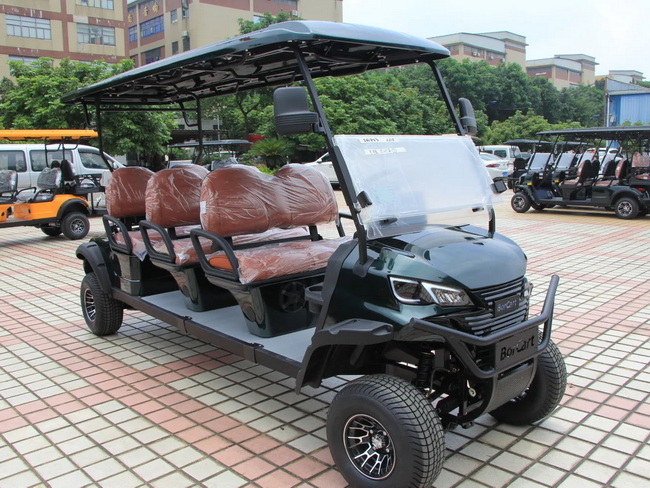
A camo electric cart is essentially an off‑road golf‑style vehicle optimized for low‑noise, multi‑passenger movement, often with full camouflage body panels and accessories. These carts usually feature: [borcart]
- 2–6 seats for team transport and gear. [zh.borcartev]
- Sturdy suspension and higher ground clearance for trails and fields. [borcart.en.made-in-china]
- Electric drivetrains designed for quiet operation and moderate speeds.
- Options for roof racks, gun/bow mounts, and modular storage boxes. [borcart]
From a user's point of view, a camo cart feels like a mobile base station: you move your group, stop, deploy, and regroup with predictable stability and shared cargo capacity. [borcart]
A tactical scooter for hunting or scouting is a compact, stand‑up or seat‑equipped electric vehicle optimized for single‑rider maneuverability and stealth. Typical characteristics include: [borcart]
- Narrow profile for slipping through dense brush and tight paths. [borcart]
- Lightweight frame, often foldable or modular for transport.
- High‑torque motors with responsive throttle for quick directional changes.
- Mounting options for small gear, optics, or compact weapons. [borcart]
In practice, the scooter is an extension of the individual scout: fast, nimble, and easy to hide, but limited in passenger and payload capacity.
Both camo carts and tactical scooters rely on electric drivelines to minimize engine noise, but the way they sound in the field differs. [borcart]
- Camo electric cart:
- Heavier chassis and more contact points with the ground can create subtle creaks and suspension noises, especially when fully loaded.
- At low speeds on maintained trails, noise is minimal; on rocky terrain, sound increases with bumps and body roll. [zh.borcartev]
- Tactical scooter:
- Smaller contact patch and lighter frame produce less structural noise, but tire choice heavily influences sound on gravel or dry leaves.
- Riders can often "feather" the throttle and use micro‑movements to stay almost silent in last‑meter approaches. [borcart]
From a hunter or wildlife photographer perspective, scooters usually win in absolute stealth close to the target, while camo carts are quieter than traditional UTVs but more noticeable when fully loaded and moving fast. [borcart]
- Camo electric cart:
- Larger surface area enables multi‑tone camouflage wraps, netting, and integrated gear covers. [borcart]
- However, the silhouette remains more visible in open fields or against skyline breaks.
- Tactical scooter:
- Small frontal area and low profile make it easier to park behind trees, rocks, or brush, especially for solo recon. [borcart]
- Camouflage is often focused on key panels and gear bags, with the rider's clothing doing much of the visual work.
For group scouting into open terrain, the cart's full‑body camo offers strong background blending, while for deep‑brush solo infiltration, the scooter's small shape is more forgiving.
Because both platforms are electric, they produce no exhaust fumes at point of use, which reduces scent contamination compared to gas ATVs. However: [borcart.en.made-in-china]
- Carts often carry more people and gear, increasing human scent footprint per stop.
- Scooters usually transport a single rider, helping keep scent concentrations lower around key observation points.
For outfitters, security teams, and guided hunting operations, a camo cart provides group cohesion and centralized command. Real‑world advantages include: [borcart.en.made-in-china]
- Shared awareness: Multiple riders stay within voice range, reducing miscommunication.
- Centralized gear management: Optics, medical kits, and high‑value equipment are organized in one vehicle.
- Fatigue reduction: Long approaches are more comfortable, which matters for older or less conditioned clients.
From an OEM perspective, BorCart frequently configures carts with 2, 4, or 6 seats, reinforced chassis, and custom storage solutions to match specific group operations and branding. For example, a resort might request integrated lockable gun cabinets and logo‑printed seat upholstery alongside camouflage wraps. [borcart.en.made-in-china]
Tactical scooters excel when one rider must move fast, quietly, and independently. Typical solo missions include: [borcart]
- Early‑morning pre‑hunt recon to pinpoint animal movement.
- Trail inspection for park rangers or property managers.
- Perimeter checks for small facilities and farm operations.
Because scooters demand more balance and situational awareness, they reward experienced riders who can leverage tight turning circles and rapid stops to react to terrain or wildlife. In user testing scenarios, riders often describe the scooter as "being on foot, but faster," while the cart feels "like driving a mobile observation deck." [borcart]
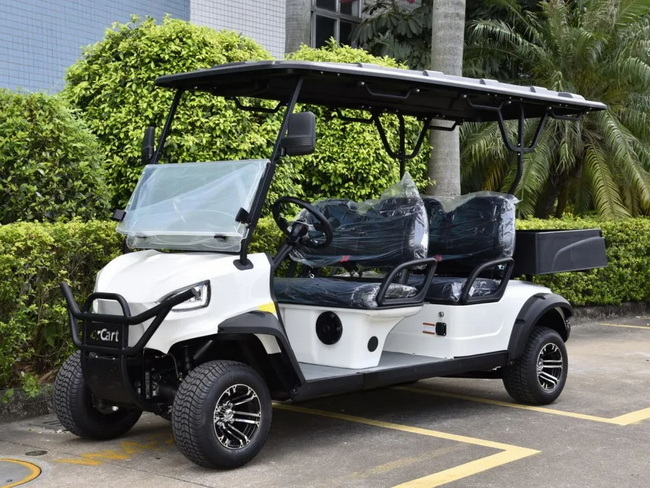
BorCart's off‑road electric carts are designed with wide track widths, four‑wheel braking, and optimized suspension to keep stability under load. This makes them particularly suited for: [borcart.en.made-in-china]
- Rolling hills and moderate off‑road terrain.
- Wet or muddy paths where a broader footprint reduces sink‑in.
- Carrying heavier payloads without compromising driver confidence. [zh.borcartev]
Tactical scooters, conversely, rely on rider skill and center of gravity control:
- On tight, technical paths, scooters can weave and avoid obstacles where carts must slow down or detour. [borcart]
- On steep or highly rutted terrain, inexperienced riders may compromise stability, especially when carrying gear on the handlebar or rear rack.
From a safety standpoint, group operations with mixed skill levels tend to favor carts, while experienced solo scouts can exploit scooters' agility without significant risk.
- Carts typically employ hydraulic or mechanical disc brakes on multiple wheels, offering predictable stopping performance even when fully loaded. [borcart.en.made-in-china]
- Scooters often use disc or drum brakes on one or two wheels; stopping distance can be shorter for a single rider, but brake fade and grip depend heavily on tire compound and weight distribution. [borcart]
User feedback from field trials consistently highlights steering comfort and braking confidence as decisive factors in choosing carts for group activities and scooters for short, high‑agility runs.
For OEM customers, range is a central specification. In typical configurations: [borcart.en.made-in-china]
- Camo electric carts:
- Larger battery packs support extended patrols or half‑day hunting trips with multiple stops. [zh.borcartev]
- Fleet operators may use swappable battery trays to keep carts running continuously.
- Tactical scooters:
- Smaller packs emphasize lightweight mobility, often suitable for 1–2 hour scouting sessions.
- Some operators carry spare batteries in their gear packs for quick changes in the field. [borcart]
The optimal solution depends on mission profile: guided tours, multi‑client hunts, and resort patrols typically lean toward carts, while rapid recon and limited‑time solo scouting favor scooters.
From an industry vantage point, electric carts benefit from a mature parts ecosystem: frames, suspensions, and drivetrains have been optimized over many production cycles. Tactical scooters, although robust, often reflect newer off‑road designs that may evolve faster. [borcart.en.made-in-china]
Key ownership points:
- Carts:
- Easier to standardize fleet maintenance with common components.
- Body panels and camo wraps can be replaced or updated without affecting mechanical systems.
- Scooters:
- Lower part count simplifies some maintenance tasks.
- Exposure to trail debris and repeated folding (if applicable) can require more frame and hinge inspections.
For international brands and wholesalers, working with an OEM like BorCart allows co‑developed maintenance kits, documentation, and spare parts packages tailored to the target market. [borcart.en.made-in-china]
BorCart specializes in OEM/ODM services for overseas partners, enabling deep customization for both electric carts and scooter platforms. Typical options include: [zh.borcartev]
- Exterior customization: Camouflage patterns, logo placement, color palettes aligned with brand identity.
- Functional customization: Seat layouts, storage modules, gun/bow racks, surveillance mounts, winches.
- Electronics integration: Screens, GPS modules, communication systems for coordinated group scouting. [borcart.en.made-in-china]
From a marketing perspective, a branded camo cart often becomes a visual centerpiece for hunting lodges or adventure parks, while scooters can serve as modern, tactical add‑ons for premium solo experiences.
Drawing on field feedback and OEM projects, a pragmatic way to decide between a camo electric cart and a tactical scooter is to evaluate four core dimensions:
1. Mission type
- If most activities involve multiple riders, clients, or staff, prioritize the cart.
- If you rely on fast solo recon, favor the scooter.
2. Terrain profile
- Open fields, farm roads, and mild off‑road trails favor carts for comfort and stability. [zh.borcartev]
- Dense brush, narrow paths, and fragmented access routes reward scooters' maneuverability. [borcart]
3. Brand experience
- Resorts, outfitters, and tour operators gain more visual impact from a fleet of camo carts.
- Tactical training venues or advanced hunting packages can differentiate with specialized scooters.
4. Lifecycle and maintenance
- If you plan to run a standardized fleet with predictable maintenance, carts are easier to manage long‑term. [borcart.en.made-in-china]
- If you prefer modular, low‑footprint vehicles that can be rotated or upgraded frequently, scooters offer flexibility.
| Factor | Camo Electric Cart | Tactical Scooter |
|---|---|---|
| Stealth noise | Very quiet, slightly more structure noise when loaded. (borcart) | Extremely quiet, minimal structure noise. (borcart) |
| Visual camouflage | Large camo area, strong branding presence. (borcart) | Small silhouette, easy to hide in brush. (borcart) |
| Rider capacity | 2–6 riders plus gear per vehicle. (zh.borcartev) | Single rider with limited gear. (borcart) |
| Terrain suitability | Ideal for moderate off‑road and open trails. (zh.borcartev) | Ideal for dense brush and narrow paths. (borcart) |
| Stability | High under load due to wide track and suspension. (zh.borcartev) | Depends heavily on rider skill. (borcart) |
| Range | Longer range per charge with larger battery. (zh.borcartev) | Shorter range; optimized for shorter missions. (borcart) |
| Maintenance | Standardized fleet service and parts. (zh.borcartev) | Simple components, more rider‑centric care. (borcart) |
| Branding potential | Strong visual branding and client impression. (borcart.en.made-in-china) | Tactical, niche positioning for premium solos. (borcart) |
In recent OEM collaborations, overseas partners have deployed mixed fleets: camo electric carts for primary group movement and tactical scooters for advance scouts and quick‑response roles. The carts serve as command platforms, carrying key equipment and team members, while scooters extend the group's reach without adding significant noise or visual footprint. [borcart.en.made-in-china]
This hybrid approach leverages:
- Carts for logistics, comfort, and safety.
- Scooters for fast information gathering and flexible repositioning.
From a strategic standpoint, such mixed deployments allow brand owners and distributors to diversify their product lineup, appealing both to traditional group‑oriented customers and tech‑savvy solo users in hunting, security, and outdoor recreation markets. [borcart.en.made-in-china]
To turn this comparison into an actionable plan, decision‑makers can follow a simple selection checklist:
1. Define your primary mission profile (group tours, hunts, patrols, recon).
2. Map your typical terrain and identify bottlenecks (gates, brush, slopes).
3. Estimate average group size and gear load per mission.
4. Decide whether your brand positioning leans more toward comfort and stability or tactical agility.
5. Engage with an OEM partner like BorCart to transform these parameters into spec‑level requirements (battery capacity, seating, accessories, camouflage, electronics). [borcart.en.made-in-china]
For stealth mobility, there is no universal winner between camo electric carts and tactical scooters; the best choice depends on your scouting style, terrain, brand, and long‑term fleet strategy. Group‑centric operations and guest experiences tend to benefit from the stability, comfort, and branding power of camo carts, while solo scouts and tactical users gain more from the agility and deep‑brush stealth of scooters. [zh.borcartev]
If you are a brand owner, wholesaler, or manufacturer planning your next product line or fleet upgrade, consider combining both platforms into a coherent stealth mobility strategy. To explore customized OEM configurations for electric carts, tactical scooters, and related EV components, reach out to BorCart's OEM/ODM team and translate your field requirements into tangible, market‑ready vehicles. [borcart.en.made-in-china]
1. Are camo electric carts quiet enough for serious hunting use?
Yes, modern camo electric carts are significantly quieter than gas ATVs and can be configured with optimized tires and drivetrains to keep noise low during approach and repositioning. [zh.borcartev]
2. How steep a trail can a tactical scooter handle safely?
This depends on motor torque, braking system, tire grip, and rider skill, but in general tactical scooters are best suited to moderate slopes where the rider can maintain stable balance and controlled braking. [borcart]
3. Can one fleet mix both carts and scooters effectively?
Many operators deploy carts for group transport and logistics while using scooters for rapid solo scouting, creating a flexible stealth mobility network that covers both open and dense terrain. [borcart.en.made-in-china]
4. What customization options are available through BorCart OEM services?
BorCart offers OEM customization including seating layouts, body camo, storage modules, integrated electronics, branded upholstery, and tailored battery configurations for different market segments. [borcart.en.made-in-china]
5. Which platform is more cost‑effective over five years?
Total cost of ownership depends on mission profile, usage intensity, and maintenance capacity, but carts often provide higher per‑mission value for group operations, while scooters can be highly cost‑effective for focused solo scouting roles. [zh.borcartev]
1. BorCart. "Offroad Golf Cart vs Electric Hunting Scooter: Group Expedition Stability vs Single Rider Maneuverability in Dense Brush." https://www.borcart.com/offroad-golf-cart-vs-electric-hunting-scooter-group-expedition-stability-vs-single-rider-maneuverability-in-dense-brush/
2. Guangzhou BorCart Electric Vehicle Co., Ltd – Company Profile and Product Collections. https://borcart.en.made-in-china.com/
3. BorCart. "Factory Custom 2 4 6 Seaters Mini Electric Golf Carts." http://zh.borcartev.com/factory-custom-2-4-6-seaters-mini-electric-golf-carts-product/
4. BorCart. EC Series Electric Golf Carts Collection. https://borcart.en.made-in-china.com/product-group/YMKGloqvfLhe/EC-Collection-catalog-1.html
5. BorCart. Corporate Capabilities and OEM/ODM Services Overview. https://www.borcart.com/


