


Views: 202 Author: BorCart Publish Time: 2026-07-25 Origin: Site


Content Menu
● Vehicle Purpose and Operating Environment
● Safety Features That Matter Most
● FAQs
City Sightseeing Bus vs Electric Tour Bus is a practical comparison for operators who must balance public-road compliance, passenger comfort, and on-site safety. For buyers planning urban sightseeing routes or closed-campus transport, the right choice depends less on appearance and more on where the vehicle will operate, how fast it will travel, and what safety equipment it must carry.
Many organizations buy a sightseeing vehicle first and only later discover that route rules, speed limits, and required equipment can change the entire deployment plan. In practice, a city sightseeing bus is usually selected for structured public-tour routes, while an electric tour bus is often better suited to resorts, campuses, parks, and other controlled environments.
For international buyers, the key question is simple: Will this vehicle be used on public roads, or only inside a managed property? That single decision affects vehicle category, permitted speed, safety specification, registration needs, and operator training requirements.
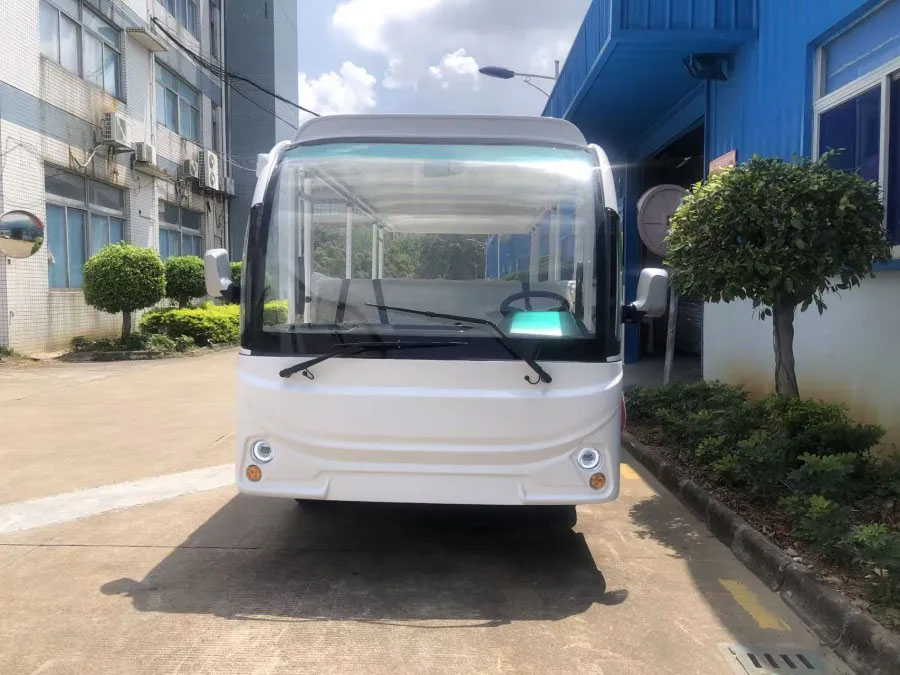
A city sightseeing bus is built for short-stop passenger service in urban areas, where visibility, maneuverability, and predictable traffic behavior matter most. These vehicles are often used on routes with frequent boarding, narrow streets, pedestrian crossings, and public-facing tourism operations.
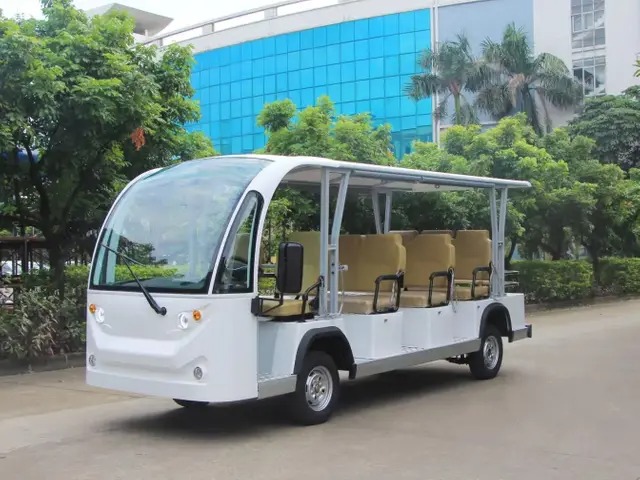
An electric tour bus is more commonly designed for closed-campus use, such as parks, resorts, industrial sites, universities, and private communities. In these environments, the bus can prioritize passenger capacity, smooth low-speed travel, and longer route efficiency over street-ready compliance.
In plain terms, the city model is about public accessibility, while the campus model is about controlled convenience. That distinction should guide the entire specification process from the start.
Road legality is where the gap becomes most important. In the U.S. framework, low-speed vehicles must meet minimum federal safety equipment rules, including lights, reflectors, mirrors, windshield, windshield wipers, parking brake, and seat belts, and they are defined by speed and weight limits.
That means a vehicle intended for public streets must be planned around compliance, not just comfort. By contrast, vehicles used only on private property or internal roads generally face fewer public-road requirements, although local operating rules and employer safety policies may still apply.
For city sightseeing routes, operators should confirm:
- Whether the route includes public streets.
- Whether the vehicle is classified as a low-speed vehicle or another bus category.
- Whether registration, insurance, licensing, and route approval are required.
- Whether the intended speed profile matches local road rules.
For closed-campus use, the focus shifts to:
- Internal safety policy.
- Speed control.
- Driver training.
- Passenger loading and unloading safety.
- Route visibility and site-specific hazard management.
Safety features should be matched to the operating environment, not chosen by appearance alone. On public urban routes, driver-assistance functions such as forward collision warning, lane departure warning, rear-view camera systems, and automatic emergency braking can help reduce crash risk in dense traffic.
The NHTSA notes that driver-assistance technologies are designed either to warn the driver or actively help avoid a crash, and that features like forward collision warning, lane departure warning, backup camera systems, and automatic emergency braking are central to safer operation.
For city sightseeing use, especially on mixed traffic streets, the most valuable features are:
- 360-degree or backup cameras for tight turns and reversing.
- Blind-spot visibility support for pedestrian-heavy areas.
- Automatic emergency braking for urban stop-and-go conditions.
- Seat belts and structural protection for passenger security.
For closed-campus electric tour buses, the best safety package often includes:
- Speed limiting to reduce site risk.
- Clear entry and exit handrails for older passengers and children.
- Low-floor or easy-step access for frequent boarding.
- Strong lighting and mirrors for early-morning or evening operations.
| Factor | City Sightseeing Bus | Electric Tour Bus |
|---|---|---|
| Main use | Public sightseeing routes in urban areas | Private campuses, parks, resorts, and internal roads |
| Legal focus | Public-road compliance and route approval | Property-based operation and site safety policy |
| Speed profile | Lower urban speeds, frequent stops | Low-speed controlled transport |
| Safety priority | Traffic visibility, braking support, pedestrian awareness | Passenger flow, route control, and operational simplicity |
| Best buying logic | Compliance first, then passenger experience | Capacity and convenience first, then site safety |
This side-by-side view makes a practical truth obvious: the best vehicle is not the one with the most features, but the one whose features match the operating zone.
One common mistake is assuming that an electric sightseeing vehicle automatically qualifies for street use. In reality, many low-speed vehicles are limited by speed, weight, and equipment requirements, and public-road deployment may require a completely different specification than a private-property vehicle.
Another mistake is underestimating driver workload in urban tourism. Even at low speeds, city routes can involve narrow lanes, pedestrians, bicycles, frequent stops, and complex turning patterns, which makes visibility and braking support far more important than top speed.
A third issue is maintenance planning. Electric buses and low-speed vehicles require routine checks for braking, tires, electrical systems, lighting, and battery health, especially when they run daily and carry passengers repeatedly.
Use this sequence before placing an order:
1. Define the operating zone: public road, campus, resort, park, or hybrid route.
2. Confirm the legal category required for that zone.
3. Match speed, passenger capacity, and body style to the route.
4. Specify the safety package, including visibility and braking systems.
5. Plan charging, maintenance, and operator training before delivery.
For BorCart, this is where OEM customization becomes valuable. A buyer may need a public-road-oriented city sightseeing bus for export markets, or a controlled-environment electric tour bus for a resort, university, or industrial park. The right chassis, seating layout, safety package, and exterior branding should all be built around that use case.
Demand for electric buses continues to expand in Asia-Pacific markets, supported by emissions pressure and fleet electrification policies. Japan's electric bus market is projected to grow from about $288 million in 2025 to $573 million by 2030, showing that buyers increasingly want low-emission passenger transport solutions.
That growth matters for sightseeing and campus vehicles too. As tourism operators, parks, and institutions electrify transport, they increasingly expect quieter vehicles, lower operating costs, and a cleaner passenger experience without sacrificing safety.
For manufacturers, this means the competitive advantage is no longer just in making an electric vehicle. It is in delivering a vehicle that is compliant, comfortable, route-specific, and easy to operate.
Choose a city sightseeing bus when:
- The route uses public streets.
- Passenger flow is tied to city tourism.
- Visibility and urban maneuverability matter most.
- Local compliance is a major purchasing factor.
Choose an electric tour bus when:
- The vehicle stays inside a campus, resort, park, or private estate.
- The route is predictable and controlled.
- You want efficient low-speed passenger movement.
- Branding, comfort, and simplicity are top priorities.
If you are planning an export project for sightseeing transport, the smartest next step is to define your route first, then build the vehicle around that route. BorCart can support OEM customization for city sightseeing buses and electric tour buses so your final model aligns with your market, legal environment, and passenger needs.

1. Is a city sightseeing bus always street legal?
No. Street legality depends on the vehicle's classification, required equipment, and local road rules, not just its appearance or branding.
2. Can an electric tour bus be used on public roads?
Only if it meets the relevant road-legal requirements for that market and route, including speed and safety equipment standards where applicable.
3. What safety features are most important for urban sightseeing?
Forward collision warning, lane departure warning, rear cameras, mirrors, braking support, and strong passenger restraint systems are especially valuable in city traffic.
4. Why are closed-campus vehicles easier to deploy?
Because they usually operate on private property with predictable routes, lower conflict with traffic, and fewer public-road compliance demands.
5. What should a buyer confirm before ordering?
The route type, speed limit, legal category, seating layout, charging plan, and safety package should all be confirmed before production begins.
6. Why is OEM customization important for this vehicle type?
Because the same basic platform may need very different configurations depending on whether it will serve city streets or private grounds.
1. NHTSA — Driver Assistance Technologies: https://www.nhtsa.gov/vehicle-safety/driver-assistance-technologies
2. NTEA — FMVSS 500: https://www.ntea.com/fmvss-500
3. Federal Register — Federal Motor Vehicle Safety Standards; Low-Speed Vehicles: https://www.federalregister.gov/documents/2006/04/19/06-3590/federal-motor-vehicle-safety-standards-low-speed-vehicles
4. NHTSA — Interpretation ID: Zozloski_1635: https://www.nhtsa.gov/interpretations/zozloski1635
5. City Sightseeing — Home: https://city-sightseeing.com/en-us/home
6. Oxford Bus Company — City Sightseeing Oxford launch new electric open top tour buses: https://www.oxfordbus.co.uk/city-sightseeing-oxford-launch-new-electric-open-top-tour-buses
7. Endera Motors — University Shuttle Bus: https://www.enderamotors.com/blog/university-shuttle
8. MarketsandMarkets — Japan Electric Bus Market (2025-2030): https://www.marketsandmarkets.com/Market-Reports/geography/electric-bus-market/japan
9. ScienceDirect — Introducing electric buses in urban areas: https://www.sciencedirect.com/science/article/pii/S0965856424001514
10. BorCart — City Sightseeing Bus vs Electric Tour Bus: https://www.borcart.com/city-sightseeing-bus-vs-electric-tour-bus-low-speed-urban-lane-navigation-vs-high-capacity-park-perimeter-patrols/


