


Views: 222 Author: Loretta Publish Time: 2025-12-23 Origin: Site


Content Menu
● What Electric Buggy “Size” Really Covers
● Step 1: Clarify Your Primary Use Case
● Step 2: Decide on Passenger Capacity
>> Typical configurations and best uses
● Step 3: Check Storage Space, Path Width, and Turning Radius
● Step 4: Plan for Cargo, Equipment, and Payload
● Step 5: Select Battery Type and Daily Range
● Step 6: Align Motor Power and Terrain
● Step 7: Prioritize Comfort, Safety, and User Experience
● 4-Seater vs 6-Seater: Real Use Examples
● Quick Sizing Checklist Before Ordering
● Compact vs Large Buggies: Making the Trade‑off
● Plan Your Ideal Electric Buggy Configuration
● FAQs
>> 1. Is a 4 seater golf cart sufficient for most golf courses?
>> 2. When is a 6 seater electric buggy the better choice for resorts?
>> 3. Do larger buggies always require stronger motors?
>> 4. How does choosing lithium or lead‑acid batteries influence size decisions?
>> 5. What is the most frequent sizing mistake fleet buyers make?
Choosing the right electric buggy size is essential for safety, comfort, and long‑term operating efficiency across golf courses, resorts, industrial facilities, and private use. By matching passenger capacity, dimensions, battery configuration, and performance to real operating conditions, fleet owners avoid under‑specced vehicles, bottlenecks, and unnecessary long‑term costs.

Electric buggy “size” is not only about physical length or width; it also includes passenger capacity, payload, and performance characteristics. When these elements are aligned with the intended application, the result is a more reliable and user‑friendly vehicle.
Key dimensions that define buggy size include:
- Passenger capacity (2, 4, 6 or more seats)
- Overall dimensions for parking, storage, and pathway width
- Payload capacity for passengers plus cargo
- Turning radius in confined or crowded areas
- Battery capacity and motor power for range and terrain
The best starting point for size selection is a clear definition of where and how the buggy will be used. Different operating environments prioritize different combinations of capacity, footprint, and durability.
Typical use scenarios:
- Golf courses: Usually require compact 2–4 seater golf carts that protect turf and provide enough space for players and clubs.
- Resorts, campuses, communities: Often need 4–6 seater electric buggies to move guests, residents, or students efficiently and comfortably.
- Industrial and commercial sites: Benefit from utility or multi‑purpose buggies configured for tools, parts, and towing.
- Hunting, farms, and off‑road: Prefer robust 2–4 seater hunting or multi‑purpose vehicles with higher ground clearance and off‑road tires.
A practical approach is to write down the three most frequent daily tasks and choose the buggy size and layout that supports those tasks first.
Passenger capacity is a fundamental size decision and directly affects vehicle length, weight, stability, and turning radius. Selecting the right configuration avoids both under‑utilized seats and overcrowded trips.
Configuration | Impact on size | Best suited for | Main benefits |
2-seater | Shortest chassis | Maintenance, personal use, small sites | Excellent maneuverability and easiest storage |
4-seater golf cart | Medium wheelbase | Golf courses, families, small resorts | Strong balance between capacity and compact footprint |
6-seater buggy | Longest chassis | Resorts, campuses, tour operators | Moves more people per trip and reduces shuttle frequency |
Key questions:
- How many passengers ride together in most trips?
- Are there peak times when more seats are essential?
- Will longer vehicles still navigate existing corners, ramps, and parking bays safely?
A 4 seater golf cart usually fits facilities where 3–4 passengers ride together most of the time, while a 6 seater electric buggy is ideal where larger groups are common.
Even a technically advanced buggy can cause operational problems if it does not physically fit the site. Measuring critical areas in advance ensures the chosen size works in daily use, not just on paper.
Points to verify:
- Garage and charging area: Confirm length, width, and door size, leaving extra room to walk around, park, and perform maintenance.
- Paths, aisles, and gates: Identify the narrowest segments of routes, including any internal doors or security barriers.
- Turning radius: Make sure the buggy can complete safe turns at intersections, cul‑de‑sacs, and loading areas without repeated maneuvering.
Suggested visual: A top‑view layout showing turning circles of different buggy lengths on a typical path grid.
Real‑world usage often involves more than just passengers, especially in industrial, service, and hospitality environments. Correctly sizing for payload prevents premature wear and performance issues.
Key considerations:
- Types of cargo: golf bags, suitcases, tools, cleaning supplies, or parts
- Need for lockable storage to secure valuable items
- Requirements for special racks such as hunting gear, medical equipment, or housekeeping modules
Common storage configurations:
- Rear golf bag holders or dedicated wells
- Flip‑down rear seats that convert into cargo decks
- Fixed cargo boxes in metal or heavy‑duty plastic
- Roof or side racks for long or bulky items
When reviewing specifications, give priority to maximum payload rather than volume alone to avoid overloading the chassis or braking system.
Battery choice belongs in every size discussion because it determines how far and how reliably the buggy operates each day. The right configuration prevents mid‑shift downtime and unplanned charging breaks.
Main battery options:
1. Lead‑acid:
- Lower acquisition cost and widely available.
- Requires periodic watering and more frequent replacement cycles.
2. Lithium‑ion:
- Lighter, more compact, and typically offers longer usable range.
- Higher upfront cost but reduced maintenance and faster charging.
Sizing range correctly:
- Estimate average and maximum daily driving distance.
- Determine whether mid‑day or opportunity charging is realistic.
- Factor in hills, frequent stops, and heavy loads that increase consumption.
Many operators select a configuration capable of covering at least 1.5–2 times their expected daily distance to account for route variation, payload changes, and battery aging.
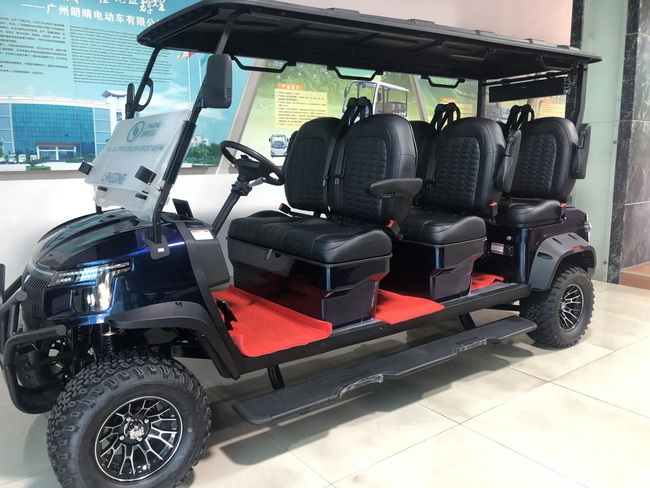
Two buggies with similar size and seating can perform differently depending on motor power and controller configuration. Matching power to terrain and load is critical for smooth acceleration and safe hill‑climbing.
Key aspects:
- Motor power and torque: Higher torque is important for gradients, soft ground, and full passenger loads.
- Controller tuning and drive modes: Eco, normal, or power modes help balance speed, range, and safety in different environments.
- Tire and suspension selection: Turf tires protect grass, while more aggressive tread and reinforced suspension are better suited for off‑road or mixed‑surface applications.
In general, larger and heavier buggies benefit from stronger motors and optimized controllers to avoid sluggish behavior on ramps or long climbs.
A well‑sized buggy should feel stable, easy to board, and comfortable for the full duration of typical rides. Good ergonomics improve satisfaction for both passengers and drivers, especially in commercial fleets.
Comfort factors:
- Seat cushioning, back support, and entry height
- Ride smoothness over uneven surfaces
- Intuitive controls and clear display of speed and battery status
Safety essentials:
- Seat belts and grab handles on higher‑capacity models
- Adequate LED lighting, brake lights, and turn signals for low‑light conditions
- Mirrors, horn, and reverse alarm in busy or mixed‑traffic areas
Using scenarios helps translate specifications into practical decisions.
Scenario 1 - Standard 18‑hole golf course:
- Main need: Move 2–4 golfers plus clubs around the course.
- Recommended size: 4 seater golf cart with dedicated bag storage.
- Benefit: Comfortable seating, efficient use of paths, and easy parking near tees and greens.
Scenario 2 - Resort or hotel with dispersed villas:
- Main need: Shuttle families and luggage between reception, rooms, and common areas.
- Recommended size: Mix of 4 seater and 6 seater electric buggies.
- Benefit: Flexible fleet that handles both small groups and peak‑time demand with fewer trips.
Scenario 3 - Factory, park, or large facility:
- Main need: Move teams with tools, spare parts, or maintenance equipment.
- Recommended size: Utility buggies in 2–4 seat configurations with cargo beds.
- Benefit: Better focus on payload and practicality rather than pure seating capacity.
This simple checklist helps confirm that the planned buggy size matches your environment and usage pattern.
1. Define application
- Golf, hospitality, campus, industrial, or off‑road use.
2. Estimate typical passengers per trip
- Average and peak numbers, plus any special groups (children, elderly, VIPs).
3. Account for cargo and payload
- Weight and dimensions of tools, bags, and other equipment.
4. Measure physical constraints
- Storage, charging areas, doors, ramps, and narrow paths.
5. Set range and charging expectations
- Daily distance, shift length, and available charging windows.
6. Check power and terrain fit
- Slopes, loose ground, and braking requirements.
7. Review comfort and safety needs
- Required seating comfort level and mandatory safety features.
Completing these steps gives a clear indication whether a 2‑seater, 4 seater golf cart, or 6 seater electric buggy will work best and what configuration details to prioritize.
Choosing between compact and larger models often comes down to space, passenger volume, and operating style. Understanding the trade‑off helps create a balanced fleet instead of relying on a single model type.
Compact buggies (2–4 seats):
- Ideal for narrow paths, dense areas, and shorter trips
- Easier to park and store, often with lower energy use per trip
Larger buggies (6 seats and above):
- Suitable for long internal routes and regular group transport
- Reduce the number of trips and driver hours per passenger moved
Many operators combine both types to cover different journeys within the same property or facility.
Selecting the right electric buggy size becomes much easier when the decision is guided by real operating data: passengers, distance, terrain, and cargo. Working with an experienced OEM manufacturer of golf carts, sightseeing buses, low‑speed vehicles, hunting buggies, and multi‑purpose EVs allows you to turn those requirements into a tailored configuration.
Share your expected daily routes, typical passenger loads, and cargo needs, and request proposals that compare 4 seater golf carts and 6 seater electric buggies with clear specifications. This collaborative approach helps you build a fleet that is safe, efficient, and aligned with your brand image from the beginning.

For standard 18‑hole golf courses, a 4 seater golf cart usually meets typical group sizes and offers enough space for players and their bags. Courses with frequent corporate groups or special events may add higher‑capacity buggies for staff and support roles.
A 6 seater electric buggy is the better option when resorts frequently move families, groups, or luggage between distant areas and have wide internal roads. In these situations, larger buggies reduce shuttle frequency and waiting times at peak periods.
Larger, heavier buggies generally benefit from motors with higher torque, especially where slopes or soft surfaces are common. On flat terrain with controlled speeds, careful matching of motor, controller, and gearing can still deliver efficient performance.
Lithium‑ion batteries are lighter and more compact than lead‑acid packs, which helps offset the additional weight of 6‑seater or utility configurations. They also provide faster charging and longer service life, which is attractive for fleets operating in multiple daily shifts.
A common mistake is focusing only on the number of seats and ignoring narrow paths, slopes, and real payload requirements. Measuring routes and clarifying daily tasks before ordering prevents buying buggies that are either too large to maneuver or too weak for actual loads.


