


Views: 222 Author: Leah Publish Time: 2026-01-03 Origin: Site


Content Menu
● Understanding Key Weight Terms
● Average Weight Ranges by Electric Golf Cart Type
>> Standard 2-Seater Electric Golf Cart
>> 4-Seater and 6-Seater Electric Golf Carts
>> Street-Legal Low-Speed Electric Vehicles
>> Specialized and Customized Electric Golf Carts
● How Batteries Influence Electric Golf Cart Weight
>> Impact of Battery Weight on Design and Use
● Frame, Materials, and Accessory Weight
>> Frame and Body Construction
>> Seats, Roofs, and Structures
>> Tires, Lift Kits, and Off-Road Equipment
● Why Electric Golf Cart Weight Matters
>> Safety, Handling, and Braking
>> Shipping, Towing, and Storage
● Practical Tips for Buyers and Fleet Managers
● FAQ
>> 1. How much does a typical 2-seater electric golf cart weigh?
>> 2. How much weight can an electric golf cart safely carry?
>> 3. How much weight does switching to lithium batteries save?
>> 4. Does a heavier electric golf cart always mean better stability?
>> 5. How can I find the exact weight of my electric golf cart for shipping or towing?
For most owners, the first practical question is simple: “How heavy is the cart I am actually going to drive and transport?” A typical recreational electric golf cart designed for two passengers, with a standard 48 V lead-acid battery pack, usually falls somewhere between 900 and 1,100 lb curb weight. Smaller, minimalist designs can be slightly lighter, while multi-seat or heavily accessorized electric golf carts can push well beyond 1,300–1,500 lb.
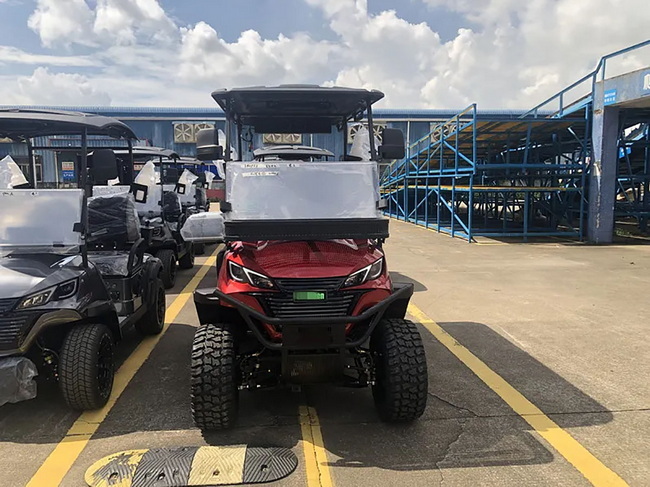
Another important reality is that weight is not a single fixed number. A brochure might list a dry weight, the dealer may talk about curb weight, and the chassis plate might mention a gross vehicle weight rating. All of these describe different aspects of what “weight” means for an electric golf cart, and each is important in different situations such as road registration, trailer selection, or calculating freight costs.
To evaluate and compare electric golf carts correctly, it helps to clarify the core terms that appear in specifications and manuals. Using the wrong figure can lead to mistakes when planning towing, loading, or even battery upgrades.
- Dry weight
Dry weight is the base weight of an electric golf cart without batteries, passengers, or any removable cargo. This number is typically lower than what the cart will weigh in real use, but it is useful for engineering and design comparisons between different frames and body structures.
- Curb weight
Curb weight is the realistic, ready-to-drive weight of an electric golf cart with its batteries and standard equipment installed, but without passengers or cargo. This is the most relevant number for owners and logistics planners, because it reflects how heavy the vehicle will be when it is rolled onto a trailer or container.
- Gross vehicle weight rating (GVWR)
GVWR is the maximum permissible total of the cart, passengers, and cargo combined. When the moving weight of an electric golf cart goes beyond this rating, the frame, axles, tires, and brakes may be overloaded, increasing the risk of mechanical failure or accidents.
Understanding the distinction between these three terms ensures that an electric golf cart is used, loaded, and transported within safe limits. For OEM buyers and distributors, clarifying which weight figure appears on marketing materials also helps avoid confusion in downstream sales channels.
Electric golf carts are no longer limited to simple two-seat models on the fairway. Today, manufacturers like BorCart produce a wide variety of golf carts and low-speed vehicles for golf courses, resorts, industrial parks, hunting grounds, and gated communities. Each configuration has its own typical weight band.
The classic 2-seater electric golf cart used on courses and in residential areas is usually the lightest configuration. With a steel or aluminum frame, body panels, a roof, and a 36–48 V lead-acid battery pack, this format typically weighs around 900–1,100 lb at curb weight. Compact designs aimed at lighter duty or shorter ranges may reduce the pack size or the body equipment, bringing the curb weight closer to 800–900 lb, especially if the manufacturer uses lightweight materials.
As seating capacity increases, so does the structure required to support the extra passengers. A 4-seater electric golf cart usually has an extended frame, rear seat kit, and often a larger battery pack to maintain range, which pushes many models into the 1,100–1,300 lb range. Six-seat electric golf carts, often used as resort shuttles or sightseeing buses, require an even more robust chassis and suspension, making curb weights around 1,300–1,400 lb or higher quite common.
Some electric golf carts are purpose-built or upgraded to meet local requirements for low-speed vehicles. To comply with such rules, they typically need additional equipment such as headlights, tail lights, turn signals, mirrors, seat belts, reinforced roofs, and sometimes windshield wipers and bumpers. All of these elements add weight, so street-legal electric golf carts often weigh between about 1,000 and 1,500 lb depending on seating and battery configuration.
Hunting carts, lifted carts, multi-purpose vehicles with cargo beds, and highly customized units carry even more components. Larger off-road tires, lift kits, protective guards, cargo boxes, and specialized racks can add substantial mass. It is not unusual for a heavily customized electric golf cart to approach or exceed 1,600–1,800 lb curb weight. This is why careful attention to frame strength and braking performance is especially important in these segments.
Battery systems are usually the single heaviest subsystem in an electric golf cart. This means the choice between lead-acid and lithium technology has a dramatic impact on total vehicle weight, balance, and performance.
Traditional flooded or AGM lead-acid batteries are still widely used because they have a lower upfront cost and are familiar to many technicians. A typical 36–48 V lead-acid pack made of multiple 6 V, 8 V, or 12 V batteries can weigh anywhere from about 250 to nearly 500 lb depending on capacity. For example, a 48 V system using eight 6 V batteries tends to be particularly heavy because each individual unit has a robust lead plate structure and thick casing.
This weight adds stability to the electric golf cart, but it also results in higher rolling resistance and greater energy consumption. When the cart is fully loaded with passengers and cargo, the extra mass can make acceleration slower and braking distances longer.
Lithium-ion or lithium iron phosphate packs are much lighter for the same usable energy. In many cases, a 48 V lithium system for an electric golf cart weighs only around 120–180 lb. That means switching from a conventional lead-acid pack to lithium can reduce total battery weight by roughly 200–300 lb or even more, depending on the original configuration.
Lighter batteries help the electric golf cart accelerate more quickly, climb hills more confidently, and stop more easily. They also reduce stress on the chassis and suspension over the long term. In addition, lithium batteries often deliver more consistent voltage and longer life cycles, which raises overall efficiency and reduces maintenance.
From a design perspective, battery placement and weight distribution affect handling. A heavier rear battery compartment can make the electric golf cart more prone to nose-up behavior on steep inclines or when braking aggressively downhill. By contrast, a lighter lithium pack allows more flexibility in packaging, enabling engineers to optimize center of gravity and stability.
For fleet managers, battery weight has a direct influence on transport costs. When shipping large volumes of electric golf carts to overseas markets, even a 50–100 kg reduction in each unit's curb weight can translate into noticeable freight savings per container. That is one reason why OEM buyers for foreign brands increasingly specify lithium options in their private-label electric golf cart programs.
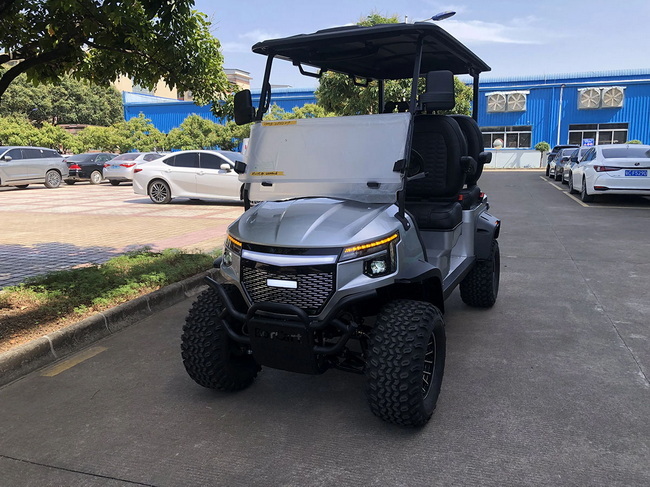
Beyond batteries and seats, the structural design and accessories also play major roles in how much an electric golf cart weighs.
Traditional steel frames offer high strength but add more mass. Aluminum or mixed-material frames can significantly reduce weight while maintaining rigidity, especially when combined with modern welding and extrusion techniques. Body panels made from lightweight plastics or composites further cut weight and are often easier to shape into modern designs.
The choice between a heavier, durable frame and a lighter, more efficient one depends on the intended application. A hunting or industrial electric golf cart may benefit from a stronger, heavier chassis to cope with rough terrain and frequent loading. In contrast, a low-speed vehicle designed mainly for urban streets and resorts can prioritize lighter construction to enhance efficiency and maneuverability.
Seat frames, cushions, and covers add more than comfort—they add kilograms. Thick cushions and armrests weigh more than basic designs. Likewise, full-length canopies or enclosed cabins with doors and windows are heavier than minimalist roofs or open designs.
Handrails, rear safety bars, and front brush guards all improve safety and durability in daily use, but they also increase curb weight. When customizing an electric golf cart, it is helpful to evaluate each accessory not only for its function and aesthetics but also for its contribution to total mass.
Large off-road tires and wheels often used on hunting or utility electric golf carts weigh noticeably more than standard low-profile golf tires. Lift kits that raise ground clearance typically require stronger suspension components, brackets, and sometimes extended steering links, all of which add weight.
For customers who need off-road capability, this extra weight is usually an acceptable trade-off. However, it must be considered when choosing battery capacity and motor power to ensure that the electric golf cart still meets performance expectations.
Understanding how much an electric golf cart weighs is not only a technical detail—it has real consequences for day-to-day use, safety, and operational cost.
Heavier electric golf carts require more energy to move, especially during acceleration and hill climbing. This means that, for the same battery capacity, a heavier cart will generally have a shorter driving range than a lighter one. Conversely, reducing weight through lithium batteries or lighter accessories can help extend the distance that the electric golf cart can travel on a single charge.
On the other hand, some weight is beneficial. A heavier chassis can feel more planted at higher speeds or on uneven surfaces. The goal is to find a balance where the electric golf cart remains stable while still delivering good efficiency and range.
Weight distribution influences how the electric golf cart behaves in turns and under braking. Too much rear weight can cause instability, while excessive front weight can increase steering effort. Overloading the cart beyond its rated capacity not only worsens handling but can also overheat the brakes, strain suspension components, and increase the risk of rollover.
Manufacturers must carefully match the braking system, tire load rating, and suspension design to the expected curb weight and GVWR of the electric golf cart. Operators should always respect the published capacity limits to preserve both safety and mechanical reliability.
For importers, distributors, and large end-users such as resorts or golf club chains, weight becomes a logistics issue. Heavier electric golf carts are more expensive to ship and may require stronger trailers, loading ramps, and lifting equipment. When calculating transport costs, knowing the exact curb weight of each configuration is essential.
For private owners, weight matters when towing the electric golf cart behind an RV or truck. Trailers are rated for specific maximum loads, and overloading a trailer can lead to structural failure or brake problems. This is why accurate weight information is crucial before any long-distance travel.
Whether the goal is to pick the best model for a golf course or to specify a complete OEM product line, there are several practical steps to manage electric golf cart weight effectively.
- Confirm whether the published number is dry weight or curb weight, and always use curb weight as the reference for transport and operational planning.
- When possible, opt for lithium batteries if reduced weight, longer range, and lower maintenance costs justify the higher initial price.
- Consider how many passengers and how much cargo the electric golf cart will carry regularly, then choose a model whose GVWR safely covers that use pattern.
- For off-road or hunting carts, balance the need for rugged accessories with the additional weight they bring, and check that the motor and controller are sized appropriately.
- When working with an OEM like BorCart, provide clear target specifications for seating, range, and maximum curb weight so the engineering team can propose the most suitable frame, battery, and accessory combinations.
By taking these steps, buyers and fleet operators can ensure that each electric golf cart not only feels good to drive but also remains safe, durable, and cost-effective over its entire service life.
In practice, most standard electric golf carts weigh roughly 900–1,200 lb at curb weight, while compact two-seat designs can be somewhat lighter and large multi-passenger or street-legal variants often climb into the 1,300–1,500 lb range or higher. Battery technology, especially the choice between lead-acid and lithium systems, is the single largest factor in determining how heavy an electric golf cart will be. Frame materials, seating capacity, roofs, tires, and accessories then fine-tune the final number and shape the way each electric golf cart feels on the course, in the resort, or on city streets.
For golf courses, resorts, hunting operations, and industrial facilities, understanding these weight drivers helps match the vehicle to the job and avoid overloading or under-specifying a fleet. For OEM and private-label partners, controlling weight through smart engineering and component selection is essential to optimize logistics, meet regulatory requirements, and deliver electric golf carts that satisfy both operators and end users. When range, handling, safety, and transport costs all matter, paying close attention to how much an electric golf cart weighs is one of the most effective decisions any buyer or brand can make.

A typical 2-seater electric golf cart with a standard 36–48 V lead-acid battery pack usually weighs about 900–1,100 lb at curb weight. Lightweight designs can be slightly below this range, while versions with more robust frames or extra accessories may sit at the higher end.
Most standard electric golf carts are designed to carry two to six passengers plus clubs or light cargo within a combined capacity of roughly 800–1,600 lb, depending on the model and seating configuration. To stay safe, the total weight of passengers and cargo should never exceed the cart's published gross vehicle weight rating.
Replacing a conventional lead-acid pack with a lithium battery system can often reduce the battery portion of the weight by 40–70%. In practical terms, many electric golf carts shed about 200–300 lb after converting to a properly sized lithium pack of similar or greater usable capacity.
Extra weight can improve straight-line stability and help the electric golf cart feel more planted on rough surfaces, but too much weight or poor distribution can hurt handling and increase braking distances. A well-balanced design that matches frame strength, suspension, and brakes to its curb weight will always be more important than simply being heavier.
The fastest way is to check the identification plate or specification label on the chassis, which usually lists the curb weight and sometimes the GVWR. If that information is missing or unclear, weighing the electric golf cart on a certified vehicle scale gives a precise measurement that can be used for trailer selection, freight quotes, and safety checks.


