


Content Menu
● Understanding Typical Golf Buggy Lengths
>> Two-Seater Golf Buggy Length
>> Four-Seater Golf Buggy Length
>> Six-Seater and Limo Golf Buggy Length
● Overall Size: Length, Width, and Height
● Why Golf Buggy Length Matters
>> Maneuverability and Turning Radius
>> Storage and Transport Planning
● Examples of Real-World Golf Buggy Dimensions
>> Sample Dimensions from Popular Models
● Use Cases and Length Choices
>> Golf Courses and Country Clubs
>> Resorts, Hotels, and Theme Parks
>> Industrial, Campus, and Utility Use
>> Street-Legal and Low-Speed Vehicles
● How Accessories Affect Golf Buggy Length
>> Cargo Boxes and Utility Beds
>> Body Kits and Custom Styling
● Practical Tips for Choosing Golf Buggy Length
>> Balance Capacity and Maneuverability
>> Check Manufacturer Specifications
● FAQ
>> 1. How long is a standard golf buggy?
>> 2. How long is a four-seat golf buggy?
>> 3. How long is a six-seat or limo golf buggy?
>> 4. Do accessories change golf buggy length?
>> 5. Why is golf buggy length important for buyers?
A standard golf buggy is usually around 2.3–3.0 meters long (about 92–118 inches), depending mainly on seating capacity and configuration. Larger multi-row or limo-style golf buggy models can exceed 3.5 meters (over 140 inches) in length to accommodate more passengers or cargo.[1][2][3]
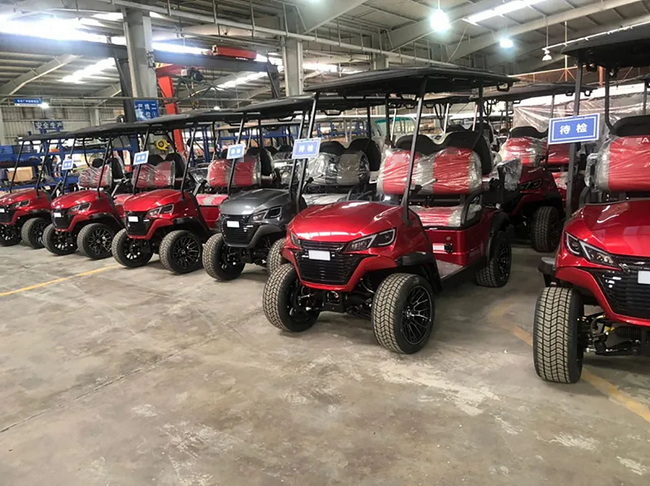
A typical two-seat golf buggy used on golf courses is about 92–96 inches long, which is roughly 2.3–2.4 meters. Four-seat golf buggy models commonly extend to around 108–118 inches in length, particularly when they add a rear-facing seat and step.[2][4]
Extended six-seat or limo-type golf buggy models can reach 144–160 inches, or around 3.6–4.0 meters, giving space for three rows of seats. These longer designs are popular in resorts, communities, and sightseeing operations where group transport is essential.[3][5][1][2]
Different golf buggy configurations have distinct length ranges, even when width and height remain similar.[1][2]
A normal two-passenger golf buggy typically measures about 92–96 inches (around 2.3–2.4 m) from front bumper to rear. Many mainstream models from well-known brands sit in this compact range to balance comfort, stability, and maneuverability.[6][2]
Some specific designs, such as popular Club Car and Yamaha two-seat units, are around 238–240 cm in length, with widths near 120 cm. This compact footprint is ideal for standard golf course paths and for home garages where space is limited.[4][7][3][6][1]
A four-seat golf buggy is usually longer than a two-seat version, commonly in the 108–118 inch range. Many four-seat configurations are created by adding a rear-facing bench seat and footrest to a standard two-seat chassis, pushing overall length to roughly 105–110 inches or more.[8][2][3][4]
Purpose-built four-passenger golf buggy models use extended frames and wheelbases to maintain comfort and balance, which is why some units reach 280–300 cm in length. This extra length provides better legroom and access but requires more attention when maneuvering in tight spaces or parking bays.[2][6][1]
A six-passenger or limo-style golf buggy can exceed 350 cm in length, with many examples measuring 142–160 inches. These models usually feature three rows of seats and a significantly stretched wheelbase to keep handling predictable even at full passenger capacity.[3][1][2]
Because of their greater length, these golf buggy variants need wider turning circles, deeper parking spaces, and larger loading ramps for trailers and trucks. As a result, they are often chosen by resorts, hotels, airports, and large campuses that value capacity and comfort over ultra-compact maneuverability.[5][6][1][2]
Length is just one dimension of a golf buggy; width and height are equally important when planning paths, storage, and transport.[6][2]
Most golf buggy designs keep width within about 48–52 inches, which allows safe travel on narrow paths and bridges. Standard two-seat models typically measure around 120 cm (about 48 inches) in width, while larger buggies seldom exceed 125–130 cm.[9][1][2]
Many leading models from brands such as Club Car and EZGO list widths between 48 and 51 inches, whether or not a rear seat is installed. This consistency helps golf courses and communities design paths and garages that suit different brands and types of golf buggy without frequent layout changes.[7][9][1][3]
Average golf buggy height, including the canopy, tends to fall between 70 and 77 inches, or roughly 175–195 cm. Standard two-seat designs often stand around 175 cm tall, while six-seat and lifted models can be slightly higher, especially when they use larger wheels and suspension lifts.[1][2][3]
Height matters for indoor storage and for moving golf buggy fleets through tunnels, underpasses, and low overhead structures. Accessories such as roof racks, light bars, and safety beacons can add several centimeters, so operators must consider total height rather than only the catalog figure.[7][2][3][6]
Golf buggy length significantly influences handling, storage, and overall practicality in day-to-day operations.[2][6]
Shorter two-seat golf buggy models generally offer the tightest turning radius, which is ideal for winding paths and densely arranged golf holes. Longer four-seat and six-seat versions require more room to turn, especially in narrow driveways, parking lots, or older courses with compact layouts.[3][6][2]
As a golf buggy grows in length, operators must think ahead about turning points and potential bottlenecks. In many modern golf facilities, architects plan intersections and curves to match typical turning radii for both standard and extended golf buggy fleets.[9][1]
Length directly determines how many golf buggy units can be parked in a given space. For example, a row of 92-inch two-seat models occupies far less total length than an equivalent row of 144-inch limo-style buggies.[4][6][2][3]
Transporting a golf buggy fleet on trailers, containers, or trucks is also affected by overall length, because it limits how many units can be loaded per trip. Fleet managers often check exact length figures from technical sheets to calculate optimal stacking and reduce logistics costs.[8][6][1][2]
Golf course designers and facility planners must base path width, tunnel height, and bridge clearance on the largest and tallest golf buggy in regular use. Paths are usually between 2.0 and 2.5 meters wide, allowing two standard buggies to pass safely without leaving the pavement.[9][1]
Parking areas outside clubhouses, villas, and resort lobbies are arranged with enough depth to accommodate extended and limo-style golf buggy models. For multi-level properties, the dimensions of ramps and elevators can also depend on the maximum golf buggy length they intend to handle.[5][4][6][1]
Looking at concrete data from known brands shows how length varies across configurations.[2][3]
Several mainstream designs fall into clear length bands, even when they can be customized:
- Standard two-seat golf buggy models often list dimensions around 92–96 inches in length, 48–50 inches in width, and about 72–75 inches in height.[2]
- Four-seat buggies with rear-facing seats typically measure 104–110 inches in length, while preserving similar width and height to the base model.[4][3]
- Six-seat or limo-style designs commonly reach 142–160 inches in length, with widths around 48–58 inches and heights up to about 77–80 inches.[3][2]
- Compact Club Car two-seat units may be about 91–92 inches long and 48 inches wide with a height around 69 inches, highlighting a particularly space-efficient footprint.[3]
- Long-wheelbase six-passenger models from the same family can extend to roughly 142–144 inches, keeping width near 48–51 inches and height near 77 inches.[3]
These figures illustrate that width and height stay relatively stable, while length scales dramatically as more seats or cargo capacity are added. Such information helps buyers and fleet operators select a golf buggy size that matches their storage areas, transport equipment, and operational needs.[6][2][3]

Different applications call for different golf buggy lengths, and choosing the right size can improve comfort and efficiency.[1][2]
On traditional golf courses, the standard two-seat golf buggy remains the most common length, offering enough room for two players and clubs while staying highly maneuverable. Some clubs also use four-seat buggies for groups or caddies, but extremely long limo-style units are less common on narrow fairway paths.[6][9][1][2]
Course managers must balance passenger comfort against turf protection and path width, which often leads them to favor light, mid-length golf buggy models. Where groups or VIP guests are transported between holes or facilities, a mix of standard and slightly extended buggies is frequently used.[5][1][6][2]
Resort properties and theme parks frequently adopt four-seat and six-seat golf buggy fleets to move guests and luggage efficiently. These locations usually have wider internal roads and dedicated loading zones, making it easier to operate longer buggies without congestion.[10][5][1]
In such settings, the additional length of a multi-row golf buggy pays off in higher capacity per trip, reducing the number of vehicles needed. For VIP or premium services, operators may choose upgraded, limo-style buggies that combine extra length with enhanced seating comfort and styling.[5][1]
Factories, logistics centers, campuses, and large residential communities often rely on utility-focused golf buggy designs with cargo beds or custom bodies. These versions may be similar in length to four-seat or six-seat models but use the rear area as a flatbed, toolbox, or enclosed cargo space instead of passenger rows.[1][2][3]
Because utility buggies might carry tools, equipment, or maintenance staff, operators must balance load capacity with the need to maneuver among buildings and warehouses. As a result, mid-length or slightly extended golf buggy platforms are widely used in this segment.[6][1][2]
In some regions, golf buggy designs are adapted into street-legal low-speed vehicles (LSVs) that operate on public roads with speed limits up to around 35 mph. These LSVs typically share similar structural dimensions with standard golf buggy platforms but add safety features like lights, mirrors, and seat belts.[11][5]
Street-legal versions often favor four-seat or extended two-seat configurations because they must safely accommodate passengers alongside other vehicles. While length is important for parking and lane positioning, compliance depends more on maximum speed and equipment requirements than on exact golf buggy dimensions.[10][11][5]
Add-on parts and custom options can subtly or significantly increase golf buggy length.[2][3]
The most common length-increasing accessory is a rear-facing seat kit, which transforms a two-seat golf buggy into a four-seat layout. Such kits often include a folding rear seat and a rear step or footrest that extends beyond the original rear bumper.[8][4][3]
As a result, a golf buggy that started at around 92 inches can grow to 104–110 inches after installation, depending on the design. Operators must ensure that their trailers, garages, and storage racks can accommodate this new overall length.[4][6][2][3]
Utility conversions typically replace or supplement the rear seat with a cargo box, dump bed, or specialized enclosure. Some kits sit within the original footprint, but others extend rearwards, adding several inches to the golf buggy length.[2][3]
For industrial and agricultural users, the added length is often acceptable because it brings greater cargo capacity and versatility. However, extra overhang must still be considered when turning, backing up, and loading onto narrow trailers or ramps.[8][1][6][2]
Custom body kits, stylized bumpers, and decorative rear panels can also change overall golf buggy length. While many cosmetic upgrades keep dimensions similar, some luxury or off-road-oriented kits introduce larger bumpers and protective bars.[3][2]
This can slightly increase the total front-to-back size of a golf buggy, which may be relevant where clearances are tight. Before adopting aggressive styling kits, fleet managers often verify that all modified buggies can still pass through gates, doors, and storage aisles.[9][1][6][2]
Selecting the right golf buggy length requires matching technical dimensions to real-world usage scenarios.[6][2]
Buyers should measure the depth of garages, sheds, and parking bays before deciding on a golf buggy configuration. It is wise to account not only for the body length but also for comfortable walking and maneuvering space around parked units.[4][6][2]
For trailer transport, measuring usable deck length and ramp width is just as important. These measurements help determine how many golf buggy units can be moved per trip and whether extended or standard lengths will be easier to handle.[8][1][6][2]
When choosing between shorter and longer models, buyers must balance passenger or cargo capacity against maneuverability. Two-seat buggies are ideal for tight, winding environments, while four-seat and six-seat options serve high-traffic routes and hospitality applications.[5][1][6][2]
If a property includes both narrow paths and spacious roads, a mixed fleet can work well: compact buggies for sensitive areas and longer buggies for main corridors. This approach optimizes efficiency while protecting turf and infrastructure.[9][1][6][2]
Although typical ranges provide a good starting point, every buyer should review the official technical sheets for each golf buggy model. These sheets specify length, width, height, wheelbase, and weight, along with recommendations for loading and transport.[1][2][3]
International buyers, OEM partners, and wholesalers in particular need accurate figures to optimize container loading and dealership display layouts. Precise data also simplifies communication with architects and engineers when integrating golf buggy fleets into new facilities.[9][1][2]
In most cases, a standard golf buggy measures roughly 92–96 inches in length for two seats, 108–118 inches for four seats, and 144–160 inches for six-seat limo-style layouts. This length not only determines how the golf buggy fits into paths, garages, and trailers, but also affects maneuverability, riding comfort, and overall transport efficiency.[1][6][2][3]
By understanding typical dimension ranges and how accessories or conversions can extend the body, buyers and fleet managers can select golf buggy configurations that perfectly match their space and usage patterns. For golf courses, resorts, industrial parks, and communities, choosing the right combination of compact and extended golf buggy models ensures smooth operations and a better experience for players, guests, and staff.[5][1][2]
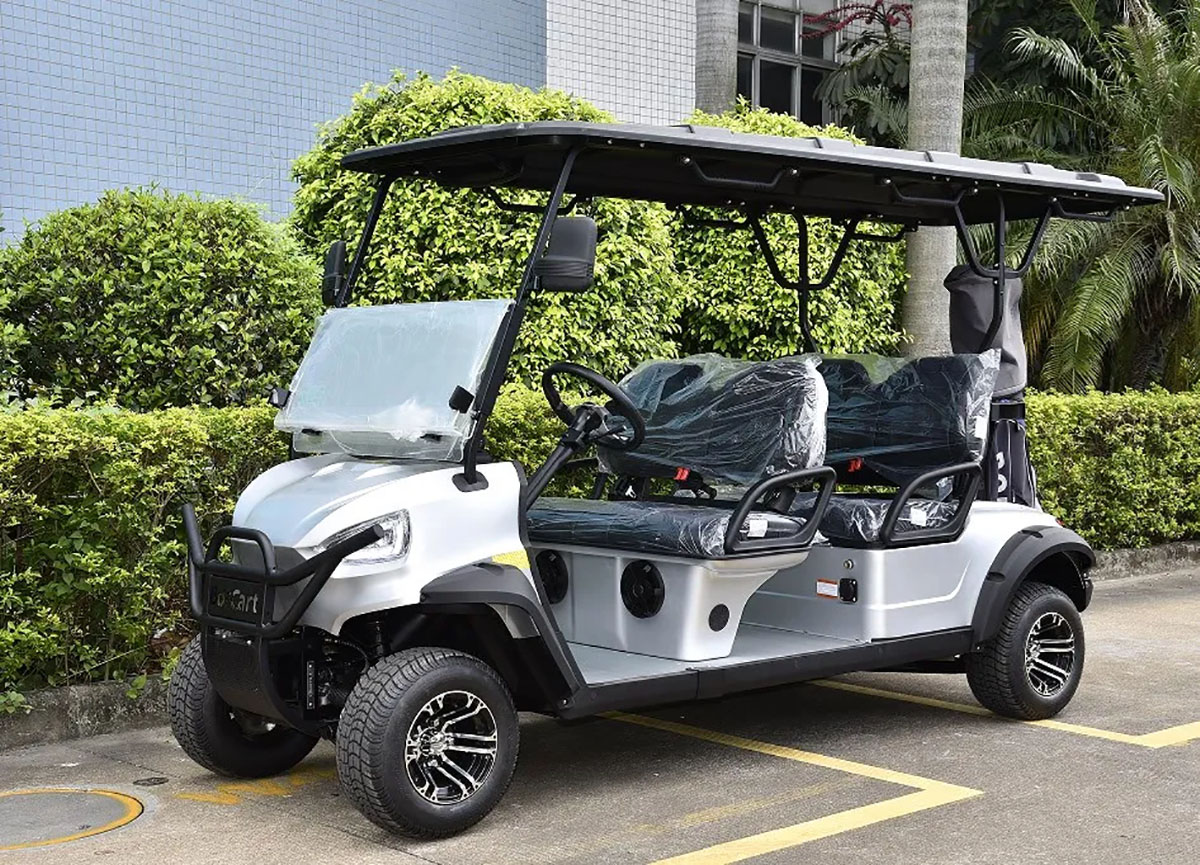
A standard two-seat golf buggy is usually around 92–96 inches long, or about 2.3–2.4 meters. This size is widely used on golf courses and in residential communities because it balances comfort with easy maneuverability.[6][2]
A typical four-seat golf buggy, especially one with a rear-facing seat, often measures about 105–110 inches in overall length. Some extended four-seat designs with extra legroom or cargo space can reach up to around 118 inches.[4][8][2][3]
Six-passenger and limo-style golf buggy models generally range from about 142 to 160 inches in length. Depending on the brand and configuration, a few units with enlarged cargo areas or special bodies can exceed 3.5 meters.[1][2][3]
Yes, accessories such as rear seats, cargo boxes, and extended steps often add several inches to a golf buggy's total length. Even if the core chassis stays the same, the new rear overhang can make the buggy longer than the original catalog specification.[8][4][2][3]
Golf buggy length affects where the vehicle can be parked, how easily it can turn, and how many passengers or how much cargo it can carry. Buyers planning fleets for golf courses, resorts, campuses, or utility work need accurate length data to design paths, garages, and transport logistics efficiently.[5][2][6][1]
[1](https://www.taragolfcart.com/news/golf-buggy-dimensions-standard-sizes-and-a-practical-guide/)
[2](https://wis-tek.com/blogs/knowledge/comprehensive-guide-to-golf-cart-dimensions-width-length-and-height-explained)
[3](https://kingofcarts.net/faq/q-golf-cart-length-width-height-lifted-and-non-lifted.html)
[4](https://jsgolfcarts.com/blog/golf-cart-dimensions/)
[5](https://www.cartguysinc.com/street-legal-golf-carts-rules-requirements-and-benefits)
[6](https://www.golfcartgarage.com/blog/golf-cart-dimensions-and-their-importance/)
[7](https://www.vatrerpower.com/blogs/news/how-wide-is-a-golf-cart)
[8](https://hartvillegolfcarts.com/how-long-is-a-golf-cart/)
[9](https://taraelectricvehicles.com/blog/2025/05/23/how-wide-is-a-golf-cart-golf-cart-dimensions-by-type-length-width-height/)
[10](https://golfcartsearch.com/golf-cart-laws/washington)
[11](https://tidewatercarts.com/what-are-lsv-street-legal-golf-cart-requirements.html)


