


Content Menu
● What Is the Typical Golf Buggy Speed?
● Maximum Speed vs. Legal Limits
● Key Factors That Determine Golf Buggy Speed
● Standard Golf Buggy vs. Modified Performance
● Typical Speed Ranges by Category
● Safety and Stability at Higher Speeds
● Regulatory View on Golf Buggy Speed
● Choosing the Right Golf Buggy Speed for Your Application
● How BorCart Optimizes Golf Buggy Speed
● Electric vs. Gas Golf Buggy Speed Characteristics
● Range, Speed, and Battery Life
● Comfort, Handling, and Braking at Speed
● Practical Speed Recommendations for Different Users
● Future Trends in Golf Buggy Speed and Technology
● FAQ
>> 1. What is the average speed of a golf buggy?
>> 2. How fast can an electric golf buggy go with upgrades?
>> 3. Are there laws limiting golf buggy speed on public roads?
>> 4. Does carrying more passengers make a golf buggy slower?
>> 5. Is a faster golf buggy always better for OEM customers?
A modern golf buggy typically travels between 12 and 15 mph in standard form, and upgraded models can reach 20–25 mph while remaining within most legal limits for low-speed vehicles. With performance modifications, some electric and gas golf buggy designs can exceed 30 mph and even approach 40 mph, but these speeds require careful attention to safety and regulations.[1][2]
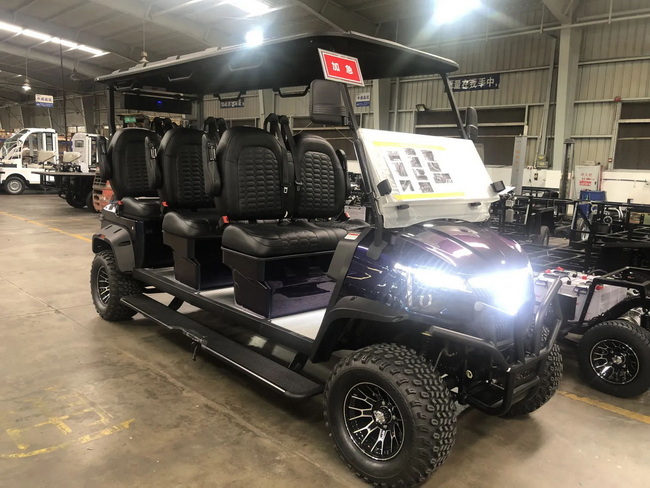
Most standard electric and gas golf buggy models are factory-limited to around 12–15 mph, which suits golf course use and quiet community driving. Many current electric golf buggy lines list “average top speed” ranges of 15–25 mph, with 20–25 mph usually reserved for higher-voltage or street-oriented configurations.[2][1]
A typical 36 V electric golf buggy runs at roughly 12–14 mph, while 48 V versions commonly reach 15–19 mph under normal load. Some 72 V electric platforms and premium low-speed vehicle (LSV) golf buggy models are tuned to 20–25 mph for residential streets and resort environments.[3]
From an engineering perspective, an electric or gas golf buggy chassis can be built to run far faster than 25 mph, and modified buggies with upgraded controllers, motors, or engines can hit 35–40 mph or more. However, once a golf buggy is capable of more than about 20–25 mph, many jurisdictions reclassify it as a different vehicle type, triggering stricter safety and registration requirements.[4][2]
In the United States, a low-speed vehicle is generally defined as a four-wheel vehicle with a top speed between 20 and 25 mph and a relatively low gross vehicle weight rating. For on-road use, such an LSV-type golf buggy may be allowed only on roads signed at 25–35 mph or below, and local rules often restrict operation to clearly marked golf buggy zones.[5][4]
Several technical and environmental factors control how fast a golf buggy can go in real conditions.
- Motor power and torque
Electric golf buggy motors commonly deliver 3–5 horsepower (about 2,200–3,700 W), enough to push the vehicle to roughly 15–25 mph depending on load and terrain. High-performance golf buggy motors in the 3,000–6,000 W range provide stronger acceleration, better hill-climbing, and higher potential top speed when paired with appropriate controllers and batteries.[6][7]
- Battery voltage and controller programming
Higher battery voltage, such as upgrading from 36 V to 48 V or 72 V, enables a golf buggy motor to reach greater speeds and maintain performance on inclines. At the same time, speed controllers are often programmed to cap a golf buggy at a target speed—factory settings might limit the cart to 12–15 mph, while an unlocked or “speed code” tune can allow 20+ mph.[1][3]
- Vehicle weight, passengers, and cargo
A heavily loaded golf buggy with multiple passengers, golf bags, or utility cargo accelerates more slowly and may struggle to hit its rated top speed, particularly on slopes. Lightweight hunting or utility golf buggy builds with strong motors can reach around 30–32 km/h on suitable terrain even with off-road equipment installed.[8][6]
- Terrain, tires, and aerodynamics
Soft ground, steep hills, and aggressive off-road tires all absorb extra energy and reduce effective speed for an electric golf buggy. On flat, paved surfaces with low-rolling-resistance tires, the same golf buggy can approach its nominal maximum speed more consistently.[7][2]
Many everyday users are content with a standard golf buggy that cruises quietly at around 12–15 mph on the course or within a residential community. This baseline configuration prioritizes safety, range, and reliability over headline speed, aligning with golf course policies and neighborhood rules.[9][1]
Enthusiasts and commercial operators sometimes choose performance upgrades to push a golf buggy to 23–25 mph or beyond for use on private property, large resorts, or LSV-approved roads. With stronger motors, higher-voltage systems, tuned controllers, and suitable tires, modified electric or gas golf buggy builds have been documented at 35–40 mph or higher, although such speeds demand more robust brakes, suspension, and safety equipment.[2]
Golf buggy type | Typical top speed |
Standard electric golf buggy (36 V) | About 12–14 mph on flat ground. |
Standard electric golf buggy (48 V) | Roughly 15–19 mph with a light load. |
72 V or high-spec electric golf buggy | Often 20–25 mph in LSV-style setups. |
Standard gas golf buggy | Typically 10–15 mph depending on age and tune. |
Factory LSV-class golf buggy | Limited to about 20–25 mph by law. |
Modified electric golf buggy | Commonly 35–40 mph with performance upgrades. |
Off-road hunting golf buggy | Around 32 km/h (about 20 mph) in 4x4 layouts. |
For many buyers, a 20–25 mph electric golf buggy offers a practical balance of speed, safety, and battery range across golf, resort, and light utility usage. Faster builds are more specialized and are best suited to controlled environments or markets where high-performance golf buggy products are specifically demanded.[2][3]
Because a golf buggy lacks many of the structural protections found in passenger cars, its safe operating speed is naturally lower. Narrow track widths, simple suspension designs, and open seating mean that abrupt maneuvers at high speed can increase rollover and ejection risks for occupants.[11][9]
Most safety frameworks therefore focus on keeping a golf buggy at or below 20–25 mph in mixed-use areas and ensuring suitable operator behavior. Where a golf buggy is used as a low-speed vehicle, the addition of safety features such as lights, mirrors, belts, and compliant braking systems becomes essential before allowing road operation.[12][4]
Global and national regulations treat a faster golf buggy differently from a simple course vehicle, especially once it approaches on-road use. In North America, a low-speed vehicle is often defined as a four-wheel electric vehicle that can travel at least 20 mph but not more than 25 mph on level pavement.[4]
Cities and local governments may designate specific zones where a golf buggy is permitted to share the road, often limiting these areas to streets posted at 25–35 mph or lower. If a golf buggy is modified to surpass the 25 mph threshold, it can fall outside low-speed classifications and may not be legal for road use without full registration, lighting, and safety compliance as a regular motor vehicle.[5][11]
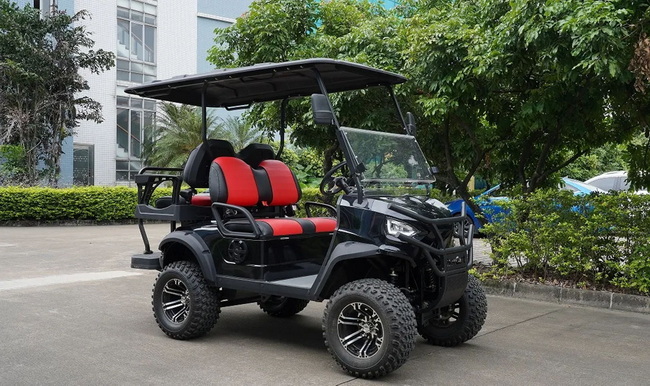
The ideal speed for a golf buggy depends heavily on how and where it will be used.
- Golf courses and resorts
For traditional golf courses, a quiet, 12–15 mph golf buggy keeps play flowing smoothly without creating safety concerns for pedestrians and other players. Resort environments sometimes prefer slightly faster buggies in the 15–20 mph range to shuttle guests efficiently over greater distances.[1][3]
- Residential and community mobility
Planned communities and campuses often set rules that align with low-speed vehicle categories, making a 20–25 mph golf buggy an attractive mobility choice. In these scenarios, stakeholders must match golf buggy capabilities with local signage, speed limits, and any requirements for registration or equipment.[13][12]
- Commercial, hunting, and utility work
For hunting, maintenance, or multi-purpose work in rugged terrain, an off-road golf buggy emphasizes torque and ground clearance rather than sheer speed, often topping out around 20 mph. More powerful gas or 4x4 electric hunting buggy models can reach higher figures on open ground, but range, traction, and payload remain primary design drivers.[14][8]
As a specialist in electric vehicles and automotive components, BorCart can tailor a golf buggy to suit different international customer profiles and regulations. By adjusting motor power, battery voltage, controller programming, and gear ratios, a single golf buggy platform can be optimized for 12–15 mph course duty, 20–25 mph community transport, or higher-performance private-land applications.[3]
For OEM partners such as overseas brands, wholesalers, and manufacturers, BorCart's engineering team can design high-volume golf buggy solutions that meet local low-speed vehicle requirements while preserving the desired ride quality and durability. This includes aligning OEM-spec golf buggy speed with LSV legal boundaries, ensuring reliable hill-climbing, and integrating component packages that support hunting, sightseeing, or multi-purpose usage.[4]
Electric and gas golf buggy platforms achieve speed in different ways, and this influences how they feel on the course or on a community road. Electric golf buggy models deliver instant torque from zero rpm, giving smooth and quiet acceleration up to their limited top speed, which is particularly beneficial on hilly courses and in residential settings.[7]
Gas-powered golf buggy designs tend to build power gradually and may offer slightly stronger performance over long distances or under heavy loads, especially where refueling is easier than charging. However, many operators now prefer an electric golf buggy for its low noise, lower local emissions, and the ease of speed control through software and electronic controllers.[10][7]
Speed is never the only consideration; a practical golf buggy must also deliver enough range for a full round of golf, a day of resort shuttling, or a shift of maintenance work. Driving an electric golf buggy continuously at its maximum speed generally reduces range compared with operating at a moderate pace, because aerodynamic drag and rolling resistance increase with speed.[7]
Manufacturers therefore often tune an electric golf buggy so that the most efficient cruising speed is slightly below its absolute top speed, encouraging operators to stay in a band that balances speed and energy consumption. For fleets, choosing a 15–20 mph ceiling can provide a useful compromise between time savings and battery longevity for each golf buggy in service.[12][3]
The way a golf buggy is sprung and equipped also shapes how safe and comfortable it feels as speed rises. Suspension setups on many course-oriented golf buggy models are intentionally soft to improve comfort over turf and small bumps, but this can lead to more body roll in quick turns at higher speeds.[9]
Upgraded shocks, wider tracks, and lower-profile tires can help a performance-oriented golf buggy feel more planted at 20–25 mph or more, though they may trade a little comfort on uneven ground. Braking systems—whether mechanical drums or hydraulic discs—must also be sized and maintained correctly so the golf buggy can stop predictably when fully loaded.[2][4]
Because every buyer has different expectations, it helps to think in use-case bands when choosing a golf buggy configuration.
- Golfers and club fleets
For most clubs, a 12–15 mph golf buggy is ideal, moving players efficiently between holes without creating congestion or noise. Fleet managers can standardize on a single, moderate speed setting across every golf buggy to simplify safety training and maintenance.[9][1]
- Resorts, hotels, and parks
In large resorts or theme parks, a slightly faster 15–20 mph electric golf buggy helps staff and guests cover more distance while still feeling safe and relaxed. Multi-row shuttle golf buggy vehicles can be tuned to similar speeds, with emphasis placed on smooth acceleration and braking rather than outright performance.[12][3]
- Property managers and industry
For industrial parks, campuses, and large facilities, a 20–25 mph low-speed vehicle configuration gives a golf buggy enough pace to function as a practical internal transport tool. These applications often favor robust tires, all-weather enclosures, and enhanced lighting packages alongside the chosen speed capability for each golf buggy.[13][4]
- Hunters and outdoor users
In forests, farms, and hunting grounds, torque and traction matter more than top speed, so a 4x4 golf buggy set to about 20 mph is often the sweet spot. Extra ground clearance, off-road tires, and accessory mounts can be specified without pushing the golf buggy beyond safe speeds for uneven surfaces.[14][8]
The next generation of golf buggy platforms is being shaped by advances in batteries, motor control electronics, and connectivity. Higher-energy-density lithium packs allow an electric golf buggy to maintain a chosen speed for longer ranges without a significant increase in weight, which benefits both course users and commercial fleets.[7]
Smart controllers and telematics now make it possible to geofence speed in specific areas, automatically slowing a golf buggy near clubhouses, pedestrian zones, or steep slopes and unlocking higher speeds on safe, open stretches. Connected fleet management systems also let operators monitor how fast each golf buggy is driven, enabling better safety policies and predictive maintenance planning.[9][12]
In practice, a typical golf buggy is engineered to travel at 12–15 mph in standard trim and around 20–25 mph in low-speed vehicle configurations that satisfy common regulatory definitions. While performance-tuned electric or gas golf buggy builds can reach 35–40 mph or more, operating at such speeds requires a stronger focus on safety systems, stability, and legal compliance, especially where public roads or shared spaces are involved.[1][2]
For OEM customers and global partners, BorCart can configure a golf buggy product line that balances speed, range, and safety for golf courses, resorts, residential communities, hunting grounds, and multi-purpose environments. By matching motor, battery, and control strategies to the intended use and regulatory framework, it becomes possible to offer a golf buggy that feels responsive and efficient while still being safe, reliable, and compliant.[3]
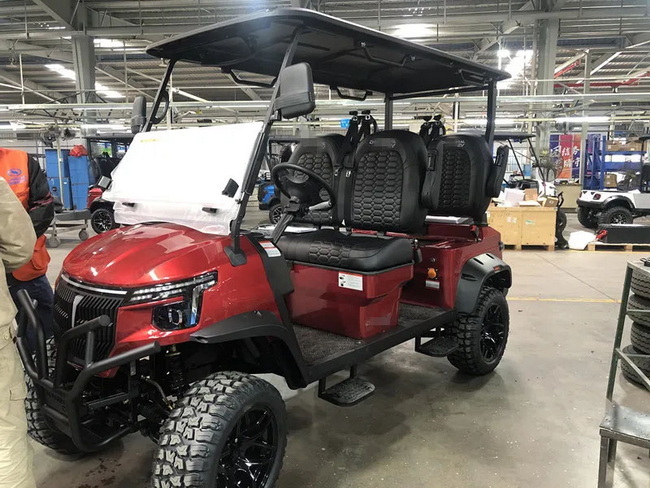
Most standard golf buggy models average about 12–14 mph without performance upgrades. Many newer electric golf buggy designs also offer factory options that raise this to roughly 15–19 mph under normal conditions.[1][3]
With higher-voltage battery packs, stronger motors, and reprogrammed controllers, an electric golf buggy can often reach 23–25 mph while still fitting common low-speed vehicle categories. More extreme tuning can push a performance-oriented golf buggy into the 35–40 mph range, though this is generally intended for private or controlled environments rather than public streets.[2]
Many regions classify road-going electric golf buggy models as low-speed vehicles and cap their legal top speed at about 25 mph. Local rules also commonly restrict a golf buggy to roads signed at 25–35 mph or below and may require additional safety equipment for on-road use.[5][4]
Extra passengers and cargo add weight, which reduces acceleration and can prevent a golf buggy from reaching its nominal top speed, especially on hills or rough ground. For commercial or hunting use, choosing a higher-power golf buggy motor and suitable gearing helps maintain adequate performance when fully loaded.[6][8]
For many OEM markets, the most practical solution is a golf buggy tuned to 15–25 mph, balancing customer expectations with safety and low-speed vehicle regulations. Higher speeds can be attractive in marketing, but they often increase engineering complexity, regulatory overhead, and the need for enhanced braking, suspension, and occupant protection in the golf buggy platform.[9][3]
[1](https://jsgolfcarts.com/blog/how-fast-can-golf-carts-go/)
[2](https://www.golfcarttiresupply.com/blog/how-fast-can-a-golf-cart-go/)
[3](https://hartvillegolfcarts.com/how-fast-do-golf-carts-go/)
[4](https://afdc.energy.gov/laws/6112)
[5](https://golfcartsearch.com/golf-cart-laws/washington)
[6](https://guildgolfcarts.com/how-many-watts-is-a-golf-cart-motor/)
[7](https://evtitan.com/electric-golf-carts-understanding-motor-power-and-performance/)
[8](https://blog.buggiesunlimited.com/hunting-golf-carts/)
[9](https://taraelectricvehicles.com/blog/2025/05/26/understanding-golf-cart-top-speed-regulations-and-safety/)
[10](https://www.kandiamerica.com/how-fast-do-electric-golf-carts-go/)
[11](https://en.wikipedia.org/wiki/Low-speed_vehicle)
[12](https://www.gowithgarretts.com/how-fast-do-golf-carts-go-5-faqs-about-golf-carts-speed/)
[13](https://taraelectricvehicles.com/blog/2025/06/04/golf-cart-driving-laws-in-washington-state/)
[14](https://hizimo.en.made-in-china.com/product/knrpaubKhFWc/China-2025-4-Seater-4X4-Hunting-Buggy-Gasoline-Off-Road-Golf-Cart.html)


