


Views: 222 Author: Loretta Publish Time: 2025-12-22 Origin: Site


Content Menu
● What Are Electric Golf Carts on Campus?
● Eco‑Friendly Campus Transportation
● Cost‑Effective Transportation for Large Campuses
● Enhanced Mobility and Accessibility
● Quiet, Comfortable and Low‑Stress Transport
● Operational Efficiency for Campus Services
● Safety Benefits and Best‑Practice Guidelines
● Planning and Implementing a Campus Electric Golf Cart Fleet
>> Step 1 - Assess Mobility Needs
>> Step 2 - Define Fleet Size and Vehicle Types
>> Step 3 - Plan Charging Infrastructure
>> Step 4 - Create Policies, Training and Maintenance Plans
● Real‑World Use Cases: Electric Golf Carts on Campus
● Choosing the Right Electric Golf Cart OEM Partner
● How BorCart Supports Campus Electric Golf Cart Projects
● Practical Tips for Daily Operation of Campus Electric Golf Carts
● Summary Table: Key Advantages of Electric Golf Carts on Campus
● Start Your Campus Electric Golf Cart Project
● FAQs about Electric Golf Carts on Campus
>> 1. Are electric golf carts really better for the environment than gas carts?
>> 2. How far can a campus electric golf cart travel on a single charge?
>> 3. What kind of maintenance do electric golf carts require?
>> 4. Do campuses need special infrastructure to use electric golf carts?
>> 5. How can a campus improve safety when using golf carts?
Using electric golf carts on campus offers clear advantages in sustainability, operating cost, mobility, and user experience, and they are increasingly becoming a core part of modern campus transport strategies. When planned and managed well, electric carts help universities, schools, and corporate campuses cut emissions, improve accessibility, and streamline daily operations.[1][2][3]

Electric golf carts on campus are battery‑powered low‑speed vehicles used to move students, staff, visitors, and cargo across school, college, and corporate grounds. They typically run on lead‑acid or lithium batteries, operate at moderate speeds, and are designed for short‑distance, stop‑and‑go trips.[1][2]
Common campus use cases include:
- Shuttle services between parking lots, dormitories, classrooms, and labs.[4][2]
- Transport for people with mobility challenges or temporary injuries.[2][4]
- Operations support for maintenance, security, housekeeping, and event teams.[5][6]
For manufacturers and OEM partners, campus fleets represent a growing global market as institutions accelerate sustainability and accessibility initiatives.[3][2]
Electric golf carts help campuses cut emissions and support their climate pledges more effectively than gas‑powered vehicles.[7][5]
Key environmental advantages include:
- Zero tailpipe emissions, which directly reduce localized air pollution around classrooms and walkways.[5][7]
- Lower overall carbon footprint when charged from increasingly decarbonized power grids or on‑site solar energy.[8][7]
- No risk of fuel leakage, which can contaminate soil and water around green spaces and sports fields.[7]
Many universities now publish annual sustainability reports, and switching to electric campus fleets is often highlighted as a visible, measurable initiative. For OEM suppliers, offering lithium‑powered, energy‑efficient models is a strong selling point in RFPs and tenders.[9][3][8][2]
Operating a fleet of electric golf carts for campus transportation is typically more cost‑effective than using conventional vehicles or small buses.[3][5]
Main cost benefits:
- Lower “fuel” cost: electricity is generally cheaper per kilometer than gasoline or diesel for low‑speed, short‑range travel.[5][3]
- Reduced maintenance: electric drivetrains have fewer moving parts, no oil changes, and less frequent service needs.[10][5]
- Longer component life: modern lithium batteries, when correctly managed, offer long life cycles and predictable total cost of ownership.[8][9]
For budget‑conscious colleges, this helps redirect funds from fuel and repairs to teaching, facilities, and student services.[4][3]
On large or spread‑out campuses, walking long distances between buildings can be time‑consuming and physically demanding. Electric golf carts significantly improve on‑campus mobility and accessibility.[1][2]
Typical benefits:
- Faster movement across parking lots, academic blocks, dormitories, sports fields, and research centers.[4][1]
- Dedicated services for people with disabilities, elderly visitors, or injured students, improving campus inclusiveness.[2][4]
- On‑demand shuttle routes that connect key hubs during peak times, reducing late arrivals and congestion.[3][2]
For facilities managers, a centralized electric golf cart fleet makes it easier to guarantee timely access to all parts of the campus.
Electric golf carts operate much more quietly than internal‑combustion vehicles, which directly improves the learning environment.[5][2]
Noise‑related advantages:
- Low noise levels near lecture halls, libraries, labs, and dormitories.[2][5]
- Less stress and fewer distractions for students during exams, classes, and research activities.[9][4]
Quiet operation also enables early‑morning and late‑evening operations (security patrols, maintenance checks) without disturbing residential areas.[11][4]
A well‑designed electric golf cart fleet can transform daily operations across university, school, or corporate grounds.[6][5]
Examples of improved efficiency:
- Maintenance and facilities teams reach distant buildings quickly with tools and spare parts.[6][3]
- Campus security patrols larger areas more frequently, improving response times.[11][6]
- Event management teams move equipment, signage, and VIP guests efficiently during conferences or sports events.[6][4]
Electric golf carts can be configured as multi‑purpose vehicles with cargo boxes, flatbeds, or modular seating layouts, making them highly flexible for different departments.[9][5]
When properly managed, electric golf carts offer a safe solution for short‑range campus mobility. However, clear safety policies and driver training are essential.[12][11]
Common safety best practices include:
- Limiting operation to trained, authorized drivers and setting minimum age requirements.[13][12]
- Enforcing speed limits suitable for mixed pedestrian–vehicle environments.[12][11]
- Requiring all passengers to remain seated with arms and legs inside the vehicle while in motion.[12][11]
- Using lights, reflectors, and horns to improve visibility, especially in low‑light or high‑traffic areas.[13][12]
Many universities publish golf‑cart and low‑speed vehicle guidelines, covering routes, parking rules, weather restrictions, and inspection routines. For OEM manufacturers, integrating safety features such as seat belts, speed limiters, and automatic braking can be a strong differentiator.[14][11][13][12]
To gain full value from electric golf carts on campus, institutions should follow a structured implementation process.[3][2]
- Map key routes between parking areas, academic buildings, dorms, and service zones.[2][3]
- Identify peak periods (class change times, events, visiting days) and special needs (accessibility services, laboratory logistics).[15][2]
- Estimate required number of electric golf carts based on trip volume, route length, and turnaround times.[3][2]
- Choose between passenger carts, cargo carts, and multi‑purpose UTV‑style vehicles.[9][5]
- Design centralized or distributed charging stations near parking hubs and service depots.[2][3]
- Consider smart chargers, solar‑assisted systems, and overnight charging schedules.[8][9]
- Draft clear operating guidelines, including approved routes, parking rules, and safety protocols.[11][12]
- Schedule routine inspections and battery health checks, and maintain digital logs for each vehicle.[13][12]
Partnering with an experienced OEM manufacturer ensures that vehicle specifications, charging solutions, and after‑sales service support long‑term reliability.[8][2]
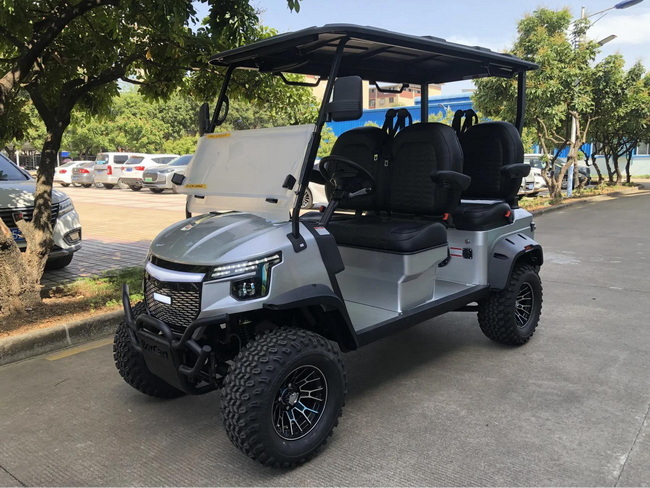
Across North America, Europe, and Asia, campus golf carts are used in schools, universities, business parks, resorts, airports, and industrial campuses.[4][2]
Representative use scenarios:
- University campuses using electric carts for security patrols and 24/7 accessibility transport.[11][2]
- K‑12 schools adopting small fleets to move staff and supplies across distributed buildings.[16][15]
- Corporate and industrial parks using multi‑purpose electric carts to connect factory halls, office blocks, and warehouses.[17][9]
In some communities, solar‑powered charging further reduces operating emissions and highlights environmental leadership, helping institutions enhance their brand image.[18][8]
For campus decision‑makers, selecting the right OEM electric golf cart manufacturer is critical for long‑term success.[8][9]
Key selection criteria:
- Proven experience supplying campus‑ready carts, low‑speed vehicles, and utility models.[5][9]
- Ability to customize seating, cargo configuration, branding colors, and safety features for different departments.[9][8]
- Robust technical support, spare parts availability, and clear warranty terms.[9][2]
A manufacturer like BorCart, specialized in electric golf carts, sightseeing buses, low‑speed vehicles, hunting carts, and multi‑purpose vehicles, can provide OEM and private‑label solutions tailored to international brand owners, wholesalers, and assemblers.[8][9]
As a professional Chinese manufacturer focusing on electric golf carts and a wide range of EV‑based campus and utility vehicles, BorCart is well‑positioned to support overseas partners.
Typical support services can include:
- OEM manufacturing for foreign brands, including custom body design, logo printing, and color schemes.
- Technical advisory on fleet configuration, battery selection, and charging infrastructure suited to local grid conditions.
- Flexible production for golf carts, sightseeing shuttles, low‑speed vehicles, hunting carts, and multi‑purpose utility vehicles.
By collaborating with an experienced OEM, campus buyers and distributors reduce technical risk, accelerate implementation, and secure reliable long‑term supply.
To maintain high uptime and safety, campus teams should follow simple, daily best practices.[12][13]
Recommended steps:
1. Pre‑trip inspection
- Check brakes, tires, lights, horn, and battery indicator.[13][12]
- Ensure no loose items or obstructions around pedals and steering.
2. Safe driving habits
- Drive at speeds suitable for pedestrian areas and weather conditions.[12][11]
- Avoid sharp turns, sudden braking, and overloading the vehicle.[11][13]
3. Parking and charging
- Park only in designated areas, avoiding building entrances and emergency exits.[12][11]
- Plug in vehicles at scheduled times to maintain healthy state of charge and battery life.[2][9]
These habits extend battery life, reduce accidents, and keep the fleet ready for peak‑hour demands.
Benefit category | How electric golf carts help on campus |
Environmental impact | Zero tailpipe emissions, lower carbon footprint, no fuel leakage near green spaces. |
Operating cost | Lower energy cost per km and reduced maintenance vs gas vehicles. |
Accessibility & comfort | Better access for people with mobility challenges; quiet, low-stress rides. |
Operational efficiency | Faster response for maintenance, security, events, and logistics. |
Safety potential | Safe at low speeds with proper rules, training, and vehicle safety features. |
Campuses that adopt electric golf carts for transportation gain immediate benefits in sustainability, cost control, mobility, and user satisfaction. Whether you manage a university, school district, industrial park, or resort campus, now is the right time to move from scattered vehicles to a planned, efficient electric fleet.[3][2]
If you are a brand owner, wholesaler, or local vehicle producer looking for a reliable OEM partner, consider partnering with an experienced manufacturer such as BorCart to design and supply campus‑ready electric golf carts and low‑speed vehicles tailored to your market.
Yes. Electric golf carts produce zero tailpipe emissions, reduce reliance on fossil fuels, and eliminate the risk of fuel spills that can damage soil and water.[7][5]
Typical range depends on battery type, load, and terrain, but many modern carts can cover 30–70 kilometers per charge, which is more than enough for daily campus operations.[5][9]
Maintenance focuses on checking brakes, tires, steering, lighting, and battery condition, as well as keeping terminals clean and ensuring proper charging cycles.[13][12]
Campuses usually install dedicated charging stations near depots or parking areas and may add solar‑assisted systems or smart chargers for larger fleets.[8][2]
Institutions should create clear policies, define approved routes, set speed limits, require driver training, and regularly inspect vehicles for mechanical or electrical issues.[11][12]
[1](https://www.rootsev.com/blog/advantages-of-using-electric-golf-carts-inside-campus/)
[2](https://www.rootsev.com/blog/electric-golf-carts-for-campus-transportation-benefits-and-implementation/)
[3](https://trielectric.in/electric-golf-cart-college-campuses.php)
[4](https://www.lakeeriegolfcars.com/blog/golf-carts-on-campus-a-practical-and-sustainable-transportation-solution--63392)
[5](https://trielectric.in/benefits-of-using-electric-golf-carts.php)
[6](https://www.trielectric.in/benefits-of-using-electric-golf-carts.php)
[7](https://evtitan.com/are-electric-golf-carts-eco-friendly-a-breakdown-of-their-environmental-impact/)
[8](https://gtgolfcart.com/html_news/?13-A-New-Era-of-Green-Mobility-How-Golf-Carts-Drive-Sustainable-Community-Development-13.html)
[9](https://www.redwaypower.com/electric-golf-carts/)
[10](https://www.redwaypower.com/pros-and-cons-of-electric-golf-carts/)
[11](https://www.ue.org/risk-management/transportation-safety/golf-carts-on-campus/)
[12](https://www.cedarville.edu/offices/campus-security/golf-utility-cart-operation-guidelines)
[13](https://www.tdi.texas.gov/pubs/videoresource/fsgolfcart.pdf)
[14](https://risk.web.baylor.edu/sites/g/files/ecbvkj1966/files/2025-02/Golf%20Cart%20and%20UTV%20Safe%20Operation%20Guidelines%202025.pdf)
[15](https://taraelectricvehicles.com/blog/2025/07/13/operating-a-golf-cart-on-school-grounds-benefits-and-key-considerations/)
[16](https://taraelectricvehicles.com/blog/2025/07/13/school-golf-cart-safety-essential-guidelines-for-safe-operation-on-campus/)
[17](https://www.golfcartannapolis.com/the-advantages-of-electric-golf-carts)
[18](https://gccleaguecity.com/why-electric-golf-carts-are-better-for-the-environment/)
[19](https://evfmx.com/top-5-benefits-of-using-electric-golf-carts-inside-campus/)
[20](https://www.reddit.com/r/golfcarts/comments/15ljtid/an_indepth_look_at_the_pros_and_cons_of_gas_and/)


