


Views: 222 Author: Leah Publish Time: 2026-01-21 Origin: Site


Content Menu
● How a Golf Car Battery System Works
● Why a Car Charger Is a Poor Fit for a Golf Car
>> Voltage and System Mismatch
>> Safety Risks
● When Golf Car Owners Use Car Chargers Anyway
● Typical Golf Car Battery Capacities
● Car Charger Output and Its Limitations
● Example Charging Time Scenarios
>> Scenario 1: One 12 V Battery in a 48 V Golf Car
>> Scenario 2: 36 V Golf Car with Six 6 V Batteries
>> Scenario 3: Rule‑of‑Thumb Comparison
● Step‑by‑Step: Emergency Charging a Golf Car with a Car Charger
>> Step 1: Prepare a Safe Working Area
>> Step 2: Identify Battery Type and Voltage
>> Step 3: Inspect the Golf Car Battery Pack
>> Step 4: Decide How to Connect the Car Charger
>> Step 5: Start Charging Gradually
>> Step 6: Rotate Across the Golf Car Pack
>> Step 7: Finish with the Proper Golf Car Charger
● Protecting Golf Car Battery Life When Using a Car Charger
>> Maintain Regular Golf Car Charging Habits
● Best‑Practice Charging Times with Proper Golf Car Chargers
● Everyday Best Practices for Charging a Golf Car
● FAQ
>> 1. Can I charge my golf car directly with a car charger?
>> 2. How long does it take to charge a golf car battery with a car charger?
>> 3. Is it safe to use a car charger on lithium golf car batteries?
>> 4. Can a car charger damage my golf car batteries?
>> 5. What is the best way to charge a golf car battery?
Using a regular car charger on a golf car battery pack is possible only in limited emergency situations, and it is rarely the best long‑term solution. For everyday charging, a matched golf car charger is the safest and most efficient way to keep your golf car ready for work, leisure, or rental operations.
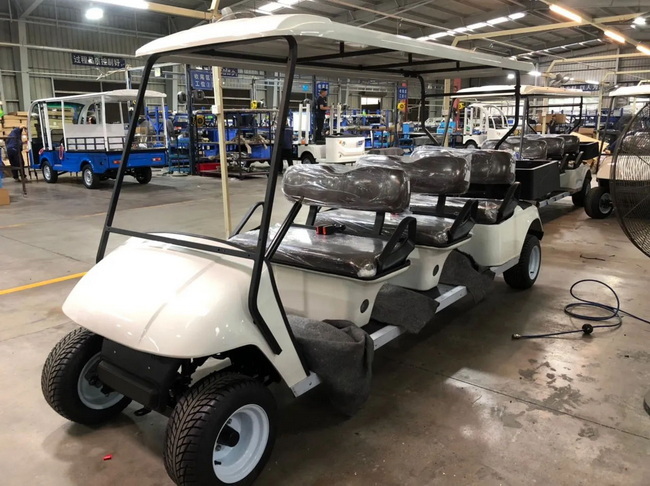
A typical electric golf car uses a high‑capacity battery pack rather than a single 12 V battery. The pack is built from multiple deep‑cycle batteries connected in series to reach the required system voltage.
Common configurations include:
- 36 V golf car: often six 6 V batteries
- 48 V golf car: often six 8 V or four 12 V batteries
- 72 V systems: used in some high‑performance or utility golf car models
These deep‑cycle batteries are designed to deliver steady power over many hours of driving instead of short bursts of current like automotive starter batteries. Because of this, they need a different charging approach, with:
- Correct total voltage (36 V, 48 V, 72 V, etc.)
- Appropriate charging current
- Multi‑stage charging profiles (bulk, absorption, float, and sometimes equalization)
When any of these elements do not match, the golf car pack can become undercharged, overcharged, or unbalanced, shortening its service life.
Most car chargers are designed for 12 V starter batteries, not for multi‑battery golf car packs. This mismatch creates several practical and safety problems.
A 36 V or 48 V golf car pack cannot be charged as a whole with a single 12 V car charger. At best, the charger can be:
- Connected to a single 12 V battery within the pack, or
- Connected to a pair or small section of lower‑voltage batteries
This approach leaves the rest of the golf car pack uncharged and can cause imbalances between individual batteries. Over time, some batteries become chronically undercharged while others receive more energy, leading to uneven performance and early failure.
Car chargers are typically optimized for automotive starting batteries that are:
- Discharged shallowly
- Charged quickly back to near full
Deep‑cycle golf car batteries are built for deeper discharge and slower, controlled charging. Dedicated golf car chargers usually:
- Use staged charging
- Monitor voltage and sometimes temperature
- Shut off or switch to maintenance modes automatically
A simple car charger may lack these protections, increasing the risk of:
- Overcharging
- Excessive heat
- Accelerated sulfation or capacity loss
When a charger is not matched to the golf car battery type and pack voltage, safety issues can arise, especially in enclosed garages or storage areas. Potential risks include:
- Overheating and swelling of batteries
- Boiling of electrolyte in flooded lead‑acid batteries
- Corrosive vapor release and hydrogen gas buildup
- Fire risk if sparks or ignition sources are present nearby
For lithium golf car batteries, the risk is higher. Improper charging can interfere with the built‑in battery management system (BMS), potentially causing shutdowns, overheating, or in extreme cases, thermal runaway and fire.
Despite the drawbacks, some golf car owners still reach for a car charger in real‑world situations. Typical emergency scenarios include:
- The golf car pack is so deeply discharged that the original golf car charger will not turn on
- The user is away from the usual charging location and only has access to a car charger
- One particular battery in the golf car pack appears weak and needs a short “boost”
In these cases, the car charger is often used to:
- Raise the voltage of one battery or a small group of batteries
- Bring pack voltage up just enough for the dedicated golf car charger to recognize and start the normal charging cycle
Even then, the car charger is more of a temporary rescue tool than a full‑time solution. Once the golf car can use its designed charger again, it should do so.
To understand how long it takes to charge a golf car battery with a car charger, it helps to start with a simple formula.
For any battery, a rough estimate of charging time is:
Charging time (hours)≈Battery capacity in amp hours (Ah)/Charger output in amps (A)
Real charging takes longer because current usually tapers off as the battery approaches full, so it is common to add 20–30% extra time to this result.
Key points:
- Amp‑hour (Ah) rating tells you how much energy the battery can store
- Charger amp rating tells you how fast energy is being put back in
- Starting state of charge also matters: topping up from 70% takes much less time than recharging from 10%
Electric golf car packs vary widely, but common ranges are:
1- 36 V lead‑acid golf car pack
- Often 180–225 Ah total capacity
- Six 6 V deep‑cycle batteries
2- 48 V lead‑acid golf car pack
- Often 100–200 Ah total capacity
- Six 8 V or four 12 V deep‑cycle batteries
3- 48 V lithium golf car pack
- Commonly around 100 Ah
- Higher usable depth of discharge and faster acceptance
Standard golf car chargers often deliver about 10–15 A and are sized to bring a mostly discharged pack back to full in roughly 6–10 hours under normal conditions.
If you try to replace that process with a small 2–10 A car charger, especially when you have multiple batteries in your golf car, the total effective charging time increases dramatically.
Many consumer car chargers offer:
- 2–4 A trickle mode for small batteries
- 6–10 A standard mode for automotive batteries
- A brief “boost” or “start” mode that can be higher but is not meant for continuous charging
When a car charger is connected to a single 12 V battery from a golf car pack:
- A 2 A setting will be very slow but gentle
- A 10 A setting will be quicker but still only works on that one battery
Because the golf car pack has several batteries connected in series, you must either:
- Move the car charger from battery to battery, or
- Charge small combinations of batteries with care
Either way, you are charging only a portion of the golf car pack at any one time, so the total time adds up quickly.
Assume:
- Four 12 V batteries in series for a 48 V golf car
- Each battery rated at 150 Ah
- Car charger delivers 10 A
- Battery is 50% discharged (about 75 Ah to refill)
Using the basic formula:
75÷10=7.5 hours
Adding extra time for tapering and inefficiencies, it may take about 8–9 hours to bring that single 12 V battery close to full.
To bring all four 12 V batteries in the 48 V golf car from 50% to full, you would need to repeat this for each battery:
- 4 batteries × 8–9 hours ≈ 32–36 hours
With a proper 48 V golf car charger, the same pack would typically be fully charged in roughly 6–8 hours.

In a 36 V golf car using six 6 V batteries in series, a simple 12 V car charger does not match the pack directly. You can either:
- Charge one 6 V battery at a time (if the charger supports 6 V mode), or
- Charge two 6 V batteries in series as a 12 V group
If each battery is about 200 Ah and you are using 10 A:
- For a 200 Ah section, a simple estimate is 200 ÷ 10 = 20 hours from empty
- If the batteries are only half discharged, you might still need around 10–12 hours for each section
To reach the entire pack, you will rotate across multiple sections:
- Three 12 V sections at roughly 10–20 hours each
- Total time can easily exceed 30–60 hours of actual charger operation
If a correctly matched 36 V or 48 V golf car charger needs 6–10 hours to fully recharge the pack, using a 12 V car charger on individual batteries or sections often results in:
- Two to four times more total charging time
- Additional manual effort to move clamps and monitor each battery
- More risk of imbalance and uneven charging within the golf car pack
For this reason, using a car charger as the main charging method for a golf car is highly inefficient.
If you must use a car charger on a golf car battery pack in an emergency, it is important to plan and proceed carefully. The method below is for conventional flooded lead‑acid batteries and is intended only as a last resort.
- Park the golf car on a level surface, outdoors or in a very well‑ventilated space
- Turn the golf car off, remove the key, and engage the parking brake
- Keep open flames, cigarettes, and other ignition sources away from the golf car
- Wear gloves and eye protection to avoid acid splashes and fumes
- Confirm whether your golf car uses lead‑acid, AGM, gel, or lithium batteries
- Determine pack voltage (36 V, 48 V, or higher)
- Check the label of each battery for its individual voltage (6 V, 8 V, or 12 V)
If the golf car has lithium batteries, do not connect a basic car charger unless the battery manufacturer clearly allows it and the charger is fully compatible. Lithium systems require dedicated, precisely controlled charging.
- Lift the seat or access cover to expose the golf car batteries
- Look for cracks, bulging, leaks, or heavy corrosion on terminals
- Do not attempt to charge damaged batteries; they should be replaced
For flooded lead‑acid batteries, check electrolyte levels after charging is complete and top up with distilled water if necessary, following manufacturer recommendations.
Because the car charger is usually 12 V:
- On a 48 V golf car with four 12 V batteries, connect to one 12 V battery at a time
- On a 36 V golf car with six 6 V batteries, either use a 6 V mode (if available) or connect to two 6 V batteries in series to form a 12 V section
When connecting:
- Ensure the car charger is switched off
- Attach the positive clamp to the positive terminal
- Attach the negative clamp to the negative terminal or an appropriate ground
- Make solid connections to avoid arcing and heat
- Select a low or medium amp setting if your car charger provides options
- Turn on the charger and observe the initial behavior
- Monitor the temperature of the golf car battery case regularly
- Normal charging may produce some warmth and gentle bubbling in flooded batteries, but not strong hissing or violent boiling
If the battery becomes hot to the touch, emits strong odors, or makes loud bubbling sounds, stop charging immediately and allow it to cool.
Because only part of the golf car pack is being charged at one time:
- Plan a schedule to move the charger from one battery or section to the next
- Aim to give each battery a similar amount of time on the charger
- Avoid leaving one part of the golf car pack much more charged than the rest
For example, if you give one 12 V battery in a 48 V golf car eight hours of charging, then move to the second battery for a similar eight hours, and so on. This rotation takes planning and patience.
Once the overall pack voltage has risen to the point where the original golf car charger can recognize it:
- Disconnect the car charger safely
- Connect the dedicated golf car charger
- Allow the golf car charger to complete a full automatic cycle
This final step helps to balance the pack more evenly, top off all cells, and restore a more normal state of charge.
If you occasionally use a car charger to rescue a golf car, it is important to protect the battery pack as much as possible.
High‑amp “engine start” or “boost” settings found on many car chargers are designed for quick bursts, not for deep‑cycle charging. Using these modes on golf car batteries can:
- Create excessive heat
- Warp internal plates
- Shorten overall battery life
Stick to lower, continuous charge settings whenever possible.
Overcharging is one of the fastest ways to damage golf car batteries. When a battery is held at a high voltage for too long:
- Lead‑acid cells can lose water, concentrate electrolyte, and overheat
- AGM and gel cells can dry out internally
- Lithium cells can be pushed beyond safe limits if their protection circuits fail or are bypassed
Watch for:
- Unusually long charging times
- Excessive heat
- Swollen cases or strong sulfur odors
Stop charging if any of these warning signs appear.
To reduce the need for emergency car charger use:
- Charge your golf car after each day of use instead of waiting until the pack is deeply discharged
- Avoid letting the golf car sit for long periods at a very low state of charge
- Store your golf car in a cool, dry place and periodically check the pack if the vehicle is idle
Healthy charging habits reduce the chance that the golf car pack will fall so low that a car charger is required to “wake it up.”
Understanding standard charging times helps you see how unusual it is to rely on a car charger.
Typical ranges with dedicated golf car chargers:
- Lead‑acid golf car packs: approximately 6–12 hours for a nearly empty pack, depending on charger output, capacity, and battery condition
- AGM and gel golf car packs: similar or slightly shorter, thanks to different internal design
- Lithium golf car packs: often 2–5 hours to full, due to higher charge acceptance and smart BMS management
External factors such as temperature, age of the golf car batteries, and depth of discharge also influence actual times. As batteries age, charging may take longer or finish at lower effective capacity.
To keep your golf car battery system healthy and minimize costly replacements, consider these routine best practices:
- Use a charger that matches the golf car pack voltage and battery chemistry
- Plug in the golf car after each day's use rather than waiting for the pack to drain
- Charge in a well‑ventilated area and keep seat bases or battery lids slightly open if recommended
- Inspect and clean terminals regularly to prevent resistance and heat buildup
- For flooded lead‑acid batteries, check water levels after full charging and refill as needed with distilled water
- Avoid leaving an older, manual charger connected for days at a time without monitoring
By following these habits, your golf car will charge more predictably and the pack will last longer, reducing downtime and operating cost.
Charging a golf car battery pack with a car charger is technically possible but slow, inconvenient, and potentially risky if done without care. Because a 12 V car charger can only work on individual batteries or small sections, fully charging a 36 V or 48 V golf car this way can require dozens of hours and constant attention, compared to the 6–12 hours typical with a matched golf car charger. For long‑term safety, performance, and battery life, every electric golf car should rely on a charger specifically designed for its system voltage and battery chemistry, while a car charger should be reserved strictly for supervised emergency use.
Contact us to get more information!
No. A standard 12 V car charger cannot safely charge an entire 36 V or 48 V golf car pack directly, because the voltage is too low and the charging profile is not designed for deep‑cycle packs. At most, the car charger can charge one 12 V battery or a small section at a time, which leaves the rest of the golf car pack uncharged and unbalanced.
The time depends on battery capacity, charger amperage, and state of charge. For example, bringing a 150 Ah 12 V battery from around 50% to near full with a 10 A car charger can take about 8–9 hours. If you repeat that process for each battery in a 36 V or 48 V golf car pack, total time can easily reach 30–60 hours, far longer than using a properly matched golf car charger.
Generally, it is not safe to use a conventional car charger on lithium golf car batteries unless the battery manufacturer explicitly approves a specific charger model and settings. Lithium packs rely on a battery management system and precise voltage limits, and an incompatible charger can cause shutdowns, overheating, or in extreme cases, thermal runaway. For lithium golf car systems, always use a dedicated, compatible charger.
Yes. If used incorrectly or for too long, a car charger can overcharge or undercharge golf car batteries. Overcharging can cause excessive heat, loss of electrolyte in flooded lead‑acid batteries, swelling, and permanent capacity loss. Undercharging or chronic partial charging can lead to sulfation and reduced runtime. Repeated misuse shortens the service life of your golf car battery pack.
The best way is to use a charger that matches the golf car pack voltage (36 V, 48 V, etc.) and the specific battery chemistry (flooded lead‑acid, AGM, gel, or lithium). Plug the golf car in after daily use, allow the charger to complete its automatic cycle in a well‑ventilated area, and avoid deep discharges whenever possible. This approach keeps the golf car ready for use and maximizes the lifespan of the battery pack.
1. https://www.lexsong-ev.com/how-do-you-charge-a-golf-cart-battery-with-a-car-charger
2. https://boltenergyusa.com/best-practices-for-charging-golf-cart-batteries/
3. https://carts-and-parts.com/how-long-does-it-take-to-charge-a-golf-cart/
4. https://www.redwaybattery.com/can-you-charge-a-golf-cart-using-a-regular-car-battery-charger/
5. https://bslbatt.com/blogs/golf-cart-battery-charging-dead-batteries-without-equipment/
6. https://useppafire.org/golf-cart-safety%2Fcharging
7. https://wheelzllc.com/blogs/golf-cart-news/is-your-current-golf-cart-battery-charger-a-safety-hazard
8. https://jsgolfcarts.com/blog/how-long-does-a-golf-cart-take-to-charge/
9. https://diamondgolfcars.com/how-long-does-it-take-to-charge-a-golf-cart-battery/
10. https://ecoplaneta.com/how-long-does-it-take-to-charge-a-golf-cart/
11. https://www.olelonenergy.com/the-guide-to-charging-your-golf-cart-tips-tricks-and-faqs/
12. https://carts-and-parts.com/can-you-overcharge-a-golf-cart-battery/
13. https://www.formcharge.com/blogs/golf-cart-charger-knowledge/how-long-does-it-take-to-charge-a-golf-cart-a-comprehensive-guide
14. https://www.puttersgolfcarts.com/blogs/putters-blogs/the-ultimate-guide-to-charging-your-golf-cart-batteries-lead-acid-and-lithium-batteries
15. https://intermountaingolfcars.com/explosive-risks-lithium-battery-fires-in-golf-carts-how-to-prevent
16. https://taraelectricvehicles.com/blog/2025/05/28/how-long-does-it-take-to-charge-a-golf-cart-everything-you-need-to-know/
17. https://www.vatrerpower.com/blogs/news/how-long-to-charge-golf-cart-batteries
18. https://txpgolfcarts.com/tips-for-maximizing-your-battery-life/


